Bench Degree·LASERSchapter

Chapter 1: Light That Marches in Step
Shine a cheap laser pointer at a wall and look closely at the dot. It is crawling. A flashlight never does that, and the reason it crawls is the reason a laser can cut steel.
You need a flashlight, which readers in Britain will call a torch, and a laser pointer. Any flashlight, and any pointer, including the three-dollar one that came free with something. Stand about 3 m (10 ft) from a plain painted wall and shine each one at it in turn.
Three differences, and all three are visible without instruments.
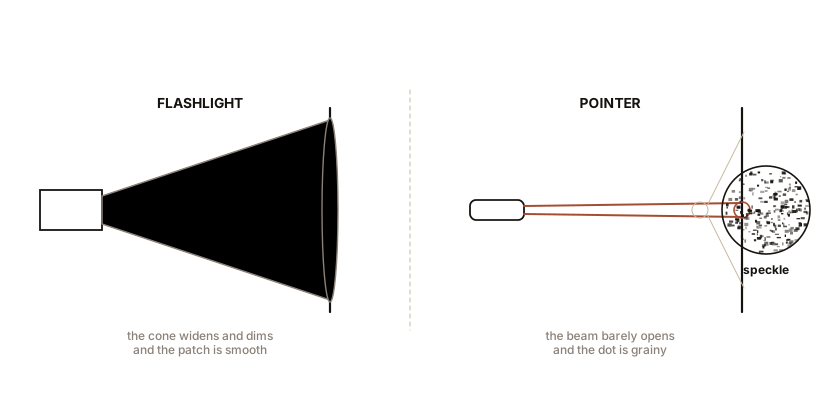
The flashlight spreads and the pointer does not. Walk backwards and the flashlight’s patch of light grows and dims, roughly as you would expect: twice as far, four times the area, a quarter as bright. The pointer’s dot barely changes. Take it outside at night and put it on a building a hundred metres away and it is still a dot.
The flashlight is white and the pointer is one colour. Not mostly one colour. One. Hold a prism or the edge of a CD in the flashlight beam and it fans into a rainbow, because white light is a crowd of every colour travelling together. Do it to the pointer and nothing fans out. There is nothing in there to separate.
And now the one worth the chapter. Put your face close to the wall, within 300 mm (12 in), and look hard at the dot itself.
It is not a smooth spot. It is a boiling, granular, glittering mess. A random pattern of bright and dark grains, and if you move your head even slightly, the grains crawl. They swim across the dot. If you are shortsighted and take your glasses off it is even more obvious.
Do the same to the flashlight’s patch of light. It is smooth. Perfectly, boringly smooth, and no amount of moving your head makes it do anything.
You have just seen, with your naked eye, for nothing, the property that makes a laser a laser.
ON THE BENCH: Flashlight against pointer
Parts: any flashlight; any laser pointer, Class 2 or under 1 milliwatt, which is what an ordinary keychain pointer is; a plain light-coloured wall. Everything else: every part this book asks for is listed once, at the back, in Appendix A: The Bench. Nothing is specified by brand, so it can be ordered from anyone. You do not need any of it yet. Cost: nothing, or three dollars. Time: 10 minutes. Hazards: even at Class 2, never look into the beam and never point it at anyone’s face. Point it at a wall and look at the wall. Chapter 2 is where this gets serious and it is worth reading before you buy anything more powerful than a keychain. Method: compare the two sources at 1 m and at 5 m (3 ft and 16 ft) from the wall. Then examine each spot from close range with your eye. What you should see: the flashlight patch grows with distance and stays smooth. The pointer dot stays nearly the same size and is visibly grainy, and the grain moves when your head moves. Better, if you have one: photograph the pointer dot with a phone. The grain shows up in the photograph, so it is not an artefact of your eye.
Section 1: What the Crawling Is
That grain is called speckle, and it is not dirt on the wall, dust in the air, or a fault in the pointer. It is an interference pattern, and you are looking directly at one.
The wall is rough. Not visibly rough, but rough on the scale of the wavelength of light, which is a few hundred nanometres. Paint that looks perfectly flat to you is, at that scale, a landscape of hills and pits.
So the light reflecting off it does not all travel the same distance to reach your eye. Light bouncing off a pit travels slightly further than light bouncing off a bump a fraction of a micrometre away.
Here is the part that matters. Because the pointer’s light is all one wavelength and, crucially, all in step, those two paths arrive at your retina still able to interfere with one another. Where the two arrive in step they add and you see a bright grain. Where they arrive out of step by half a wavelength they cancel and you see a dark grain. The random roughness of the paint becomes a random pattern of grains.
The grains crawl when you move because you have changed the path lengths, by a fraction of the thickness of a hair, and the whole pattern reshuffles.
And the flashlight does not do this because its light is a crowd. Every colour, every phase, all mixed. Any two paths that might have cancelled for one colour add for another, and the average of everything cancelling and adding at random is a smooth grey.
IN PLAIN ENGLISH: Speckle happens when light is orderly enough to interfere with itself after bouncing off something rough. A flashlight cannot do it because its light is a disorganised mob. A laser can, because its light is in step. The grain you are looking at is the visible signature of that order.
Section 2: The Word for It
Three properties, and now they can be named from what you have already seen rather than asserted at you.
Monochromatic: one wavelength. The prism showed you this. The pointer emits an extremely narrow band of colour, where a flashlight emits everything.
Collimated: it does not spread much. The walk backwards showed you this. Chapter 6 explains why no beam is perfectly parallel and what sets the limit, which turns out to be a hard physical bound rather than sloppy manufacturing.
Coherent: it is in step. The speckle showed you this, and it is the one that does the real work. Coherence means the waves keep a fixed relationship with each other, in time and across the beam, so that light from one part of the beam can still interfere with light from another part.
Those three are not three separate achievements. They are one mechanism seen from three sides, and Chapters 3 through 5 build that mechanism from nothing.
Section 3: Now Measure It
Here is where this chapter stops being a demonstration and becomes a measurement, and it is the reason to do the work rather than read about it.
You are going to measure the wavelength of light, on a table, with a compact disc and a tape measure, and get an answer good to three significant figures.
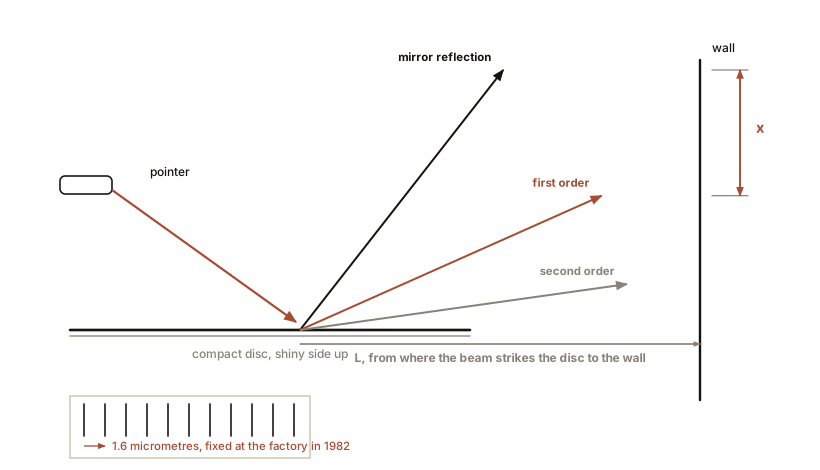
The trick is that a CD has a ruler built into it. The data on a CD is written in a spiral track, and the spacing between adjacent turns of that track is a manufacturing standard: 1.6 micrometres (0.000063 in), on every audio CD ever pressed. That row of evenly spaced grooves is a diffraction grating with a known, guaranteed pitch, and it cost you nothing.
Shine the pointer at the shiny side of a CD at a shallow angle and the reflection does not come off as one dot. It comes off as several, spread out in a line, because the grating sends different wavelengths to different angles. Measure the angle to the first bright spot away from the straight reflection and the wavelength follows from one line of arithmetic:
wavelength = groove spacing × sine of that angleThat is the whole calculation. Measure the angle by measuring two lengths with a tape and dividing.
ON THE BENCH: Measure the wavelength of light
This is the experiment of the chapter. Everything above prepares for it.
Parts: a red laser pointer and, if possible, a green one, both under 1 milliwatt; one audio CD, which may be scratched, the label side is irrelevant; a tape measure or metre rule; a wall; tape. Cost: nothing. Time: 45 minutes for the first one, 10 minutes for each after. Hazards: the CD reflects the beam in several directions at once, some of them unexpected. Set it up so none of those directions can reach a face, including your own when you lean in to measure. Work with the beam travelling horizontally at bench height, not at eye height, and never at a window. Method: tape the CD flat on a table, shiny side up. Mount the pointer so the beam strikes it at a shallow grazing angle and the reflections land on a nearby wall. You will see the ordinary mirror reflection and, to one side of it, one or more additional spots. Measure L, the distance from the point on the CD where the beam lands to the wall, and x, the distance along the wall from the mirror reflection to the first extra spot. Then the angle is the one whose tangent is x over L. The arithmetic, worked, so you can check your setup against it: with a red pointer at L of 1000 mm (39.4 in) you should find x near 444 mm (17.5 in). The tangent is 0.444, so the angle is 23.9 degrees, whose sine is 0.406. Multiply by the 1600 nm groove spacing and you get 650 nm. Now check yourself against the manufacturer. Look at the pointer’s label or its listing. A red pointer will be specified at 650 nm, sometimes 635 or 660. You just measured it with a disc and a tape. Then do the green one. You should find x near 352 mm (13.9 in) at the same L, giving 532 nm, which is the number printed on every green pointer in the world. Getting two different right answers with the same apparatus is what turns a demonstration into a measurement. If your answer is out by more than a few percent: you are almost certainly measuring L to the wrong point. It must be measured from where the beam actually strikes the disc, not from the pointer.
Section 4: What You Just Did, and Why It Is Not a Party Trick
Stop and consider what happened in that experiment.
You determined the size of something too small to see, using no instrument more precise than a tape measure, by exploiting the fact that a consumer product from 1982 was manufactured to a tolerance you could rely on. The measurement is real. The number is right. And you can check it against a specification written by someone who has never met you.
That is the whole method of this series in one afternoon, and it is why this chapter comes first.
It also gives you something concrete to hold on to for the rest of the volume. 650 nanometres. Six hundred and fifty billionths of a metre, from crest to crest. About a hundred and fifty of those wave crests would fit across a red blood cell. When Chapter 8 says a crystal halves the wavelength of infrared light from 1064 nm to 532 nm, you will know what those numbers mean because you have measured one of them.
Section 5: The Uncomfortable Half of the Same Fact
One more thing before Chapter 2, and it belongs here rather than there, because it comes directly out of the experiment you just did.
The reason the pointer’s dot was still a dot at a hundred metres is that the light is collimated. It goes where it is sent, and it stays gathered. That is the property that makes a laser useful for measuring, for cutting, for sending data down a fibre, and for reaching the moon.
It is also exactly why a laser is dangerous in a way a lamp is not.
Your eye is a lens, and a lens’s job is to take parallel light and concentrate it onto a single point on the retina. It does that superbly. So a beam that has stayed gathered across a room arrives at your pupil still gathered, and your own eye then concentrates it into a spot a few micrometres across.
A milliwatt spread over a wall is nothing. A milliwatt focused into a few micrometres of retina is a power density comparable to staring at the sun. The eye does the focusing for free, and it does it faster than you can decide not to let it.
The pointer you have been using is Class 2, which means it is limited to a power where your blink reflex protects you, and that is genuinely why the class exists. It is not a claim that the light is harmless. It is a bet on your reflexes, and it is a bet that stops being valid a very short distance up the power scale, and stops being valid entirely for a wavelength your eye cannot see and therefore will not blink at.
That is Chapter 2. It is the only chapter in this series placed at the front for safety reasons, and the reason it is at the front is that in every other volume you get a warning before you get an injury, and here you do not.
IN PLAIN ENGLISH: The thing that makes a laser beautiful and the thing that makes it dangerous are the same thing. It stays gathered, and your eye is very good at gathering it further. Read the next chapter before you buy anything brighter than the pointer you already have.

Bench Degree
Get the degree without the diploma.
Learn the material, not how to pass the exam.