Bench Degree·CYMATICSchapter
Chapter 1: The Rose Window
Tonight you will make sound draw a picture in salt. By the end of the evening you will have a black disc carrying a white wheel of twelve spokes and a ring, and a page of numbers that make no sense yet.
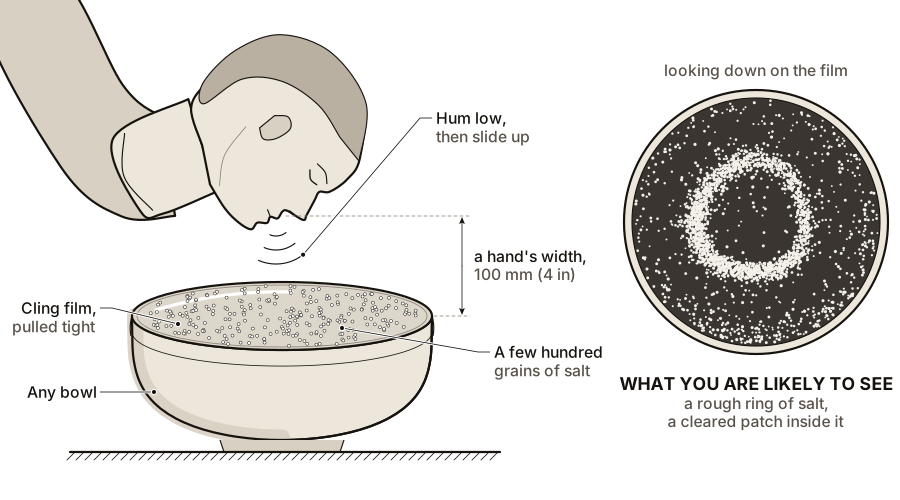
Take a mixing bowl, any bowl, and stretch plastic cling film tight across its mouth like the skin of a drum. Pull it until it is smooth and tap it with a fingernail. It should give a dull tick with a little pitch in it. Sprinkle a pinch of table salt on the film, a few hundred grains, spread thin.
Now lean over the bowl and hum. Start low, lower than you speak, and slide slowly upwards. For most of the slide nothing happens. Then, at one pitch, the salt jumps. It hisses, skitters across the film and gathers. Hold that note. In a few seconds the grains have cleared out of some places and piled up in others, usually a ring, sometimes a lopsided pair of lobes. Stop humming and the picture stays where your voice left it.
Try it again a little higher and you will find a second pitch that does it, and the picture is different. Hum between those two pitches and the salt only shivers.
That took five minutes and cost nothing. It also showed you everything this book is about. Sound is a vibration, a vibrating surface has a few favourite pitches, and at each favourite pitch it moves in a fixed shape that grains of salt can draw. The bowl gives you blurred rings because cling film is a poor drum and your voice is a poor oscillator. The rest of this chapter builds something that does the same thing precisely, and what it draws is a rose window.
Section 1: Tap It and Listen
The obvious way to do this properly is with black cardboard and white sand, because the contrast is perfect. It does not work, and the reason it does not work is the first idea in the book.
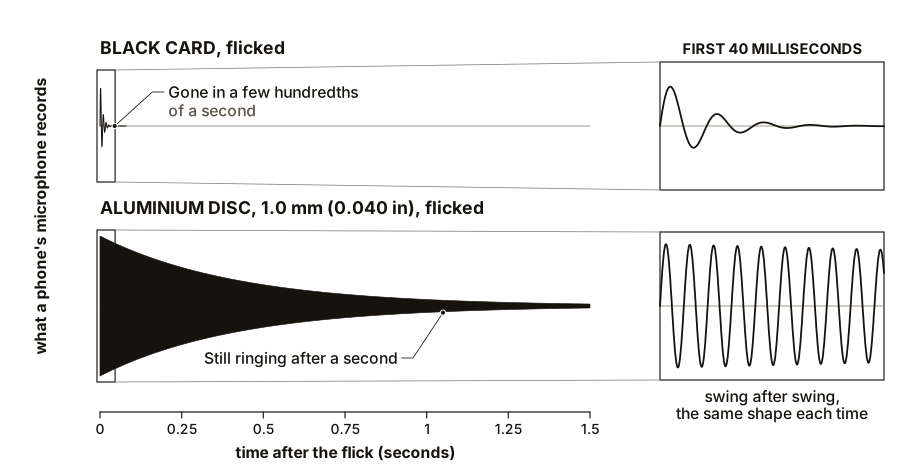
Hold a sheet of black card by one corner and flick it with a fingernail. You hear a thud. Now find something metal and thin: a baking sheet, the lid of a biscuit tin, a saw blade. Hold it lightly near the middle and flick the edge. You hear a ring, a note that hangs in the air for a second or more.
That difference is everything. A surface that rings keeps moving long after you stop pushing it, which means it can store the energy of many small pushes and add them up. Feed it a tone at exactly the pitch it rings at, and every push arrives in step with the last one. The motion grows and grows until the surface is jumping hard enough to throw sand. A surface that thuds throws away each push almost as soon as it receives it. Cardboard is made of paper fibres that rub against each other and turn motion into a trace of warmth. It never builds up anything.
So the bench test for any surface you want to make figures on takes ten seconds. If it rings, it will draw. If it thuds, it will not. Keep the black card. It makes an excellent background to photograph against.
IN PLAIN ENGLISH: A metal disc keeps ringing after you tap it, so a steady tone can build its motion up bit by bit, like pushing a child on a swing at the right moment each time. Cardboard soaks up each push and goes quiet. Only something that rings can be pumped up far enough to throw sand around.
The material that rings best for the money is thin aluminium sheet, and it is what both of the commercial classroom kits use. A disc of it 300 mm (12 in) across and 1.0 mm (0.040 in) thick weighs about 191 g (6.7 oz), cuts with hand snips, and when you flick its edge it rings like a small gong. Paint it matte black and it gives you the contrast that cardboard promised.
Section 2: Building the Plate
The plate has to be held, and how you hold it decides what it can draw. The design in this chapter bolts the disc at its exact centre to the cone of a loudspeaker. The loudspeaker does the pushing, and because it pushes at the centre, the patterns come out symmetrical about the centre: wheels, spokes and rings. That is precisely what a rose window is.
ON THE BENCH: Building the plate
Parts: a sheet of aluminium 1.0 mm (0.040 in) thick and at least 300 × 300 mm (12 × 12 in); matte or satin black spray paint; a woofer 165 to 200 mm (6.5 to 8 in) across, salvaged from an old speaker cabinet if you have one; a 5 mm (#10) bolt 75 mm (3 in) long, two nylon-insert lock nuts, flat washers and two 25 mm (1 in) fender washers; five-minute epoxy. Everything else: every part this book asks for is listed once, at the back, in Appendix A: The Bench. Nothing there is specified by brand. You need nothing from it yet beyond this box. Cost: about $40 with a salvaged woofer, $85 with a new one. Time: an evening, most of it waiting for paint. Hazards: snipped aluminium is razor sharp until you file it. Gloves while cutting, and file the whole edge before you handle it bare-handed. Spray paint outdoors. Method: draw a 300 mm (12 in) circle on the sheet with a pencil on a string, and mark its centre with a punch. Cut it out with aviation snips, a little outside the line, then file to the line. Drill a 5 mm (3/16 in) hole at the exact centre. Drill a second hole 50 mm (2 in) from the centre; you may need it later. Scuff both faces with fine abrasive paper, wipe them with alcohol, and give the top face two light coats of matte black. Gloss reflects your lamps and turns black to grey in photographs. On the woofer, cut out the domed dust cap in the middle of the cone along its glue line with a craft knife. Under it is a stiff paper or aluminium tube, the voice-coil former, which is the part that actually moves. Epoxy a small plastic plug inside that tube, carrying the bolt head, so the bolt stands up straight from the dead centre. Keep every drop of epoxy out of the narrow gap around the tube, or the speaker is ruined. When it has set, put a fender washer on the bolt, then the disc, then another fender washer and a lock nut, and snug it up. What you should see: a flat black disc standing on the speaker on its bolt. Flick its edge: it should still ring, almost as long as before. If it does not work: if the disc no longer rings, the nut is too loose and the disc is rattling on the bolt, or it is so tight that the washers are digging in. Snug, not crushed. If the cone sags more than 2 mm (0.08 in) under the disc, measured with a ruler before and after, use a 250 mm (10 in) disc instead; it weighs 133 g (4.7 oz).
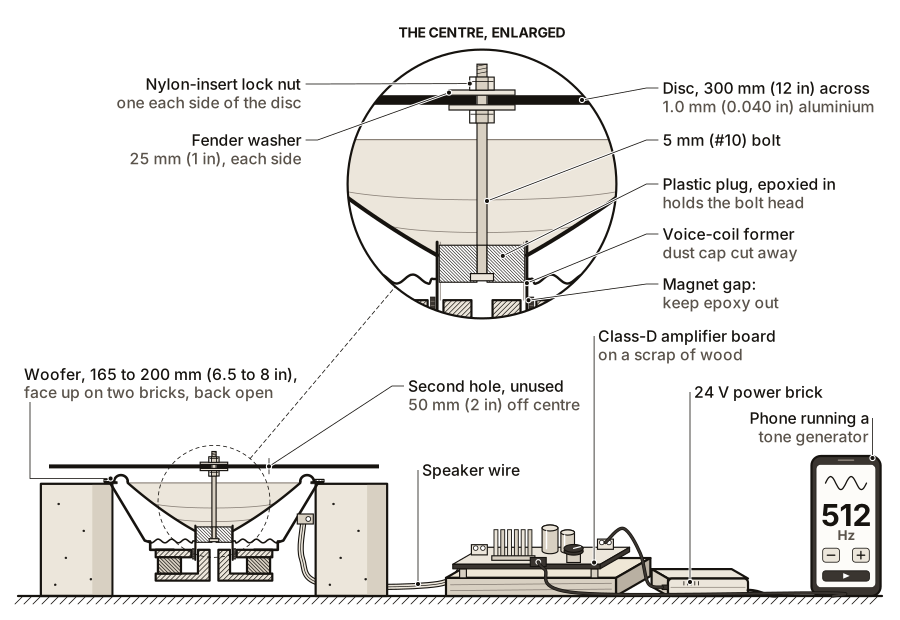
Stand the woofer face up on something open underneath, a box with a big hole cut in it or a pair of bricks. A speaker pumping against a sealed space is fighting a spring of trapped air. Then put a spirit level, or a phone running a level app, on the disc, and shim the speaker until the disc is level in both directions. Sand drifts downhill, and a plate that tilts will draw you a fake figure that is nothing but the slope.
Section 3: Making the Tone
The speaker needs a pure tone at a pitch you can set precisely, and it needs more power than a phone can give it.
The tone is free. A browser tone generator, or a desktop audio editor, will play a smooth single pitch, a sine wave, at any frequency you type in. Frequency is the number of times per second something swings back and forth, and its unit is the hertz, written Hz. Middle C on a piano is about 262 Hz. The figures on this plate live between about 200 Hz and 1,400 Hz, which is the middle of the range of a singing voice and up past the top of it.
The generator must step finely, one hertz at a time or better. You will find out why in a few minutes: the plate’s favourite pitches are so sharp that a generator stepping five hertz at a time will jump straight over them.
A phone’s headphone socket gives about a volt, enough for earbuds and nowhere near enough for a woofer carrying a metal disc. So the phone feeds a small amplifier, and the amplifier drives the speaker. A bare class-D amplifier board, about the size of a playing card, costs around $14 and runs from a 24 V power brick of the kind that charges a laptop. The mains electricity stays inside that brick. Nothing on your bench runs above 24 V.
ON THE BENCH: The drive, and the check that can fail
Parts: a class-D amplifier board with a volume control, 15 to 50 W per channel; a safety-listed 24 V DC power adapter rated 3 A or more; a 3.5 mm audio lead; 2 m (6 ft) of speaker wire; a multimeter; a phone or laptop with a tone generator; a sound level meter app; foam ear plugs or ear muffs. Cost: about $55, or $40 if you own the meter. Time: 20 minutes. Hazards: the bare board can be shorted by stray salt or sand, so screw it to a scrap of wood well away from the plate. This kind of amplifier drives both speaker wires; neither one is ground. Never connect either speaker terminal to the power supply’s negative wire. Turn the volume to zero before connecting or disconnecting the speaker. Method: connect the power brick and the audio lead, but not yet the speaker. Turn the amplifier on with no tone playing. Set the multimeter to DC volts and put its probes across the two speaker terminals. What you should see: close to zero, tens of thousandths of a volt at most. If it does not work: if the meter reads more than about 0.1 V, do not connect the speaker. A steady voltage pushes the cone off centre and holds it there, and the coil overheats. The board is faulty; replace it. This check matters because it is capable of failing. A healthy board passes it, a bad one does not, and you find out before the speaker does.
Then protect your ears. A metal plate driven at its favourite pitch is a loudspeaker, and an efficient one, and the tone sits near the pitches where human hearing is most sensitive. Put a sound level meter app on a phone at the bench. If it reads above 85 dBA, wear plugs or muffs. That number is the level the United States occupational health institute, NIOSH, sets as the most a worker should hear averaged over a full working day, and the allowance halves for every 3 decibels above it. Chapter 15 explains what a decibel is. For tonight, the number on the meter is enough.
Section 4: Finding the Figures
Sprinkle one level teaspoon (5 mL) of table salt evenly across the disc. A salt shaker held at arm’s length above the plate does it well. Use salt and not sand for the first evening: it is cheap and white, its grains are all about the same size, and it raises no dust. (Wipe the plate afterwards. Salt left on bare aluminium corrodes it.)
Set the tone generator to 100 Hz. Turn the amplifier’s volume to zero, start the tone, and raise the volume until the salt just begins to shiver. No higher. Then climb: one hertz at a time to 300 Hz, two hertz at a time above that.
For most of the climb almost nothing happens. The plate hums faintly and the salt trembles in place. Then, suddenly, three things happen at once. The plate’s note gets much louder, as if someone turned up the volume. The salt starts to hiss and dance. And within a few seconds the grains begin to run, clearing out of some regions and collecting along lines.
Stop climbing there. Rock the frequency up and down by a hertz, then by a tenth of a hertz, until the lines are sharpest. Raise the volume for a second or two to throw the last stray grains onto the lines, then lower it again before it throws the lines off too.
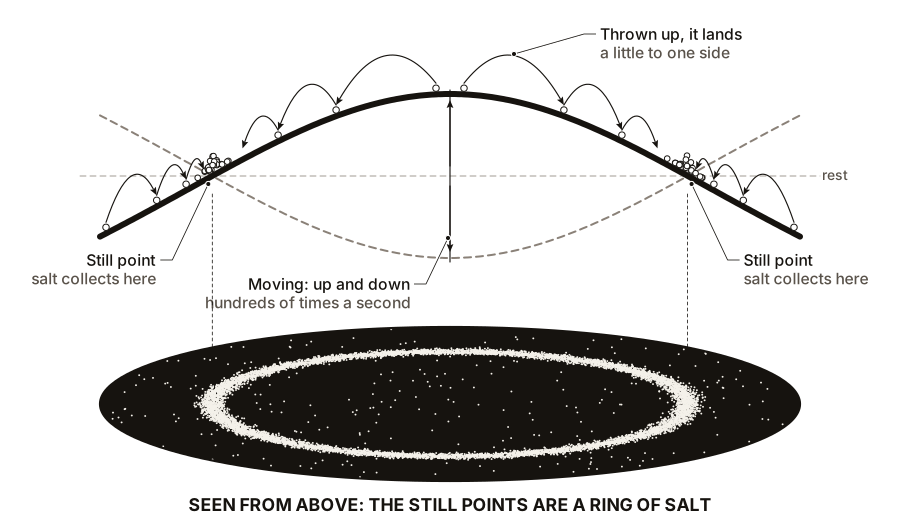
What you are looking at is a figure: the shape the plate takes at one of its own natural pitches. The salt is not piling up where the plate moves. It is piling up where the plate is still. Every patch of plate that moves hurls its grains into the air; they land a little to one side, get hurled again, and wander until they land on a line that is not moving. There they stay. The lines of salt are a map of stillness.
On a 300 mm (12 in) disc of 1.0 mm (0.040 in) aluminium bolted at its centre, here is roughly where to look. Your plate will differ by a few percent in every row, all in the same direction, because no sheet is exactly 1.0 mm (0.040 in) thick and paint adds a little weight.
| What you see | Look near |
|---|---|
| Hub and 8 spokes | 235 Hz |
| A plain ring, no spokes | 250 Hz |
| Hub and 10 spokes | 362 Hz |
| Hub and 12 spokes | 512 Hz |
| Hub and 14 spokes | 686 Hz |
| Two plain rings | 725 Hz |
| 8 spokes and a ring | 802 Hz |
| Hub and 16 spokes | 884 Hz |
| 10 spokes and a ring | 1,055 Hz |
| 12 spokes and a ring | 1,337 Hz |
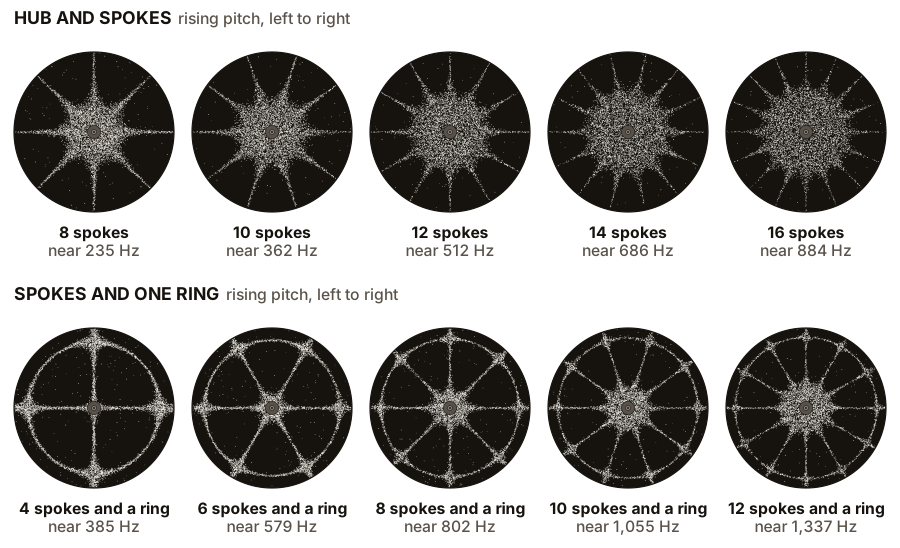
These are predictions, computed from the size, thickness and stiffness of the disc by a method this book will reach in Chapter 5. Treat each as a place to start searching rather than a promise. Do not start below 100 Hz. The plate has a figure near 58 Hz, but a woofer asked to throw a metal disc around at that pitch moves a long way and is easily wrecked.
ON THE BENCH: A rose window in salt
Parts: the plate and drive from the two boxes above; table salt; a teaspoon; a spirit level or level app; safety glasses; ear protection; a notebook. Cost: nothing beyond the boxes above. Time: 20 minutes to the first figure, an evening to find them all. Hazards: loud, so watch the meter. At high volume the grains leave the plate at speed and the rim of the disc is moving fast enough to nip a finger. Glasses on, fingers off the edge. Method: level the plate, sprinkle a teaspoon of salt, start the tone at 100 Hz with the volume low, and climb slowly. When the plate suddenly sings and the salt hisses, stop and fine tune. Write down the frequency, count the spokes, count the rings, and sketch it. Brush the salt back to an even layer and go on climbing. What you should see: near 512 Hz, a solid hub of salt at the centre with twelve spokes running out to the rim. Near 1,337 Hz, the same twelve spokes crossed by a ring of salt close to the rim, about 18 mm (0.7 in) in from the edge. That is the rose window. If it does not work: if the salt only shivers everywhere, you have passed the figure; go back down in tenths of a hertz. If the salt runs off to one side, the plate is not level. If you get rings but never spokes, move the bolt to the off-centre hole. The figures will be a little less symmetrical and much easier to raise. The reason is in Chapter 5. Better, if you have one: a second phone running video, lying at the edge of the plate with the tone generator’s display in frame. The frequency is then recorded inside every picture you take, and the minute when the salt arrives on the lines is the part people want to see.
Section 5: The Rose Window
Climb to 512 Hz and stop. The salt that was trembling in an even sheet rushes outwards from the middle and gathers, and in ten seconds you are looking at a wheel. A solid disc of white sits at the centre like the hub of a cartwheel. From it run twelve straight white spokes, evenly spaced, out to the rim. Between the spokes the black plate has been swept almost clean.
Keep climbing. The wheel dissolves into shivering salt, and at about 686 Hz it comes back with fourteen spokes, at about 884 Hz with sixteen. Somewhere in between you will pass figures that are only rings, and figures with eight spokes crossed by a circle.
Then, a little above 1,300 Hz, the twelve spokes return with a ring of salt crossing them close to the rim, like the outer circle of tracery that frames a window. Twelve spokes, a hub and a ring: that is the plan of a rose window, the great round window of a Gothic cathedral, where twelve stone spokes radiate from a central hub to an outer circle of tracery. The north rose of Chartres was built around 1235. Nobody in the thirteenth century could have seen this figure, and nobody needed to. Chapter 19 takes up why a stonemason’s compass and a ringing plate should end up dividing a circle the same way.

Photograph each figure as you find it. A phone held directly above the plate, lens pointing straight down, works well. Lock its focus and exposure on the salt, usually by pressing and holding on the screen, and turn the flash off. Light the plate from two lamps set low and on opposite sides, so each grain throws a small shadow and the lines stand up in relief against the black.
ON THE BENCH: The spokes that move
Parts: the rig, salt, patience. Cost: nothing. Time: 15 minutes. Hazards: as before. Method: find the twelve-spoke figure and tune it until the lines are sharp. Then change the frequency by a single tenth of a hertz at a time, up and then down, watching the spokes. What you should see: on many plates the spokes swing round slowly to a new angle, or blur and resharpen, as you move through a few tenths of a hertz. The figure has no preferred direction on a perfect disc, so the spokes can sit at any angle. On a real disc, with a hole that is not quite central and a thickness that varies a little, there turn out to be two slightly different figures a fraction of a hertz apart, at two angles. If it does not work: if the spokes stay put, your plate happens to favour one angle strongly. That is not a fault. Try the fourteen-spoke figure instead.
Section 6: The Numbers That Should Not Be There
You now have a notebook page that looks something like this, with your own measurements in the middle column.
| Spokes | Your frequency | Divided by your 8-spoke frequency |
|---|---|---|
| 8 | 1.00 | |
| 10 | ||
| 12 | ||
| 14 | ||
| 16 |
Fill in the last column: divide each frequency by the frequency of the eight-spoke figure. With the predicted values from the table you would get 1.00, 1.54, 2.18, 2.92 and 3.76.
Now compare that with something you already know. Pluck a guitar string and it sounds a note. Touch it lightly at its midpoint while you pluck, and it sounds a note at exactly twice the frequency; at a third of its length, three times; at a quarter, four times. A string’s natural pitches go up in whole numbers: 1, 2, 3, 4. Chapter 4 shows why, and why that whole-number ladder is what makes a string sound musical at all.
Your plate does not do that. Going from eight spokes to sixteen doubles the number of spokes, but the frequency does not double. It nearly quadruples. The frequency climbs roughly as the square of the number of spokes. Twice the spokes, about four times the pitch.
ON THE BENCH: Plotting the square
Parts: your notebook page; graph paper or a spreadsheet. Cost: nothing. Time: 15 minutes. Hazards: none. Method: for each spoked figure with no ring, halve the number of spokes. That gives 4 for the eight-spoke figure, 5 for ten, 6 for twelve, 7 for fourteen, 8 for sixteen. Square each number: 16, 25, 36, 49, 64. Plot your measured frequency up the side against that squared number along the bottom. What you should see: the points fall close to a straight line. Plot frequency against the plain number of spokes instead and they curve upwards. If it does not work: if one point sits far off the line, you probably counted the spokes wrong. It is easy to miscount at sixteen. Re-find the figure, photograph it, and count on the photograph.
That straight line is not a coincidence of this plate. A plate twice as thick gives you the same figures at twice every frequency, and the same straight line. A plate of steel instead of aluminium gives you nearly the same frequencies again, for a reason Chapter 5 explains. The same thing happens on square plates, on plates held at the edge, on church bells and on cymbals. The rule was first found in the 1780s by a man counting lines in sand on a brass plate in a vice, and he wrote it down as a formula that holds for rings as well as spokes. Chapter 2 is his story.
SLOW DOWN. Check Your Understanding: Suppose you build a second plate exactly like the first but from aluminium 2.0 mm (0.080 in) thick. Twice as thick means twice as heavy, and heavier things vibrate more slowly. Does the twelve-spoke figure appear at a lower frequency, a higher one, or the same? Answer before you read on.
It appears at a higher frequency, about twice as high, near 1,020 Hz. The intuition that a heavier plate vibrates more slowly is half right: doubling the thickness doubles the mass, and mass on its own would lower every pitch. But doubling the thickness makes the plate far harder to bend, eight times harder, because resistance to bending grows as the cube of the thickness. Stiffness raises pitch and mass lowers it, and here stiffness wins by a wide margin. The net effect is that every frequency doubles. The ratios between the figures do not change at all, which is why the last column of your table, and the straight line on your graph, are the measurements worth keeping. They describe the shape of the vibration, and the shape does not care how thick the plate is. Chapter 3 builds the idea of stiffness and mass from a ruler twanged on a table edge; Chapter 5 brings it back to the plate.
Section 7: What You Have Not Been Told
You have just done something a good deal of the internet describes as mysterious. Sound, it says, organises matter into sacred geometry. Certain frequencies create certain holy shapes. Water remembers. Cells listen. A machine named after a 1930s inventor is said to shatter cancer cells with their own frequency, the way a singer shatters a glass. An orchestra’s A is said to belong at 432 vibrations a second, the frequency of the universe. A famous inventor once said that the secrets of the universe are energy, frequency and vibration.
Every one of those claims gets its own chapter in Part IV, after you have the physics to test it. Some of them turn out to have a real experiment buried underneath them, and one of them is a genuine 2025 laboratory result whose authors were more careful than the headlines about it. Several of the famous quotations turn out to have been written by somebody else decades after the person they are attributed to had died. The plate in front of you is a better instrument for sorting the true from the false than any photograph of one, because you can change one thing at a time on it and watch what happens.
For now there are four questions on the table, and the rest of the book exists to answer them.
Why does the salt go to the still lines? Section 4 gave the short answer. Chapter 7 shows that very fine powder goes the opposite way, to the places that move most, and that the man who explained why was Michael Faraday.
Why only at certain pitches? That is resonance, and it is Part II.
Why spokes and rings, and why does the hub stay still? That is the shape of a vibrating plate, built up from a twanged ruler in Chapter 3, a coil spring and a string in Chapter 4 and the plate itself in Chapter 5.
Why does the frequency go as the square? Chapter 5 again, and by the end of it you will be able to predict the frequency of a figure on a plate you have not built yet.
That last item is the promise of this book, and here it is stated plainly enough to test. By the last chapter you will be able to take a plate, a drum or a room you have never measured, predict from its size and material the frequencies at which it will draw its figures, go and find them, and say by how much you were wrong and why. You will also be able to read any claim about sound, vibration and matter, and say what experiment would test it and whether that experiment has been done.
Leave the plate set up. It comes back again and again in the chapters that follow.

Bench Degree
Get the degree without the diploma.
Learn the material, not how to pass the exam.