Bench Degree·CYMATICSchapter
Chapter 2: The Man with the Violin Bow
In 1785 a young doctor of law clamped a brass disc in a vice, drew a violin bow across its edge, and sprinkled sand on it. What he saw kept him busy for the rest of his life, and it beat every mathematician in Europe for sixty-five years.
Disconnect the speaker wire from the chapter 1 rig, so that the woofer is only a stand. Sprinkle a level teaspoon of salt on the black disc. Now rest the tip of one finger lightly on the rim of the disc, and with your other hand draw a rosined violin bow slowly and firmly down across the edge, a little way round from your finger.
If the stroke is right, the disc does not hum. It howls, a clean loud note, and the salt leaps. When you lift the bow and the note dies, the salt has drawn a figure: a cross, or a star of six rays, or, with practice and a lighter, faster stroke, a star of ten or twelve. No amplifier, no tone generator, no electricity. One hand, one finger and a bow.
That is how the first of these figures was ever seen, on a disc held the same way, by its centre. The man who saw it wrote his method down in enough detail to follow, and this chapter follows him.
ON THE BENCH: Chladni’s first figure, on your own plate
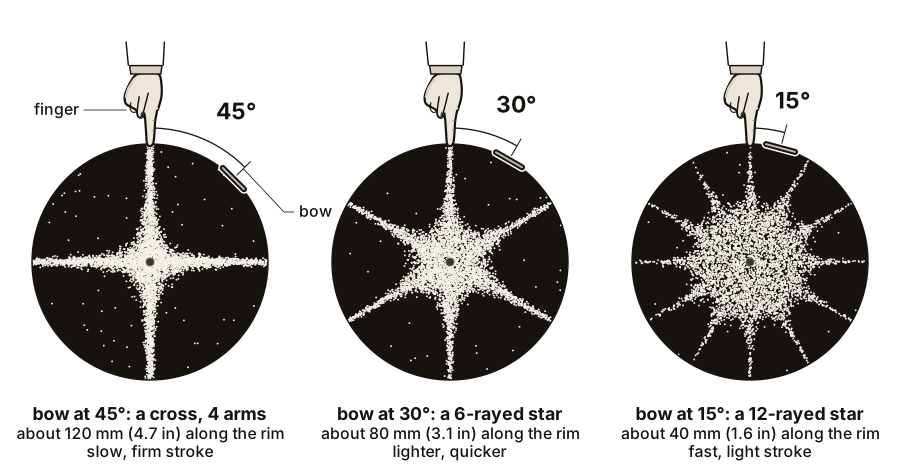
Parts: the chapter 1 disc on its woofer, speaker wire disconnected; a violin or cello bow (a student bow costs about $15 to $25); a cake of rosin, about $5; table salt. Cost: about $25, or nothing if there is a bow in the house. Time: 30 minutes, most of it learning the stroke. Hazards: a bowed plate is loud at close range. Run the sound meter app and wear plugs above 85 dBA. File the rim of the disc smooth first if you have not, or it will cut the bow hair. Method: rub rosin along the bow hair until a stroke on your thumbnail leaves white dust. Sprinkle the salt. Touch one fingertip lightly to the rim, and bow the rim straight down, square to the edge, an eighth of the way round the disc from your finger: 45 degrees, which on this disc is about 120 mm (4.7 in) along the rim. Press firmly and draw slowly. When a note sounds, hold the stroke steady and listen; if a second, different note breaks in, stop. What you should see: at 45 degrees from your finger, a cross: four arms meeting at the hub. Move the bow to 30 degrees from your finger, about 80 mm (3.1 in) along the rim, and stroke lighter and quicker: a six-rayed star. At 15 degrees, about 40 mm (1.6 in) along, with a fast light stroke: twelve rays. If it does not work: if the bow skids silently, it needs more rosin. If it squawks, press less hard or draw more slowly. If the figure comes out with the wrong number of rays, your finger is not where the figure wants a still line. Slide it a little round the rim and try again.
Section 1: A Brass Disc in a Vice
Ernst Florens Friedrich Chladni was born in Wittenberg, in Saxony, on 30 November 1756. His father was the senior professor of law at the university there, and the son was meant to follow him. He was taught at home and then at the school in Grimma, studied law at Wittenberg and Leipzig, and took his doctorate. Then his father died, and Chladni left the law.
He had come to music late, by his own account in his nineteenth year, around 1775. Plenty was known by then about how strings vibrate. Almost nothing was known about bells, plates or rods.
In 1785 he did the experiment you have just done. His 1802 book Die Akustik tells it in one sentence:
“I clamped a brass disc, which belonged to a grinding machine, by a pin at its middle into a vice.”
He drew a violin bow across its edge, and different strokes drew different notes. He wanted to see what the disc was doing to make each one. The motion was far too small and fast to see.
Two ideas gave him the way in. The first was the bow. An Italian priest, the Abbé Mazzocchi, had played bells by bowing them, and Chladni cites the report in his 1787 book. A bow grips the edge, slips, and grips again many times a second, and keeps a plate sounding as long as the stroke lasts. Chapter 10 takes that mechanism apart.
The second idea came from Göttingen. In 1777 the physicist Georg Christoph Lichtenberg had sprinkled fine powder on a cake of resin that carried an electric charge, and the powder had arranged itself into branching, fern-like figures. Lichtenberg’s powder made electricity visible. Chladni wondered whether sand would do the same for sound.
He strewed sand on the brass disc and bowed it. In his French book of 1809 he describes what appeared: a figure that “resembled a star of 10 or 12 rays.” And then, the sentence every later account quotes:
“Imagine my astonishment at seeing this phenomenon, which no one had yet seen.”
That claim was close to true. Galileo, in his Two New Sciences of 1638, had scraped a brass plate with an iron chisel, heard it whistle, and found on it “a long row of fine streaks parallel and equidistant”, closer together when the pitch was higher. Robert Hooke’s diary for 8 July 1680 is reported, at secondhand, to describe flour on a bowed glass plate; the exact wording is uncertain. Neither man pursued it. Chladni published hundreds of figures. (Tyndall’s famous 1867 lectures turn the brass disc into “a round plate of glass.” Chladni’s own German and French both say brass.)
Section 2: The Book of 1787
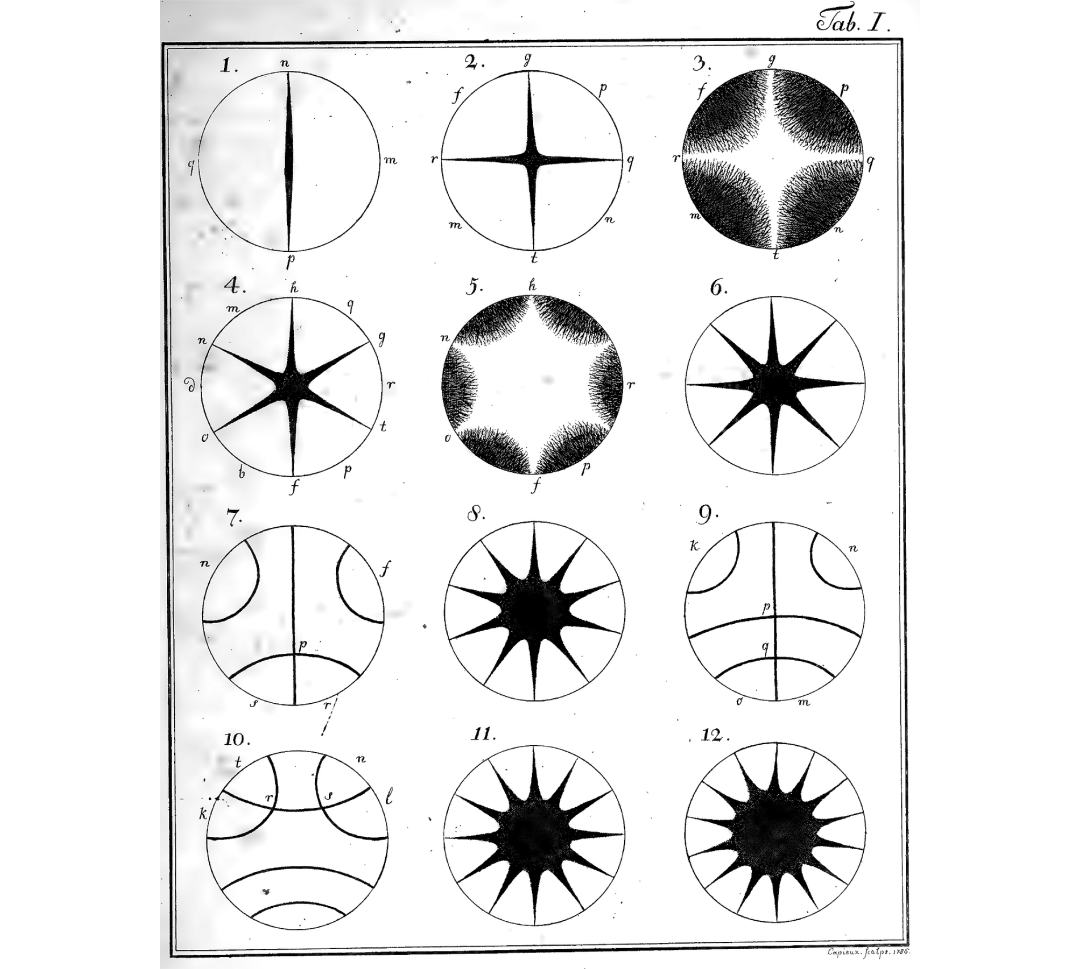
In 1787 Chladni published his results at Leipzig as Entdeckungen über die Theorie des Klanges, “Discoveries on the theory of sound.” Eleven copper engravings at the back carry 166 numbered figures of plates, rods, rings and bells.
On page 4 he states his method in one long sentence, translated here:
“All places of the sounding body where the axis is crossed by the serpentine curves can be made visible, if its surface is flat and held level, by strewing a little sand on it before or while bowing. The sand is thrown off the vibrating places, often with great violence, and stays lying on the places that do not move.”
That is the whole of chapter 1’s salt rule, written down nearly two and a half centuries ago. The “serpentine curves” are the wavy shape the plate takes as it vibrates, and the places where they cross the “axis” are the lines that stay still. Chapter 4 gives those places their modern name. The same page says the bow should be rubbed with rosin, and the copper plates show figure after figure in which the sand has drawn exactly the lines he describes.
He noticed two more things that would take other people decades to explain. On page 31 he reports that when the sand had a little very fine dust in it, the dust did the opposite of the sand: it gathered in small heaps at the middle of each moving region. He thought the cause was obvious and did not say what it was. It was not obvious. Michael Faraday needed until 1831 to show that air currents were doing it, and that is Chapter 7.
The second observation is the one you can try tonight. On page 25 he says that touching the plate lightly on one of its still lines does not stop the sound. It makes the note “purer and more definite.” A light finger there holds still a place that wanted to be still anyway, and it silences every other way the plate might be moving at the same time.
ON THE BENCH: The finger that purifies
Parts: the disc and bow from the box above; salt. Cost: nothing more. Time: 15 minutes. Hazards: as before. Method: raise the six-rayed star with your finger at twelve o’clock and the bow at one o’clock, 30 degrees round. Note what the tone sounds like. Brush the salt flat. Now bow at the same spot with your finger moved to half past twelve, 15 degrees round, which is the middle of a moving region of that figure. What you should see: with the finger on a still line, a clean, steady note and a crisp star. With the finger in a moving region, a dull, short sound, or a different and rougher note, and the salt shuffles but draws nothing clear. The finger in the wrong place has stopped the very motion the bow was trying to start.
Section 3: Glass, Sand and Fingertips
Chladni never won a university chair. He gave paid lectures at Wittenberg, but they did not keep him, and his applications for a professorship failed. He lived by touring, demonstrating his figures and playing instruments of his own invention: the euphon of 1790, glass rods the thickness of a writing quill stroked with wet fingers, and the clavicylinder of 1800, a keyboard in which a turning glass cylinder rubbed a mechanism he kept secret.
He also founded a science on the side. In 1794 he argued in print that stones and lumps of iron fall to earth from space. Some German readers, he recalled, took it for a hoax to test how gullible physicists were. Then Jean-Baptiste Biot’s report on the stones that fell at L’Aigle in Normandy in 1803 vindicated him, and meteoritics counts him as its founder.
In 1802 he published his full treatment of sound, Die Akustik. It has twelve copper plates and figures numbered to 269. It is dedicated to the Batavian Society of Sciences at Haarlem, “which has set as its prize question for this year a more exact investigation of the vibrations of a surface discovered by the author.” A learned society was already offering money for an explanation of the sand figures, and it did not get one.
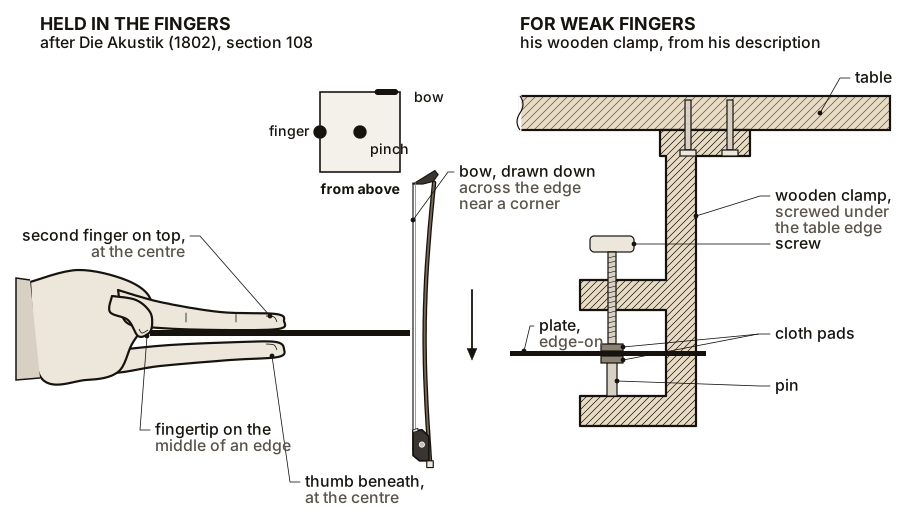
Section 108 of Die Akustik is a practical manual, clear enough to follow today:
- Use glass. It is more even in thickness than brass, and you can see through it to place your fingers underneath. Ordinary window glass serves. File the edges, or they cut the bow hair.
- Size. His plates ran from about 7 cm (2.8 in) across to about 63 cm (25 in). Thin plates give more figures.
- Hold, do not clamp. Pinch the plate between the extreme tips of the thumb and second finger, at a point that will be still. For weak fingers he drew a small wooden clamp that screws under a table edge, though he says he never needed it himself.
- Bow square to the edge, near the middle of a moving region. A slow, heavy stroke raises the low figures, a light, quick one the high figures. Listen for the right note, swell it, and stop the instant a wrong one breaks in.
- Use ordinary sand, washed so the finest dust is gone, on a level plate.
Square plates gave him his most famous figures, and they are the easiest to raise with a bow.
ON THE BENCH: A square plate, Chladni’s way
Parts: a square of aluminium sheet 200 mm (8 in) on a side and 2.0 mm (0.080 in) thick, with a 5 mm (3/16 in) hole drilled at its exact centre (find the centre by drawing both diagonals); a 5 mm (#10) bolt, nut, two rubber or fibre washers and two flat washers; a block of hardwood about 50 × 50 × 150 mm (2 × 2 × 6 in) with a matching hole; a woodworking clamp or a vice; the bow and rosin; salt. Glass works too: a 200 mm (8 in) square of picture-frame glass from a glazier, with the edges ground smooth, held in the fingers as Chladni held it. Cost: about $15 for the sheet and hardware, plus the bow. Time: an hour. Hazards: file every edge and corner of the aluminium until you can run a finger along it. Ground glass edges only, never a freshly cut pane. Loud at close range: meter and plugs. Method: bolt the plate to the end of the block through its centre hole, a rubber washer either side of the plate, snug and not crushed. Clamp the block to the table so the plate stands clear of everything. Level it. Sprinkle a teaspoon of salt. For the cross: touch the middle of one edge lightly with a fingertip, and bow the same edge close to a corner. For the diagonal X: touch one corner lightly, and bow the middle of an edge. What you should see: for the cross, two lines of salt parallel to the edges, meeting at the centre, from a low note. For the X, two lines along the diagonals, from a note roughly a fifth higher. On this plate the two notes lie near 160 Hz and 240 Hz. Chapter 5 shows where those numbers come from, and how to predict them for a plate you have not cut yet. If it does not work: if neither figure appears, the bolt is too tight and the washers are holding a patch of plate still that wants to move. Loosen it a quarter turn. If you get the X when you wanted the cross, your finger has drifted toward the corner. Better, if you have one: play your tone generator quietly at 160 Hz and then 240 Hz while you bow, and slide it until it matches the bowed note by ear. You have measured each figure’s frequency with nothing but a bow and your hearing.
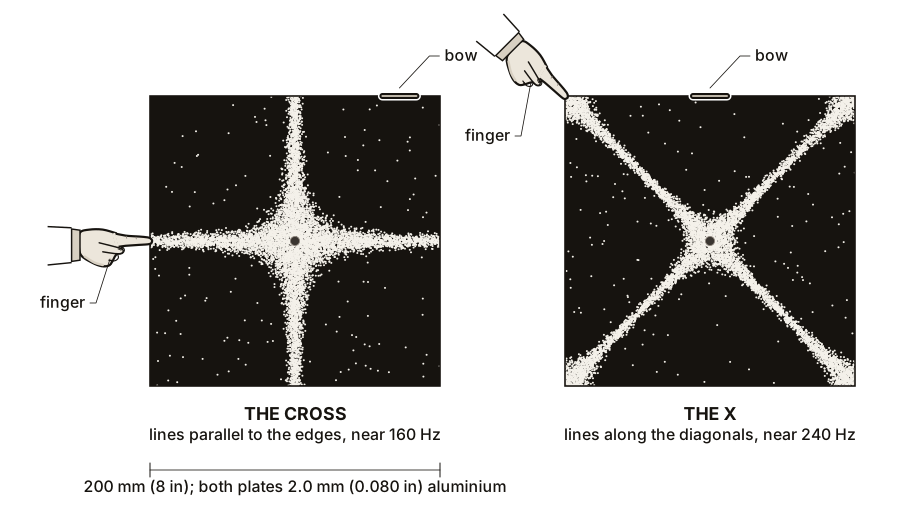
IN PLAIN ENGLISH: Every figure has lines that stay still and patches that move. To raise a particular figure, put a finger where that figure needs stillness and bow where it needs motion. Every other figure the plate could make needs motion somewhere your finger is, or stillness where your bow is, so they never get started. You are not forcing the plate into a shape. You are choosing, from the shapes it already has, the one you want.
Section 4: Two Hours with Napoleon
In 1807 Chladni set out on a long tour through Holland, Antwerp and Brussels to Paris, where he stayed until 1810. At the end of 1808 he asked the Institute of France, the national academy, to examine his work. It appointed a mixed commission: three scientists, Lacépède, Haüy and Prony, and three composers, Grétry, Méhul and Gossec. Their report was adopted on 19 and 24 December 1808.
Then the Emperor sent for him. Napoleon was in Spain until late January 1809, so the audience at the Tuileries took place in February 1809, not in 1808 as popular accounts say. Laplace, Berthollet and Lacépède presented him. Chladni wrote in 1817:
“He gave my discoveries his attention for an hour and a half to nearly two hours, and I had to explain everything to him quite exactly.”
And then:
“On the following day he had 6,000 francs paid to me as a gratuity, and also assigned 3,000 francs to the Institute for setting an extraordinary prize for the mathematical theory of the vibrations of surfaces.”
The 6,000 francs paid for a French edition of Die Akustik. Chladni rewrote the book, with Biot, Poisson and Cuvier correcting his French, and it appeared in November 1809 as the Traité d’acoustique. Its dedication reads: “Napoleon the Great has deigned to accept the dedication of this work, after having seen its fundamental experiments.”
Section 5: The Prize Nobody Could Win
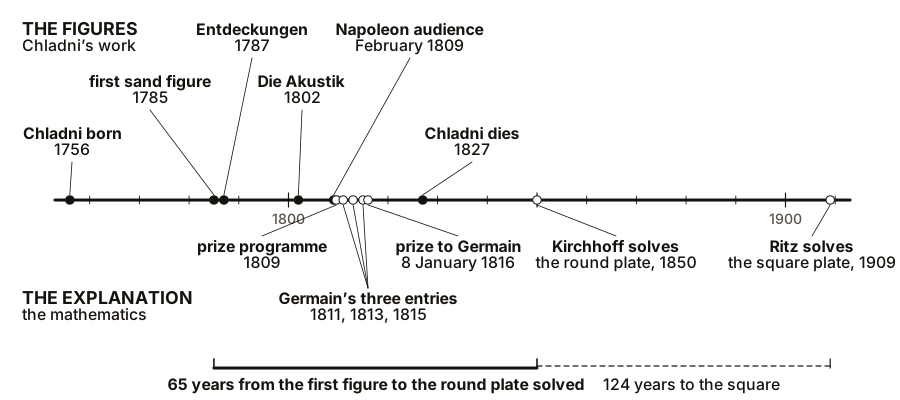
The Institute printed the prize programme in 1809. The task was “to give the mathematical theory of the vibrations of elastic surfaces, and to compare it with experiment.” The prize was a gold medal worth 3,000 francs. Later retellings call it a kilogram of gold; the programme names only the value. The Emperor, it said, wished the prize to be “proposed to all the savants of Europe.” Entries were due by 1 October 1811, and “this deadline is strict.”
All the savants of Europe produced one entry. It came from Sophie Germain, a Parisian woman of thirty-five with no formal training, because women could not then enrol in the schools that taught higher mathematics. She had taught herself, and from 1804 had corresponded with Carl Friedrich Gauss under a man’s name, Monsieur Le Blanc.
She told the story herself in 1821, with unusual candour. A great geometer, from her account clearly Joseph-Louis Lagrange, had first warned her off the problem. Chladni’s demonstrations in Paris changed her mind.
Her first entry, in 1811, was wrong. She had guessed, reasonably, that the force with which a bent plate springs back depends on how sharply it is curved. Her working had what she later called “serious errors.” The prize was not awarded. Yet Lagrange, one of the judges, took her starting idea and from it derived what she called “the equation that I should have given myself.” That equation was right, and it is the one Chapter 5 uses.
The Institute set the question again, with a deadline of 1 October 1813. Germain entered again, now with the correct equation, a treatment of the plate’s edge, and a comparison with Chladni’s experiments. She won an honourable mention, but not the prize. In August 1814 a member of the Institute, identified by later historians as Siméon Denis Poisson, read a rival memoir reaching the same equation by a different route.
The question was set a third time, for 1 October 1815. Germain entered a third time. On 8 January 1816 the prize went to “Demoiselle Sophie Germain” for the only treatise submitted, and the Institute added that her demonstration “had not seemed to it entirely satisfactory.” Chladni noted in 1817 that no entry had fully done what the programme asked.
The judges were right to hesitate. Her equation described the inside of the plate correctly. What she had wrong was the edge. A free edge, which is what a plate held by its centre has all the way round, has to obey particular rules about what it can and cannot do, and Germain’s rules for it were not the right ones. Lord Rayleigh’s Theory of Sound put it in one line in 1894: she had “the correct differential equation, but was led to erroneous boundary conditions.” Poisson’s version of the edge was wrong in a different way. Chapter 5 explains what the edge has to do and why it is hard.
The man who got it right was the German physicist Gustav Kirchhoff, in 1850. He went back to first principles, worked out the two conditions a free edge must satisfy, and solved the round plate completely. His theory reproduced Chladni’s figures and pitches, and he was blunt about his predecessor: Germain’s agreement with experiment, he wrote, “can only be regarded as accidental.” That is harsher than she deserves. She found the equation, working alone, and every solution since has started from it.
The square plate held out longer still. Its corners make the mathematics far harder than a circle’s. It fell in 1909 to Walther Ritz, a Swiss physicist of thirty-one, by a new method of his own, and his story belongs in Chapter 5.
Chladni lived to see neither. He kept touring and writing, fled the siege of Wittenberg in 1813, and died at Breslau on 3 April 1827, aged seventy, still with no professorship. The figures carry his name.
SLOW DOWN. Check Your Understanding: In 1809 Chladni wrote that the very high note of his first ten- or twelve-rayed star was “the one that corresponded to the square of the number of diametral lines.” He wrote that sentence 24 years after the event. Why does that matter, and what should a careful reader do with it? Answer before you read on.
It matters because a person remembering a discovery a quarter of a century later knows how the story ended. By 1809 Chladni had been bowing plates for 24 years and had printed the square rule in 1802. There is no way to tell from the 1809 sentence whether he noticed the square on the first evening, or read it back into the memory later. A careful reader keeps two things apart: what the document shows, which is that Chladni held the square law by 1802, and what it only claims, which is that he saw it at once. This book holds to that rule throughout, and it matters most in Part IV, where several famous stories were first written down decades after they supposedly happened. Your own chapter 1 notebook has no such problem: you wrote the numbers down on the night.
Bench Degree
Get the degree without the diploma.
Learn the material, not how to pass the exam.