Bench Degree·CYMATICSchapter
Chapter 3: What a Vibration Is
A ruler on the edge of a table knows a number. Push it, let go, and it tells you. This chapter is about where that number comes from.
Lay a steel ruler flat on a table so that most of it sticks out over the edge. Press the end on the table down hard with the flat of one hand, and with the other flick the free end down and let it go.
It goes thwack-a-a-a-a-a. The tip swings up and down so fast it blurs, the sound buzzes and fades, and in a second or two it is still. Slide the ruler further out and flick it again. The swing is slower now, slow enough that you can almost follow it with your eye, and the buzz is lower. Pull it back in until only a short stub hangs over the edge and flick that. Now it is a blur you cannot follow at all, and the buzz has become a note, a low hum with a pitch you could sing.
Flick it hard, flick it gently. The note gets louder and quieter, but at any one overhang it does not change pitch. The ruler has its own number of swings per second, set by how much of it hangs out, and nothing your finger does will change it.
That number is what this chapter is about. The black disc from chapter 1 has dozens of them, one for every figure. Before the disc, the ruler.
Section 1: Counting What You Cannot See
Chapter 1 called the number of swings per second the frequency, measured in hertz. To measure the ruler’s frequency you have to count its swings, and they are too fast to count by eye. A phone can count them for you.
Nearly every phone made in the last ten years will film in slow motion, usually at 240 frames per second. Played back, a swing that took a twentieth of a second takes twelve frames, and you can step through them one at a time.
ON THE BENCH: The ruler that knows a number
Parts: a steel ruler 300 mm (12 in) long, about 25 mm (1 in) wide and about 0.8 mm (1/32 in) thick; a C-clamp or a heavy book; a phone that films in slow motion; a strip of masking tape and a pen. Cost: about $5 for the ruler. Plastic and wooden rulers work too, but their swings die out quickly. Time: 30 minutes. Hazards: none worth the name. Keep your face away from the swinging tip. Method: clamp the ruler to the table edge so that exactly 240 mm (9.5 in) hangs over, measured from the edge. Mark that on the tape. Stand the phone on its side on the floor or on a box, so the tip of the ruler swings across the frame against a plain wall. Start slow-motion filming, flick the tip, and stop. Step through the video frame by frame. Find a frame where the tip is at the bottom of a swing, and count frames until it has reached the bottom ten more times. Then: frequency = 240 × 10 ÷ (frames counted) Repeat with 170 mm (6.7 in) and then 120 mm (4.7 in) hanging over. What you should see: with a ruler 0.8 mm (1/32 in) thick, about 11 Hz at 240 mm (9.5 in), about 23 Hz at 170 mm (6.7 in), and about 45 Hz at 120 mm (4.7 in). Your ruler is probably a little thicker or thinner, so your numbers will differ, but their pattern will not. Halve the overhang and the frequency goes up about four times. If it does not work: if the count changes from one flick to the next, the clamp is slipping and the ruler is not held at the same point every time. Tighten it. If at 120 mm (4.7 in) each swing takes only five frames or so, the count gets coarse; count 20 swings instead of 10 and use 20 in the formula.
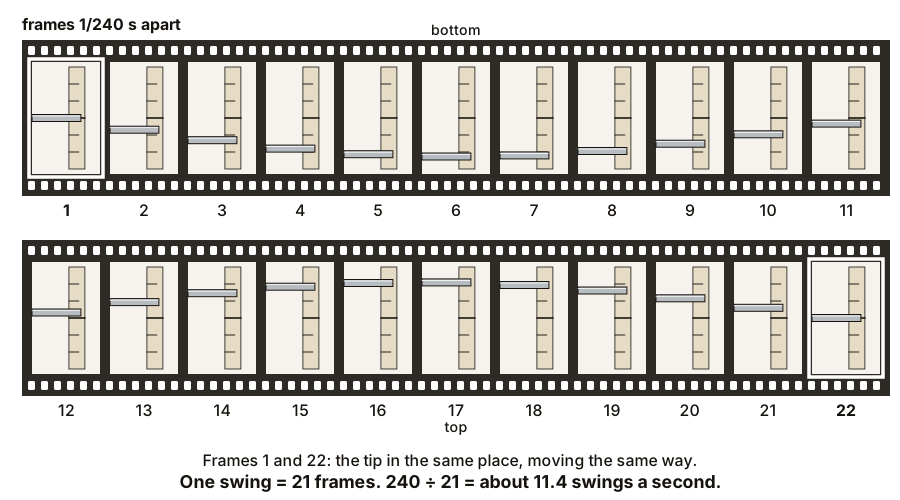
Halving the overhang and getting four times the frequency is not what most people guess. Most guess twice. Hold on to the four. It is the same square that turned up in your chapter 1 notebook, and by the end of this chapter you will see where it comes from.
Section 2: Period, Frequency and Amplitude
Three words describe any swinging thing, and every chapter from here on uses them.
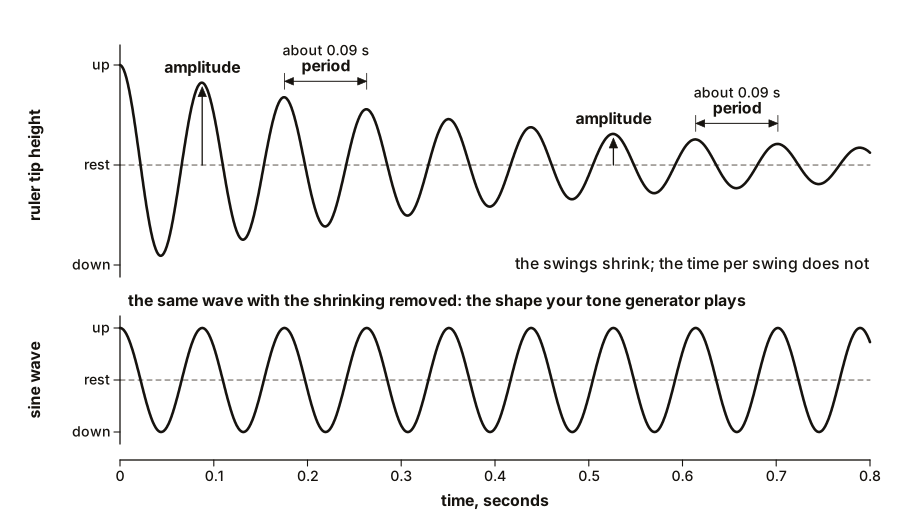
The period is the time one complete swing takes: from the bottom, up through the middle to the top, and back down to the bottom again. The ruler at 240 mm (9.5 in) has a period of about 0.09 seconds.
The frequency is how many complete swings fit into one second. It is one divided by the period. A period of 0.09 seconds is a frequency of 1 ÷ 0.09, about 11 Hz. A period of a thousandth of a second is a frequency of 1,000 Hz. Period and frequency are the same fact written two ways, and you use whichever is handier.
The amplitude is how far the swinging thing moves away from where it rests. On the ruler it is the distance from the tip’s resting position to the top of its swing. Flick hard and the amplitude is large. Flick gently and it is small.
Now look back at your video. Step through a swing near the start, when the ruler was flung far, and count its frames. Then step through a swing near the end, when the tip is barely moving. The amplitude has shrunk to a fraction of what it was. The number of frames per swing has not changed. The ruler takes just as long to make a small swing as a large one. It moves faster on the big swings, exactly fast enough to cover the extra distance in the same time.
That is why the ruler’s buzz fades without sliding down in pitch. The amplitude sets how loud it is. The frequency sets the pitch. They are separate dials.
Section 3: The Mass and the Spring
Why should the ruler swing at all, and why at that frequency? Two things are needed, and you can separate them with a spring from the hardware shop and a bag of coins.
The first is something that pulls back. Bend the ruler down and it pushes up; let go and it springs back toward straight. The harder you bend it, the harder it pushes back. Robert Hooke published that rule in 1678 for springs of every kind, in four words of Latin, ut tensio, sic vis: as the stretch, so the force. Stretch a spring twice as far and it pulls twice as hard.
The number that says how hard a thing pulls back for each unit of stretch is its stiffness. A stiff spring pulls back hard after a small stretch. A soft one has to be stretched a long way before it pulls back much. Engineers measure stiffness in newtons of force per metre of stretch. A newton is a small force, about the weight of a 100 g (3.5 oz) apple held in your hand.
The second thing needed is something heavy enough to keep going. When the spring has pulled the ruler back to straight, the ruler is moving fast, and its own weight carries it straight on past, bending it the other way. Now the spring pulls the other way, slows it, stops it, and sends it back. The spring keeps pulling the mass back toward the middle, and the mass keeps overshooting. That is a vibration.
So every vibrating thing is a mass and spring: something with weight, and something stiff that pulls it back. On a ruler they are the same piece of steel. On a spring hung from a shelf, they are easier to tell apart.
ON THE BENCH: Weigh a spring, then predict it
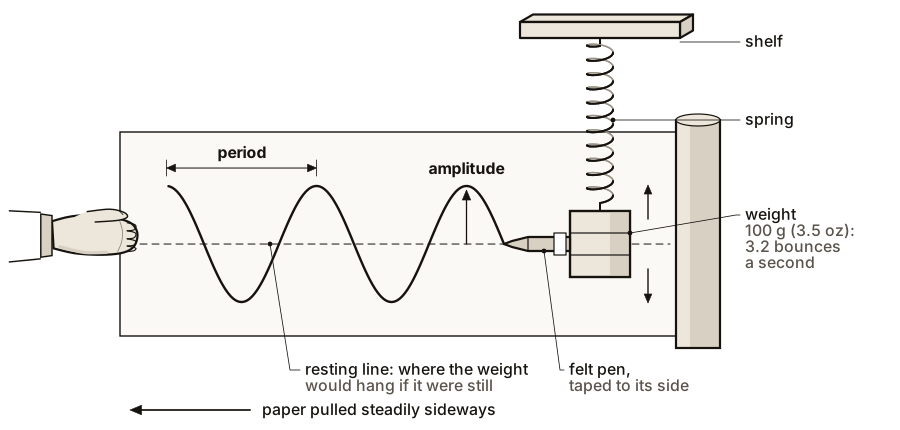
Parts: a small steel extension spring, the kind sold loose at hardware shops, about 50 to 75 mm (2 to 3 in) long; a small plastic bag or cup and a pile of coins; a kitchen scale; a ruler; a hook, or a pencil taped firmly across the edge of a shelf; a phone stopwatch. Cost: about $3. Time: 40 minutes. Hazards: a spring overstretched can snap back. Do not hang more than the spring will carry without staying longer when you take the load off. Method: hang the spring from the hook and the empty bag from the spring. Mark where the bottom of the bag sits. Weigh out 100 g (3.5 oz) of coins and put them in. Measure how far the bag drops: that is the sag. Now pull the bag down a finger’s width and let go. Start the stopwatch as it passes the lowest point, count 20 bounces, and stop. Divide the time by 20 to get the period. Then put in coins until the load weighs 400 g (14 oz), four times as much, and do it again. What you should see: a spring that sags 25 mm (1 in) under 100 g (3.5 oz) bounces with a period of about 0.32 seconds, about 3.2 Hz. With four times the load it sags four times as far, 100 mm (3.9 in), and its period doubles to about 0.63 seconds, about 1.6 Hz. Four times the mass, half the frequency. Pull the bag down further before letting go, and the period stays the same. If it does not work: if the sag at 400 g (14 oz) is not four times the sag at 100 g (3.5 oz), the spring is being stretched beyond its straight-line range, or its coils were pressed together to begin with. Use lighter loads. Do not use a rubber band; rubber’s pull does not grow in step with its stretch, and the result wanders.
Section 4: The Formula, and Why It Has a Square Root
You have now seen the two rules every vibration obeys. A stiffer spring makes it faster. A heavier mass makes it slower. The exact relation is short:
f = (1/2π) × √(k/m)
Here f is the frequency in hertz, k is the stiffness in newtons per metre, and m is the mass in kilograms. The 2π is there because the swing goes round a full cycle, and a full turn of a circle is 2π in the units mathematicians use for angles. You do not need to follow that part to use the formula.
The square root is the important part. Quadruple the mass and the frequency halves, because the square root of 4 is 2. Quadruple the stiffness and the frequency doubles. To make a spring vibrate twice as fast you need four times the stiffness, or a quarter of the mass, or some mixture of the two.
Try it on your spring. It sagged 25 mm (1 in) under 100 g (3.5 oz). The weight of 100 g is 0.98 newtons (0.22 pounds-force), so the stiffness is 0.98 ÷ 0.025 = 39 newtons per metre (0.22 pounds-force per inch). Then:
f = (1/2π) × √(39 ÷ 0.1) = (1/2π) × 19.8 = 3.15 Hz
That is the 3.2 Hz you timed. You predicted a vibration from a ruler measurement and a kitchen scale.
IN PLAIN ENGLISH: A vibration is a tug of war between two things. Stiffness pulls the moving part back toward the middle, and the stiffer it is, the faster the part gets turned round. Mass resists being turned round, and the heavier it is, the slower everything goes. The frequency is set by which one is winning, and by how much. Because of the square root, it takes a big change in either one to make a modest change in pitch: four times, to get twice.
A vibration of this kind, in which the pull back is always in proportion to the distance from the middle, has a name: simple harmonic motion. It has two marks. Its period does not depend on its amplitude, which you saw on both the ruler and the spring. And if you plot its position against time, the trace is a sine wave, the same smooth shape your tone generator played in chapter 1. That is not a coincidence. The speaker cone in chapter 1 was moving in simple harmonic motion, and the sine wave was its trace.
Section 5: Natural Frequency
Every mass on a spring has one frequency that it vibrates at when you disturb it and let it go. That is its natural frequency. The ruler at 240 mm (9.5 in) has a natural frequency of about 11 Hz. The spring with 100 g (3.5 oz) on it has a natural frequency of about 3.2 Hz. Nothing about how you started it changes the number. Only changing the mass or the stiffness does.
Now go back to the ruler and the puzzle of the four. Shortening the overhang does two things at once. It makes the ruler stiffer, and by a lot: a ruler half as long bends only an eighth as far under the same push at its tip, so it is eight times as stiff. Stiffness of a strip like this goes as one over the cube of its length. Shortening also makes the swinging part lighter, half as heavy when you halve the length.
Put those into the formula. Eight times the stiffness and half the mass is sixteen times k ÷ m. The square root of 16 is 4. Halve the length, and the frequency goes up four times. Frequency goes as one over the length squared. That is what your video showed.
ON THE BENCH: A lump of clay on the ruler
Parts: the clamped ruler at 240 mm (9.5 in); modelling clay; the kitchen scale; the slow-motion phone. Cost: about $2 for the clay. Time: 20 minutes. Hazards: none. Method: measure the ruler’s frequency as before. Then press a pea-sized lump of clay firmly onto the tip, flick, and measure again. Add clay a little at a time until the frequency has dropped to half its first value: the frames per swing have doubled. Take the clay off and weigh it. Then weigh the ruler and work out what the overhanging part weighs: multiply the whole ruler’s weight by the overhang and divide by the ruler’s full length. What you should see: the frequency falls as you add clay. The lump that halves it, which must have made the total moving mass four times larger, weighs roughly three quarters as much as the overhanging steel. On a ruler 0.8 mm (1/32 in) thick that is about 27 g (1 oz) of clay against about 38 g (1.3 oz) of steel. If it does not work: if the clay flies off, press it on harder, or wrap it once round the ruler. If the frequency hardly changes, the clay is not stuck firmly and is rattling.
That last result needs an explanation, and it is a good one. The ruler’s overhang weighs about 38 g (1.3 oz), so a lump that quadruples the moving mass should weigh three times as much as the ruler, over 100 g (3.5 oz). Yet about 27 g (1 oz) does it. The reason is that most of the ruler hardly moves. The steel near the clamp barely shifts; only the tip swings its full distance. Measured by its effect on the frequency, the ruler behaves like a quarter of its overhang weight concentrated at the tip, about 9 g (0.3 oz). Adding 27 g (1 oz) at the tip brings that to 36 g (1.3 oz), four times as much, and the frequency halves. A real object is many small masses and many small springs, joined together, and some of them work harder than others.
Section 6: Many Masses, Many Springs
The black disc from chapter 1 is a mass and spring too. Every small patch of aluminium has weight, and every patch is held to its neighbours by stiff metal that pulls it back when it bends. That ought to give it a natural frequency, and it does.
It gives it many. A disc is thousands of small masses held together by thousands of small springs, and a collection like that can vibrate in many different shapes, each with its own natural frequency. In one shape the rim moves while the centre stays put. In another, alternate wedges move up and down, with still spokes between them. Each figure you found in chapter 1 is one of those shapes, raised at its own natural frequency. When you climbed through the tone generator and the plate suddenly sang, you had just landed on one.
The rule you found with the ruler carries straight across. A disc twice as wide is, strip by strip, like a ruler twice as long, and every frequency falls fourfold. The frequency of a plate goes as one over its diameter squared, for the same reason the ruler’s goes as one over its length squared. A disc twice as thick, as chapter 1 hinted, is eight times as stiff and only twice as heavy. That is four times k ÷ m, and the square root of 4 is 2, so every frequency doubles. Chapter 5 does that arithmetic properly.
What is still missing is a way to describe the shapes themselves, the spokes and rings, and to say why one shape should sit at a higher frequency than another. That needs waves, and Chapter 4 builds them.
SLOW DOWN. Check Your Understanding: You have two springs. One is stiff and carries a heavy weight. The other is soft and carries a light one. Each sags exactly 100 mm (3.9 in) under its weight. Which bounces faster? Answer before you read on.
They bounce at the same frequency. The sag tells you how stiff each spring is compared with its load: weight divided by stiffness. A spring that sags 100 mm (3.9 in) has a stiffness of exactly its load’s weight divided by 0.1 m, whatever that load is. Put that into the formula and the mass cancels out, leaving only the sag:
f = (1/2π) × √(9.81 ÷ sag in metres)
For a 100 mm (3.9 in) sag that is 1.58 Hz, for any spring and any load. So you can tell a hanging weight’s natural frequency from its sag alone, with a ruler and no scale. Try it on the chapter 1 rig. The disc sat on the woofer’s cone and pushed it down a little. If the cone sagged 1 mm (0.04 in), the whole disc bobs up and down on the speaker’s springy rim at about 16 Hz, as one lump, far below every salt figure. That bob is a natural frequency of the rig, not of the plate. It is one more reason chapter 1 told you to stay above 100 Hz: down at the bottom of the range, the speaker throws the whole disc around instead of bending it.

Bench Degree
Get the degree without the diploma.
Learn the material, not how to pass the exam.