Bench Degree·CYMATICSchapter
Chapter 4: Waves, Nodes and Antinodes
Shake one end of a rope and the shake runs away from you. Shake it at exactly the right rate and it stops running, and the rope hangs in loops with points between them that do not move at all. Those points are what the salt has been drawing.
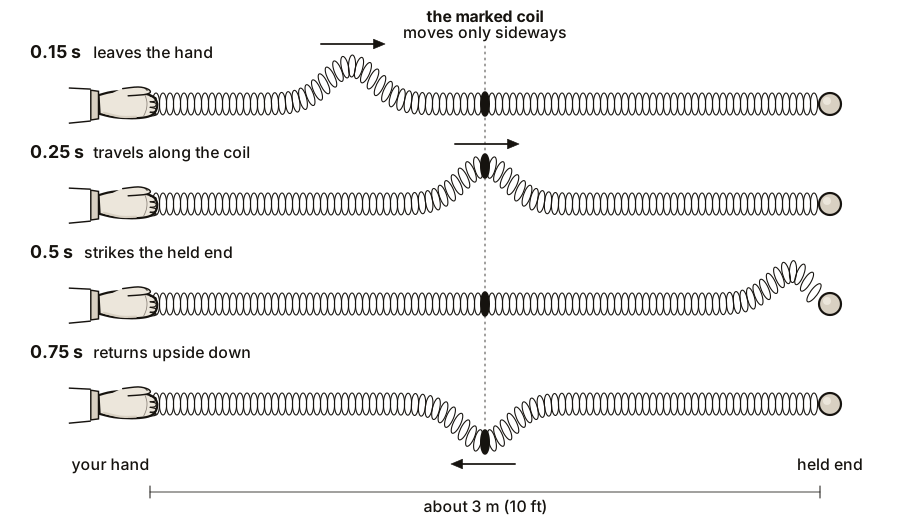
Stretch a toy coil spring across a smooth floor, the long metal or plastic kind that walks down stairs. Ask someone to hold the far end still, about 3 m (10 ft) away, or hook it over a chair leg. Pull it until it is taut but not straight-line tight.
Now flick your end once, sharply, to one side and back. A hump leaps out of your hand and races along the coil. It reaches the far end, and it comes back. Watch which side it comes back on. It went out on the left and it comes back on the right. It has turned upside down.
Flick again and watch one coil, any coil in the middle. As the hump passes, that coil jumps sideways and returns to where it was. It does not travel anywhere. The hump crossed 3 m (10 ft) of floor, but no piece of spring went with it.
Section 1: A Shape That Travels
That hump is a wave: a disturbance that travels through something while the something stays where it is. Each coil only moves sideways and back. What moves along the spring is the shape, and the energy you put in with your flick.
Every wave in this book works the same way. Sound in air is a wave: the air near a speaker cone is pushed and pulled, it pushes and pulls the air next to it, and the push travels to your ear while each bit of air only shuffles back and forth. The salt figures are waves too, running across the metal and back.
The speed at which the shape travels is the wave speed. It is set by the thing the wave travels in, the way the natural frequency of a ruler was set by the ruler. A spring under more tension carries waves faster. A heavier spring carries them slower. That is the stiffness and mass of Chapter 3 again, in a new form, and Section 6 makes it exact.
ON THE BENCH: Timing a wave
Parts: a toy coil spring, metal or plastic; a smooth floor; a helper, or a chair leg to hook the far end over; a tape measure; a phone that films in slow motion, or at ordinary speed. Cost: about $5 for the spring, if there is not one in a cupboard. Time: 20 minutes. Hazards: a stretched metal coil let go snaps back and tangles. Overstretch it and it stays stretched for good. Stretch it only until the coils separate evenly. Method: stretch the spring to a measured length, say 3 m (10 ft). Film the whole length from the side. Flick one sharp pulse. Step through the video and note the frame when the pulse leaves your hand and the frame when it has gone to the far end and back four times. Divide the distance it travelled, eight lengths, by the time. A phone filming at 240 frames per second gives each frame as 1/240 of a second; at ordinary speed, 1/30. What you should see: on a typical metal coil, about half a second for each 3 m (10 ft) trip, a speed of about 6 m/s (20 ft/s), a sprinter’s pace. The pulse comes back upside down from the held end every time, so it is right way up again after two trips. Stretch the spring further and time it again; the speed changes, because the tension did. If it does not work: if the pulse dies before four trips, the floor is dragging on the coils. Try a smooth hard floor, or count two trips instead.
Section 2: Wavelength
Now stop flicking and shake. Swing your end steadily from side to side, once a second or so, and keep going. A train of humps runs down the spring, one every swing of your hand: left, right, left, right, all travelling at the wave speed.
The distance from one left-hand hump to the next left-hand hump is the wavelength. It is the length of one complete wiggle of the wave, measured along the thing it travels in.
Wavelength, frequency and wave speed are tied together by one simple fact. In one second your hand makes f swings, so f humps leave it, and each is one wavelength behind the last. In that second the first hump has travelled one wave speed’s worth of distance. So:
wave speed = frequency × wavelength
Shake faster and the humps crowd closer. Shake slower and they spread out. For a given wave speed, double the frequency and you halve the wavelength.
Put numbers to sound in air. Sound travels at 343 m/s (1,125 ft/s) at room temperature, 20 °C (68 °F). At 512 Hz, the twelve-spoke frequency of the chapter 1 plate, the wavelength is 343 ÷ 512 = 0.67 m (2.2 ft). At the rose window’s 1,337 Hz it is 0.26 m (10 in). Middle C, 262 Hz, has a wavelength of 1.3 m (4.3 ft), about the height of a child.
Galileo met the same arithmetic in 1638. Scraping a brass plate with a chisel, he found that when it whistled it left fine parallel streaks, and that a higher whistle left them closer together. The chisel moved at a steady speed and left one streak per vibration, so the spacing was its speed divided by the frequency: the same sum as a wavelength, with the chisel’s speed standing in for the wave’s.
Section 3: Reflection
Go back to the single flick, and what happened at the far end. The pulse arrived, could go no further, and came back. A wave that meets the end of whatever it is travelling in, and turns round, has undergone reflection.
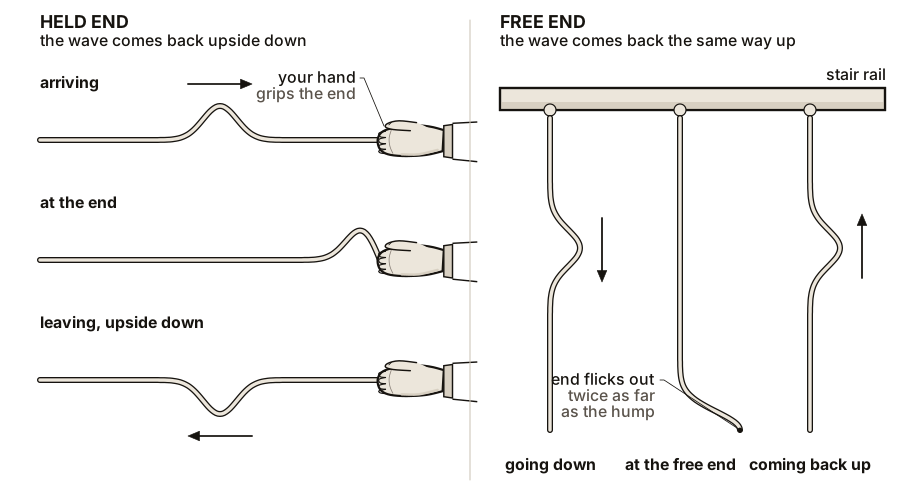
It came back upside down because the end was held. When the hump arrived, it tried to lift the last coil. The hand holding it would not let it move, so the last coil pulled back on the hand, and the hand pulled back on the coil equally hard in the opposite direction. That reverse pull launched a hump the other way up. A held end turns a wave over.
An end that is free to move does the opposite. Hang a length of rope from a high stair rail so its bottom end swings clear of the floor, and flick the top. The pulse runs down, reaches the loose end, and flicks it out to the side even further than the rest of the rope moved, because nothing is there to hold it back. The end whips back and sends the pulse up the same way up it went down. A free end reflects a wave without turning it over.
Remember the free end. The rim of the chapter 1 disc is held by nothing, and Chapter 5 shows that a free edge is exactly what made the plate problem so hard.
Section 4: Standing Waves
Now shake the spring steadily again, and slowly change how fast you shake. Most of the time the result is a mess. Humps go out, reflections come back, and the two jostle into an untidy writhing that never settles.
Then, at one particular rate, the mess vanishes. The whole spring swings from side to side in a single smooth arc, with the ends still and the middle swinging wide. The humps no longer seem to travel at all. Shake twice as fast and, after a moment of confusion, the spring settles into two arcs, swinging in opposite directions, with a point in the middle that hardly moves. Three times as fast and you get three.
What you are seeing is a standing wave. Two waves are on the spring at once: the one you are sending out, and its reflection coming back. Where the two arrive in step, they add, and the spring swings wide. Where they arrive exactly out of step, one pushing left as the other pushes right, they cancel, and the spring stays still. At most rates those places shift about and nothing settles. At the special rates the reflection arrives back at your hand exactly in time to add to your next shake, and the pattern locks in place.
The places that stay still are the nodes. The places that swing widest are the antinodes. On a standing wave they alternate, node, antinode, node, and two neighbouring nodes are always exactly half a wavelength apart.
That is the stillness the salt finds. On the chapter 1 plate, the salt was thrown off the antinodes and came to rest on the nodes. The lines of salt are lines of nodes, and Chladni’s “places that do not move,” in his 1787 description, are nodes too. The “serpentine curves” he said crossed the “axis” are standing waves, and the crossing points are the nodes.
ON THE BENCH: Standing waves by hand
Parts: the coil spring stretched to 3 m (10 ft) as before, the far end held firmly; a phone stopwatch. Cost: nothing more. Time: 20 minutes. Hazards: as before. Method: shake your end side to side, small movements, and slowly change the rate until the whole spring swings in one arc. Keep your hand’s movement small; at the right rate the spring does the work. Time 10 shakes and divide by 10 to get the period, then work out the frequency. Then find two arcs, then three, and time each one. What you should see: the frequencies for one, two and three arcs in the ratio 1 : 2 : 3. Your hand barely moves while the antinodes swing wide; your hand is almost at a node. The one-arc frequency should be close to one divided by the time of a round trip that you measured in the first box: the shake has to wait for the reflection to get home. If it does not work: if the arcs will not settle, you are shaking too hard. Move your hand less, not more. A helper who lets the far end move will spoil the pattern; ask them to brace their hand against the floor.
IN PLAIN ENGLISH: A wave that runs to the end of a spring and bounces back meets the next wave you send out. At most shaking speeds they collide in a muddle. At a few special speeds every wave lands exactly on top of the last, and the spring settles into a fixed pattern of loops. The middles of the loops swing hard. The points between them do not move at all. Those still points are where sand ends up.
Section 5: A String on the Speaker
A hand is a clumsy driver. The woofer from chapter 1 is a precise one, and with the disc taken off it can drive a string at any frequency you type into the tone generator.
ON THE BENCH: The string on the woofer
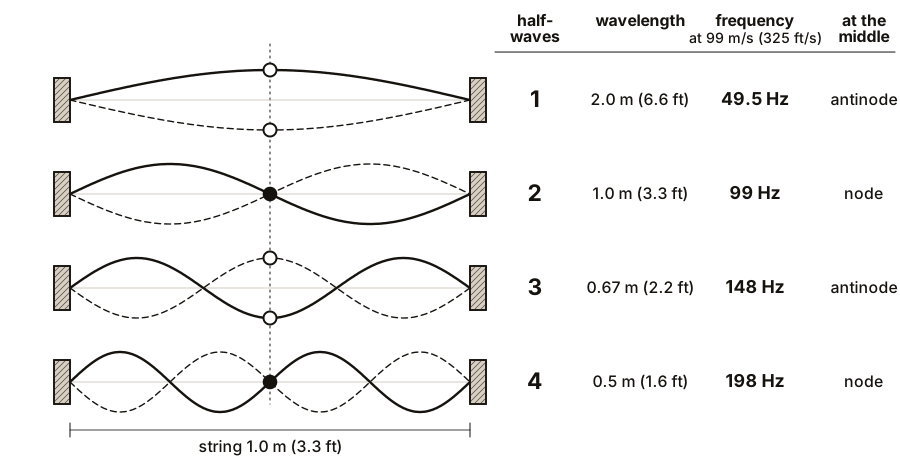
Parts: the chapter 1 woofer, amplifier and tone generator, with the disc removed and the bolt left standing; a reel of braided nylon mason’s line, or similar thin, flexible cord, at least 10 m (33 ft); a screw eye in a block of wood; a round pencil and some books; a 1 L water bottle, full; tape; a clamp; a dark background and a lamp. Cost: about $5 for the line. Time: an hour. Hazards: keep the volume low; with the disc off, the cone moves easily and a loud low tone can drive it hard enough to damage it. The full bottle hanging off the table edge should hang over the floor, not over a foot. Method: weigh 10 m (33 ft) of the line on a kitchen scale and divide by 10 to get its weight per metre. Clamp the block with the screw eye to the table 50 mm (2 in) behind the woofer, with the eye at the height of the bolt tip. Tie the line to the eye, run it across the bolt tip and take one tight turn round the bolt, then carry it 1.0 m (3.3 ft) along the table to a pencil taped across the top of a stack of books at the table’s edge, at the same height. Hang the bottle on the end over the edge. The line should run dead level; it must not press the cone down or lift it. Set a dark cloth behind the line and light it from the side. Start the tone at 30 Hz with the volume low and climb slowly. What you should see: for most of the climb the line hardly stirs. Then at one frequency it suddenly swings into a single fat blur from end to end. Climb further and it falls quiet, then swings into two blurs with a sharp still point exactly in the middle, then three, then four. With line weighing 1.0 g per metre (0.011 oz per foot), you will find them near 50, 99, 148 and 198 Hz. If it does not work: if the loops are lopsided, the line is touching something, or it is not level. If nothing happens anywhere, raise the volume a little. If the bottle swings, steady it; a swinging bottle changes the tension.
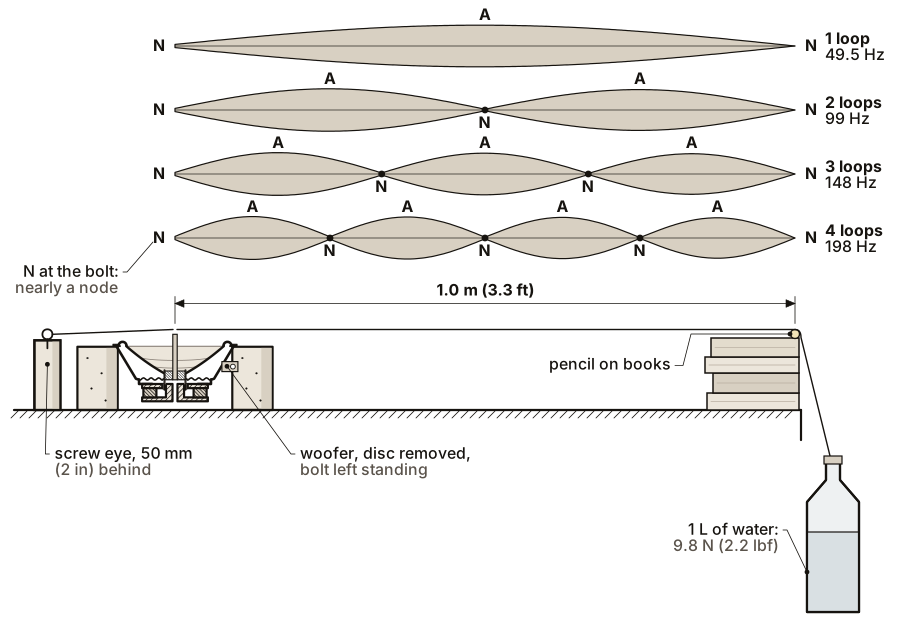
Each of those frequencies is a harmonic of the string. The lowest, the single loop, is the first harmonic, or the fundamental. The others sit at exactly two, three and four times its frequency. Musicians call every harmonic above the fundamental an overtone, so the second harmonic is the first overtone. That off-by-one trips everybody up once. This book will say “harmonic” and give the number.
Each harmonic has its own shape, its own pattern of nodes and antinodes, and its own frequency. A shape of vibration with its own natural frequency is called a mode. The single loop is the string’s first mode, two loops its second, and so on. A mode is the general idea. A harmonic is a mode whose frequency is a whole-number multiple of the lowest one, as on a string. The figures on the chapter 1 plate are modes of the plate, and the salt draws their nodes. As you will see, they are not harmonics.
Now repeat Chladni’s experiment from Chapter 2. Drive the string at its second harmonic, two loops, and touch the line lightly with a fingertip exactly at the middle node. Nothing changes; you are holding still a point that was still already. Now drive the first harmonic, one loop, and touch the same spot. The loop collapses. The fundamental needs that point to move, and your finger forbids it.
Section 6: Why a String Is the Easy Case
The harmonics of a string come in whole numbers, 1, 2, 3, 4, and it is worth seeing exactly why, because the plate does not do this and Chapter 5 is about why not.
A string held at both ends must have a node at each end. So the only standing waves that fit are those with a whole number of half-wavelengths between the ends: one half-wave, two, three. For a string 1.0 m (3.3 ft) long, the wavelengths that fit are 2 m, 1 m, 0.67 m and 0.5 m (6.6, 3.3, 2.2 and 1.6 ft).
Now the frequency of each is the wave speed divided by its wavelength. On a string, the wave speed is the same at every frequency. It is set by the tension and the weight of the string alone:
wave speed = √(tension ÷ weight per length)
with tension in newtons and weight per length in kilograms per metre. For your line, with 9.8 newtons (2.2 pounds-force) of tension from a full 1 L bottle and 0.001 kg per metre (0.011 oz per foot), that is √(9,800) = 99 m/s (325 ft/s). Divide it by the wavelengths and you get 49.5, 99, 148 and 198 Hz, exactly 1, 2, 3 and 4 times the fundamental.
That is the whole secret. Fixed wave speed, plus wavelengths that fit in whole halves, gives frequencies in whole numbers. The same formula has the shape of Chapter 3’s, too: tension is the stiffness pulling the string back to straight, and weight per length is the mass being pulled.
Look again at the last column of your chapter 1 table. The eight-, ten-, twelve-, fourteen- and sixteen-spoke figures sit at 1.00, 1.54, 2.18, 2.92 and 3.76 times the first. Those are not whole numbers, and they climb faster and faster. Something about the plate breaks one of the two conditions that make the string so tidy. The wavelengths on a disc still have to fit, so the culprit is the other one. On a plate, the wave speed is not fixed. It changes with frequency, and Chapter 5 shows how.
SLOW DOWN. Check Your Understanding: You hang a second full bottle beside the first, doubling the tension in the line. The string was showing three loops at 148 Hz. Where do you now find three loops? Answer before you read on.
At about 210 Hz, not at 296 Hz. Doubling the tension does not double the wave speed, because of the square root: the speed rises by √2, about 1.41 times, from 99 to 140 m/s (325 to 459 ft/s). Every harmonic rises by the same factor, so the third goes from 148 to about 210 Hz. The ratios between the harmonics do not change at all: the three-loop mode is still exactly three times the fundamental, which is now about 70 Hz. This is how a guitar is tuned. Turning the peg changes the tension, which moves the whole ladder of harmonics up or down together and keeps its rungs in whole numbers. It is the same pattern as the chapter 1 plate made thicker: everything shifts by one factor, and the ratios, which describe the shapes, stay put.
Bench Degree
Get the degree without the diploma.
Learn the material, not how to pass the exam.