Bench Degree·CYMATICSchapter
Chapter 5: Why Plates Are Not Strings
A string’s notes climb 1, 2, 3, 4. A plate’s climb as the squares. The reason is in your hands the moment you try to bend something thick, and it took the best mathematicians in Europe sixty-five years to write it down.
Take two steel rulers, the same as the one you twanged in Chapter 3. Lay one on top of the other and bend the pair between your hands. They bend about twice as hard as one ruler, and you can feel them sliding over each other at the ends.
Now glue them together face to face with epoxy, let it set overnight, and bend the pair again. It is a different object. Glued, the pair is about four times as hard to bend as the loose pair, eight times as hard as one ruler. Nothing has been added except a film of glue. The steel is the same steel. What changed is that the two strips can no longer slide.
That is the first idea of this chapter, and it explains why a plate is not a string.
ON THE BENCH: Two rulers, loose and glued
Parts: two identical steel rulers, the kind from Chapter 3; five-minute or slow-setting epoxy; the clamp, the table edge and the slow-motion phone from Chapter 3. Cost: about $10. Time: 30 minutes, plus a night for the glue. Hazards: epoxy on skin; wear gloves. Scuff the faces with fine abrasive paper and wipe with alcohol before gluing. Method: clamp one ruler with 240 mm (9.5 in) overhanging and measure its frequency by counting frames, as in Chapter 3. Then clamp the two rulers stacked loose, ends level, with the same overhang, and measure again. Then glue the pair, clamp it the same way once the glue has set, and measure a third time. What you should see: the loose pair twangs at about the same frequency as one ruler: twice the stiffness, twice the mass. The glued pair twangs at about twice the frequency, near 23 Hz if the single ruler gave 11 Hz: eight times the stiffness, twice the mass, and the square root of four is two. If it does not work: if the glued pair is less than twice the single, the glue line is thick or has let go in places. Tap along it; a dull patch is a gap.
Section 1: Bending Stiffness
When a strip bends, its top face stretches and its bottom face is squeezed, and the metal resists both. The further a layer sits from the middle of the strip, the more it is stretched for a given bend, and the harder it pushes back. Loose, the rulers bend as two thin strips. Glued, they bend as one strip twice as thick, with its outer faces twice as far from the middle.
The resistance of a sheet to being curved is its bending stiffness. It grows as the cube of the thickness: twice as thick, eight times as stiff. For a plate, engineers write it as
D = E h³ ÷ 12(1 − ν²)
where h is the thickness, E is the stiffness of the metal itself, how hard it is to stretch, and ν (the Greek letter nu) is a small correction for the way metal narrows sideways when you stretch it. For aluminium, E is 69 GPa (10.0 million psi) and ν is 0.33. What matters is the cube.
The weight of the plate, meanwhile, grows only in proportion to its thickness. So a thicker plate gains stiffness much faster than it gains weight, and Chapter 3’s formula says what happens next: every frequency rises in proportion to the thickness. That is why the 2.0 mm (0.080 in) disc in chapter 1’s Check Your Understanding sings every figure an octave higher.
Section 2: Waves That Bend
The salt figures are standing waves, and the wave that runs across the plate and reflects from its rim is a new kind. It is the metal itself bending: a ripple of curvature that travels across the sheet, driven along by the plate’s own bending stiffness. A wave of that kind is a bending wave, or in engineering language a flexural wave.
Here is the decisive difference. On a string, a wave of half the length travels at the same speed, so it has twice the frequency. On a plate, a ripple of half the length is like the ruler with half the overhang: eight times stiffer for its length, half as heavy, and so four times the frequency. On a plate, halving the wavelength quadruples the frequency.
Work out what that does to the wave speed. Speed is frequency times wavelength. Four times the frequency times half the wavelength is twice the speed. A bending wave travels faster the higher its frequency. Quadruple the frequency and it goes twice as fast. When different frequencies travel at different speeds, the wave is said to show dispersion, because a sharp tap, which contains many frequencies at once, spreads out as it travels: the high-pitched parts run ahead.
On the chapter 1 sheet the bending-wave speed, in metres per second, comes out at about 3.1 times the square root of the frequency in hertz. At 512 Hz that is about 70 m/s (230 ft/s), with a wavelength of 138 mm (5.4 in). At 2,048 Hz, four times higher, it is 141 m/s (463 ft/s), and the wavelength has only halved, to 69 mm (2.7 in).
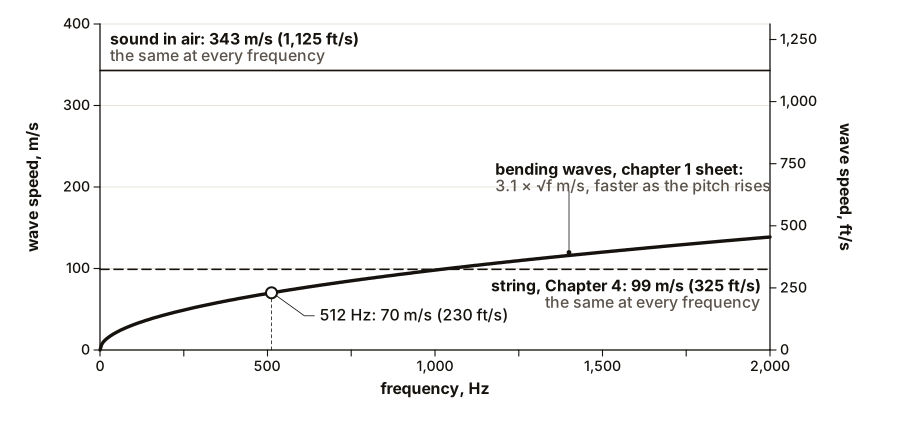
Now count the lines in a figure. A figure with twice as many spokes has twice as many half-waves round the disc, so half the wavelength, so four times the frequency. That is the square in your chapter 1 notebook. The eight-spoke figure near 235 Hz and the sixteen-spoke figure near 884 Hz are 3.76 times apart, close to four. The string’s whole numbers came from a fixed wave speed. The plate’s squares come from a wave speed that rises with frequency.
IN PLAIN ENGLISH: A string is floppy, and something else, the tension, does all the pulling back. A plate pulls itself back by its own stiffness, and short ripples are much stiffer than long ones, the way a short stub of ruler is much stiffer than a long overhang. So when a figure has more lines, and its ripples are shorter, its frequency climbs much faster than the number of lines: twice the lines, four times the pitch.
Section 3: Chladni’s Law
Chladni had none of this. He had a bow, sand, and his ears. In Die Akustik in 1802, at section 140, he printed a table of the figures he had raised on a round plate, with the musical note each one sounded. He used a notation of his own: the number of straight lines through the centre, then a stroke, then the number of circles in Roman numerals. A cross was 2|0. A single circle was 0|I.
Then he gave the rule, on page 165:
“If L denotes the number of lines running right through, and K the number of circles, the ratio of the tones of every way of vibrating of a round plate is (L + 2K)².”
He called it approximate. In his table he marked each note + or − where it ran slightly sharp or flat of the rule. And he added a warning: the figures with straight lines only, and no circles, did not fit the other series at all. He printed their numbers in brackets and set them aside.
The lines running right through are what this book has been calling diameters; each one makes two spokes, so a twelve-spoke figure is L = 6. In modern language, Chladni’s straight lines are nodal lines and his circles are nodal circles: lines and circles made of nodes. This book labels a figure (m, n), with m nodal diameters and n nodal circles, which is Chladni’s L and K. His rule is now called Chladni’s law.
ON THE BENCH: Chladni’s law, on your own numbers
Parts: your chapter 1 notebook; a calculator or spreadsheet; graph paper. Cost: nothing. Time: 30 minutes. Hazards: none. Method: for each figure you found, write down L (half the number of spokes) and K (the number of rings that cross the spokes). Work out (L + 2K)² and divide your measured frequency by it. Keep two lists: figures with spokes only, and figures with spokes and one ring. Then plot every figure’s frequency against its (L + 2K)², using two different symbols for the two families. What you should see: with the predicted values from chapter 1, the spokes-only figures give 14.7, 14.5, 14.2, 14.0 and 13.8 Hz per unit, nearly constant. The figures with a ring give about 24.1, 23.2, 22.3, 21.5 and 20.9: nearly constant again, but a different constant. On the graph, two nearly straight lines with different slopes. Within each family, Chladni’s law works. Between them, it does not, and the family that stands apart is exactly the one Chladni put in brackets in 1802. If it does not work: a point far off both lines usually means a miscounted figure. Plain rings with no spokes will also sit off by themselves, for a reason Section 5 explains.
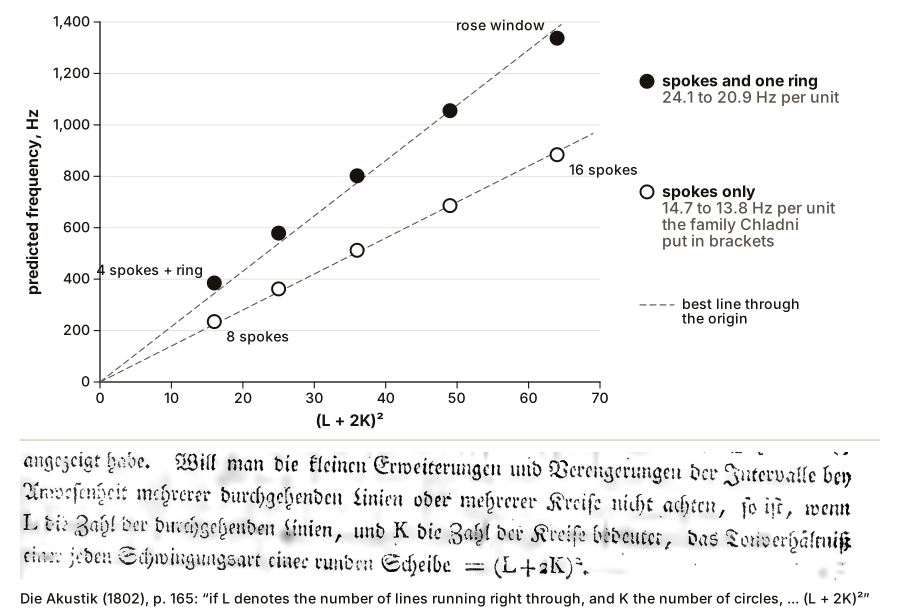
Both families drift gently downward as the figures get more complicated. That is the law telling you it is approximate. Lord Rayleigh, in The Theory of Sound (1894), showed from Kirchhoff’s theory that (L + 2K)² is what the exact answer turns into when the figure has many lines: the more lines, the better the law. Chladni found by ear the limit that the mathematics would reach half a century later.
Section 4: The Free Edge
Chapter 2 left Sophie Germain with the right equation and the wrong edge. Now you can see what both mean.
Her equation says how each small patch of plate is pushed by its neighbours when the plate is curved. It involves the bending stiffness D, and not just how sharply the plate is curved but how that curvature changes from place to place. It is correct.
But an equation for the inside of the plate is only half the problem. Every vibrating thing also has to obey a rule at its edge, and different rules give different modes. A rule of that kind is a boundary condition. A string’s ends are held, so its boundary condition is simple: no motion at the ends. That is why every mode of a string has a node at each end, and why its wavelengths fit in whole halves.
The chapter 1 disc and Chladni’s plates are held by nothing at the rim. Their edges are free. A free edge can move and tilt as it likes. What it cannot do is carry any bending or any push, because there is nothing beyond it to supply one. Writing that down correctly turns out to be subtle.
Poisson, in his rival memoir of 1814, imposed three conditions on the free edge. Kirchhoff showed in 1850 that a plate’s edge can only ever satisfy two, and that Poisson’s three contradict one another. He found the right two by thinking about the energy stored in the bent plate, and combined two of Poisson’s conditions, one about the edge twisting and one about it being pushed, into one. With those, he solved the round free plate completely. His solution gives every figure’s frequency, and its numbers agree with Chladni’s table.
The λ² column in this book’s chapter 1 table is computed from Kirchhoff’s theory. For each figure, λ² is the number his solution assigns to it: 21.53 for eight spokes, 46.81 for twelve, 122.2 for the rose window. They depend on the shape of the figure and on ν, and nothing else.
Section 5: Hubs, Spokes and the Centre Bolt
The chapter 1 disc is not quite a free plate. It is bolted at its centre, and that bolt explains three things you saw.
Look first at what a spoked figure does near the centre. Kirchhoff’s solution shows that close to the middle, the motion of a figure with m diameters grows in proportion to the distance from the centre raised to the power m. For eight spokes, m is 4: move half as far from the centre and the motion drops sixteenfold. For twelve spokes, m is 6, and it drops 64-fold. The middle of a many-spoked figure is very nearly still over a wide area. On the chapter 1 disc, for the twelve-spoke figure, everything within 55 mm (2.2 in) of the centre moves less than one hundredth as much as the rim. That broad still region is the solid hub of salt. The more spokes, the bigger the hub.
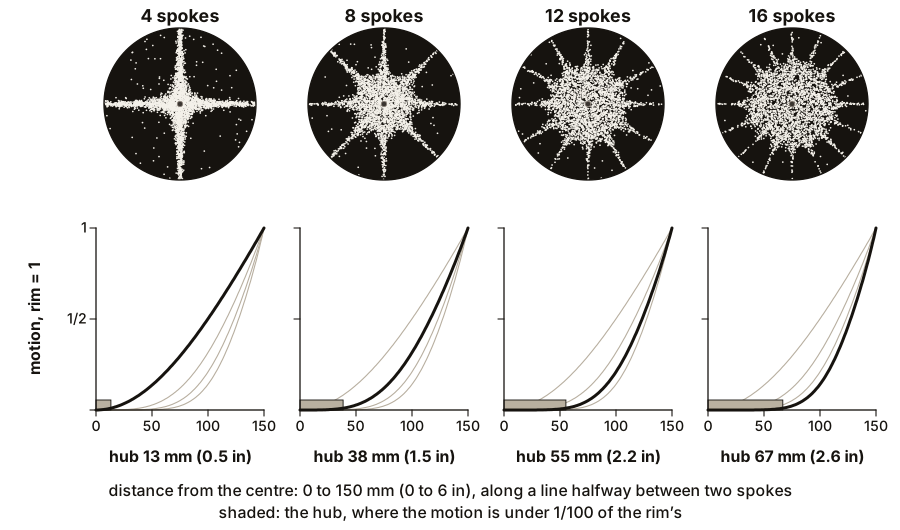
Second, because the spoked figures hardly move at the centre, they hardly notice the bolt. Their frequencies on the bolted disc are almost exactly those of a disc held by nothing. The plain rings are different. A ring figure moves most at the centre, and a bolt there changes it completely. On a free disc of this sheet the single ring would sit near 99 Hz. Bolted, it sits near 250 Hz. That is why the ring-only rows in the chapter 1 table say “about”: they depend on exactly how stiffly the bolt, washers and cone hold the middle.
Third, the same rule decides how hard the speaker can drive each figure. A push at a point drives a figure in proportion to how much that figure moves at the point. A push at the exact centre should drive the rings well and the spoked figures not at all. The rim of the 25 mm (1 in) fender washer, 12.5 mm (0.5 in) from the centre, moves for the twelve-spoke figure about 1.7 millionths as much as the rim of the disc. On a centre-bolted disc the spoked figures are raised by small imperfections: a hole slightly off centre, a cone that rocks, a sheet thicker on one side. They appear at all because the aluminium rings for a long time, adding up a feeble push over hundreds of swings, which is Chapter 9’s subject.
That is why chapter 1 offered a second hole. At 50 mm (2 in) from the centre, the twelve-spoke figure moves about 0.57 percent as much as the rim, more than three thousand times as much as at the washer. Moving the bolt to the off-centre hole buys the spoked figures a drive three thousand times stronger, at the price of a slightly lopsided pattern.
Section 6: Square Plates and Ritz
Kirchhoff’s method needed the plate to be round: a circle’s edge is all at one radius. A square’s edge is four straight lines meeting in corners, and at the corners the mathematics misbehaves. For sixty years, the square plate, Chladni’s favourite, could not be solved.
Walther Ritz was born at Sion, in Switzerland, in 1878. In 1908 he moved to Göttingen, already in failing health, and was working on a new way to attack problems of exactly this kind. Instead of solving the plate’s equation and its edge conditions directly, he went back to the principle from which both are derived: that a vibrating body takes up the shape that keeps a particular balance between its energy of bending and its energy of motion as small as possible. He built trial shapes out of the known shapes of a vibrating free bar as long as the square’s side, and let that principle choose the best mixture. More trial shapes gave a better answer, without limit.
On 15 December 1908 he wrote from Göttingen: “The theory of Chladni’s figures is going to be a good occasion for my method to show its qualities.” A few lines later: “It has tired me out, but there is no comparing the fatigue with the fame of this problem, which has stayed unsolved despite so many efforts.”
The paper appeared in the Annalen der Physik in 1909. Ritz computed 35 overtones of the free square plate, spanning six octaves, and drew their figures exactly. He reported that Chladni had obtained most of the corresponding 46 figures, “though only drawn in rough outline,” and that his computed pitches agreed with Chladni’s within the expected error. He settled an old argument: the nodal lines that look straight on a square plate are truly straight only along the diagonals and the lines through the middles of the sides. Everything else curves a little. And he pointed out that until then, whether a given high figure appeared at all had been left largely to chance; with his drawings in hand, an experimenter could see exactly where to hold the plate.
He died on 7 July 1909, aged 31. His method, extended by others, is an ancestor of the computer methods engineers now use to find the modes of anything from a guitar top to an aircraft wing.
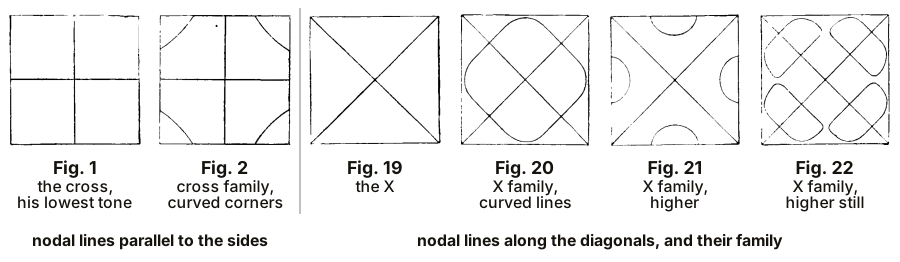
For a free square plate of aluminium, the λ² numbers that correspond to Kirchhoff’s for the disc, measured with a as the length of a side, are about 13.2 for the cross, 19.3 for the X, and 24.4 for the next figure up, a closed curve round the centre. They are modern values, computed by Ritz’s method with ν = 0.33.
Section 7: Predicting a Plate You Have Not Built
Everything in this chapter collapses into one formula. For any figure on a thin plate,
f = (λ² ÷ 2πa²) × h × √(E ÷ 12ρ(1 − ν²))
Here λ² is the figure’s number, from Kirchhoff for a disc or Ritz’s method for a square; a is the radius of a disc or the side of a square, in metres; h is the thickness in metres; and E, ρ (the density) and ν describe the material. For aluminium the whole square-root term is 1,546 m/s (5,072 ft/s). For the chapter 1 disc, a = 0.15 m and h = 0.001 m, the formula gives 10.94 Hz for each unit of λ², which is every number in the chapter 1 table.
Three rules fall out of it at a glance. Frequency goes up in proportion to thickness. It goes down as the square of the size. And it barely depends on the metal. The square-root term for steel is 1,522 m/s (4,993 ft/s), for window glass about 1,590 m/s (5,220 ft/s), within a few percent of aluminium, because in each case a stiffer material is also a denser one, in almost the same proportion.
For the square you bowed in Chapter 2, 200 mm (8 in) on a side and 2.0 mm (0.080 in) thick, it gives 12.30 Hz per unit of λ²: the cross near 162 Hz and the X near 237 Hz, the notes Chapter 2 asked you to match by ear.
ON THE BENCH: Predict, then find
Parts: a second disc 250 mm (10 in) across from the same 1.0 mm (0.040 in) sheet as chapter 1, drilled at its centre and painted; the chapter 1 drive; salt; a calculator. Cost: about $10 for the sheet. Time: an evening. Hazards: as in chapter 1: file the edge, watch the sound meter, glasses on. Method: before you mount it, write down your predictions. The radius is 0.125 m (4.9 in). Work out the Hz per unit of λ² from the formula, then multiply by the λ² column of the chapter 1 table. Then mount the disc and search near each predicted frequency. For each figure, write the measured frequency beside the prediction and work out the percentage difference. What you should see: about 15.75 Hz per unit of λ², so eight spokes near 339 Hz, twelve near 737 Hz, sixteen near 1,273 Hz, and the rose window near 1,925 Hz. Every number is 1.44 times the 300 mm (12 in) disc’s, because (300 ÷ 250)² is 1.44. Your measurements will probably all miss in the same direction by a similar few percent. That is the signature of a wrong input, not a wrong theory: sheet sold as 1.0 mm (0.040 in) is rarely exactly that, and aluminium alloys differ a little in E. Measure the thickness with calipers, put the true value into the formula, and the gap should shrink. If it does not work: as in chapter 1. If the spokes will not appear, use an off-centre hole; Section 5 says why.
SLOW DOWN. Check Your Understanding: The ringed figures on the 300 mm (12 in) disc each have one nodal circle. Before reading on, guess where the circle of the rose window lies: near the hub, halfway out, or near the rim?
Near the rim. Kirchhoff’s solution puts the nodal circle of the twelve-spokes-and-a-ring figure at 0.88 of the radius: on the chapter 1 disc, 132 mm (5.2 in) from the centre, only about 18 mm (0.7 in) in from the edge. The eight-spokes-and-a-ring figure has its circle at 0.86 of the radius, almost as far out. Most people guess halfway. The free rim pushes it outward. Roughly speaking, nothing beyond a free edge can bend it, so the last strip of plate stays nearly straight across and swings almost as a single flap. The circle of stillness has to sit just inside that flap, and the more spokes the figure has, the stiffer each short wedge is and the closer to the rim its circle moves. A prediction of where the salt will go is as testable as a prediction of when. Measure your own rose window’s ring with a ruler.
Bench Degree
Get the degree without the diploma.
Learn the material, not how to pass the exam.