Bench Degree·CYMATICSchapter
Chapter 6: Drums and Voices
A drum head is a plate with its stiffness taken away and a stretch put in its place. Its figures climb by a third set of numbers, neither a string’s nor a plate’s, and in 1885 a Welsh singer found that her own voice could draw them.
Go back to the bowl from the first five minutes of this book: cling film stretched over a mixing bowl, a pinch of salt, a hum. What you most likely saw was a ring. Perhaps a lopsided pair of lobes. Almost certainly not spokes.
Now press a fingertip gently into the middle of the film and feel it push back. Lay the same film flat on a table and it lies limp. Cling film springs back only because you stretched it, and the stretch pulls every part of it towards flat. A metal plate fights bending. Film obeys its stretch.
That gives the stretched surface a different set of favourite pitches, different figures, and a reason why a voice draws rings. This chapter builds a proper drum to measure them, then goes back to the voice and to the woman who made a habit of singing figures into being.
Section 1: Stretch Instead of Stiffness
A membrane is a sheet so thin and flexible that its own resistance to bending can be ignored. What restores it is tension: the pull along the sheet that you put there by stretching it. A drum head, a banjo head, cling film over a bowl and a balloon over a tube are all membranes. Chapter 5 showed that a plate’s figures are set by bending stiffness and mass. A membrane’s are set by tension and mass.
Chapter 4’s string is its closest relative: a stretched line instead of a stretched sheet. Galileo gave the string’s rule in 1638. To raise a string an octave by stretching alone, “it does not suffice to double the stretching weight; it must be quadrupled” (Two New Sciences, Crew and de Salvio translation, 1914, p. 100). Pitch goes as the square root of the tension. A drum head obeys the same rule, because it is held up by the same kind of force.
Where the drum parts company with the string is in shape. A round membrane bends around and across at once, so its modes take two numbers. This book writes them (m, n): m is the number of nodal diameters, straight lines of stillness through the centre, and n the number of nodal circles. On a drum the rim counts as the first circle, because it is clamped and never moves. The simplest mode, the whole head bulging up and down like a breathing chest, is (0,1).
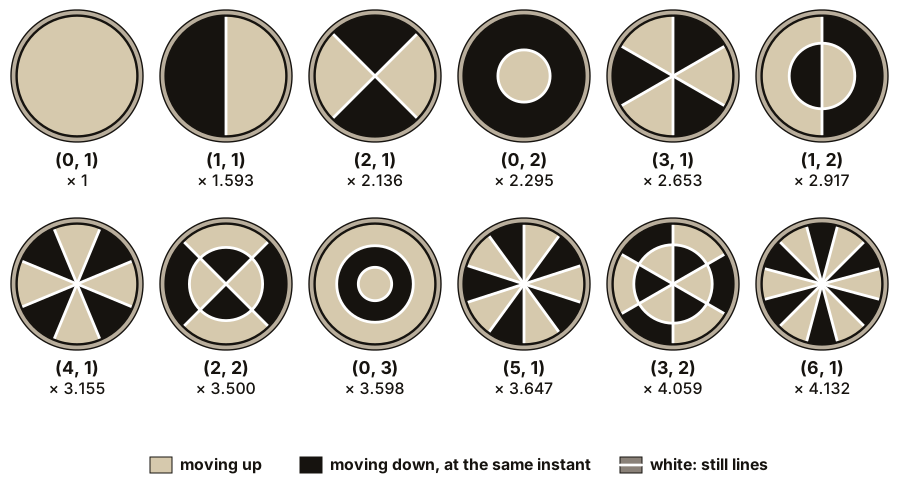
Here are the frequencies of an ideal round membrane’s first modes, each divided by the frequency of (0,1).
| Mode (m, n) | What the salt draws | Frequency ÷ (0,1) |
|---|---|---|
| (0,1) | salt runs to the rim | 1.000 |
| (1,1) | one diameter | 1.593 |
| (2,1) | a cross | 2.136 |
| (0,2) | one ring inside the rim | 2.295 |
| (3,1) | six sectors | 2.653 |
| (1,2) | one diameter and a ring | 2.917 |
| (4,1) | eight sectors | 3.155 |
| (2,2) | a cross and a ring | 3.500 |
| (0,3) | two rings inside the rim | 3.598 |
| (4,2) | eight spokes and a ring | 4.601 |
| (7,1) | fourteen sectors | 4.610 |
| (6,2) | twelve spokes and a ring | 5.651 |
These are the Bessel ratios, named for the German astronomer Friedrich Bessel, whose name was given to the family of curves that describe a round membrane’s modes. Each number is set by where one of those curves crosses zero. This book will not derive them. It will measure them, which is the better test.
A string climbs 1, 2, 3, 4. The chapter 1 plate’s spoked figures climbed 1.00, 1.54, 2.18, 2.92, roughly as the square of the spoke count. The drum climbs by neither rule. Its ratios are crowded and irregular, and (4,2) and (7,1) sit only 0.2% apart. That crowding is why a struck drum sounds like a thud with a tone in it, and why a drum has a clear pitch only when a drummer works for one.
Section 2: The Drum on the Bench
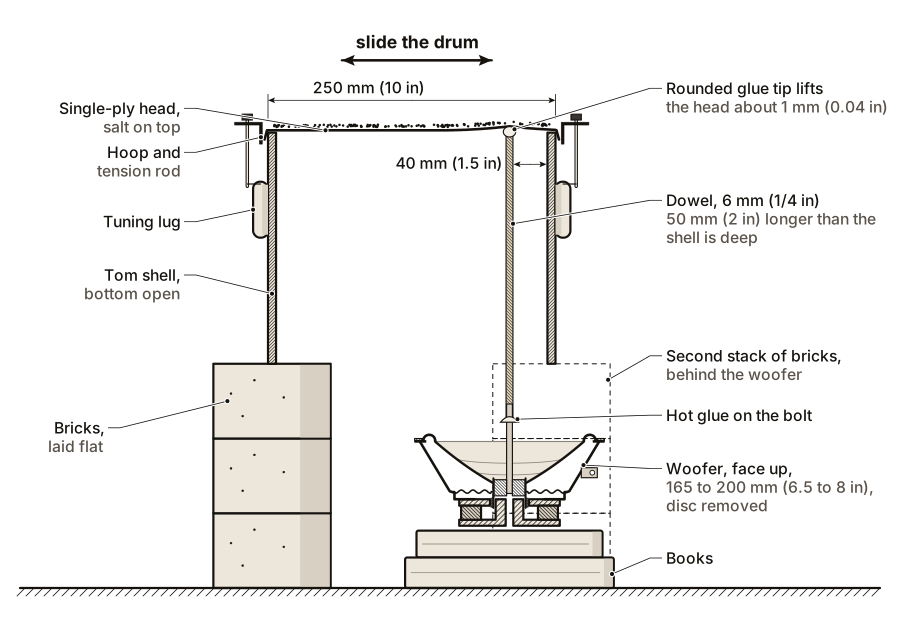
The chapter 1 woofer and amplifier will drive a drum, but not the way they drive the plate. A drum has to be pushed at one point, off centre, and the point moved until the sand answers. The method here follows the Caltech physicist David Politzer’s work on a banjo head (“Banjo Drum Physics: sound experiments and simple acoustics demos”, arXiv:1806.08857, 2018). A piezo disc taped to the head, he reports, “produced distracting static cling” in the sand. His figures came instead from a dowel with a hot-glue tip, touched to the head and moved “to a region of greatest motion”.
An embroidery hoop will not tension a head evenly. A drum head is a film glued into a rigid collar, and it pulls flat only when a drum’s hoop draws it down over the shell’s edge from every side. You need a shell with tuning lugs: a used tom from a second-hand shop, or the drum already in the house.
ON THE BENCH: A drum that draws
Parts: a drum shell with tuning lugs, 250 mm (10 in) across, and a single-ply black head to fit; a drum key; the woofer, amplifier and tone generator from chapter 1; a hardwood dowel 6 mm (1/4 in) thick and about 50 mm (2 in) longer than the shell is deep; a hot-glue gun; table salt; four bricks; books. Cost: $25 to $75 for head and used shell; nothing if a drum is in the house. Time: an evening. Hazards: loud. Wear plugs or muffs above 85 dBA, as in chapter 1. Volume to zero before you move the driver. Method: unbolt the disc from the woofer. Drill a 5 mm (3/16 in) hole into one end of the dowel and fix it on the bolt with hot glue. Round the far end with a blob of glue. Fit the head, tighten the lugs half a turn at a time in a star pattern, and tap 25 mm (1 in) in from each lug until every tap gives the same pitch. Stand the drum, bottom open, on two stacks of bricks tall enough for the woofer to sit underneath it. The woofer need not be centred: slide it until the dowel, rising up inside the shell, sits about 40 mm (1.5 in) in from the rim, and let the speaker overhang the shell’s edge if it must. Stack books under the woofer until the dowel lifts the head about 1 mm (0.04 in). Sprinkle a level teaspoon of salt, start at 80 Hz with the volume low, and climb. When the salt first stirs, slide the drum so the dowel sits under the place it moves most. What you should see: first, salt along a single diameter: (1,1). Higher, a cross, (2,1), then a ring part way in, (0,2). On a 250 mm (10 in) head at medium tension the (1,1) figure should fall, by a rough estimate, somewhere between about 150 and 400 Hz; the tension decides, so sweep that whole range. If it does not work: if the salt only creeps to the rim, the dowel is too near the centre, where it can feed only the ringed modes. Move it out. Lopsided figures mean uneven tension; tap and retune. If nothing moves, raise the volume. Politzer found that the sand needed “rather large amplitude vibrations”, loud enough to bring a complaint from the next office.
The (0,1) mode is the awkward one. Its only nodal line is the rim, so the salt just runs to the edge, and it is the mode most dragged on by the air in the shell, which is squeezed every time the whole head moves at once. So do what Politzer did and count from (1,1). Divided by 1.593, the ideal ratios become: (2,1) 1.341, (0,2) 1.441, (3,1) 1.665, (1,2) 1.831, (4,1) 1.981.
ON THE BENCH: Measuring the Bessel ratios
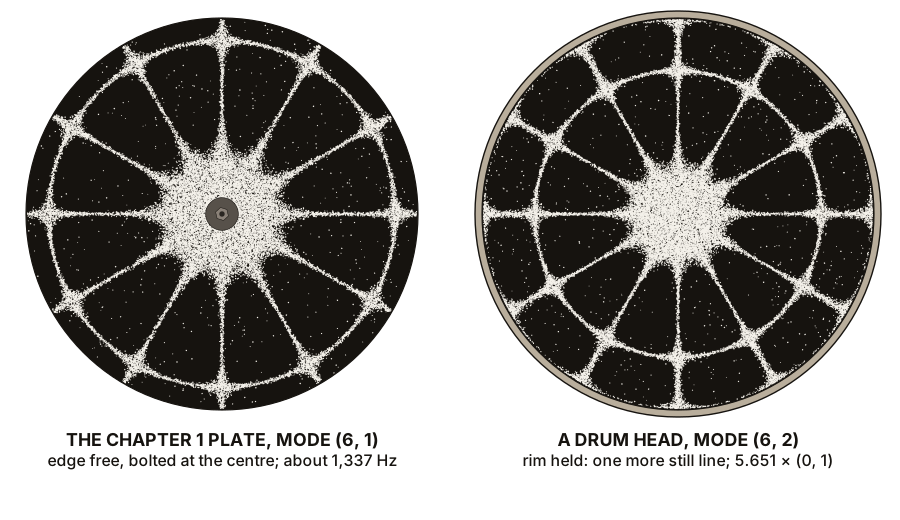
Parts: the drum rig; a notebook. Cost: nothing more. Time: an hour. Hazards: as above. Method: find and sharpen each figure, moving the dowel each time. Write down its frequency and sketch it. Divide each frequency by your (1,1) frequency. Then tighten every lug by the same quarter turn and do it again. What you should see: ratios within a few percent of 1.341, 1.441, 1.665, 1.831 and 1.981, mostly erring on the same side. After tightening, every frequency rises and the ratios hardly move. If it does not work: if the low ratios come out small, the air is dragging on the head; tighten it. Politzer’s 279 mm (11 in) Mylar head, at the top of its tension range, “followed the ideal model perfectly over the frequency range of interest”. Slacker heads gave him sharper lines but crowded modes. Better, if you have one: hunt the drum’s rose window. (6,2), twelve spokes and a ring, sits at 5.651 ÷ 1.593 = 3.547 times your (1,1) frequency; (4,2), eight spokes and a ring, at 2.888 times. Put the dowel a quarter of the way in from the rim and search a few percent either side in 1 Hz steps. If the figure keeps turning into a plain fourteen-spoke star, you are on (7,1), only a few hertz away on a typical head; step past it.
Section 3: The Woman Who Sang Figures
In May 1891 The Century Illustrated Monthly Magazine of New York printed “Visible Sound. I. Voice-Figures”, by Margaret Watts Hughes, a Welsh singer (Century 42, May 1891, pp. 37 to 40). “In 1885,” she wrote, “while seeking means to indicate readily the intensities of vocal sounds, I first met with these figures.” By 1891 she had shown them in London at the Musical Association, the Royal Institution and the Royal Society.
She called her apparatus the eidophone. “It consists merely of an elastic membrane, such as thoroughly flexible soft sheet-rubber, tightly stretched over the mouth of a receiver of any form, into which receiver the voice is introduced by a wide-mouthed tube of convenient shape.” It is a drum with a hose in its side, played by singing into the hose.
She tried materials in an order worth remembering. First sand and lycopodium powder. Then “a thin layer of liquid; e.g. water or milk”, on which a note of the right pitch raised “beautiful crispations”, and a note too loud threw the liquid up “in a shower of spray”. Then coloured glycerine. Then moist colour-paste, and with the paste came the forms that made her name.

The best known is the daisy. A heap of wet paste sits in the middle of the membrane, and she sings one note “very steadily”, softly at first. The paste gathers tighter. “Now is the moment to increase the intensity of the note, still steady in pitch; suddenly all around the heap petals shoot out like those of a daisy from the raised center.” If they come out imperfect, “all that is needed is just to sing the same note again, but diminuendo, and straightway all the petals will retreat into the central heap.” Louder, petals; softer, none; one pitch throughout. The petals numbered “from six to thirty or more, for the number increases with every rise in the pitch of the note sung.”
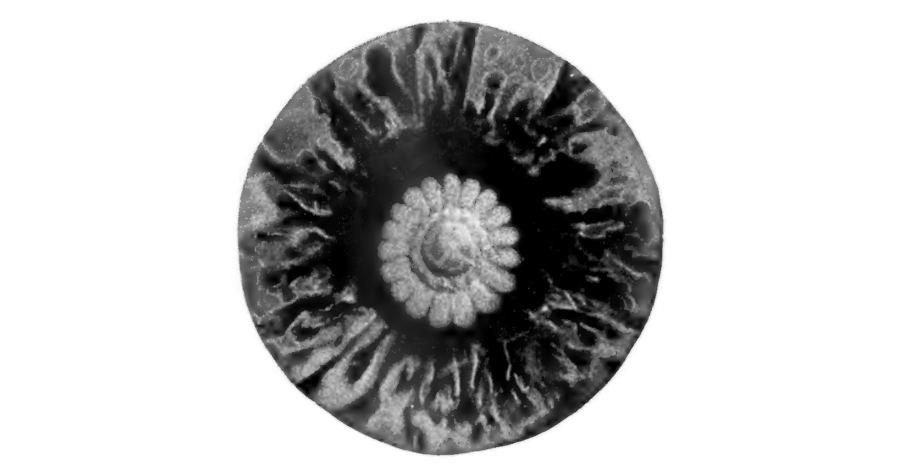
She closed with care. She had worked “as a vocalist, using my own voice as the instrument of investigation, and I must leave it for others more acquainted with natural science to adjust the accordance of these appearances with facts and laws already known.” Her hope was that the figures might show something of the “organized universe that, we are told in Holy Writ, took its shape at the voice of God.” That is a statement of faith, made as one, by an observer who kept her observations and her faith on separate lines.
The same issue printed “II. Comment” by Sophie B. Herrick (pp. 40 to 44), as good a piece of scientific caution as any popular magazine of the century carried. “The waves generated in the closed bowl of the eidophone are reflected again and again from the sides of the vessel. The volume of air inclosed has its own rate of vibration; the stretched membrane has also its own rate, which in turn is modified by the character and thickness of the paste.” The figure is “the resultant of all these complicated forces”, and “so far we have the resultant of many forces, not one of which has been weighed and measured.”
Herrick quoted Watts Hughes’s own reply to her questions: “any one note may, under different circumstances, produce different figures, and, conversely, different notes may, under different circumstances, produce similar figures.” No note owns a figure. The membrane, the cavity and the paste own it; the note only selects among what they can do. That sentence will be needed again in Part IV.
Herrick also recorded the range. The daisies came from “extremely low notes very softly sounded, some of them by A in the first space of the bass clef”, about 110 Hz. Her top note was “the B-flat above the treble clef”, about 932 Hz. Some of her glass impression figures survive; a group came to light in 2016 at Cyfarthfa Castle Museum, Merthyr Tydfil (R. Mullender, “Divine agency”, SoundEffects 8, 2019, pp. 125 to 127).
Section 4: Why a Voice Gives Rings
ON THE BENCH: An eidophone
Parts: a PVC pipe coupling 150 mm (6 in) across and 100 mm (4 in) long, or a rigid food tub of that size; a black party balloon; a hose clamp or two strong rubber bands; 600 mm (2 ft) of flexible hose 25 mm (1 in) across; a craft knife or hole saw; a board to close the bottom; table salt. Cost: under $10. Time: half an hour. Hazards: singing into a tube near your own ears is fine for a few minutes. Do not have a second person shout into it beside you for half an hour. Method: cut a 25 mm (1 in) hole in the side wall near the top and push the hose in. The inlet goes in the side, so your breath never reaches the salt. Cut the neck off the balloon, slit it open, stretch it evenly over the top, and clamp it. Tap it: it should give a pitch. Stand it on the board, sprinkle a pinch of salt, and sing a steady vowel into the hose, low, sliding slowly up until the salt jumps. Then press a phone’s speaker to the end of the hose, play the tone generator through it, and sweep to find the frequency you sang. What you should see: at the lowest pitch that moves it, salt running to the rim. A little higher, a ring part way in. Perhaps a lopsided pair of lobes. Spokes, rarely. If it does not work: if nothing moves, the balloon is too tight or too thick; stretch it less. Watts Hughes blew gently into the tube first so the membrane domed slightly (Mullender 2019, citing her 1904 book). Try it.
The voice gives rings because of how it pushes. Sound from the hose fills the coupling, and the air inside pushes on the underside of the membrane almost equally everywhere at once. Think about (1,1), which seesaws about a diameter: one half rises as the other falls. A push that is the same on both halves helps one exactly as much as it hinders the other, so the seesaw never starts. The same cancellation stops every mode with a diameter in it. An even push can feed only the modes in which each ring moves as one: (0,1), (0,2), (0,3). Those draw circles.
IN PLAIN ENGLISH: Push down on both ends of a seesaw at once and it does not rock. A voice pushes the whole skin at once, the same everywhere, so no wobble in which one side rises while the other falls can get going. Only wobbles in which whole rings move together can grow, and those draw circles.
That is why the chapter 1 bowl gave rings, and why the drum’s dowel has to sit off centre: a push at the exact centre is an even push on every diameter. Spokes need something lopsided: a drive point to one side, a cavity that sends sound round unevenly, a skin stretched tighter one way than the other.
Then where did Watts Hughes’s six to thirty petals come from? Nobody measured it, and Herrick said so in 1891. But notice two things. The petals formed only when a steady note was swelled louder, so the motion had to cross a threshold first. And they crowded closer as the pitch rose. A shaken layer of liquid does both, by a mechanism unrelated to spokes on a drum. Her paste was wet, and she had already seen “beautiful crispations” on water and milk in the same instrument. Chapter 8 builds them.
SLOW DOWN. Check Your Understanding: Your drum’s (1,1) figure is at 200 Hz and its cross at 268 Hz. You tighten every lug until (1,1) has risen to 283 Hz. Where is the cross now, and by how much did you raise the tension? Answer before you read on.
The cross moves to about 379 Hz. The ratio between two figures belongs to the shape of the head, so it holds: 268 ÷ 200 = 1.34, and 283 × 1.34 = 379. The tension rose by more. Every frequency went up by 283 ÷ 200 = 1.415, the square root of 2, so you doubled the tension. That is Galileo’s string rule carried across to a skin: to double a drum’s pitch you must quadruple its tension. It is why each extra semitone near the top of a drum’s range costs more turns of the key than the last, and why a little beyond that the head is being stretched rather than tuned, and tears. Read the other way, it is why a drummer tunes in small turns: 10% more tension raises every pitch by about 5%, nearly a semitone.
Section 5: Three Ladders
The string gives whole numbers. The chapter 1 plate gives near-squares. The drum gives Bessel’s ratios, and you have measured half a dozen of them on a skin you tuned yourself. Three surfaces, three ladders, one cause. Each ladder is fixed by what pulls the surface back towards flat and by what holds its edge. Change those and the ladder changes. Change the size, the tension or the thickness and the whole ladder only slides up or down.
Two loose ends remain. The salt in this chapter went to the still places. Watts Hughes began with sand and lycopodium mixed, and in the 1780s Chladni had noticed that very fine dust in his sand went the other way. That is chapter 7. And her water and milk, crinkling into fine ripples as she sang, were moving at a pitch she was not singing at all. That is chapter 8.

Bench Degree
Get the degree without the diploma.
Learn the material, not how to pass the exam.