Bench Degree·CYMATICSchapter
Chapter 7: Sand Goes One Way, Dust the Other
Mix a pinch of flour into the salt and the plate draws two pictures at once, one in each powder, in opposite places. Chladni saw it in 1787 and thought the reason obvious. It took Michael Faraday, an air pump and a tank of water to find it.
Set up the chapter 1 plate and find the rose window, twelve spokes and a ring, near 1,337 Hz. Tune it sharp, then turn the volume to zero. Brush the salt back into an even layer and add a pinch of plain flour over the top, a quarter of a teaspoon at most, spread thin.
Bring the volume up slowly. The salt does what it always does. It hisses, runs and settles on the twelve spokes and the ring. The flour does the opposite. It lifts off the plate in a faint haze over the places that are moving hardest, hangs there, and gathers into small soft heaps in the middle of each black patch between the salt lines. Turn the tone off and you are looking at two figures laid over each other: white salt lines on the still places, and white flour tufts on the moving ones.
Chapter 1 said the salt lines were a map of stillness. The flour has drawn a map of motion. Same plate, same note, same moment. This chapter is about why two powders that differ only in the size of their grains go to opposite places.
Section 1: Two Powders on One Plate
The grain size is the whole difference. Table salt comes in cubes about 0.3 to 0.5 mm (0.012 to 0.020 in) across. A grain of flour or cornstarch is a few hundredths of a millimetre, about a thousandth of an inch, so light that a breath would carry it away. Salt grains are thrown into the air by the moving plate, land, and are thrown again until they come to rest on a line that does not move. Flour grains are thrown too, but something in the air above the plate catches them before they come down, and carries them inwards.
ON THE BENCH: Salt and flour together
Parts: the chapter 1 plate and drive; table salt; plain flour or cornstarch; a tea strainer; a damp cloth; ear protection; safety glasses. Cost: nothing beyond the kitchen. Time: 20 minutes. Hazards: fine powder is an inhalation nuisance. Use a pinch, not a spoonful, keep your face out of the haze, and wipe up with a damp cloth afterwards rather than blowing or dry-brushing. Keep flames away: any fine powder in a cloud can burn. Do not use lycopodium, the club-moss spore powder of the old experiments; it is used for stage flash effects because its dust ignites so readily. The usual ear protection rule applies above 85 dBA. Method: find the twelve-spoke and ring figure near 1,337 Hz with salt alone, and tune it sharp. Volume to zero. Shake a quarter teaspoon of flour through the tea strainer from a height of 300 mm (12 in), so it settles evenly. Raise the volume until the salt just begins to move, hold it there for half a minute, then lower it slowly to zero. What you should see: the salt returns to the spokes and the ring. The flour rises into small hazy clouds over the middle of the black patches, especially the twelve enclosed patches inside the ring, then settles into soft heaps there as the tone fades. Watch one heap closely while the tone is on: its surface seems to boil, rising in the middle and rolling down the sides. If it does not work: if the flour simply coats everything, raise the volume a little. If it is blown off the plate, lower it. Near the rim much of the flour is lost over the edge; the patches enclosed by the ring give the clearest result. Damp flour clumps; use it dry.
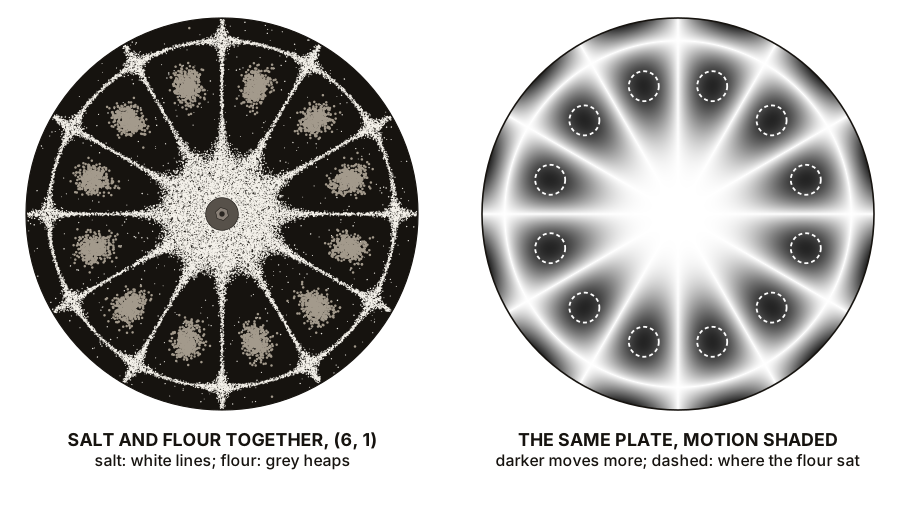
You can also see why the enclosed patches work best. In 1831 Faraday made the same point: the effect shows “in its purest form at those places which are surrounded by nodal lines”, because near an edge the air escapes sideways and the pattern is spoiled (Phil. Trans. 121, §52).
Section 2: Chladni Saw It First
Chapter 2 met the first report: on page 31 of his 1787 Entdeckungen, Chladni noted that very fine dust in the sand gathers at the centre of each vibrating part, and left the reason unsaid.
Faraday’s 1831 paper records a second observation, which he credits to Chladni: shavings from the hairs of the violin bow “did not proceed to the nodal lines, but were gathered together on those parts of the plate the most violently agitated, i.e. at the centres of oscillation” (§2). The Danish physicist Hans Christian Oersted used lycopodium powder for the same purpose (§3).
Then, in August 1827, the French physicist Félix Savart read a paper to the Academy of Sciences in Paris that gave the dust a meaning. Sand, he argued, shows the main way a plate divides as it vibrates. The fine powder, gathering somewhere else, must be drawing a second set of divisions laid over the first, a hidden “secondary mode of division” that every sounding body carries. Faraday quotes him: “every time a body emits sounds, not only is it the seat of many modes of division which are superposed, but amongst all these modes there are always two which are more distinctly established than all the rest” (§4).
It was a reasonable idea. The powder really does draw a second figure, tied to the first: given the sand lines, you can predict where the dust will go. Faraday saw what was at stake. If Savart was right, the theory of plates needed a new layer. If he was wrong, that needed proving just as firmly, because Savart’s name would otherwise carry the error forward (§5).
Section 3: Faraday’s Case
Michael Faraday’s paper “On a peculiar class of acoustical figures; and on certain forms assumed by groups of particles upon vibrating elastic surfaces” was read to the Royal Society on 12 May 1831 and printed in Philosophical Transactions 121, pp. 299 to 340. The page and section references here are to the reprint in his Experimental Researches in Chemistry and Physics (1859), pp. 314 to 358.
He began with a square of glass 3 or 4 inches (75 to 100 mm) on a side, nipped at its centre between corks, sprinkled with lycopodium and bowed at the middle of one edge. Sand on this plate draws a diagonal cross. The lycopodium went to four parcels near the middles of the edges, where the plate moved most. While the plate sounded, each parcel was “a rather diffuse cloud, moving rapidly within itself”, and as the sound died the clouds settled into little heaps whose powder “continues to rise up at the centre and flow down on every side”. That is the boiling heap you watched on your own plate.
His explanation was one sentence long. “The cause of these effects appeared to me, from the first, to exist in the medium within which the vibrating plate and powder were placed” (§9). The medium was air. A vibrating plate, he argued, sets up air currents, steady flows of air, which run across the surface of the plate from the still lines towards the places that move most, rise there, and loop back over the top towards the still lines.
Then he proved it.
He tilted the plate. With the vibrations strong, “the plate might be inclined 5°, 6°, or 8° to the horizon, and yet the gathering clouds retain their places” (§10). Sand and filings slid straight off. The dust climbed. Savart had suggested the powder gathered at the moving centres because those were the only flat places on a vibrating plate; a deliberate tilt many times larger than any vibration could produce disposed of that.
He built walls. A strip of card 25 by 6 mm (1 by 1/4 in), cemented upright near one edge, pulled the dust cloud over to sit right against it (§12). Bend the card flat and the dust went back to its old place; stand it up again and the dust returned to the card (§18). A weight could not do that. An obstacle in a current could.
He laid gold leaf on the plate. The air crept in under it from all sides and raised it “into the form of a blister”, 1.6 to 2 mm (0.06 to 0.08 in) off the glass over the centre of motion (§16).
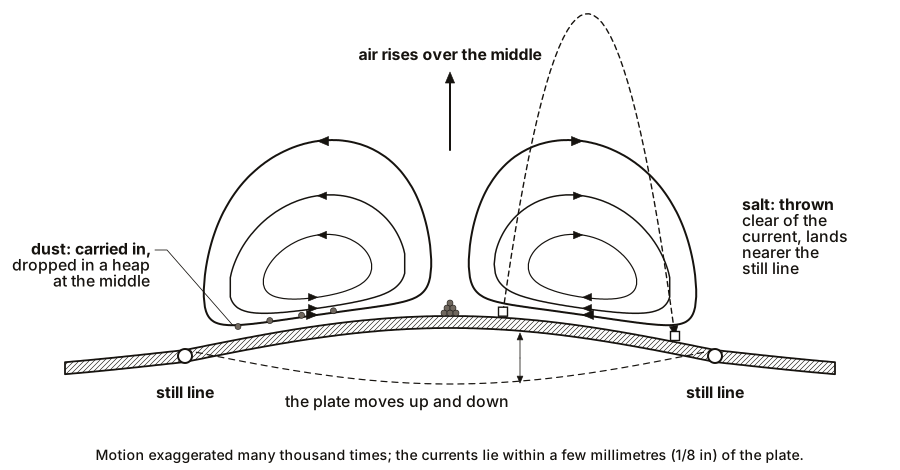
How does a plate moving straight up and down make air flow sideways? Faraday’s own account (§24) is still a good one. Where the plate moves furthest and fastest, it throws the air above it upwards hardest. When it falls back, that air is the slowest to follow, and the air from the quieter part next door slides in to fill the gap. Repeat that hundreds of times a second and there is a steady drift along the surface from the still lines inwards, with a rising column over the place of most motion. A grain of dust lying on the plate is pressed down while the plate rises and left floating for an instant while it falls, and in that instant the drift moves it on (§25).
Today a steady flow driven by a vibration is called streaming: a slow drift riding on a fast back-and-forth motion, which is why it can carry a dust grain steadily while the air itself mostly just shivers.
IN PLAIN ENGLISH: The moving parts of the plate act like tiny fans. They push air up and away, and air slides in along the surface from the quiet parts to replace it. Fine dust rides that breeze inwards and gets dumped where the plate moves most. Salt is too heavy to be carried, and the plate keeps tossing it until it lands where nothing tosses it again.
That last point answers why sand goes the other way. Faraday put it in §32: sand grains are thrown so high that they leave the thin layer of moving air altogether, and are too heavy for it even when they are in it. Fine powder is not thrown out of the lowest layer, and is light enough to be carried wherever the current goes. The same silica does either, depending on its size: “finely divided silica rivals lycopodium in the beauty of its arrangement at the vibrating parts of the plate, although the same substance in sand or heavy particles proceeds to the lines of rest” (§8).
ON THE BENCH: Faraday’s card wall
Parts: the plate with salt and flour from the first box; a strip of thin card 25 by 6 mm (1 by 1/4 in); a pea-sized piece of reusable adhesive putty. Cost: nothing. Time: 15 minutes. Hazards: as before. Keep fingers clear of the plate while it is driven. Method: with the volume at zero, stand the card upright on its long edge, fixed with the putty, inside one of the twelve patches enclosed by the ring, about halfway between the patch’s centre and one of its spokes. Raise the volume as before. What you should see: in that one patch, the flour heap forms pressed against the card instead of in the middle. In the other eleven patches, nothing has changed. Now press the card flat to the plate and try again: the heap goes back to the middle. If it does not work: if the figure itself vanishes, the putty is damping the plate, soaking up its motion as cardboard did in Chapter 1; use less, or move the card further from the ring. A slightly lower figure, such as the plain twelve spokes near 512 Hz, has larger patches and gives the card more room.
Section 4: Taking the Air Away
If air currents carry the dust, then without air the dust should behave like sand. And in something much heavier than air, sand should behave like dust. Faraday tested both (§33).
The vacuum test meant making something vibrate inside a sealed glass jar. His first rig was a round glass plate on cork feet, set vibrating by a glass rod rubbed with wet fingers through a greased collar in the top of the jar. With the jar full of air, fine silica gathered at the centre and in a ring, both places of motion. With the jar pumped out “to twenty-eight inches”, a gauge reading of 711 mm (28 in) of mercury, which left about a fifteenth of the air, “the silica went from the middle towards the nodal line or place of rest, performing exactly the part of sand in air” (§34). Then the apparatus broke.
He built a second one: parchment stretched over a funnel, vibrated by a horsehair drawn through resined fingers, the hair passing into the jar through a cork packed with grease and topped with water so no air could leak in along it (§35). With air in the jar, the lycopodium gathered at the centre “with great facility”. Pumped out to the same reading, it crossed the membrane and went to the edge, “although the powder was more agitated at the middle than elsewhere”. He let air back in by stages. At 24 inches (610 mm) the gathering at the centre began to return; at 20 inches (508 mm), with about a third of the air back, the currents “had force enough to cause the collection of the principal part of the lycopodium at the centre of vibration”. Pump it out again and the dust went back to the edge. “These alternate effects were obtained several times in succession before the apparatus was dismounted” (§36). An effect you can switch on and off by adding and removing one thing is hard to explain any other way.
The water test was the mirror image. A round glass plate under 2 or 3 inches (50 to 75 mm) of water, vibrated by the wet-finger rod, was sprinkled with brass filings. The lines they made “were not however lines of rest, as they would have been in the air, but were the places of greatest vibration”. Sand did the same, “and even grains of platina”, platinum, among the heaviest of metals, “could be in this way collected by the currents formed in so dense a medium as water” (§38). In water, sand is dust.
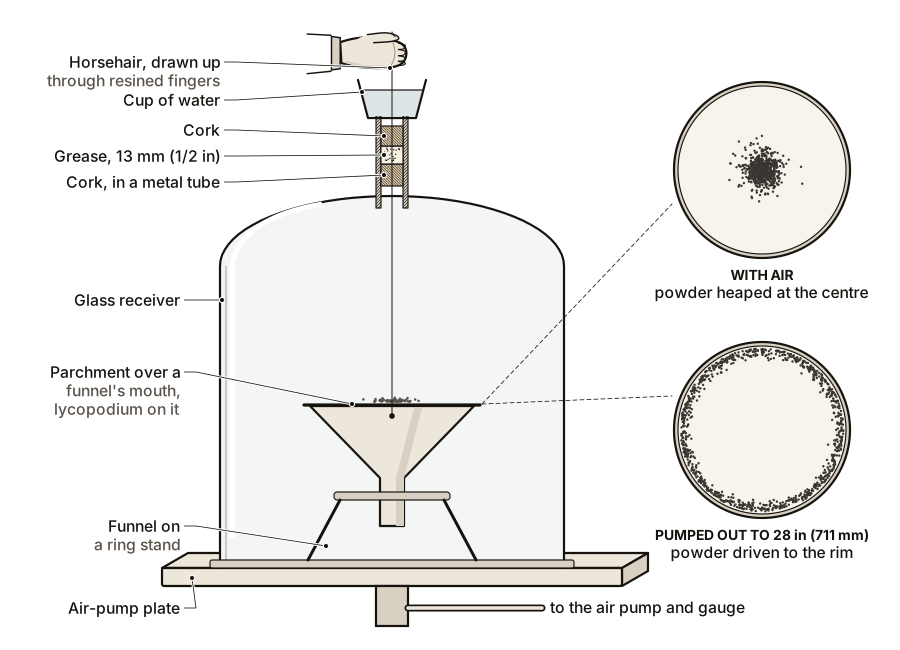
John Tyndall, Faraday’s successor at the Royal Institution, gave the result its best-known phrasing in his lectures on Sound (1867, Lecture IV, pp. 149 to 150). Lycopodium mixed with sand, he told his audience, “forms little heaps at the places of most violent motion”, and Faraday had found the “extremely simple cause”: the light powder “is entangled by the little whirlwinds of air produced by the vibrations of the plate; it cannot escape from the little cyclones, though the heavier sand particles are readily driven through them.” And then: “In vacuo no such effect is observed: here all powders, light and heavy, move to the nodal lines.”
Section 5: Why a Tent Will Not Help
The obvious thought, once you have seen flour drift about the plate, is that the room is draughty. Put the plate in a tent of cling film, keep the air still, and the flour should behave.
It will not, and it is worth being clear why. The currents that carry the dust are not draughts from the room. The plate makes them itself, in the layer of air lying on its own surface, a few millimetres (an eighth of an inch or so) deep. A tent keeps out the air from the rest of the room. It does nothing to the air touching the plate, and that air is what the plate stirs. Faraday’s dust gathered just as well under a glass jar as in the open, so long as there was air in the jar. Only pumping the air out changed it.
ON THE BENCH: The tent that changes nothing
Parts: the plate with salt and flour; a cardboard box larger than the plate, with its bottom cut away; cling film; tape. Cost: nothing. Time: 15 minutes. Hazards: as before. Method: stretch cling film over the top of the box and tape it, to make a clear-topped tent. Find the rose window figure with salt and flour in the open and photograph it. Clear and re-sprinkle, lower the tent over the plate without touching it, wait a minute for the air to settle, and run the same tone at the same volume. Photograph through the film. What you should see: the same flour heaps in the same places. If anything changes, it is that stray flour drifting in from beyond the plate’s edge stops, because the tent does keep out room draughts. The heaps over the moving patches do not move, shrink or go to the salt lines. If it does not work: if the figure itself shifts, the box is touching the plate or the bench is carrying vibration into the box; lift it clear.
The tent is still useful for photographing flour figures in a room with a fan or heater running. It will not make flour behave like salt. That takes an air pump and a sealed jar, beyond what this book asks you to build, so Faraday’s numbers stand in for it.
SLOW DOWN. Check Your Understanding: Faraday drove a round glass plate under 2 or 3 inches (50 to 75 mm) of water, and sprinkled ordinary sand on it. In air, that sand would have drawn the still lines. Where did it go under water, and why? Answer before you read on.
It went to the places of greatest motion, exactly as dust does in air. Water is about 800 times denser than air and far more viscous, so the currents the plate stirs in it are far stronger at carrying grains, and a grain in water cannot be thrown high and clear of them the way a salt grain is thrown clear of the air. Heavy and light are not properties of a grain on its own. They describe a grain compared with the fluid it sits in. In a vacuum, there is nothing to carry anything, so every grain is heavy and every powder draws the still lines; in air, sand is heavy and flour is light; in water, even sand and platinum are light. The same rule is why a river drops its sand near its mouth and carries its fine mud far out to sea.
Section 6: What the Flour Proved
Savart’s secondary mode of division did not survive. Faraday concluded that “no secondary mode of division need be assumed” (§51), and explained why he had piled up so much evidence against so eminent a man: “the weight of evidence against it should be such as fully to establish the truth and prevent a repetition of the error by others.”
The lesson he left is worth more than the dust itself. A pattern can be perfectly real, perfectly repeatable and tied exactly to the vibration, and still be drawn by something other than the vibration you think you are looking at. Savart’s dust figures were all of those things. They were drawn by the air.
The salt on your plate draws the plate. The flour draws the air above the plate. And in Faraday’s appendix to the same paper, added because his results came in “at too late a period” for the session, a layer of water on the same plate drew something stranger still: a pattern of tiny heaps that rose and fell at a different pitch from the plate beneath them. That is chapter 8.
Bench Degree
Get the degree without the diploma.
Learn the material, not how to pass the exam.