Bench Degree·CYMATICSchapter
Chapter 8: Waves on Water
Shake a dish of water up and down and its surface breaks into a grid of tiny peaks. They rise and fall at half the pitch you are shaking it with, a fact Michael Faraday worked out in 1831 by watching candlelight twinkle through them.
Fill a wine glass a third full of water. Wash your fingertip with soap, rinse it, dip it in the water, and run it slowly and steadily round the rim, pressing lightly. After a few turns the glass begins to sing: a pure, clear note that swells as you keep going.
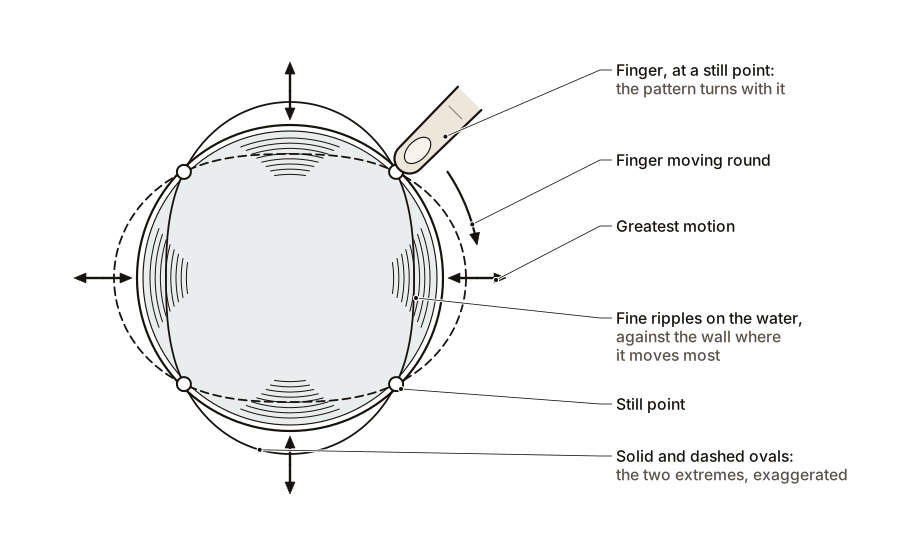
Now look at the water, not the glass. Near the wall, in four patches evenly spaced round the circle, the surface has gone matte with fine ripples, so fine they look like frost. Keep circling and the four patches travel round the glass with your finger. Press harder and the water in the patches begins to spit tiny droplets.
The glass is drawing its own figure in the water. This chapter follows that idea from Galileo, who saw it first, to Faraday, who found that water shaken from below does something no plate or drum in this book has done: it answers a note with a different note, exactly an octave lower.
Section 1: Galileo’s Goblet
The singing glass is the oldest experiment in this book. Galileo described it in 1638, in the First Day of his Two New Sciences (Crew and de Salvio translation, 1914, pp. 99 to 101). “A glass of water may be made to emit a tone merely by the friction of the finger-tip upon the rim of the glass; for in this water is produced a series of regular waves.” To see them better, he stood the goblet in a larger vessel of water filled nearly to its brim, and watched “ripples spreading with the utmost regularity and with high speed to large distances about the glass.”
Then he noticed something that mattered to him more. “When, as sometimes happens, the tone of the glass jumps an octave higher I have noted that at this moment each of the aforesaid waves divides into two; a phenomenon which shows clearly that the ratio involved in the octave is two.” Musicians had long called the octave 2 to 1, meaning string lengths. Galileo saw the vibrations themselves double, written in water.
The four patches in your glass come from the glass’s own shape as it rings. Chapter 5 showed that a ringing plate divides into parts moving in opposite directions, separated by nodal lines. A wine glass is a bell, and its lowest note comes from the rim squeezing into an oval, then into the opposite oval, and back. That shape has four places that move most and four that hardly move. The water against the wall is shaken hardest at the four places of most motion.
ON THE BENCH: The singing glass
Parts: a thin wine glass with a stem; water; dish soap; a little white vinegar; a desk lamp. Cost: nothing. Time: 10 minutes. Hazards: a thin glass can crack if pressed hard. Hold it by the base, flat on the table. Method: wash the glass and your finger with soap and rinse both well; grease stops the finger gripping. Fill the glass about a third full. Wet a fingertip, dipping it in vinegar if plain water slips, and circle the rim slowly and evenly. Place the lamp so its reflection shows in the water’s surface. What you should see: a clear tone, and four matte patches of fine ripples near the wall, evenly spaced, travelling round with your finger. Add water and the note falls, because the water moving with the wall makes the glass effectively heavier. Pour some out and it rises. If it does not work: if the glass squeaks without singing, the finger is greasy or pressing too hard. Wash, wet and lighten the touch. Thick glasses and cut crystal are hard to sound; use the thinnest glass in the house.
Section 2: Faraday’s Crispations
In 1831 Faraday added an Appendix to his paper on dust figures, “On the forms and states assumed by fluids in contact with vibrating elastic surfaces” (Phil. Trans. 121, reprinted in his Experimental Researches in Chemistry and Physics, 1859, pp. 335 ff.). It began from something every experimenter with plates had seen: cover a vibrating plate with water and the water “usually presents a beautifully crispated appearance in the neighbourhood of the centres of vibration” (§63). Oersted, Wheatstone and Weber had all noticed it. Nobody had explained it.
Faraday called it crispation, from the Latin for curling. Looked at closely, it was “small conoidal elevations of equal lateral extent, usually arranged rectangularly with extreme regularity” (§65): a grid of tiny peaks, in rows and columns, like the bristles of a brush. He found three things about them at once. They grew taller when the plate was bowed harder but did not grow wider. They were smaller for a high note and larger for a low one. And the same note gave the same size of crispation on plates of different sizes, vibrating in different modes. The size belonged to the note, not to the plate.
To study them he needed slower vibrations and bigger heaps. He fixed glass plates to wooden laths 2 to 4 ft (0.6 to 1.2 m) long, set vibrating by a glass rod rubbed with wet fingers, and could get vibrations down to “five or six” a second; three or four heaps then fitted in an inch (25 mm). Eventually he built a board 18 ft (5.5 m) long carrying a pool of water 3/4 in (19 mm) deep and 28 by 20 in (710 by 510 mm) across. Its vibrations were slow enough to drive by hand, and the heaps were 25 to 50 mm (1 to 2 in) wide, yet “identical in their nature with those forming crispations on so small a scale as to appear merely like a dullness on the surface of the water” (§72).
He tried a basin of water 356 mm (14 in) deep and found the crispations just as regular as in a shallow film (§111). And in a footnote he recorded seeing the same peaks “in a pail placed in a barrow, and that on the head of an upright cask in a brewer’s van passing over stones.”
Section 3: A Dish on the Speaker
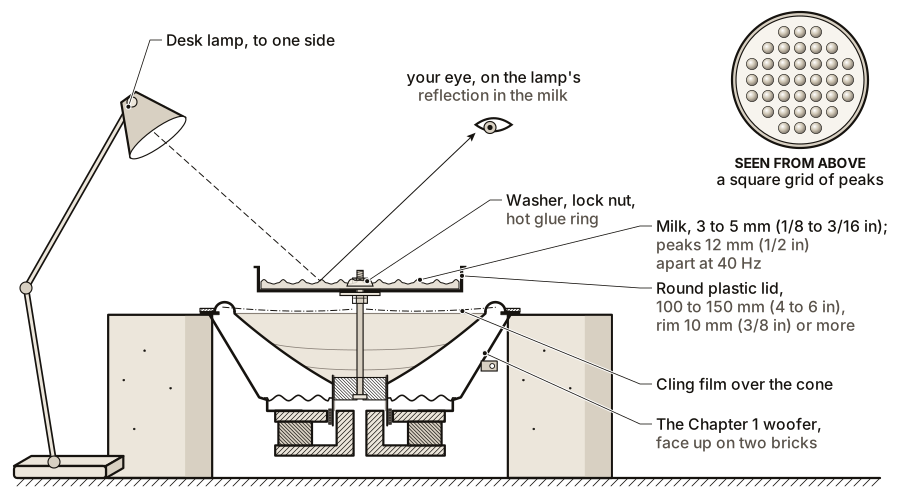
You do not need an 18 ft (5.5 m) board. The chapter 1 woofer, at low pitches, shakes up and down by far more than enough.
ON THE BENCH: Crispations on a speaker
Parts: the chapter 1 woofer, amplifier and tone generator, with the disc unbolted; a rigid round plastic lid 100 to 150 mm (4 to 6 in) across with a rim at least 10 mm (3/8 in) high; a fender washer and lock nut; hot glue; milk, or water with a few drops of black ink; a medicine syringe or measuring spoon; a desk lamp; cling film; a towel. Cost: nothing beyond what you own. Time: 30 minutes. Hazards: water and electronics. Keep the amplifier board well away on its wood and lay the towel round the woofer. Stretch cling film over the woofer’s cone around the bolt so a spill cannot reach the gap round the voice coil. Everything runs at 24 V or less. At these low pitches the cone moves a long way, so raise the volume slowly and stop if you hear the cone knock or rattle. Method: drill the lid’s centre, bolt it on where the disc was with the washer and nut, and seal round the nut with a ring of hot glue so it does not leak. Level it. Pour in milk to a depth of 3 to 5 mm (1/8 to 3/16 in). Set the lamp so you see its reflection in the surface. Start the tone at 40 Hz with the volume at zero, and raise it very slowly. What you should see: for a while, nothing but a faint trembling at the edge. Then, at one volume, the flat surface breaks all at once into a grid of tiny peaks, arranged in squares, spaced about 12 mm (1/2 in) apart. Turn the volume down a little and they vanish. Change to 80 Hz and find the volume again: the grid is finer, about 7 mm (1/4 in). If it does not work: if the whole surface sloshes from side to side, the lid is not level or the volume is far too high. If you see only rings running in from the wall, raise the volume further; the grid appears above them. If nothing happens even at high volume, use a shallower layer.
The suddenness matters. Sand on the plate moved as soon as the plate moved. Here there is a threshold. Below a certain shake, the flat surface stays flat however long you wait. Just above it, the grid appears everywhere at once and holds steady. Faraday saw why it appears so fast. Any tiny unevenness, “the smallest atom of dust falling on the surface”, is “by each vibration of the plate, increased in amount”, and spreads “the breadth of a heap, in at least four directions”, so that “in less than a second a large surface would be affected” (§106).
Section 4: Half the Pitch
Faraday wanted to know what each peak actually did. Seen directly, the grid looked frozen. But when he put a candle beneath a shallow pool of ink on glass and held a sheet of tracing paper above it, each heap focused the light into a small star, and the star twinkled, “appeared and disappeared alternately, as the heap rose and fell” (§96). The heaps were not standing still. They were rising and collapsing.
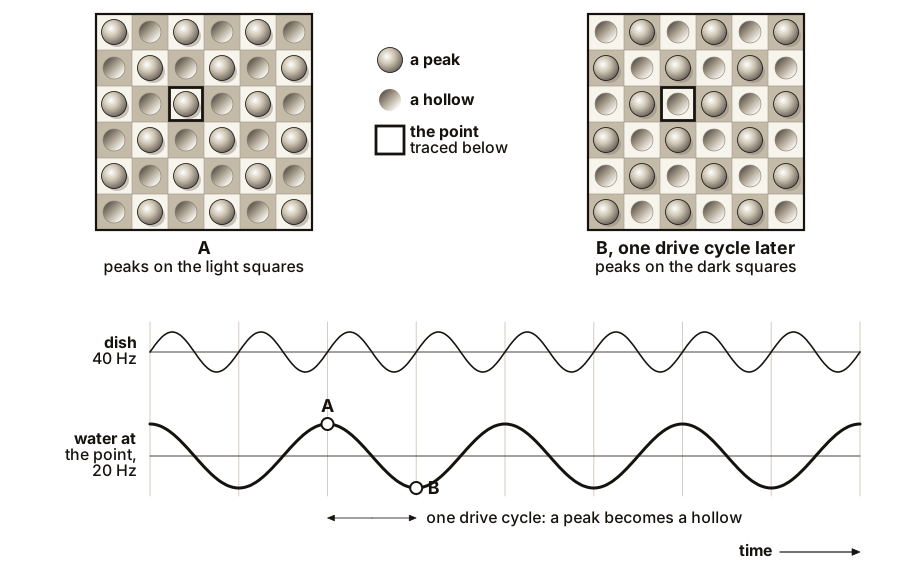
Enlarging the board’s pool until the heaps were 64 mm (2.5 in) wide, he could see it with the naked eye. “The heaps were not stationary, but rose and fell; and also that there were two sets regularly and alternately arranged, the one set rising as the other descended” (§98). Picture a chessboard. On one push of the plate, peaks rise on the white squares while the black squares are hollows. On the next push, the white peaks collapse and their water runs sideways to build peaks on the black squares. On the push after that, the white squares rise again.
So a peak on any one square rises once every two pushes. Faraday wrote it down exactly: “Each heap … recurs or is reformed in two complete vibrations of the sustaining surface” (§101), and later, the heaps “are due to vibrations of that fluid occurring in twice the time of the vibrations of the plate” (§108). The water vibrates at half the frequency of the plate that drives it. Shake the dish at 40 Hz and each spot on the surface goes up and down 20 times a second.
That is now called a Faraday wave: a standing wave on a liquid surface, raised by shaking the container up and down, at half the shaking frequency. A response at a whole-number fraction of the drive frequency, half or a third, is called a subharmonic, because it sits below the note that causes it, the way the harmonics of chapter 4 sit above.
How can shaking at one frequency make something move at half of it? Lord Rayleigh gave the answer in The Theory of Sound (vol. 1, 2nd ed. 1894, §68b, p. 82). The dish is not pushing the waves directly. It is moving everything in it up and down together, and to the water, a container accelerating upwards feels like stronger gravity, and one accelerating downwards like weaker gravity. Rayleigh puts it plainly: “the effect is as if gravity were variable.” Shaking the dish turns the strength of gravity up and down, once per shake. A ripple whose own natural frequency is half the shaking frequency feels that change twice in each of its swings, always at the same points, so its restoring force is strengthened at just the right moments, and it grows.
Rayleigh grouped the crispations with Franz Melde’s string, tied to a tuning fork that tugs it lengthways, which “may settle down into a state of permanent and vigorous vibration, whose period is the double of that of the fork”. Driving something by rhythmically changing one of its own properties, its tension or the gravity it feels, is called parametric drive. Picture a child on a swing who stands and squats twice in every complete swing, and pumps it higher with nobody pushing.
IN PLAIN ENGLISH: The speaker jiggles the whole dish up and down. To the milk, that feels like gravity getting stronger and weaker, over and over. The ripples that grow are the ones whose rhythm fits that pumping, and the fit works when the ripples go up and down once for every two jiggles. So the milk sings an octave below the speaker.
ON THE BENCH: Catching the half
Parts: the dish rig with milk; a phone that records slow-motion video at 240 frames per second (check the setting; some record at 120); a second phone or computer for the tone generator. Cost: nothing. Time: 30 minutes. Hazards: as before. Method: set the tone to 30 Hz and raise the volume until the grid forms, with peaks about 15 mm (5/8 in) apart. Hold the slow-motion phone close above the dish with the lamp’s reflection in view and record ten seconds. Play the clip back frame by frame. Pick one peak and count the frames from one moment it is tallest to the next time the same peak is tallest again. Do it five times and average. What you should see: about 16 frames per rise of the same peak at 240 frames per second, which is 15 rises a second: half of 30 Hz. In between, at about 8 frames, the peak is a hollow and its four neighbours are tall. That is Faraday’s chessboard, and at 30 Hz you are seeing each half of it 15 times a second. If it does not work: if the count wanders, film a stopwatch to check the phone’s true frame rate. If the grid is too fine to follow, drop to 20 Hz. Better, if you have one: a strobe light whose flash rate you can set, or a phone strobe app that will flash steadily at the rates you need. Drive at 20 Hz and set the strobe to 10 Hz: the grid stands frozen. Set the strobe to 20 Hz, the drive frequency, and the two halves of the chessboard appear on alternate flashes, so the grid seems to shimmer with twice as many peaks. A pattern that freezes at half the drive frequency and not at the drive frequency itself is the half-frequency proved.
Section 5: Why Squares, and Why Stripes
The grid on your dish was squares, and Faraday’s was too, “with extreme regularity”. He offered a reason (§104). A surface tiled with two sets of heaps that take turns needs a tiling that can be split into two halves that alternate, the way a chessboard splits into white and black. Of the regular shapes that tile a floor, only squares and triangles allow that, and between them squares have shorter boundaries for the same area. So, he concluded, the fluid settles on squares as the arrangement that offers “the least resistance in its undulations”. It is ingenious, but it is a sketch from 1831; the full theory came in the late twentieth century and is much harder.
The pattern is chosen by the liquid and the shaking together, not by the note. Faraday himself found the arrangement unsteady on round plates, “sometimes arranged rectangularly”, at other times “as if hexagonal”, always shifting (§93). In rectangular pools the rows lay at 45° to the edges (§91). Laboratory surveys since the 1990s report that thin, runny liquids give squares when shaken above about 50 Hz, that more viscous liquids tend to give parallel stripes instead, and that at low frequencies hexagons can appear in either (A. Kudrolli and J. P. Gollub, Physica D 97, 1996, pp. 133 to 154). Shake with two frequencies at once and stranger patterns still become possible.
Your dish adds a complication. Where the milk meets the wall it curves up, and the moving wall rocks that curve and sends rings of ripples inwards at the drive frequency. Below the threshold those rings are all you see. Above it, rings and squares compete, and a small round dish often lays its own circles over the square grid.
SLOW DOWN. Check Your Understanding: You drive the dish at 40 Hz and your slow-motion clip shows each peak rising 20 times a second. A friend says the milk is simply too sluggish to keep up, so it skips every other push. Is that right? Answer before you read on.
No. A liquid that skipped every other push would sit idle half the time, and the dish’s energy on those pushes would be wasted. Look again at Faraday’s chessboard: every push builds peaks, just on alternate squares. The pattern as a whole changes on every cycle of the drive; each single spot repeats only every second cycle. They answer at half the drive because a parametric drive, which works by varying the gravity they feel, feeds a wave best when it changes that gravity twice per wave cycle. That is also why there is a threshold. A direct push adds a little motion on every cycle however weak it is, but a parametric drive only amplifies motion that is already there, and must amplify it faster than the liquid’s friction removes it. Below that point every stray ripple dies, and the surface stays flat. It may be why Watts Hughes’s petals appeared only when a note was swelled louder, though nobody has measured her instrument to show it.
Section 6: The Photographs
Search for “cymatics” and many of the most striking images will be of water: a small round dish, lit by a ring of lights reflected in its surface, showing a glittering mandala of points and petals. They are often captioned with a frequency, a note, a planet or a word.
Those photographs are real, and you now know what many of them probably show. The published descriptions of the instruments are brief, but they describe a shallow layer of water in a small round dish shaken from below, which is the rig on your bench, built more carefully and photographed with a ring light. A rig like that makes Faraday waves at half the drive frequency, combined with the rings sent in by the dish’s wall. Their shapes are set by the size of the dish, the depth and kind of liquid, the frequency, and the volume. Change any one of them and the same note gives a different picture. Watts Hughes said as much about her own figures in 1891: “any one note may, under different circumstances, produce different figures.”
Try it. Hold your dish at 60 Hz and photograph the pattern at depths of 3 and 6 mm (1/8 and 1/4 in), just above the threshold and well above it, in two lids of different sizes. One note gives you several pictures. Near threshold the grid is neat; well above it, the peaks jostle into a restless, glittering disorder, which is what many of the most dramatic photographs show.
That is no reason to dismiss the photographs, any more than Herrick dismissed Watts Hughes. It is a reason to ask what was held fixed when one is offered as the picture of a sound. Part IV takes up the claims attached to such images.
Three chapters, three ways sound draws. In chapter 6 grains drew the still places of a membrane. In chapter 7 dust drew the air above a plate. Here the liquid draws nothing of the plate at all. It makes waves of its own, at a pitch of its own, half that of the sound driving it. Chapter 9 asks why a plate can be made to sing so loudly by so gentle a push.
Bench Degree
Get the degree without the diploma.
Learn the material, not how to pass the exam.