Bench Degree·CYMATICSchapter
Chapter 9: Resonance and Q
A child on a swing can be pushed higher by a finger than by a shove, if the finger arrives at the right moment. This chapter measures how right the moment has to be, using the plate on your bench and a phone.
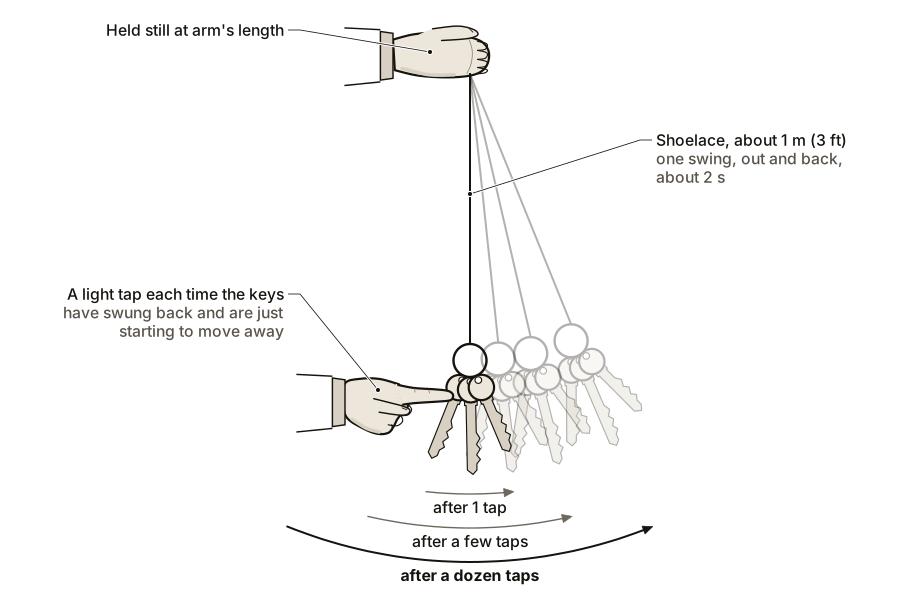
Tie a bunch of keys to a shoelace about 1 m (3 ft) long and hold the other end still at arm’s length. Now tap them sideways with one fingertip of your other hand, very lightly, once.
They swing a little and settle. Tap again, but this time wait, and tap each time the keys come back towards your finger and are just starting to move away. Light taps, no harder than the first. After a dozen taps the keys are swinging through a wide arc, far wider than any single tap could throw them.
Now try tapping at a steady beat of your own choosing, a little faster than the keys want to go. The swing grows for a few taps, then your finger starts meeting the keys as they come towards it, and the arc shrinks again. Tap at the wrong rhythm and you never get anywhere.
In Chapter 1 the plate drew nothing for most of the climb and then, at one pitch, suddenly sang. Your keys just did the same thing at one swing every two seconds. The plate does it at five hundred swings a second, and this chapter measures how sharp that “suddenly” is.
Section 1: The Push in Time
Chapter 3 gave every mass on a spring a natural frequency, the rate at which it swings when you displace it and let go: f = (1/2π)√(k/m), with k the stiffness and m the mass. Your keys are a pendulum, where gravity plays the part of the spring, and a pendulum 1 m (3 ft) long has a natural frequency of about 0.5 Hz. One full swing, out and back, takes about two seconds.
Resonance is what happens when something with a natural frequency is pushed, again and again, at that same frequency. Each push arrives in step with the motion already there and adds to it. At any other frequency the pushes drift in and out of step, half helping and half hindering, and the motion never builds.
The best tap lands as the keys pass through the bottom, moving fastest, in the direction they are already going. At resonance the push keeps pace with the speed, a quarter of a swing ahead of the position. A push on keys standing still at the top of the arc does almost nothing, because you cannot do work on something that is not moving.
ON THE BENCH: The push that adds up
Parts: a bunch of keys or a heavy nut; a shoelace or string about 1 m (3 ft) long; a phone with a stopwatch. Cost: nothing. Time: 10 minutes. Hazards: none, if the keys are not swung near a face or a window. Method: hang the keys and give them one small tap. Time ten full swings with the stopwatch and divide by ten; that is the period. Then stop them, and tap lightly once per period, each time as they pass through the bottom moving away from your finger. Count the taps until the arc is as wide as your hand. Stop them again, and tap at a steady beat about one and a half times faster. What you should see: a period close to 2.0 seconds. In time, the arc keeps growing for ten or twenty taps and then stops growing, however long you go on. Out of time, it grows for a tap or two and then dies away again, over and over. If it does not work: if the arc never grows, your taps are too hard and you are holding the keys as much as tapping them. Use the very tip of a fingernail.
The arc grows, and then it stops growing. Each tap adds the same small amount, yet the swing settles at a fixed width. Something is taking energy away, and at that width it takes exactly as much per swing as your finger puts in.
Section 2: Damping, and the Number Called Q
Everything that vibrates loses a little energy on every cycle. The keys push air aside. Inside a metal plate, the crystals of the metal slip on each other by tiny amounts. In cardboard, as Chapter 1 found, the paper fibres rub and the loss is huge. Damping is the name for all of these losses together: anything that turns the motion of a vibration into heat. It is what stops resonance running away. The motion grows until the loss per cycle equals the push per cycle, and there it stays.
How much damping a thing has, compared with how much energy it stores, is measured by a single number called the quality factor, or Q. A high Q means little loss: the thing rings a long time and can be built up to a large motion by small pushes. A low Q means heavy loss. Formally, Q is 2π times the energy stored divided by the energy lost per cycle, but two practical meanings are easier to use.
The first practical meaning is how much bigger resonance makes the motion. Push a spring of stiffness k with a steady force F and it moves a distance F/k, the way Chapter 3 had it. Push it with a force of the same size that swings back and forth at the natural frequency, and it moves Q times as far:
x = Q × F / k
A plate with a Q of 500 moves five hundred times further at resonance than the same force would push it slowly. That is why a few volts from a small amplifier can make salt jump off a metal plate.
IN PLAIN ENGLISH: Q tells you how many small pushes a thing can usefully add up. With a Q of 10, the motion stops growing after a handful. With a Q of 1,000, it keeps adding up for hundreds, and ends a hundred times larger. Cardboard has a low Q. Aluminium has a high one.
Rough values give the number a feel. Keys on a shoelace, perhaps 50 to 100. A guitar string, a few hundred to a few thousand. A quartz watch crystal, tens of thousands. A tall building, 10 to 50, as Chapter 11 will need. The chapter 1 plate, somewhere in the hundreds to the thousands, depending on its mounting. Which one your plate has is a measurement you can make tonight.
Section 3: How Long It Rings
The second practical meaning of Q is the one you can measure with a phone. Stop pushing a resonating thing and its motion dies away, a fixed fraction of what is left on every cycle. That dying away is called the ring-down, and its speed is set by Q.
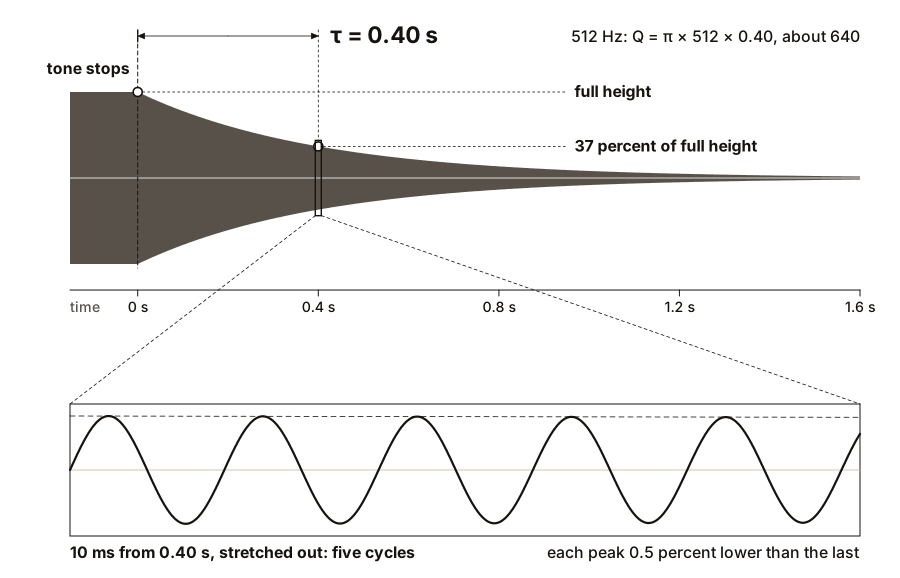
The amplitude falls by the same proportion in each equal stretch of time, like money losing a fixed percentage a year. So the useful clock is the time for the amplitude to fall to a fixed fraction of where it started. Engineers choose 1/e, about 0.37, because it makes the formula clean. Call that time τ, the Greek letter tau. Then:
Q = π × f × τ
with f in hertz and τ in seconds. Since the vibration completes f × τ cycles in the time τ, Q is also π times the number of cycles it takes for the amplitude to fall to about a third. If a third is awkward to find on a screen, measure the time to fall by half and multiply it by 1.44 to get τ.
ON THE BENCH: Measuring the Q of your plate
Parts: the chapter 1 rig; a second phone, or the same one, with a voice recorder; a laptop with a free audio editor that draws the waveform and lets you read times off it; ear protection. Cost: nothing beyond the rig. Time: 30 minutes. Hazards: as in Chapter 1. Watch the sound meter and wear plugs above 85 dBA. Method: find the twelve-spoke figure near 512 Hz with no salt on the plate, and tune to the loudest point. Put the recording phone about 300 mm (12 in) above the plate. Turn off any automatic level control in the recorder if it has one, because it will raise the gain as the sound fades and fake a longer ring. Start recording, let the tone run for five seconds, then stop the tone in the generator, not with the amplifier’s volume knob. Let the plate ring until it is silent. Open the file on the laptop, find the instant the tone stopped, and read the waveform’s height there. Find the time at which it has fallen to 37 percent of that height. That interval is τ. Multiply it by π and by the frequency. What you should see: a ring that you can hear for a second or more, and a value of τ of a few tenths of a second. If τ is 0.40 seconds at 512 Hz, the Q is π × 512 × 0.40, about 640. If it does not work: first check that the measurement can fail. Repeat the whole thing with a finger resting lightly on the rim of the plate. τ should collapse, and Q with it. If it does not, you are measuring the recorder’s level control; try another app. A ragged trace means a second mode is ringing; tune more carefully. Better, if you have one: measure Q again with the speaker wire unplugged. It will rise. A speaker coil moving in its magnet makes a current, and an amplifier connected across it lets that current flow and soak up energy. Part of your plate’s damping is the speaker itself.
Section 4: How Sharp the Peak Is
Chapter 1 told you to step the tone generator a tenth of a hertz at a time, and promised a reason. A resonance has a width. The motion is biggest at the natural frequency and falls away on either side. Plot the size of the motion against frequency and you get a peak, a resonance curve. How wide the peak is depends only on Q:
bandwidth = f / Q
The bandwidth is measured between the two frequencies either side of the peak where the power in the vibration has fallen to half. For the plate’s twelve-spoke figure at 512 Hz, with the Q of 640 from the last section, the bandwidth is 512 / 640, which is 0.8 Hz. A generator stepping 5 Hz at a time lands on that peak about one time in six.
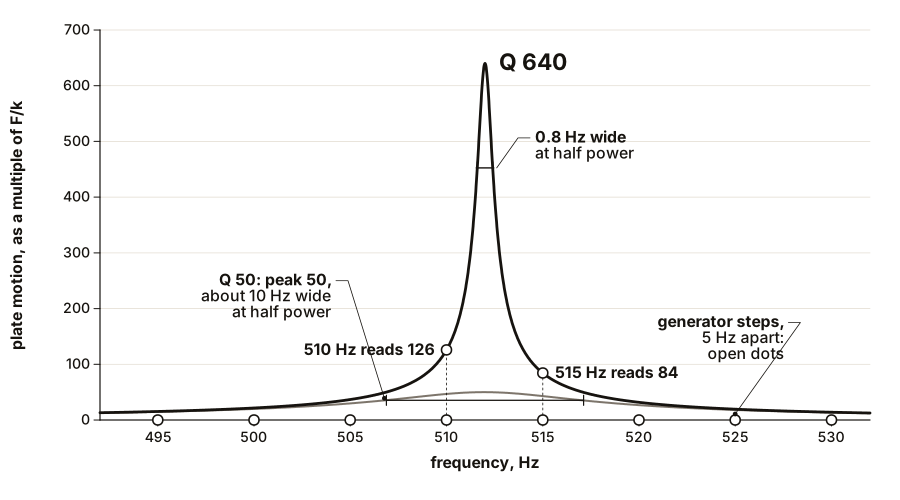
You can draw this curve for your own plate with the sound meter app. The meter reads in decibels, a unit Chapter 15 builds properly. Take one fact about it on trust for now: a reading 3 lower than the peak marks where the power has fallen to half.
ON THE BENCH: Plotting a resonance
Parts: the chapter 1 rig; a tone generator that steps in tenths of a hertz; the sound meter app on a phone held in a clamp or propped on books, so it does not move; graph paper. Cost: nothing. Time: 40 minutes. Hazards: as before. Ear protection; the volume stays fixed throughout, so set it modestly. Method: find the twelve-spoke figure and set the volume so the meter reads about 70 at the peak. Do not touch the volume again. Fix the phone about 300 mm (12 in) from the plate. Step down 3 Hz from the peak, then climb back up through it in steps of 0.1 Hz to 3 Hz above it. At each step wait three seconds before reading the meter, then write down the frequency and the reading. Plot reading against frequency. What you should see: a flat low floor, then a steep narrow peak about a hertz wide, then the floor again. The two frequencies where the reading is 3 below the peak are the edges of the bandwidth. Divide the peak frequency by the bandwidth to get Q, and compare with the ring-down. If it does not work: if the curve has two peaks a few tenths of a hertz apart, you have found the two twin figures from Chapter 1, the ones whose spokes swing to a new angle. Measure the sharper one. If the readings wander, the room is too noisy; wait for quiet, or move the meter closer.
Why wait three seconds at each step? Because a high-Q resonance builds up as slowly as it rings down. The same τ governs both: the motion covers most of the way to full size in about three τ, over a second for this plate. Sweep through the peak faster than that and it looks lower and wider than it is.
There is a fair trade inside that. High Q buys a large motion from a small push, and pays for it with a narrow target and a slow start. A loudspeaker cone is given a low Q so that it follows any frequency at once, and never multiplies anything much. A bell is given a high Q so that one strike rings for a minute, and it will only ever sound its own notes.
Section 5: The Wine Glass
A wine glass is a bell made of glass. Tap it and it rings for a second or two in its lowest mode, the swinging oval that Chapter 8 traced in water. A. P. French worked out how that note falls as the glass is filled, the liquid adding mass without adding stiffness, in “In vino veritas: a study of wineglass acoustics”, American Journal of Physics 51, page 688 (1983).
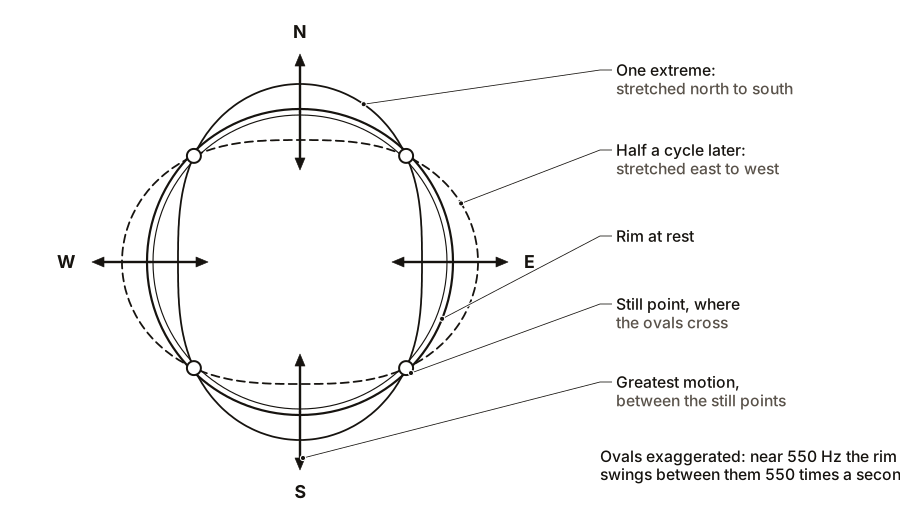
Every account of resonance reaches the singer who breaks a glass with her voice. The honest verdict is that it is real but hard, and has been recorded far less often than it is told. The singer must find the glass’s note, stay inside its bandwidth, hold it long enough to build, and be loud enough that the flexing, multiplied by Q, breaks the glass.
Start with the bandwidth. A good thin glass might ring at around 550 Hz with a Q near 1,000; you can measure your own glass in the box below. Its bandwidth is then about half a hertz. Trained singers use vibrato, a deliberate wobble in pitch several hertz wide, and must suppress it and hold a straight tone for seconds within a fraction of a hertz. Then the loudness: 105 decibels at the glass in the best-known case, the level of a power tool a short way off. Then the glass. It cracks at its worst flaw, so a scratched glass may break easily and a perfect one survive anything a voice can give it.
The printed record is thin. Karen Schrock, writing in Scientific American on 23 August 2007 (“Fact or Fiction?: An Opera Singer’s Piercing Voice Can Shatter Glass”), reports that a rock singer and voice teacher, Jaime Vendera, broke a crystal wine glass with his unamplified voice in 2005, at a measured 105 decibels, after trying 12 glasses. She describes it as the first recorded proof of the feat, and reports that the famous older cases are weaker: a well-known advertisement of the 1970s used loudspeakers, and the stories about the tenor Enrico Caruso were denied by his widow. The same article quotes Jeffrey Kysar, an engineer at Columbia University who studies fracture: “It’s possible, but you have to be both good and lucky.” Twelve glasses for one break is what “good and lucky” looks like.
A loudspeaker makes it easy, because a tone generator holds its frequency to a hundredth of a hertz. Do not do it at home: the level needed damages hearing in seconds, and a glass that fails at resonance throws its pieces.
ON THE BENCH: The Q of a wine glass
Parts: a thin wine glass with a stem, from a charity shop if you like; the recording phone and laptop from the ring-down box; the chapter 1 rig, with the plate’s tone generator; a little water. Cost: about $2 for the glass. Time: 30 minutes. Hazards: a chipped glass cuts. Use a sound one. Do not try to break it. The level stays below 85 dBA on the meter throughout. Method: hold the glass by its foot and tap the rim with a fingernail, recording the ring. Read τ off the trace and find the frequency by counting cycles in a stretch of 0.01 seconds on the stretched-out trace and multiplying by a hundred. Work out Q = π × f × τ. Then set the tone generator to that frequency, stand the glass on the bench about 50 mm (2 in) from the plate’s rim, and put a teaspoon of water in the glass. Play the tone at a modest level and step slowly through the glass’s frequency in tenths of a hertz, watching the water. What you should see: a ring of a few seconds and a Q of several hundred to over a thousand. Near the glass’s own frequency, and only within a fraction of a hertz of it, the water surface shivers into a fine pattern of ripples at four places around the rim, the four places that move most. If it does not work: if you see no ripples, move the glass closer to the plate, or set it directly on the plate with the plate’s salt brushed off, so the vibration reaches it through its foot. A glass that rings for under a second is thick or flawed; try another. Better, if you have one: measure the note with the glass a quarter, half and three quarters full. It falls slowly at first, then fast: French’s curve.
Section 6: What Q Tells You
Three numbers now describe every resonance in this book. The natural frequency says where it is. The Q says how much it multiplies a push, how long it rings and how sharp it is. The bandwidth, f/Q, says how accurately you must aim. Together they explain the three things that happened at once in Chapter 1: the note got louder (the multiplication by Q), the salt danced a second later (the build-up, three τ long), and it all happened within a hertz (the bandwidth).
SLOW DOWN. Check Your Understanding: You glue a small square of felt to the underside of your plate, near the rim. The ring-down shows that the Q of the twelve-spoke figure has fallen from 640 to 64. The tone generator and amplifier are untouched. Does the figure appear at a noticeably different frequency? Does it need more volume to raise the salt, or less? And is it easier or harder to find? Answer all three before you read on.
The frequency hardly moves. Damping shifts it by less than a percent unless Q falls below about 5. It needs ten times the force to make the same motion, since x = QF/k and Q has fallen tenfold; in practice that is a good deal more volume. But it is much easier to find. Its bandwidth has grown from 0.8 Hz to 8 Hz, it builds up ten times faster, and a generator stepping 5 Hz at a time will now land on it. That is the trade of Section 4, working in your favour for once. It matters in Chapter 11. A low-Q structure is hard to drive to a large motion, but easy to drive a little, by anything pushing at roughly the right rhythm. Buildings have low Q: easy to set trembling, very hard to set swinging.
In every case so far, something outside the object decided the frequency, and the object responded most when it matched its own. Chapter 10 turns this round: the violin bow, the reed, the wet finger on a glass and a steam engine patented in 1894 all ring at a frequency the vibrating object chooses for itself.

Bench Degree
Get the degree without the diploma.
Learn the material, not how to pass the exam.