Bench Degree·CYMATICSchapter
Chapter 10: Driven and Self-Excited
A wet finger moving steadily round the rim of a glass makes it sing a note your finger never chose. The glass picks the pitch and the finger only pays for it.
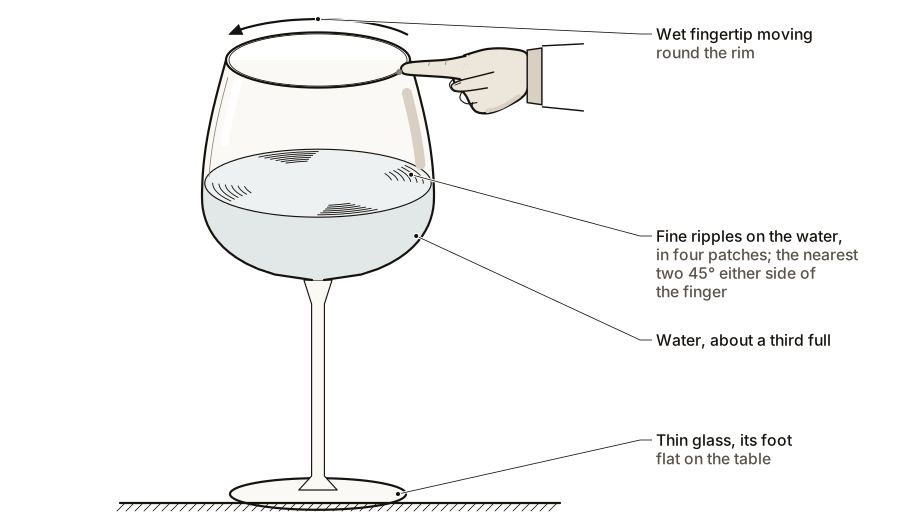
Make the wine glass of Chapter 8 sing again: a third full of water, its foot held down with one hand, a clean wet fingertip of the other run slowly round the rim with light, even pressure, as if you were tracing the edge of a coin.
For a few turns nothing happens, or the finger squeaks. Then the glass begins to sing: a pure, steady tone that swells as you keep going, with Chapter 8’s ripples travelling round the water beside your finger.
Speed up your finger. The note gets louder, perhaps, but its pitch stays put. Slow down and it falters, but while it sounds at all it sounds at the same pitch. Your finger is moving round the rim maybe once a second. The glass is vibrating several hundred times a second. Nothing about your finger’s motion has the glass’s frequency in it, and the glass sings at its own frequency anyway.
In Chapter 9 the tone generator decided the frequency. Here a steady effort, a finger dragged round in a circle, has turned into a vibration at exactly the right rate. This chapter is about how, and it ends with a steam engine that does the same trick.
Section 1: Two Ways to Keep Something Ringing
Every vibration you have made in this book so far has been a driven oscillation: the tone generator sets a frequency, and the speaker pushes the plate at that frequency whether it likes it or not. Resonance, from Chapter 9, is the special case where the driving frequency equals the plate’s natural frequency.
The wet glass is the other kind. A self-excited oscillation is a vibration kept going by a steady supply of energy that the vibration itself lets in, once per cycle, at its own natural frequency. The supply has no rhythm of its own: a finger moving steadily, a breath blowing steadily, steam at a steady pressure. The object opens and closes the supply as it moves, so every push lands in step with its motion: always at resonance, without anyone tuning it.
Three things follow. The frequency belongs to the object: press or blow harder and the vibration grows, but its pitch stays near the natural frequency. It starts itself, or needs only a nudge: any tiny motion lets in a tiny push in step with it, which makes the motion bigger. And it grows until damping limits it, where the energy let in per cycle equals the energy lost.
A pendulum clock is the familiar example. A wound spring pushes steadily; the escapement, rocked by the pendulum, lets the wheels advance one tooth per swing and gives the pendulum a tiny kick as it does. The pendulum sets the beat, and the spring pays for it.
IN PLAIN ENGLISH: A driven oscillator is told what frequency to move at, by something outside it. A self-excited oscillator is fed by something with no rhythm at all, like a steady breath, and uses its own motion to decide when to take each sip. That is why a squeaky door hinge always squeaks at much the same pitch.
Section 2: The Bow and Stick-Slip
Chladni made his figures with a violin bow: horsehair stretched on a stick and rubbed with rosin, a sticky pine resin. He specified it in 1787: the bow should be “mit Colophonium oder einem andern Harze bestrichen”, rubbed with colophony or some other resin.
Rosin matters because of a property of friction you can feel with your thumb. Press your thumb on a tabletop and push sideways, gently at first. It holds, and holds, and then suddenly slides. Once it is sliding, it takes less force to keep it sliding than it took to start it. Friction between surfaces at rest is stronger than friction between surfaces in motion, and rosin makes that difference unusually large.
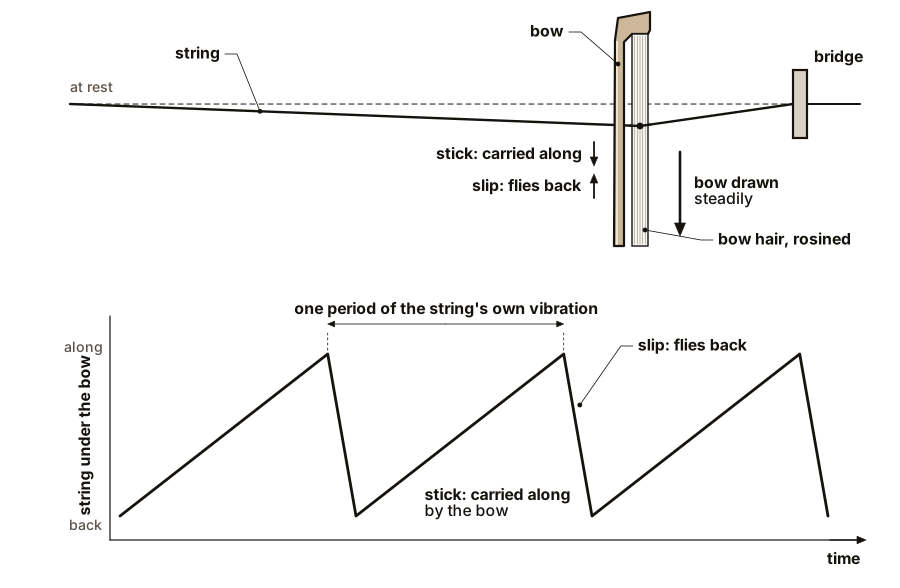
Now put a bow on a string, or on the edge of a plate, and draw it steadily. The hair grips the string and carries it along. The string bends further and further, its spring force building, until that force beats the gripping friction. Then the string breaks free and flies back. Sliding friction is weak, so it travels a long way, overshoots, and comes round again. At the moment its own swing brings it back to moving at the same speed as the bow, the hair grips it again, and the cycle repeats.
That is stick-slip: a steady drag converted into a vibration by the difference between gripping and sliding friction. The timing of each grip and each release is set by the string’s own swinging, so the string vibrates at its natural frequency and the bow simply pays the losses. Hermann von Helmholtz watched a bowed string through a vibration microscope in the 1860s and saw its motion as a sawtooth: long slow sticks and short quick slips.
The wet finger on the glass is stick-slip too. Clean skin on clean, wet glass grips and slips in small jerks. Skin oil spoils the grip, which is why you washed your finger. Galileo’s singing goblet of 1638, in Chapter 8, was stick-slip too. Chladni built an instrument on the principle in 1790, the euphon, a set of glass rods stroked lengthwise with wet fingers.
ON THE BENCH: Bowing the plate
Parts: the chapter 1 plate on its speaker, with the amplifier switched off; a cheap student violin bow; a cake of rosin; salt; a tuner app on a phone, which shows the frequency of the note it hears. Cost: about $20 for a bow and rosin. Time: 30 minutes. Hazards: a bowed plate can be very loud. Ear protection near your ear, and the meter on the bench. File any sharp spot on the plate’s edge first, or it will cut the bow hair. Method: tighten the bow hair until it stands a pencil’s width from the stick, and rub the hair with rosin twenty or thirty times until it leaves a white dust on your finger. Sprinkle salt on the plate. Touch the plate’s rim lightly with a fingertip of one hand. With the other, draw the bow down across the rim at right angles to it, firmly and steadily, a hand’s width from where your finger rests. Try again with your finger at different places, and with the bow at different places. What you should see: a loud ringing note, and salt jumping into a figure in a second or two, with no electricity involved. Your fingertip becomes a still point, so the figure arranges itself to put a line through it. The tuner app shows the note’s frequency; it should be close to one of the frequencies you logged in Chapter 1, and the figure should match the one you found there. If it does not work: if the bow skates and squeals, it needs more rosin, or more weight on it. If you get only a buzz, bow more slowly and press harder. If the plate rattles on its bolt, snug the nut.
Section 3: Reeds and Other Valves
A bow uses friction to let energy in at the right moment. A reed uses a gate.
A blade of grass held taut between your thumbs, with air blown hard past it, gives a harsh squawk. The blade is a spring with a natural frequency. The rushing air pulls it into the gap, nearly closing it; with the flow cut off the pull drops, and the blade springs back, opening the gap, and the flow pulls it shut again. The blade’s own swinging opens and shuts the valve, so the puffs of air arrive at the blade’s natural frequency without anyone tuning anything.
A clarinet reed works the same way, though there the air column in the tube has the stronger resonance and sets the beat. A trumpeter’s lips are a reed. So are your vocal folds: muscles set their tension, and the lungs pay for the sound.
ON THE BENCH: A note from a blade of grass
Parts: a blade of broad grass about 100 mm (4 in) long, or a strip of thin plastic from a carrier bag. Cost: nothing. Time: 5 minutes. Hazards: loud, close to your own ears. Brief bursts only. Method: hold the blade taut between the edges of your thumbs, along the gap between the first and second joints. Blow hard through the gap. Then stretch the blade tighter and blow again, and then slacker. What you should see: a squawk whose pitch rises when the blade is tighter. Tension is stiffness, and stiffness raises natural frequency, as in Chapter 3. Blowing harder makes it louder, and moves the pitch much less than stretching does. If it does not work: the blade must be flat and tight, and the gap behind it must be narrow. Try a wider blade, or the plastic strip.
Section 4: Feedback
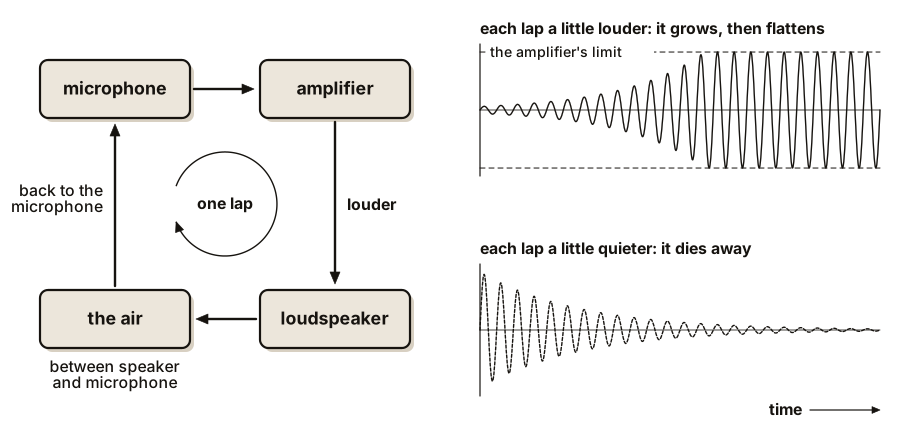
There is a self-excited oscillator that needs no friction and no moving gate at all, only a loop. A microphone hears a sound and the amplifier sends it to a loudspeaker. The speaker’s sound reaches the microphone, which sends it round again, louder. If any frequency comes back round the loop louder than it started, it grows on every lap until the amplifier can give no more, and the hall fills with a howl.
That is feedback: part of a system’s output returned to its input. When the returned part reinforces what is there, the feedback is positive, and every self-excited oscillator works that way: the bow, the reed and the wet finger are loops in which the motion controls the push. When it opposes, the feedback is negative and steadies things, as a thermostat does. Which frequency howls is decided by the loop: the one that comes round strongest and in step with itself, usually a resonance somewhere in the loop.
ON THE BENCH: A howl on purpose, quietly
Parts: the chapter 1 rig; a laptop running a free audio editor with a “play-through” or “monitor input” setting, which sends whatever the laptop’s microphone hears straight to its headphone socket; the audio lead from the laptop to the amplifier; the sound level meter app; ear protection. Cost: nothing beyond the rig. Time: 20 minutes. Hazards: feedback can jump from silence to full volume in a fraction of a second. Ear plugs in before you start. Keep one hand on the amplifier’s volume knob throughout and turn it down the instant the howl rises past 85 dBA on the meter. Start every attempt from zero volume. Method: with the amplifier at zero, connect the laptop, turn on play-through, and put the laptop about 1 m (3 ft) from the plate. Bring the volume up very slowly. When a tone starts and grows, hold the volume there or back it off a little until the tone is steady and quiet. Note its pitch with the tuner app. Then move the laptop closer, or farther, and find the howl again. What you should see: a pure tone that starts by itself. Its pitch is often one of the plate’s frequencies from Chapter 1, because the plate is the sharpest resonance in the loop. Move the laptop and the howl may jump to a different pitch. If it does not work: if nothing howls even at a comfortable volume, the microphone is too far away or the laptop is suppressing feedback on purpose; many have a noise or echo setting that does exactly that. Turn it off. Better, if you have one: sprinkle salt on the plate first. If the howl settles on one of the plate’s frequencies, the plate draws its own figure, a figure nobody tuned.
Section 5: An Engine That Times Itself
On 19 August 1893, Nikola Tesla filed a patent application for a steam engine. It was granted on 6 February 1894 as United States patent 514,169, “Reciprocating Engine”. It is one of the clearest self-excited oscillators in the history of engineering.
Its principle is stated in the patent in words Chapter 3 could have written:
It is a well known principle that if a spring possessing a sensible inertia be brought under tension, as by being stretched, and then freed it will perform vibrations which are isochronous and, as to period, in the main dependent upon the rigidity of the spring, and its own inertia or that of the system of which it may form an immediate part.
“Isochronous” means “of equal times”: the period stays the same however big the swing. “Rigidity” is stiffness and “inertia” is mass. So the sentence is f = (1/2π)√(k/m) in words.
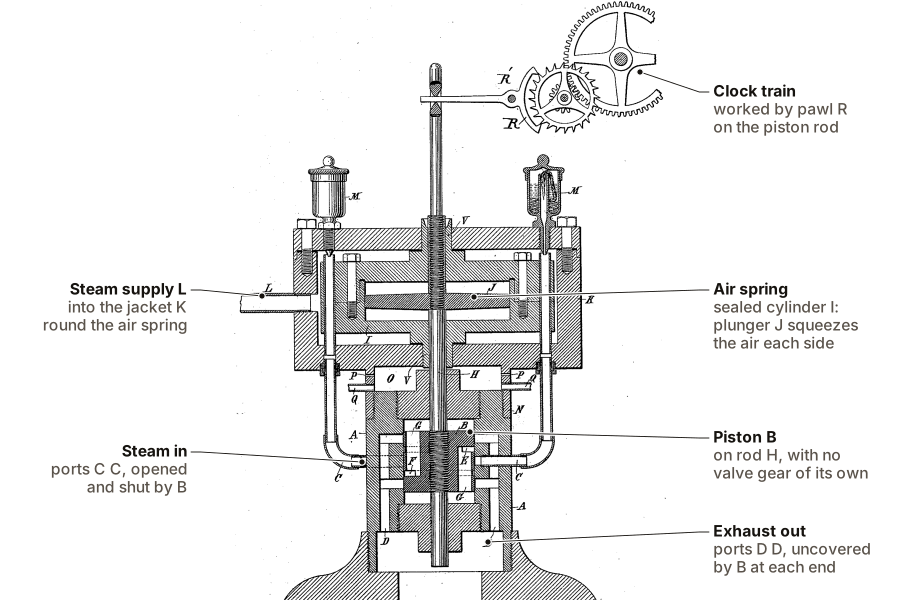
The machine has two cylinders on one rod. In the first, steam pushes a piston. There is no separate valve gear. The piston itself uncovers and covers the steam and exhaust ports as it moves, so that, in the patent’s words, “the piston has shut off at a given point, the pressure that impelled it and established the pressure that tends to return it”. In the second cylinder, sealed, a plunger on the same rod squeezes the trapped air first on one side and then the other. That trapped air is the spring. Tesla said it acts “exactly the same in principle as though the piston rod were connected to the middle point of a coiled spring, the ends of which are connected to fixed supports.”
So the moving parts and the air spring make a mass on a spring with a natural frequency. The steam is the steady supply. And the piston’s own position decides when steam is let in and when it is let out. The valve is timed by the piston it drives. That is a self-excited oscillator, built out of iron.
Tesla saw the consequence clearly, and it was the point of the invention. The rate of the engine, he wrote, “is no more dependent upon the pressure applied to drive it, than would be the period of oscillation of a pendulum permanently maintained in vibration, upon the force which periodically impels it”. More steam pressure gives a longer stroke, not a faster one. To change the rate you change the spring or the mass: “by varying the dimensions of the air chamber which is equivalent to varying the rigidity of the spring, or by adjusting the weight of the moving parts.”
He demonstrated it in public a few days after filing. T. C. Martin’s Inventions, Researches and Writings of Nikola Tesla (1894), chapter XLIII, reports the lecture at the Electrical Congress of the Chicago World’s Fair on the evening of 25 August 1893. Tesla vibrated “a weight of approximately 20 pounds at the rate of about 80 per second and with a stroke of about 7/8 inch”, that is 9 kg (20 lb) moving through 22 mm (7/8 in). To start it, “a powerful blow is struck”, although “it will start by merely turning on the pressure suddenly”: the nudge of Section 1. He showed the pieces of “a steel arbor which had been actually torn apart while vibrating against a minute air cushion”. He attached a clock to one of the machines, which “would keep absolutely correct time”. He compared the air spring to “a string tightly stretched between two points, and with fixed nodes”, the picture of Chapter 4.
The constant rate was what he wanted it for. A companion patent filed the same day, US 511,916, “Electric Generator”, puts coils on the moving rod so that the engine generates alternating current at a frequency fixed by its spring. Martin’s later article in Century magazine (April 1895) reports such machines running on steam at 350 pounds per square inch (2.4 MPa), or as low as 80 pounds per square inch (0.55 MPa), and weighing a thirtieth or a fortieth as much as an ordinary engine of the same power. The steam turbine overtook it.
Section 6: What Self-Excitation Means for the Story to Come
Tesla also built a platform that vibrated on the same principle, and stood on it. In an open letter dated 10 February 1896 and printed in the Detroit Free Press six days later, he described it as “a vibrating mechanical system, in which from the nature of the construction the applied force is always in resonance with the natural period.” That is a precise description of a self-excited oscillator, in his own words, from the man who built it.
Hold on to that phrase. The next chapter is about a story in which Tesla tuned a small oscillator to a building and the building’s resonance did the rest.
The machine in the patent vibrates at its own natural frequency, set by its air spring and moving mass, and is built to ignore its load. Bolt it to a beam and it keeps its own beat, as the wet glass sings its own note whatever your finger does. To shake a building at the building’s frequency, you would have to rebuild its air chamber or change its weights until the two matched. And a building sways once or twice a second, while the Chicago machine ran at 80.
None of that rules the story out by itself. Coupled oscillators can pull each other into step. In 1665 Christiaan Huygens noticed that two pendulum clocks hanging from the same beam ended up swinging in exact opposition, each nudging the other through the wood. But pulling works only between fair matches, and Chapter 11 weighs a pocket-sized device against a building. A self-excited oscillator keeps its own time. If it is to resonate something else, someone has to make its time match.
SLOW DOWN. Check Your Understanding: Tesla’s patent says that raising the steam pressure lengthens the stroke but leaves the rate unchanged. The wet glass behaves the same way when you press harder. But a violinist pressing harder with the bow can make the note go flat, sometimes by a noticeable amount, and a feedback howl often shifts pitch as you turn the volume up. Why are those two different? Answer before reading on.
Because in those two the push does more than add energy; it also changes the spring or the timing. A bow pressed hard holds the string longer in each stick phase, which delays every release a little, and a delayed release in every cycle lengthens the period. Turning up a howl drives the speaker and amplifier past the point where they respond in proportion, which changes the loop. The rate of a self-excited oscillator is the natural frequency only as long as the push stays a small correction to a strong spring and a good mass. Tesla designed his engine so that it would: he made the air spring “of tremendous rigidity”, in Martin’s phrase, so the steam could never boss it.
Every resonance in this book from here on is one of two kinds. Either something outside chooses the frequency and the object responds, or the object chooses and draws on a steady supply. Chapter 11 needs both: a building that responds, and a machine that chooses.

Bench Degree
Get the degree without the diploma.
Learn the material, not how to pass the exam.