Bench Degree·CYMATICSchapter
Chapter 11: Tesla’s Earthquake
The story says a machine small enough for a pocket nearly brought down a building in Manhattan. It was first printed seventeen years after it could have happened, and it is a different story every time it is told.
Here is the story as it is usually told. One day in the late 1890s, in his laboratory on East Houston Street in lower Manhattan, Nikola Tesla bolted a small mechanical oscillator to an iron pillar and slowly tuned it. The building began to shake. Windows broke, machinery danced across the floor, and in the streets around, people ran out of their houses thinking it was an earthquake. The police arrived to find Tesla smashing his machine with a sledgehammer. He told them, with a straight face, that it must have been an earthquake.
It is almost always told as fact. This chapter reads it in the order it was printed, from 1912 to 1944, and asks what the record contains. Then it does the arithmetic, with Chapter 9’s x = QF/k.
One thing first, because it is true and the story is often used against him. Tesla really did build powerful mechanical oscillators, and Chapter 10 read the patent. The question is not whether he understood resonance. He did. The question is whether this event happened as told.
Section 1: The First Telling, 1912
The earliest printed version is by the journalist Allan L. Benson, “Nikola Tesla, Dreamer”, in The World To-Day for February 1912, pages 1763 to 1767. It quotes Tesla directly, and it is not about his laboratory.
In Benson’s account, Tesla first ordered a steel link “two feet long and two inches thick”, 0.6 m (2 ft) by 50 mm (2 in), fastened to it “an electric vibrator, no larger than an alarm-clock”, and tuned the vibrator until the link “dilated and contracted like a beating heart” and “finally broke!” Then he put the vibrator in his coat pocket and “went out to hunt a half-erected steel building”. He found one “down in the Wall Street district”, “ten stories of steel framework”. Benson then gives Tesla’s own words:
In a few minutes I could feel the beam trembling. Gradually, the trembling increased in intensity and extended throughout the whole great mass of steel. Finally, the structure began to creak and weave, and the steel-workers came to the ground panic-stricken, believing that there had been an earthquake. Rumors spread that the building was about to fall, and the police reserves were called out. Before anything serious happened, I took off the vibrator, put it in my pocket and went away. But if I had kept on ten minutes more, I could have laid that building flat in the street. And, with the same vibrator, I could drop Brooklyn Bridge into the East River in less than an hour.
There is no date, no address, and no named building or witness. The same article says that Tesla could “split the earth” by timing explosions to its natural period, which he gave as “approximately one hour and forty-nine minutes”. The earth does ring after a great earthquake, as Chapter 14 shows, but its slowest ring takes about 54 minutes, not 109. Benson’s own comment was candid: “There may be flaws in this theory. Others may see them. I don’t.”
Section 2: Twenty-Three Years Later, 1935
On 10 July 1935, at a press lunch at the Hotel New Yorker for his seventy-ninth birthday, Tesla told it again, now about his own laboratory.
Earl Sparling’s report in the New York World-Telegram the next day says Tesla “revealed that an earthquake which drew police and ambulances to the region of his laboratory at 48 E. Houston St. in 1887 or 1888 was the result of a little machine he was experimenting with at that time which ‘you could put in your overcoat pocket.’” The paper prints his account:
I was experimenting with vibrations. I had one of my machines going and I wanted to see if I could get it in tune with the vibration of the building. I put it up notch after notch. There was a peculiar cracking sound. … Suddenly all the heavy machinery in the place was flying around. I grabbed a hammer and broke the machine. The building would have been down about our ears in another few minutes. Outside in the street there was pandemonium. The police and ambulances arrived. I told my assistants to say nothing. We told the police it must have been an earthquake. That’s all they ever knew about it.
Asked what he would need to bring down the Empire State Building, he answered: “Five pounds of air pressure. If I attached the proper oscillating machine on a girder that is all the force I would need, five pounds.” Five pounds of force is 22 N (5 lbf).
The same day, a wire story ran in other papers, among them the Brooklyn Times-Union (11 July 1935, page 10) and the Buffalo Evening News (12 July, page 29). It calls the event “the Houston st. earthquake of 37 years ago”, which points to 1898. It has “firemen and police” responding, and Tesla knocking “a gadget from the wall of his laboratory” with a hammer. The year 1898, which most later retellings give, is a reporter’s subtraction. Tesla, the same afternoon, said 1887 or 1888.
Tesla’s laboratory was not on Houston Street in 1887 or 1888. It moved there after a fire destroyed his South Fifth Avenue laboratory in March 1895, and his own letter of 10 February 1896, quoted in Chapter 10, is headed “Nos. 46 & 48 E. Houston Street”. He worked there until about 1902. So the Houston Street story can belong only to the years 1895 to about 1902, whatever any telling says.
The context matters. Tesla had called the press to announce three inventions: a way of sending mechanical vibrations through the earth to any distance, which he called telegeodynamics and said would locate ore and guide ships; a direct-current machine with no commutator; and evidence that much of relativity was wrong. He said he expected to have $100,000,000 within two years. The Associated Press report, printed in the Binghamton Press the same day, quoted Henry A. Barton, director of the American Institute of Physics: “Truly amazing if proofs are forthcoming to verify them.” It added: “Dr. Tesla offered no proof of his claims.” The earthquake was told at an event whose purpose was to make a new vibration machine sound credible.
Section 3: The Version Everyone Knows, 1944
Tesla died in January 1943. In 1944 the science journalist John J. O’Neill published Prodigal Genius, and its account (pages 135 to 142) is the one most retellings follow.
O’Neill sets it “In 1896” on Houston Street, with the oscillator screwed to an iron pillar, and police arriving from the headquarters on Mulberry Street to find Tesla swinging a sledgehammer. He names a witness who might have confirmed it, Tesla’s long-serving secretary George Scherff, and records that Scherff “does not recall” the event. And he admits that “Tesla never told the story beyond this point.” O’Neill also gives the power Tesla said would wreck the Empire State Building as 2.5 hp (1.9 kW), and concedes his notes may say a tenth of that.
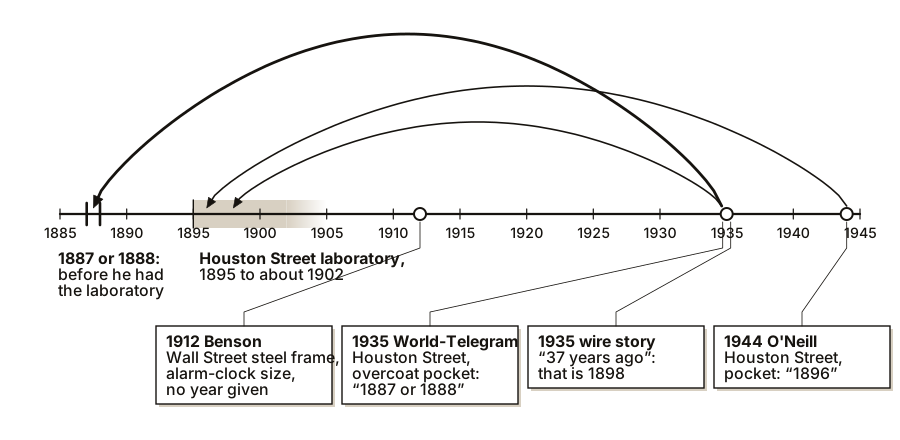
Side by side, three things are plain.
| Printed | Where it happens | When | The device | Who came |
|---|---|---|---|---|
| Benson, Feb 1912 | a steel frame near Wall Street | no year | the size of an alarm clock | police reserves |
| World-Telegram, 11 Jul 1935 | his lab, 48 E. Houston St. | 1887 or 1888 | fits an overcoat pocket | police and ambulances |
| Wire story, 11 to 12 Jul 1935 | his lab, Houston St. | “37 years ago” | on the wall | firemen and police |
| O’Neill, 1944 | his lab, Houston St. | 1896 | fits a pocket, on a pillar | police from Mulberry St. |
The place moves, from a building site to his laboratory. The date wanders across a decade, and the only year he gave himself is one in which he did not have that laboratory. The device shrinks, from an alarm clock to a pocket.
Section 4: What the Record Holds
A building shaking hard enough to bring police and ambulances, in crowded lower Manhattan, should have left a trace. Tesla was famous, and the 1895 fire at his laboratory was widely reported. No newspaper report of the event from the 1890s has been found. Nobody has produced a police record or a building department record of it. The one man O’Neill named as a witness did not remember it.
Tesla’s own writing says nothing either. His February 1896 letter from Houston Street is entirely about mechanical vibration, and it is careful: it calls his observations “incomplete” and disowns “the extraordinary opinions expressed in some journals”. It mentions no shaking building. Nor does Martin’s long article on the oscillator in Century in 1895, nor Tesla’s autobiographical series My Inventions in 1919.
Absence of a record is not proof that nothing happened; the newspapers of the period are only partly searchable. The earliest evidence for the event is Tesla’s own account, given at least seventeen years later, and the account changes each time. On that record the story is unconfirmed, and in its usual form, with a year of 1898 and a building nearly falling, it rests on a reporter’s arithmetic and on a biography written after its subject had died.
Section 5: The Arithmetic
Now suppose the event happened as Tesla told it in 1935. Could a machine that fits in an overcoat pocket, tuned to a building, shake it? At resonance, from Chapter 9, the motion of a structure is
x = Q × F / k
where F is the size of the swinging force, k is the stiffness of the structure in the way it is moving, and Q is its quality factor.
The force. An oscillator makes force by throwing a mass m back and forth through an amplitude A at frequency f, and the force is m × (2πf)² × A. It grows as the square of the frequency, which matters enormously here, because buildings sway slowly. A six-storey brick loft of the 1890s might sway back and forth about 1.7 times a second; that is an estimate, and a fair one for a building of that height. Give the pocket device a generous moving mass of 0.9 kg (2 lb) and a generous amplitude of 25 mm (1 in) each way, and at 1.7 Hz its force is 0.9 × (2π × 1.7)² × 0.025, about 2.6 N (0.6 lbf). That is the weight of a large apple.
The stiffness. A building of that kind has a mass of about 1.5 million kg (1,650 tons). In its first sway mode about half of that mass, call it 750,000 kg (830 tons), moves as one. That mass, with a natural frequency of 1.7 Hz has, by Chapter 3’s formula turned round, a stiffness of about 86 million newtons per metre (490,000 lbf per inch).
The Q. Buildings are heavily damped: floors, walls and joints rub and flex. Engineers put their damping at about 1 to 5 percent of the critical amount, which is a Q of about 10 to 50. Take 25.
Now the result:
x = 25 × 2.6 / 86,000,000
That is 0.75 µm, about 30 millionths of an inch, a hundredth of the thickness of a hair. A building needs to sway by centimetres, an inch or more, before anything in it cracks. The pocket device falls short of that by a factor of tens of thousands.
IN PLAIN ENGLISH: To make a heavy thing swing slowly, you have to push hard, because a slow push on a small weight hardly pushes at all. A pocket device shaking a little weight back and forth once or twice a second leans on the building with about the weight of an apple. Resonance multiplies that by twenty-five, and the building still does not notice.
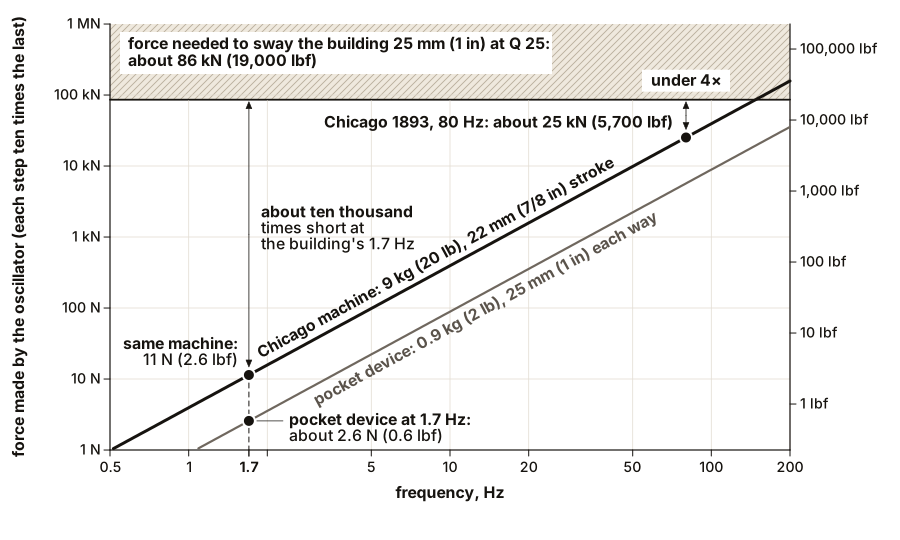
The comparison with Tesla’s real machine is instructive. In Chicago in 1893 he vibrated 9 kg (20 lb) through a stroke of 22 mm (7/8 in) at 80 times a second. Its peak force was 9.07 × (2π × 80)² × 0.011, about 25 kN (5,700 lbf), the weight of a small truck, reversing eighty times a second. That is consistent with a steel arbor torn apart. But run the same machine at a building’s 1.7 Hz and its force falls by (80/1.7)², a factor of about 2,200, to about 11 N (2.6 lbf). Its force came from its speed.
What about power? Tesla and O’Neill talk in horsepower, but the power fed into the building’s sway works out at about ten millionths of a watt. A bigger motor is no help. Resonance does not need power; it needs force at the right frequency, and a small mass moving slowly cannot make force.
The Empire State Building, at “five pounds”, does no better. A force of 22 N (5 lbf) at its sway frequency, on a modal mass of around 100 million kg (110,000 tons) with a Q of 50, moves it about 10 µm (0.0004 in). An ordinary wind moves it far more.
ON THE BENCH: A tower and two shakers
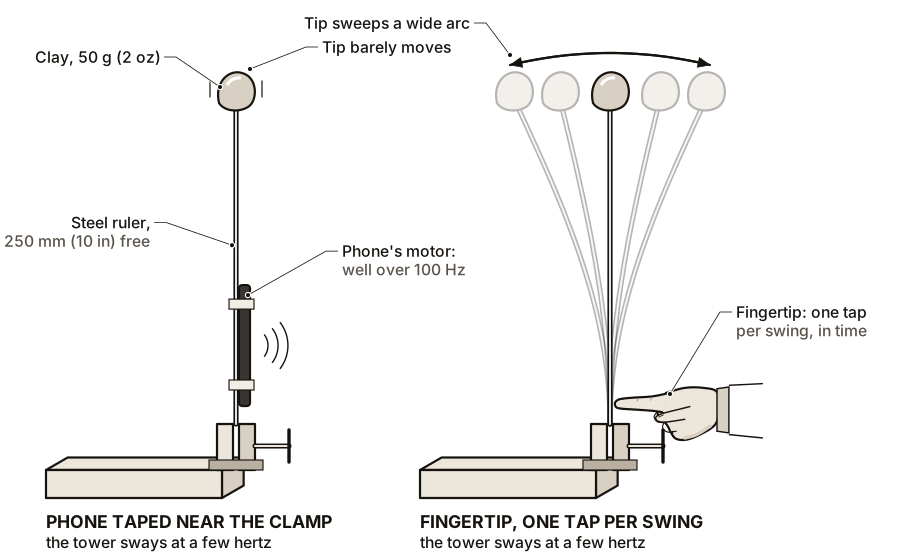
Parts: a steel ruler 300 mm (12 in) long; a G-clamp; a lump of modelling clay about 50 g (2 oz); a phone that can vibrate; tape; a stopwatch. Cost: about $8 if you need the clamp. Time: 20 minutes. Hazards: a clamped ruler springs back hard if you pull it far. Keep your face away from its tip. Method: clamp the ruler upright to the edge of a table with 250 mm (10 in) standing free, and press the clay onto its tip. This is a tower with one sway mode. Pull the tip aside 20 mm (0.8 in) and let go; time ten swings to get its natural frequency, which will be a few hertz. Then tape the phone to the ruler just above the clamp, and set it buzzing with a long vibration alert. Watch the tip. Finally, remove the phone and tap the ruler just above the clamp with a fingernail, once per swing, in time. What you should see: the phone buzzes loudly and the tip of the tower hardly moves: the phone’s motor runs at well over a hundred times a second, far above the tower’s few hertz, and nowhere near its resonance. Your fingertip, tapping a few times a second in step, sets the tip swinging wide within a dozen taps. A small push at the right frequency beats a strong buzz at the wrong one. If it does not work: if the tower barely swings when tapped, the clamp is too low or too loose; the ruler should be gripped hard. If the phone does shake the tip, it has found a higher mode of the ruler; look closely and you will see the ruler bending in an S, with a still point partway up.
Section 6: What Is Believable, and Who Has Done It
None of this means Tesla’s laboratory was quiet. A building has more than one way to vibrate. Each floor bay, window pane and pipe run has its own natural frequencies, typically between about 10 and 100 Hz, and each involves only a few tonnes (a few tons) of the building.
Run the same arithmetic on a floor bay of 15 tonnes (17 tons) resonating at 15 Hz with a Q of 20. A device with 0.9 kg (2 lb) moving through 10 mm (0.4 in) each way, at that higher frequency, makes about 80 N (18 lbf). The floor moves about 12 µm (0.0005 in), with an acceleration of about one hundredth of the acceleration of gravity. That is enough to feel underfoot and to rattle glass and loose machinery. A workshop oscillator tuned through its range could plausibly have made a floor buzz and the people on it uneasy. That is a long way from a building down about our ears.
Buildings have been shaken to alarming effect by rhythm, and the force came from people. On 5 July 2011 the 39-storey Techno-Mart building in Seoul shook for about ten minutes, and was evacuated. The building’s owners announced after an inspection, as the Korea JoongAng Daily reported on 18 and 19 July 2011, that the cause was a fitness class of seventeen people doing a vigorous Tae Bo workout to music on the twelfth floor, whose beat happened to match a natural frequency of the building. A repeat session by twenty-three people, staged for the press, shook the upper floors again. Nothing was damaged. That account comes from the press, not a published engineering study.
ON THE BENCH: How small a shake can you feel?
Parts: a phone with a free accelerometer app that plots acceleration against time; a wooden table; a friend. Cost: nothing. Time: 15 minutes. Hazards: none. Method: lay the phone flat on the table and start the plot. Rest your fingertips lightly on the table at the far end. Have a friend tap the table steadily with a fingertip, then a knuckle, then gently with a fist, while you say whether you feel it. What you should see: on most phones the plot shows the vertical axis near 9.8 metres per second per second, 32 feet per second per second, which is gravity, with a small wobble on top. Note how big the wobble is at the moment you first feel the table move. For most people that is well under a hundredth of gravity for a steady vibration; floor engineers treat half a hundredth as the most that people in a quiet office will accept. The floor-bay arithmetic predicted about a hundredth of gravity from a pocket oscillator: plainly noticeable, and nowhere near destructive. If it does not work: if the plot never moves, the app may be sampling too slowly or smoothing its readings; look for a setting for the fastest rate. Check that the measurement can fail by tapping with the phone held in your hand in the air: the wobble should vanish.
SLOW DOWN. Check Your Understanding: Twenty people in a fitness class shook a 39-storey tower. A pocket oscillator could not shake a six-storey loft. Is the difference simply that twenty people weigh more than a small machine? Answer before you read on.
Weight is only half of it. Twenty people of about 70 kg (155 lb) each is 1,400 kg (3,100 lb) of moving mass, about 1,500 times the pocket device’s 0.9 kg (2 lb). But they also move further, bouncing their bodies through several centimetres, an inch or two, two or three times a second. Force goes as mass times frequency squared times amplitude, so the class makes a force of many kilonewtons, thousands of pounds, against the pocket device’s 2.6 N (0.6 lbf). Then there is the second half. The class was driven by music, a driven oscillation with a fixed beat that happened to sit on one of the building’s natural frequencies. People can also do something no small machine does: they feel the floor move under them and fall into step with it without meaning to, which is feedback of the kind Chapter 10 built. Chapter 12 shows that happening on a London footbridge in 2000.
So the story stands like this. Tesla built mechanical oscillators of real power and understood resonance. The earthquake was first told in 1912 about a different building, retold in 1935 with a date that cannot be right, and fixed in its familiar form by a biography in 1944 whose only named witness did not recall it. The arithmetic says a pocket machine tuned to a building’s sway would move it by the width of a bacterium. Tesla knew the general rule. Writing of electrical tuning in Century in 1895, T. C. Martin reports him saying that “it is really a lucky thing that pure resonance is not obtainable; for if it were, all kinds of dangers might lie in store for us”. Damping is what makes buildings safe from small machines. Chapter 12 is about the cases where it was not enough.

Bench Degree
Get the degree without the diploma.
Learn the material, not how to pass the exam.