Bench Degree·CYMATICSchapter
Chapter 12: When Resonance Wins
Three bridges moved more than their builders meant them to. One fell because seventy-four men kept time, one because the wind learned to push back, and one because a crowd taught itself to march.
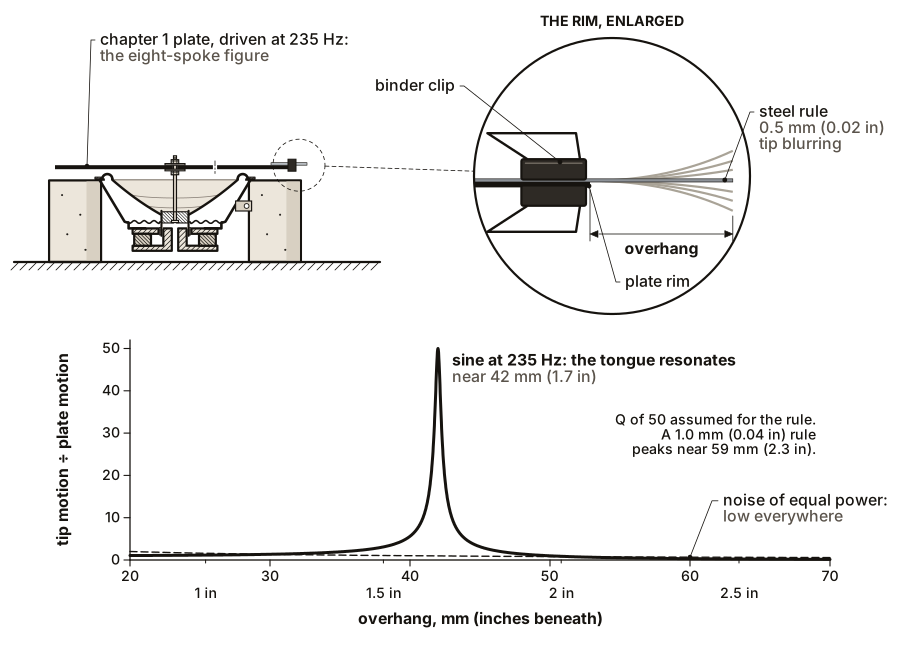
Take a thin steel rule and clip it to the rim of your chapter 1 plate with a small binder clip, so that a short tongue of steel sticks out beyond the edge like a diving board. Set the tone generator to the eight-spoke figure, near 235 Hz, and bring the volume up until the salt just stirs.
Now slide the rule outwards, two millimetres at a time. For most positions the tongue does nothing you can see. Then, at one overhang, its tip blurs into a grey smear and the plate’s note takes on a buzz. Two millimetres (0.08 in) further and the smear is gone. The plate pushes the rule equally hard at every position. Only at one length does the rule’s own natural frequency match the push, and only then does the motion add up.
That is Chapter 9 in one movement: x = QF/k, the motion at resonance is Q times what the same force would do held steady. This chapter is about what happens when the thing doing the multiplying is a bridge.
Section 1: The Rule That Keeps Time
The drive does not have to be strong. It has to be in time. A force that matches a natural frequency is multiplied by Q; a force a little off it is multiplied by almost nothing.
The experiment has a second half, and it is the one that matters for soldiers. Find the overhang where the tip blurs. Then switch the generator from a sine wave to noise, the hiss most generators offer as “white” or “pink” noise, at the same reading on the sound meter app. The same power, spread across every frequency at once, barely moves the rule. Only the sliver of noise inside the rule’s bandwidth, f/Q, does any work. The rest pushes at the wrong moments and cancels itself.
ON THE BENCH: The rule that keeps time
Parts: the chapter 1 rig; a thin steel rule 150 mm (6 in) long; a small binder clip; a pinch of salt; ear protection. Cost: about $3 for the rule if you have none. Time: 20 minutes. Hazards: the plate rim and the rule tip both move fast enough to nip a finger. Turn the volume down before moving the rule. Ear protection above 85 dBA. Method: clip the rule to the rim with a tongue of 20 mm (0.8 in) overhanging. Set the generator to about 235 Hz at a volume that just stirs the salt. Slide the rule outwards 2 mm (0.08 in) at a time, returning the volume to the same mark after each move. Sprinkle a few grains of salt on the tongue. What you should see: for a rule 0.5 mm (0.02 in) thick, the tip blurs and its salt leaps off near 42 mm (1.7 in) of overhang. A rule 1.0 mm (0.04 in) thick needs about 59 mm (2.3 in), because a cantilever’s frequency rises with its thickness and falls with the square of its length. Either side, the tongue sits nearly still. If it does not work: the clip’s weight can shift the plate’s figure a few hertz. Re-tune to wherever the plate sings loudest with the rule in place, and search again. Better, if you have one: with the tip blurring, switch to noise at the same meter reading. The tip goes almost quiet. That is what “break step” does to a bridge.
Section 2: Broughton, 1831
In 1826 a mill owner, John Fitzgerald, paid for an iron chain suspension footbridge across the River Irwell between Broughton and Pendleton, on the edge of Manchester. It spanned about 44 m (144 ft), hung from wrought-iron chains held down at each end by stay chains bolted into ground anchors.
On 12 April 1831 a detachment of the 60th Rifles, 74 men, was marching back to barracks from exercise on Kersal Moor. They crossed four abreast, in step. The contemporary reports, in the Manchester Guardian of 16 April 1831 and the Philosophical Magazine for 1831 (new series volume 9, pages 384 to 389), say the men felt the deck vibrate in time with their step and, finding it pleasant, humoured it with the way they stepped. Then a bolt in a stay chain snapped at its ground anchor, an iron column fell, and that end of the deck dropped into the river. About forty men went into the water or against the chains. More than twenty were hurt, six badly. Nobody died.
The bolt broke, and the marching broke it. The newspapers’ inquiry found the anchor relied on a single badly forged bolt, and that the engineer Eaton Hodgkinson had already warned, in a paper to the Manchester Literary and Philosophical Society, that the stay chains were weak and that bridge chains should be proof-tested. The bolt would probably have failed in time anyway. A rhythmic load gave it, in seconds, the largest swings it had ever carried. The British Army afterwards ordered troops to break step on bridges, and the order is still given. (The order is widely reported, but no printed copy of an 1831 instruction is known. The Philosophical Magazine report itself urged officers to dismiss their men from the ranks before crossing any chain bridge.)
Marching soldiers step about twice a second, and a light suspension footbridge has vertical modes in the same neighbourhood, between about one and three swings a second. Seventy-four men in step are seventy-four forces arriving together, multiplied by Q if their rhythm lands inside the bridge’s bandwidth. Seventy-four men out of step are noise. The same weight and the same footfalls, with almost none of them in time with anything.
IN PLAIN ENGLISH: A bridge has a rhythm it likes. Soldiers in step all push at once, and if their rhythm matches the bridge’s, every push adds to the last. Out of step, they push at random moments and the pushes mostly cancel. Breaking step does not make soldiers lighter. It makes them disorganised, and disorganised pushing builds nothing up.
Nineteen years later, on 16 April 1850, the Basse-Chaîne suspension bridge at Angers in France fell under a battalion crossing in a gale, and more than 220 soldiers died. An order to break step is said to have been given at the bridge; a corporal who was there wrote that it was not. The inquiry also blamed the storm and the swaying deck, which threw the men from side to side together as they fought for balance. Hold on to that. Section 4 shows how a crowd can fall back into step without meaning to.
Section 3: Tacoma Narrows: The Wind That Pushed Back
The Tacoma Narrows Bridge opened across Puget Sound on 1 July 1940. Its main span was 853 m (2,800 ft), and its deck was startlingly slender: 11.9 m (39 ft) wide, stiffened by a solid plate girder only 2.4 m (8 ft) deep along each side. From its first weeks the deck rose and fell in long slow waves in a moderate wind. Locals called it Galloping Gertie.
On 7 November 1940 the wind blew at about 68 km/h (42 mph). Then the motion changed. The deck began to twist, one half of the span rolling one way while the other half rolled the other, about a still centreline. It twisted twelve times a minute, 0.2 Hz, each twist larger than the last. About 45 minutes later the hangers broke and most of the main span fell into the water. A newspaper editor, Leonard Coatsworth, crawled from his car to safety; a dog left inside it was the only life lost.
For decades physics textbooks called this resonance: the wind shed whirlpools off the deck at a steady rate, they said, and that rate matched the bridge. In 1991 K. Yusuf Billah and Robert Scanlan corrected the story in the American Journal of Physics (“Resonance, Tacoma Narrows bridge failure, and undergraduate physics textbooks”, volume 59, pages 118 to 124).
Their first argument is arithmetic. Wind past a blunt body sheds whirlpools at a frequency set by a nearly constant ratio called the Strouhal number:
f = S × U / D
where U is the wind speed, D the depth of the body facing the wind, and S about 0.11 for this deck. With U = 18.8 m/s (61.6 ft/s) and D = 2.4 m (8 ft), the whirlpools left at about 0.85 Hz, more than four times the 0.2 Hz at which the deck was twisting itself apart. Simple forced resonance cannot explain it.
Their second argument is the one that matters. The twisting deck made its own push. As the deck rolled, it changed the angle at which the wind met it, which changed the wind’s force, and the change arrived in step with the roll. Each cycle the wind did a little net work on the deck. That is Chapter 10’s mechanism for a bowed string: a steady supply and a motion that times its own feeding. In Chapter 9’s language the wind gave the deck negative damping, and the ring-down ran backwards into a ring-up.
Flutter is a self-excited oscillation of a structure in a moving fluid, in which the structure’s own motion shapes the fluid’s forces so that they feed energy into the motion every cycle. Aircraft wings can flutter; so do flags, and so did this deck. Billah and Scanlan report that a 1:50 scale model of the whole bridge, tested in the 1950s, showed exactly one mode that grew without limit as the wind rose: a twisting mode that scales to 0.2 Hz at full size, setting in at the equivalent of about 56 km/h (35 mph).
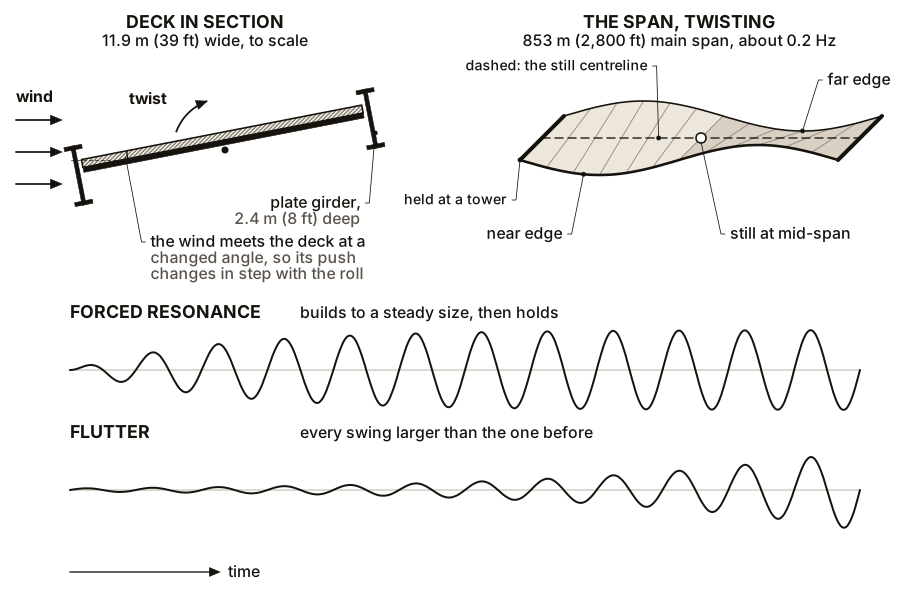
A forced resonance stops when the push moves off the natural frequency. Flutter has no outside frequency to move. The bridge chose its own rhythm. The replacement, opened in 1950, has a deep open truss under the deck that the wind blows through, and it still stands.
Section 4: The Bridge That Taught a Crowd to March
The London Millennium Bridge, a shallow steel suspension footbridge across the Thames, opened on 10 June 2000. It is 325 m (1,066 ft) long in three spans, the longest 144 m (472 ft), with a deck 4 m (13 ft) wide. About 90,000 people crossed it that day, up to 2,000 at once.
The deck began to sway from side to side, up to about 70 mm (2.8 in), and people on it walked with their feet planted wide, like sailors. The bridge closed two days later and reopened on 22 February 2002.
The engineers at Arup published their findings in The Structural Engineer in November 2001 (P. Dallard and six co-authors, “The London Millennium Footbridge”, volume 79, issue 22, pages 17 to 33). A walker pushes the ground slightly sideways with every step, left, right, so the sideways push repeats once per pair of steps, about once a second. The central span had sideways modes near 0.5 Hz and 1.0 Hz. A random crowd’s sideways pushes are noise. But once the deck moved a few millimetres (about a tenth of an inch), people adjusted their stride to keep their balance, and the adjustment put their push in step with the deck. More people in step meant more sway, which brought more people into step.
In December 2000 the team walked test crowds onto the closed north span, adding people a few at a time. Below a critical number nothing happened; above it the sway grew without limit. The crowd’s sideways force rose in proportion to the deck’s speed, which means the crowd acted as negative damping, as the wind had at Tacoma. The paper concludes that any footbridge with a sideways frequency below about 1.3 Hz could do the same if crowded enough.
In 2005 Steven Strogatz and four co-authors modelled each walker as an oscillator with its own rhythm, nudged slightly toward the rhythm of the deck (“Crowd synchrony on the Millennium Bridge”, Nature, volume 438, pages 43 to 44). In their model the swaying and the falling into step arrive together at a critical crowd size, each pumping the other. The soldiers at Broughton chose their step: one Manchester paper said they fell into a march on the bridge when one of them began to whistle a tune. This crowd was put in step by the bridge, so an order to break step could not have helped.
ON THE BENCH: Two pendulums on a string
Parts: two equal nuts about 20 g (0.7 oz) each; thread; a string about 1 m (3 ft) long; two chairs. Cost: nothing. Time: 15 minutes. Hazards: none. Method: tie the string between two chair backs, a little slack. Hang the nuts from it on threads 500 mm (20 in) long, 300 mm (12 in) apart. Hold one still, pull the other back a hand’s width along the line of the string, and let go. What you should see: it swings about once every 1.4 seconds. Over a few dozen swings it slows and stops, and the other is now swinging fully. Then the motion drifts back. Each pendulum nudges the other through the sagging string, always in step, so energy passes between them. Shorten one thread by 30 mm (1.2 in) and little energy crosses, because the two no longer share a natural frequency. Better, if you have one: two mechanical metronomes at the same tempo, on a light board resting on two empty drink cans lying on their sides. Start them out of step. Within a minute or two they tick together, because the rolling board nudges both toward one rhythm: the Millennium Bridge in miniature. James Pantaleone described it in the American Journal of Physics in 2002 (“Synchronization of metronomes”, volume 70, page 992).
Section 5: A Pendulum Inside a Building
The Millennium Bridge was cured with damping: 37 fluid dampers, like large shock absorbers, and 52 tuned mass dampers for vertical motion, at a cost of about £5 million. The paper reports damping above 20 percent of critical damping, which is the amount that would stop a disturbed deck without a single swing. In Chapter 9’s terms that is a Q of about two and a half, and a structure with a Q that low multiplies nothing much.
A tuned mass damper is a small mass on a spring, tuned to the natural frequency of the structure it protects and fitted with damping of its own. When the structure moves at that frequency the small mass swings hard, a quarter of a cycle behind, so it pulls back on the structure just when the structure moves fastest. It draws the structure’s energy into its own swing and turns it to heat in its damper. Hermann Frahm patented the idea for ships as US 989,958, “Device for Damping Vibrations of Bodies”, issued 18 April 1911.
The most famous one hangs in Taipei 101, a tower 508 m (1,667 ft) tall in a city of typhoons and earthquakes. A steel ball 5.5 m (18 ft) across, welded up from 41 plates and weighing 660 tonnes (728 short tons), hangs on cables from the 92nd floor, with dampers between the ball and the floor below. Its owners say it cuts the sway by up to 40 percent; that is their figure, not an independent measurement. During Typhoon Soudelor on 8 August 2015 the ball swung 1 m (39 in), its largest recorded movement.
A pendulum’s period depends only on its length, T = 2π√(L/g). Turned round, L = gT²/4π². A tower that sways once every 7 seconds needs a pendulum about 12 m (40 ft) long. The ball must hang as tall as the building is slow.
ON THE BENCH: A damper for a model tower
Parts: a steel rule 300 mm (12 in) long; a vice or clamp; about 200 g (7 oz) of nuts and tape; a 20 g (0.7 oz) nut on a thread; a stiff wire taped to the top as an arm; a small cup of water; a phone stopwatch. Cost: nothing to about $5. Time: 40 minutes. Hazards: a weighted rule whips back fast. Eyes clear of the top. Method: clamp the rule upright with 250 mm (10 in) free and tape the 200 g (7 oz) of nuts at the top. Pull the top 20 mm (0.8 in) aside, release, and time 20 sways; expect about two a second. Hang the small nut from the wire arm so it swings the same way. Adjust the thread until the nut, swinging alone with the tower held still, matches the tower’s time per swing; for two sways a second that is about 60 mm (2.4 in) from pivot to the middle of the nut. Release the tower again. What you should see: first a surprise. The tower stops, the pendulum swings wildly, then the tower starts again and the pendulum stops. Energy is passing back and forth, as between the pendulums on the string, and nothing is removing it. Now set the cup so the nut dips into the water. Release the tower. It now dies away in a few sways. If it does not work: if the pendulum barely moves, its length is wrong; change it 5 mm (0.2 in) at a time. If the rule bends over, use 150 g (5 oz) at the top.
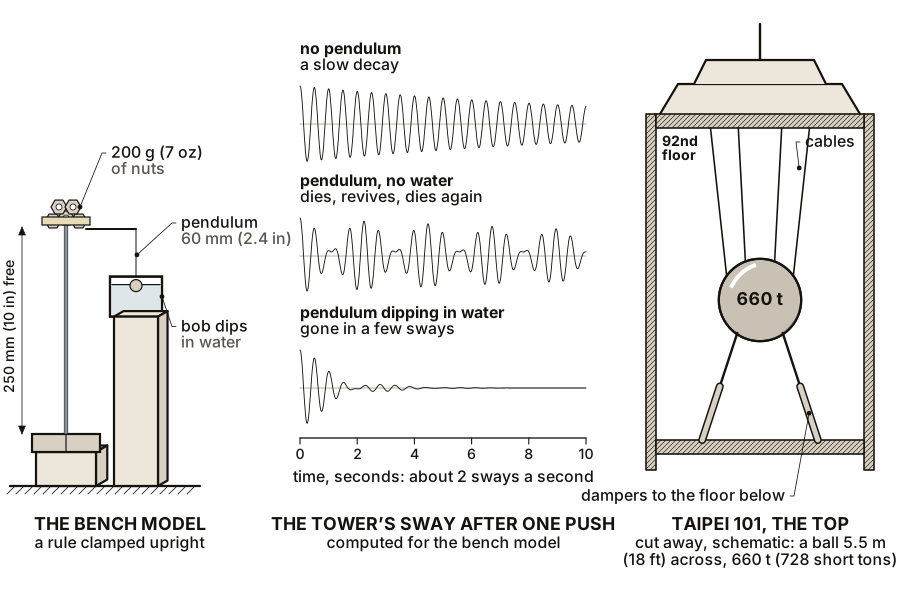
The bench shows what is easy to miss. A tuned mass with no damping does not cure a resonance; it splits it into two peaks, one a little below the old frequency and one a little above, and the tower still swings hard if pushed at either. The tuning puts the pendulum where the energy is. The damping takes the energy away. Since J. P. Den Hartog’s Mechanical Vibrations (first edition 1934), engineers have set both together, tuning slightly low and damping just enough to merge the two peaks into one low hump.
Section 6: What Each Failure Needed
Broughton needed a rhythm from outside, and a weak bolt. That is forced resonance, and the cure is to scramble the drive. Chapter 11’s Techno-Mart tower in Seoul, shaken in 2011 by an exercise class jumping in time on its 12th floor, was the same kind, and stopping the class stopped it.
Tacoma needed only a steady wind and a deck whose own twisting steered the wind’s force into it. That is flutter, and the cure is shape and damping.
The Millennium Bridge needed a crowd and a deck that moved enough to be felt. The bridge and the crowd built the rhythm between them. That is self-excitation through people, and the cure was enough damping to stop the first few millimetres from growing.
SLOW DOWN. Check Your Understanding: Suppose the Tacoma engineers had known in advance and hung a tuned mass damper inside the deck, tuned to 0.2 Hz. Would it have saved the bridge? Answer before you read on.
For a while, perhaps, and not on 7 November. A damper adds positive damping and flutter is negative damping, so the two fight. Billah and Scanlan’s paper includes a table showing that the more mechanical damping the deck has, the higher the wind speed at which flutter begins. A damper would have raised the wind the deck could survive. But the wind’s negative damping grows as the wind rises, while a damper’s help is fixed, so for any damper there is a wind that beats it, and on the day of the collapse the wind was well above the speed at which the bare deck began to flutter. That is why the cure was a new shape. The 1950 bridge’s open truss changed how the wind’s force depended on the twist, so that at any wind it was likely to meet, the wind took energy out of the twisting instead of putting it in. For flutter, damping buys margin and shape removes the cause.
Every one of these structures did on a large scale what the steel rule did on your plate: a natural frequency, a Q, and a push in time. What differs is only what the motion is asked to bear. Chapter 13 takes resonance indoors, into a bottle, a church wall and a medieval jar, where the spring is made of air.

Bench Degree
Get the degree without the diploma.
Learn the material, not how to pass the exam.