Bench Degree·CYMATICSchapter

Chapter 13: The Bottle and the Wall
An empty bottle has one note, and you can work it out with a ruler before you blow. The same arithmetic finds jars hidden in the walls of medieval churches, and it disposes of a gargoyle in ninety seconds.
Find an empty glass bottle, the narrow-necked kind that beer or soda comes in. Rest your lower lip against the rim, point your breath across the mouth, and blow a thin, gentle stream, like whistling without pursing your lips. After a few tries you will get a hollow, breathy note, a foghorn in miniature. Blow harder and the note gets louder but stays at the same pitch.
Now pour in a little water and blow again. The note is higher. Pour in more, and it is higher still. The bottle has one note, and it is set by the air left inside it. Nothing else you do with your breath will change it much.
This chapter works out that note from three measurements, then follows the same idea into a physicist’s laboratory in Heidelberg, into the walls of medieval churches, and up onto the roof of a cathedral, where a popular claim about gargoyles turns out to need a cavity the size of a chest freezer.
Section 1: A Spring Made of Air
Chapter 3 built every vibration from two things, a mass and a spring. The bottle has both, and both are air.
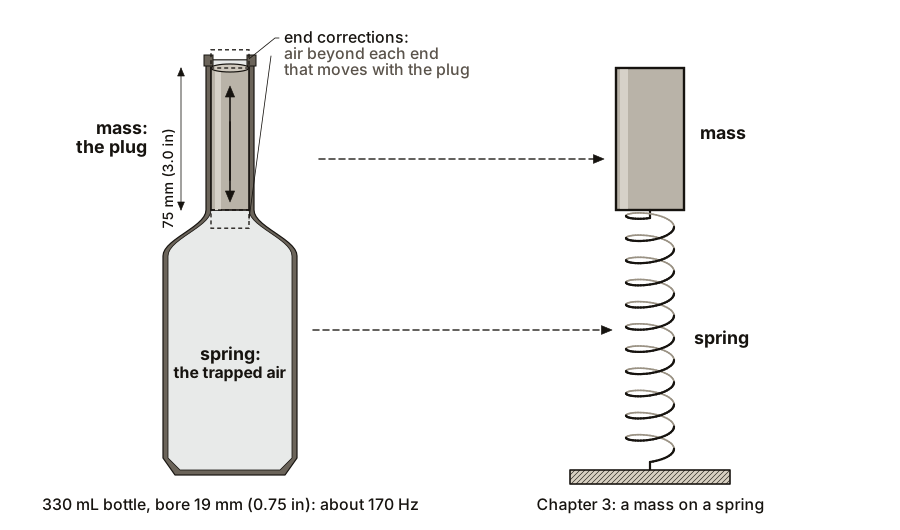
The mass is the plug of air in the neck. It is a short cylinder of air weighing a few hundredths of a gram, and it can slide in and out of the neck like a piston. The spring is the air in the body of the bottle. Push the plug inwards and it squeezes the trapped air, which pushes back. Pull the plug outwards and the trapped air is left at lower pressure, which pulls it back in. A mass on a spring has a natural frequency, so the plug bounces in and out of the neck at one rate, and the stream of your breath across the mouth gives it a small kick every cycle, in the way Chapter 10’s bow keeps a string going.
A container of air with a narrow opening, in which the air in the opening moves as a mass on the spring of the air inside, is called a Helmholtz resonator, after the German physicist who used them by the dozen. Its natural frequency is:
f = (c / 2π) × √( A / (V × L_eff) )
where c is the speed of sound, 343 m/s (1,125 ft/s) at room temperature, A is the area of the neck’s opening, V is the volume of air in the body, and L_eff is the effective length of the neck.
Each part of the formula has a plain meaning. A bigger body is a softer spring, so the note falls. A longer neck is a heavier plug, so the note falls. A wider neck lets the plug move more air for the same squeeze, which stiffens the spring more than it adds mass, so the note rises. The speed of sound comes in because it carries how stiff and how heavy air is.
IN PLAIN ENGLISH: The air in the neck of a bottle is like a cork that can bounce in and out. The air in the belly of the bottle is the spring it bounces on. A bigger belly is a softer spring and a lower note. A longer neck is a heavier cork and a lower note. Pouring in water shrinks the belly and stiffens the spring, so the note goes up.
The effective length is a little longer than the neck you can measure, because the plug of air drags some of the air just beyond each end along with it. Lord Rayleigh worked this out in 1871 (“On the theory of resonance”, Philosophical Transactions of the Royal Society, volume 161, pages 77 to 118). For an opening of radius r, about 0.85 r is added at an end that opens into a flat wall or a wide space, and about 0.6 r at an end that sticks out into open air. A bottle neck has one of each, so a good working rule is:
L_eff = L + 1.5 r
Section 2: Predicting the Note
Here is a worked example for a typical small glass bottle, holding 330 mL, with a neck bore of 19 mm (0.75 in) across and a straight neck 75 mm (3.0 in) long.
The radius is 9.5 mm (0.37 in), so the opening’s area is π × 9.5², which is 284 mm² (0.44 in²). The effective length is 75 + 1.5 × 9.5, which is 89 mm (3.5 in). In metres and cubic metres, A / (V × L_eff) is 0.000284 / (0.000330 × 0.089), which is 9.67. Its square root is 3.11. And c / 2π is 343 / 6.283, which is 54.6.
So the bottle should sound 54.6 × 3.11, about 170 Hz, a little below the F below middle C. Blow across a real bottle of that size and you will hear something close. Within 10 percent is a good result, because a real neck flares into the shoulder of the bottle and nobody can say exactly where it ends. That uncertainty is in L, and it is the largest error in the calculation.
ON THE BENCH: Predict a bottle, then blow it
Parts: two or three glass bottles of different sizes; a ruler; a kitchen measuring jug; a pencil, to measure the bore; a phone with a tuner app, or a spectrum app, which shows which frequencies are present (Chapter 16); a calculator. Cost: nothing. Time: 30 minutes. Hazards: none, unless you are light-headed from blowing. Stop and breathe normally. Method: fill each bottle to the brim from the jug to measure its volume, then empty and dry it. Measure the inside diameter of the neck by pushing in a pencil wrapped with paper until it just fits, then measuring the paper roll. Measure the neck from the rim to where the glass starts to flare. Work out the predicted note with the formula. Then blow across the bottle with the phone’s tuner a hand’s width away, or slap your palm flat over the mouth and pull it sharply away, which makes the bottle “pop” at its own note. What you should see: a measured note within about 10 percent of your prediction, and usually a little lower, because the flaring shoulder makes the true neck longer than the part you measured. If it does not work: if the tuner jumps about, it is hearing your breath. Use the palm pop instead; it is a cleaner single note. If the measured note is roughly double or triple your prediction, the tuner has locked onto an overtone of the noise. Hum the note you hear and check it against the tuner.
The formula makes one clean prediction you can test without worrying about the neck at all. Halve the volume of air and the note rises by √2, which is 1.414, about six semitones on a piano. With 165 mL of water in the 330 mL bottle, the 170 Hz note should become about 240 Hz. Everything else about the bottle, including the uncertain neck length, stays the same, so the ratio should come out right even when the absolute note does not.
ON THE BENCH: Water steps
Parts: one bottle from the box above; water; the measuring jug; the phone tuner; graph paper. Cost: nothing. Time: 20 minutes. Hazards: none. Method: measure the empty bottle’s note. Add water in steps of one tenth of the bottle’s volume, measuring the note after each step, until the bottle is about two thirds full. Above that the water reaches the shoulder and the body is no longer the shape the formula assumes. For each step, work out the air volume left. Plot the note against 1 / √(air volume). What you should see: the points lie close to a straight line through zero. Plot the note against the air volume itself and you get a curve. The check that can fail is the halfway point: the half-full note divided by the empty note should be close to 1.41. If it comes out near 2, you have been reading an overtone.
Section 3: Helmholtz’s Glass Spheres
Hermann von Helmholtz was a physician turned physicist who wanted to know what the ear actually hears when it hears a note. He worked out the theory of air vibrating in tubes and cavities in a long paper of 1860, and in 1863 he published Die Lehre von den Tonempfindungen, which Alexander Ellis translated into English in 1875 as On the Sensations of Tone. In it he describes the instruments that now carry his name:
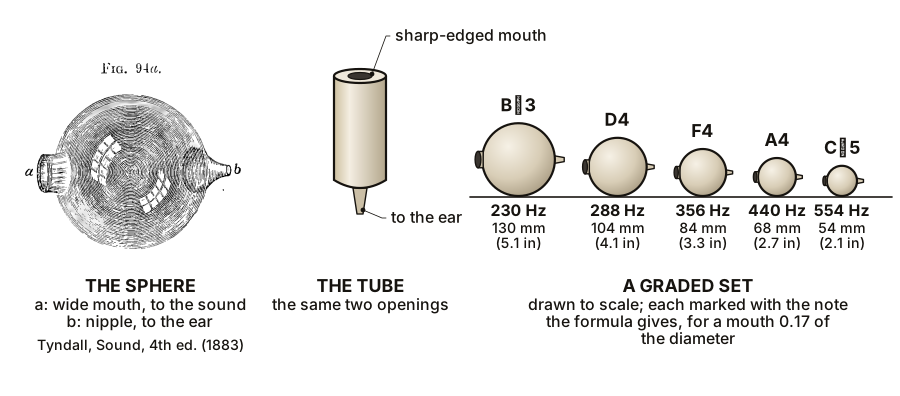
“These are hollow spheres of glass or metal, or tubes, with two openings.” One opening has sharp edges and faces the sound. The other is a small funnel that fits into the ear, and Helmholtz moulded warm sealing wax around it so it sealed against his ear canal. He stopped his other ear, listened, and found that most sounds became muffled, “but if the proper tone of the resonator is sounded, it brays into the ear most powerfully” (Ellis translation, 1875, pages 68 to 69).
A Helmholtz resonator answers one frequency and ignores the rest. Helmholtz had them made in graded sets, each tuned a step higher than the last, and with one held to his ear he could pick out a single pure tone hidden inside the sound of a violin or a voice. If the resonator for the 2nd, 3rd or 5th multiple of a note’s frequency brayed when that note was played, the note contained that component. With a row of glass spheres he took apart a sound into its ingredients, a job Chapter 16 will give to a phone app. He also noticed that the resonators were not choosy about the source: “The proper tone of the resonator may even be sometimes heard cropping up in the whistling of the wind, the rattling of carriage wheels, the splashing of water.”
ON THE BENCH: Helmholtz’s ear
Parts: a bottle whose note you have measured; a running tap, a fan or a busy street; your voice. Cost: nothing. Time: 10 minutes. Hazards: never seal a bottle tightly against your ear and never let anything make a loud sound near it. Hold the mouth close to the ear, not in it. Method: stand near a running tap. Block one ear with a fingertip, and hold the bottle’s mouth about 10 mm (0.4 in) from the other. Listen. Then take the bottle away and put it back, several times, as Helmholtz advised. Next, hum quietly and slide your hum slowly up and down across the bottle’s note. What you should see: with the bottle at your ear the tap’s hiss acquires a hollow tone, the bottle’s own note, picked out of the noise. When your hum crosses the bottle’s note, the bottle roars in your ear and you can feel it buzz in your hand. A semitone either side, it goes quiet. If it does not work: to check that you are hearing the bottle and not imagining a pitch, pour in a little water. The note you hear in the hiss should rise, by the amount the formula predicts.
Section 4: Jars in the Walls
Helmholtz gave the resonator its theory and its name. He did not invent it. Around 25 BC the Roman architect Vitruvius, in Book V, chapter 5 of De Architectura, told theatre builders to set bronze vessels in small chambers under the seats, sized so that they “may produce with one another the notes of the fourth, the fifth, and so on up to the double octave”, turned upside down and propped on wedges. A voice from the stage, he says, “will be increased in clearness of sound, and will wake an harmonious note in unison with itself” (Morgan translation, 1914). He adds that the Roman general Lucius Mummius, after destroying the theatre at Corinth, brought its bronze vessels to Rome, and that builders in poorer towns, “for lack of means, taken large jars made of clay” instead. No ancient theatre vessels survive, and whether Greek theatres ever used them is unknown.
Medieval builders took Vitruvius at his word. In churches across Europe, earthenware jars were built into the walls, floors and vaults of the choir, where the clergy sang, with their mouths open to the room. Examples are known from many churches in France, and others in Britain, Ireland, Scandinavia and eastern Europe. In St Peter Mancroft in Norwich, rows of red earthen jars were found in 1850 built into the walls of two trenches under the old choir stalls, mouths facing each other, “like guns projecting from a ship’s side”. At Fountains Abbey in Yorkshire, pots were mortared into the base of the choir screen. In St Andrew’s, Lyddington, in Rutland, a row of jars still opens high in each chancel wall.
There is one written record of why. The chronicle of the Celestine monastery at Metz records under the year 1433 that the prior, returning from a general chapter of the order, had pots placed in the choir because he believed they made the singing better and louder. The chronicler doubted it: “I do not know whether they sing better than they used to.” The passage reached English readers in a translation printed by G. W. Minns in Norfolk Archaeology in 1872.
Run the formula on a jar. Take a pot holding 4 L (about a gallon), with a mouth 60 mm (2.4 in) across, set into a wall so its neck runs 30 mm (1.2 in) through the plaster, and flush with the wall at both ends of the neck, so each end gets the full 0.85 r. Then L_eff is 30 + 1.7 × 30, which is 81 mm (3.2 in), and the note comes out at about 160 Hz. That is the middle of a man’s speaking and singing voice. Whoever chose those pots, by rule of thumb or by Vitruvius, chose them in the right size range for the job.
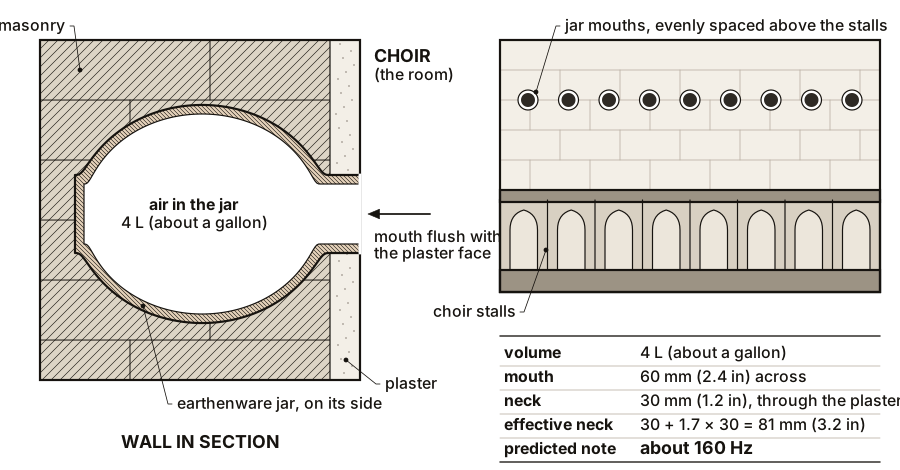
What the jars actually did is still argued, and honestly so. A resonator does not make a room louder. It takes energy from the sound at its own frequency and gives most of it back a little later and a little to the side, and loses some to friction in its neck. Jean-Christophe Valière and three colleagues surveyed 25 French churches that still contain pots and reported in Acta Acustica united with Acustica in 2013 (volume 99) that the pots are tuned near the range of the voice and that measurements are consistent with an acoustic purpose, mainly shortening how long the room keeps ringing at those frequencies, the quantity Chapter 17 measures as reverberation time. Whether a few dozen small jars can do much to the enormous volume of air in a stone church is doubtful, and some historians think the jars mattered as much as a gesture toward Vitruvius as for their sound. The object is real, the physics in it is real, and the size of the effect is unsettled.
Section 5: The Gargoyle and the Freezer
Now a claim that circulates widely and does not survive the formula. It says that gargoyles on Gothic cathedrals were not drainage spouts but acoustic resonators, tuned to 7.83 Hz.
Start with the number. 7.83 Hz is the Schumann resonance, a real and measurable resonance of the Earth’s atmosphere. Chapter 14 explains it. It is a resonance of radio waves, electric and magnetic fields, between the ground and the electrically charged upper atmosphere. Nothing in it moves air, so it has nothing to do with a stone spout. When 7.83 Hz appears in a claim about sound, that is the first thing to check.
Then ask what size a 7.83 Hz sound wave is. Its wavelength is the speed of sound divided by the frequency, 343 / 7.83, which is 43.8 m (144 ft), longer than the nave of many churches. A gargoyle is about 1 m (3 ft) long.
Then run the Helmholtz formula backwards, which is the decisive step. Rearranged for the volume:
V = A × c² / (L_eff × (2πf)²)
Be generous. Give the gargoyle a throat channel with an opening of 300 cm² (47 in²), which is a radius of about 98 mm (3.9 in), running 800 mm (31 in) through the stone. Its effective length is 800 + 1.7 × 98, which is about 970 mm (38 in). Then:
V = 0.03 × 343² / (0.97 × (2π × 7.83)²) = 3,530 / 2,350 = 1.5 cubic metres (53 cubic feet)
That is 1,500 L, about 400 US gallons, a cavity the size of a large chest freezer hidden inside a carved stone spout. The open channel of a real gargoyle is a gutter with a lid on it, holding a few litres, perhaps a gallon. The claim is wrong by a factor of about three hundred.
IN PLAIN ENGLISH: To hum at 7.83 Hz, a resonator would need a body the size of a chest freezer behind its throat. A gargoyle is a stone gutter with a face. You could hollow out the whole statue and still not fit in the air the claim requires.
Two more facts finish it. The word itself is against the claim: gargouille is Old French for throat, the root of the English gargle, and medieval builders used the spouts to throw rainwater clear of the walls, which is what they still do. And a device on the outside of a wall cannot shape the sound inside the building, where the singing is. The real resonators, the jars, were inside, open to the choir, and sized for voices.
The habit matters more than the verdict. You were given a claim with a number in it. You checked whether the number was the right kind of quantity, then put it into the formula the claim itself relied on, and the formula answered.
SLOW DOWN. Check Your Understanding: Air on a mountain top at 3,000 m (9,800 ft) is about 30 percent less dense than at sea level. Carry a bottle up there at the same temperature and blow across it. Is its note lower, higher or the same? Answer before you read on.
The same. Thinner air makes the plug in the neck lighter, which would raise the note. But it also makes the trapped air a softer spring, because there is less of it to squeeze, which would lower the note. The two effects cancel exactly, which is why air’s density does not appear anywhere in the formula; it is hidden in the speed of sound, and the speed of sound does not depend on density at a fixed temperature. What does change the note is temperature. Warm air is a stiffer spring for its weight, and the speed of sound rises with it. Take the bottle from a 20 °C (68 °F) room into a 4 °C (39 °F) refrigerator and c falls from 343 m/s (1,125 ft/s) to about 334 m/s (1,096 ft/s), so the 170 Hz bottle drops about 4 Hz, which a tuner app will show. Organists know this well: a church organ’s pipes go flat on a cold winter morning, and every pipe goes flat by the same ratio.
The bottle, the glass sphere and the jar in the wall are one device. So, it turns out, is the entire planet, if you are patient enough to wait almost an hour for each cycle. That is Chapter 14.

Bench Degree
Get the degree without the diploma.
Learn the material, not how to pass the exam.