Bench Degree·CYMATICSchapter
Chapter 14: The Earth Rings
After the largest earthquake ever recorded, the whole planet rang like a struck bell, one slow swing every 54 minutes. An inventor had named its period half a century earlier, and given twice the true figure.
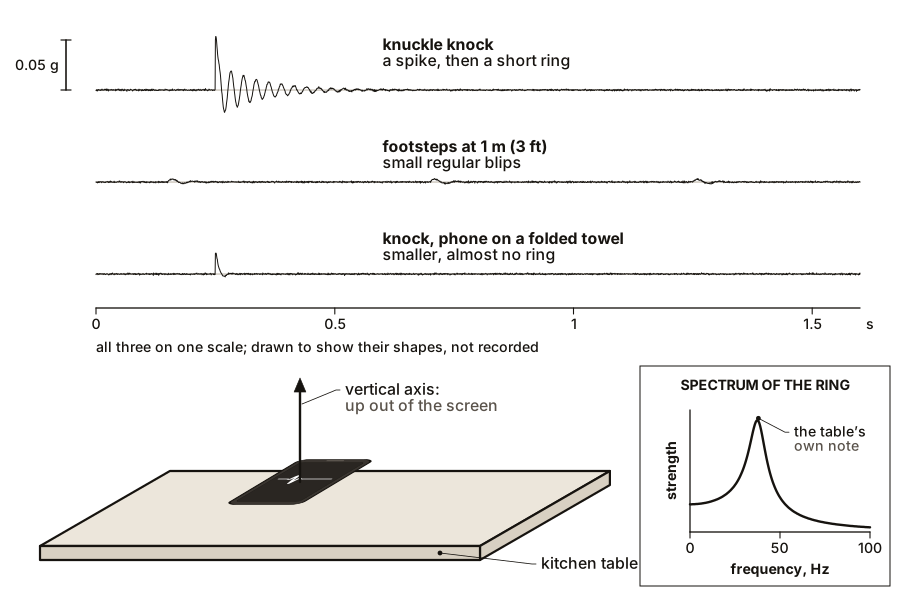
Lay your phone flat on the kitchen table and open a free accelerometer or physics-sensor app, the kind that draws a live graph of how the phone is being shaken. Choose the axis that points straight up out of the screen. Leave the phone alone and the trace is a fuzzy flat line. Now knock once on the far end of the table with a knuckle. The line jumps, rings for a moment, and settles. Walk across the room and each footstep makes a small blip. Drop a book on the floor and the table feels it.
You have built a seismometer, an instrument that records the shaking of the ground. Inside the phone a tiny mass sits on a microscopic spring, and the chip measures how far the spring is squeezed when the table moves.
The knock on the table is a small version of what happened on 22 May 1960, when the ground off southern Chile slipped along a fault about 1,000 km (620 miles) long. For days afterwards the whole Earth vibrated, and a handful of instruments caught it ringing. This chapter is about that ringing, about an inventor who claimed to know its period, and about a second way the Earth rings, which is not sound at all.
Section 1: A Seismometer on the Kitchen Table
The app reports acceleration, often as a fraction of g, the acceleration of gravity. Lying still, the phone reads one g on the upward axis, because the table holds it up against gravity, and every shake is a wiggle above or below that.
ON THE BENCH: A seismometer on the table
Parts: a phone with a free accelerometer app that can record and show a spectrum; a table; a folded towel; a second person, if you can find one. Cost: nothing. Time: 20 minutes. Hazards: none. Method: lay the phone flat in the middle of the table and start recording the vertical axis. Knock once at the end of the table. Then have someone walk past at 1 m (3 ft), 3 m (10 ft) and 6 m (20 ft) from the table. Then knock again, and look at the spectrum of the ringing after the knock, the app’s view that shows which frequencies are present. Finally fold the towel twice, put the phone on it, and repeat the knock and the walking. What you should see: the knock makes a sharp spike and then a short ring that dies in a fraction of a second. The spectrum shows a peak in the tens of hertz: that is your table’s own natural frequency, struck like a very dull bell. Footsteps make blips of a few thousandths of g close by, fading with distance. On the folded towel the knock’s ring is weaker and the footsteps fade sooner. The towel is a soft spring between table and phone, and Chapter 20 shows why it filters out the faster shaking. If it does not work: if every trace looks like noise, the app may be smoothing its data; look for a setting for raw data or highest sample rate. If the towel makes no difference at all, the check has failed: the phone is probably touching the table through a stiff case edge. Take the case off. Better, if you have one: run the app overnight on a solid floor at ground level. You will see the fridge start and the traffic pass. You will not see earthquakes on the far side of the world; the instruments that recorded the Earth’s ringing sense motions about a hundred thousand times smaller than your phone can.
Section 2: Waves Through Rock
When rock breaks in an earthquake, the shaking travels outwards as seismic waves: waves of compression and shear carried through the rock of the Earth itself. Chapter 4 built waves on a coil spring and a string. Rock carries two kinds through its body, and the difference between them told geologists what the inside of the Earth is made of.
The faster kind is the P wave, for primary. It squeezes and stretches the rock along the direction it travels, the way sound travels through air. In the crust it moves at about 6 km/s (3.7 miles/s); deeper down, where the rock is hotter but squeezed far harder, it speeds up to about 13.7 km/s (8.5 miles/s) at the bottom of the mantle, about 2,890 km (1,800 miles) down.
The slower kind is the S wave, for secondary. It shakes the rock from side to side across the direction of travel, like a flick sent down a rope. It moves at about 3.5 km/s (2.2 miles/s) in the crust and about 7.3 km/s (4.5 miles/s) at the bottom of the mantle. A liquid cannot carry a sideways shake, because a liquid does not spring back when you shear it. S waves stop dead at the boundary of the Earth’s outer core, and that shadow is the evidence that the outer core is molten iron.
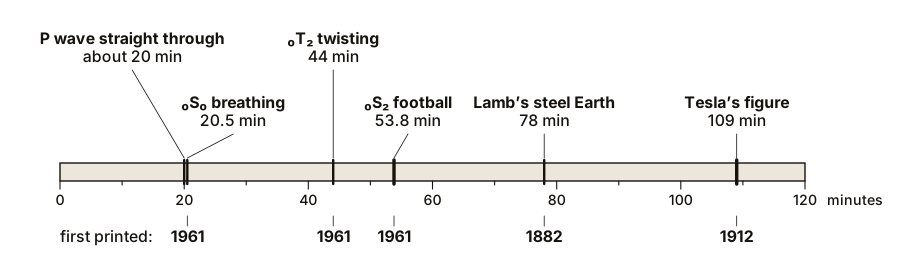
A P wave sent straight down through the centre covers the Earth’s diameter of 12,742 km (7,918 miles) in about 20 minutes. That number comes back in Section 5.
IN PLAIN ENGLISH: An earthquake sends two kinds of shove through the planet. One is a push and pull, like sound, and it is fast. The other is a side-to-side shake, slower, and it cannot get through liquid. Where the shake goes missing, there is liquid underneath. A push sent straight through the Earth comes out the other side in about twenty minutes.
Section 3: Chile, 1960: The Bell Is Struck
A struck bell rings at its own natural frequencies, in its own modes, as Chapter 4 showed for a string and Chapter 5 for a plate. Any solid body of any size does the same. The Earth, struck hard enough, rings in its own modes.
The idea is old. In 1882 the mathematician Horace Lamb worked out the vibrations of a solid elastic sphere (“On the Vibrations of an Elastic Sphere”, Proceedings of the London Mathematical Society, volume 13, pages 189 to 212), and at the end did one sum: a steel ball the size of the Earth would ring, in its slowest mode, once every hour and eighteen minutes. Lamb’s Earth was steel all through and had no gravity. The real one has an iron core, a liquid layer, rock that stiffens with depth, and its own weight pulling it back into shape. By the late 1950s Chaim Pekeris and colleagues at the Weizmann Institute had computed the periods for a layered Earth, and the slowest came out near 53 minutes. Nobody had measured it. (Hugo Benioff of Caltech had reported a wave of about 57 minutes after the Kamchatka earthquake of 1952, but the identification was doubted.)
Then, on 22 May 1960, came the Valdivia earthquake in Chile, magnitude 9.5, still the largest ever recorded. Within a year three groups published the Earth’s ringing side by side in the Journal of Geophysical Research, volume 66 (1961): Benioff, Frank Press and Stewart Smith of Caltech, with a strain meter; Norman Ness, John Harrison and Louis Slichter of the University of California, Los Angeles, with a gravity meter; and Leonard Alsop, George Sutton and Maurice Ewing of Columbia’s Lamont observatory, with long-period seismographs. All three found the same sharp peaks.
A normal mode of the Earth is one of the shapes in which the whole planet can vibrate freely at its own fixed period, after a great earthquake has set it going. The slowest is called ₀S₂, spoken “zero S two”, in which the Earth stretches into a slight rugby-ball shape, then squashes into a pumpkin, then back. Its period, measured by Smith in the Chilean records, was 53.8 minutes. Two others are worth knowing by sight. In ₀S₀ the whole Earth swells and shrinks evenly, every point on the surface rising and falling together, once every 20.5 minutes. In ₀T₂ the northern and southern hemispheres twist back and forth against each other about the axis, once every 44 minutes.
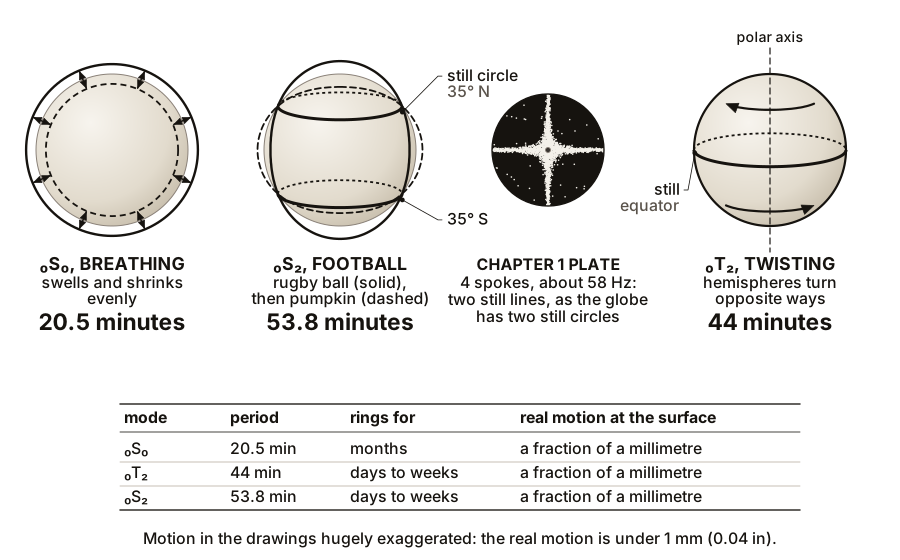
The still circles on ₀S₂ are nodal lines, like the salt lines on your plate. The Earth’s slow modes are Chladni figures with oceans on them.
ON THE BENCH: A planet in a cake tin
Parts: a round straight-sided cake tin about 230 mm (9 in) across, or the largest round straight-sided container you own; water; a phone stopwatch, or a metronome app; a pinch of ground pepper. Cost: nothing. Time: 30 minutes. Hazards: water near the phone. Work on a towel. Method: pour in water to a depth of 40 mm (1.6 in) and let it settle. Nudge the tin sharply sideways once and watch the water slop from side to side. Time ten slops. Then let it settle again, and tap the rim gently with a fingertip at a steady rhythm, using the metronome app, starting slow and raising the tempo a few beats per minute at a time. Sprinkle the pepper on the surface to help you see the motion. What you should see: the sideways slop takes about 0.67 seconds per cycle in a 230 mm (9 in) tin; one side rises while the other falls, and along the diameter between them the water stays level. That level line is a node. As you raise the tapping tempo you find a second shape near 2.3 cycles a second, with two high places opposite each other and two low ones between, rising and falling in turn: the tin’s version of ₀S₂. Near 2.7 cycles a second the centre bobs while the edge moves the other way, a version of the breathing mode. If it does not work: shallow water slops more slowly, so check the depth. If the higher shapes will not appear, tap more gently. Better, if you have one: a round tub 500 mm (20 in) across, with the same depth of water, slops once every 1.4 seconds or so. Bigger is slower.
The water in the tin is pulled level by gravity alone; the Earth is pulled back to shape by gravity and by the stiffness of its rock. The shapes are the same family. The springs are different.
Section 4: Sumatra, 2004: Ringing for Months
On 26 December 2004 the sea floor off northern Sumatra slipped in an earthquake of magnitude 9.1 to 9.3, one of the three largest ever recorded, and the cause of the Indian Ocean tsunami. By then the world had a network of superconducting gravity meters, instruments that sense changes in gravity of less than a ten-billionth of g. They recorded the Earth ringing in all its slow modes.
The breathing mode, ₀S₀, rang longest. Séverine Rosat, Shingo Watada and Tadahiro Sato analysed 13 of those gravity records and reported in Earth, Planets and Space in 2007 (volume 59, pages 307 to 311) that ₀S₀ has a frequency of 0.8146566 thousandths of a hertz, a period of 20.5 minutes, and a Q of 5,506. Chapter 9 gave you the link between Q and ring-down time: τ = Q / (π × f). Put in the numbers:
τ = 5,506 / (π × 0.000815) = 2,150,000 seconds, which is about 25 days.
Every 25 days the planet’s breathing fell to about a third of what it had been. The records followed it for three months, until another great Sumatran earthquake, on 28 March 2005, struck the bell again. The aluminium plate on your bench has a τ of about 0.4 seconds (Chapter 9). The Earth, in its breathing mode, rings for months. The other slow modes lose energy faster, mostly in the warm, slightly soft rock of the upper mantle, and die away over days to weeks.
The surface motion in these modes is a fraction of a millimetre even after the greatest earthquakes, spread over a swing lasting most of an hour. Nobody standing on the ground can feel it. Only the instruments hear the bell.
Section 5: Tesla’s Hour and Forty-Nine Minutes
Nikola Tesla, whose earthquake story filled Chapter 11, gave a figure for the Earth’s period three times in print, decades before anyone measured one.
In February 1912 the journalist Allan Benson quoted him in The World To-Day: “The vibrations of the earth have a periodicity of approximately one hour and forty-nine minutes. That is to say, if I strike the earth this instant, a wave of contraction goes through it that will come back in one hour and forty-nine minutes in the form of expansion.” Tesla went on to say that a ton of dynamite exploded at the right moment, again and again, would build the motion up until “the earth would be split in two.”
In the New York American on 7 February 1915, in an article under his own name, “How Cosmic Forces Shape Our Destinies”, he wrote that the Earth “is a sphere of a rigidity slightly greater than that of steel and vibrates once in about one hour and forty-nine minutes.” And in the Electrical Experimenter for February 1919, picturing the Earth as a rubber bag of water worked by a pump, he wrote of strokes “effected in intervals of more than one hour and forty-eight minutes.”
None of the three says where the number came from. It is not Lamb’s 1 hour 18 minutes for a steel Earth, though Tesla’s mention of steel suggests he was thinking along Lamb’s lines, and no published calculation of the period gives it. It is a little over twice the slowest real mode.
The mode Tesla actually describes, a contraction and an expansion of the whole Earth, is the breathing mode, ₀S₀. Its real period is 20.5 minutes. Against the slowest mode his figure was twice too long; against the mode his own words describe, it was five times too long. His picture of a wave that “goes through” the Earth and “comes back” fails a speed check too. A wave that crosses the Earth’s diameter and returns, 25,484 km (15,835 miles) in 109 minutes, would be travelling at 3.9 km/s (2.4 miles/s), slower than an S wave in surface rock. A real P wave crosses in about 20 minutes. The planet is a much quicker bell than he thought.
ON THE BENCH: The Earth on paper
Parts: a calculator; the numbers in this chapter. Cost: nothing. Time: 15 minutes. Hazards: none. Method: Lamb found that a steel ball of radius 1 cm (0.4 in) rings in its slowest mode at about 136,000 Hz, and that for a steel ball of any other size the frequency is that number divided by the radius in centimetres. Work out the frequency, and then the period in minutes, for a steel ball bearing 25 mm (1 in) across; for a steel ball the size of a house, 10 m (33 ft) across; and for a steel ball the size of the Earth, radius 6,371 km (3,959 miles), which is 637,100,000 cm. Compare the last with the measured 53.8 minutes and with Tesla’s 109. What you should see: the bearing rings near 109,000 Hz, far above hearing; the house-sized ball near 270 Hz, a note you could sing; the Earth-sized ball at about 0.00021 Hz, a period of about 78 minutes, Lamb’s 1 hour 18 minutes. A steel Earth would ring slower than the real one. The real Earth’s iron core, its stiffer deep rock and its own gravity all push the period down, to 54 minutes. If it does not work: if your Earth period comes out in fractions of a second, you have divided by the radius in metres instead of centimetres.
Section 6: The Other Ringing
The planet has a second resonance, and it has nothing to do with rock. Between the ground and the ionosphere, the layer of electrically charged gas beginning about 60 to 90 km (40 to 55 miles) up, lies a thin shell of air. Both surfaces conduct electricity, so the shell traps radio waves. Lightning, striking somewhere in the world about fifty times a second, fills it with radio noise, and the noise rings at the shell’s own frequencies.
In 1952 the German physicist Winfried Otto Schumann predicted those frequencies (“Über die strahlungslosen Eigenschwingungen einer leitenden Kugel, die von einer Luftschicht und einer Ionosphärenhülle umgeben ist”, Zeitschrift für Naturforschung, volume 7a, page 149). For perfectly conducting walls the formula is simple: the light speed divided by the Earth’s circumference, multiplied by √(n(n+1)) for n = 1, 2, 3 and so on. With light at 300,000 km/s (186,000 miles/s) and a circumference of 40,030 km (24,870 miles), the lowest comes out near 10.6 Hz. In 1960 Martin Balser and Charles Wagner measured the real spectrum (Nature, volume 188, page 638). The peaks sat lower, near 7.8, 14 and 20 Hz, because the ionosphere is a leaky, lossy wall. The lowest is now usually quoted as 7.83 Hz, and it has been measured ever since. Its wavelength, the speed of light divided by 7.83, is about 38,000 km (24,000 miles): almost exactly one wave fits around the planet.
That is a real, measured resonance of the Earth, and it is electromagnetic: a ringing of electric and magnetic fields, the same stuff as radio and light. It moves no air and no rock, and a loudspeaker cannot play it. Its magnetic part is about fifty million times weaker than the Earth’s steady field that turns a compass.
It gets confused with cymatics because both are called “the resonance of the Earth”, both are given in hertz, and 7.83 Hz is a frequency a big speaker can play, so it is easy to believe that a 7.83 Hz tone matches the planet. A 7.83 Hz sound wave in air is about 44 m (144 ft) long and is a pressure wave; a 7.83 Hz Schumann wave is about 38,000 km (24,000 miles) long and is a radio wave. They share a number and nothing else, which is the check Chapter 13 used on the gargoyles. And the two real ringings of the Earth are far apart: the Schumann resonance is about 25,000 times higher in frequency than the planet’s slowest mechanical mode.
SLOW DOWN. Check Your Understanding: Lamb’s steel ball rings at a frequency inversely proportional to its size: half the size, twice the frequency. Imagine a planet made exactly like the Earth, same materials, same layers, but half the radius. Would its ₀S₂ period be half of 54 minutes, 27 minutes? Answer before you read on.
Longer than 27 minutes. Lamb’s rule holds for a body held in shape only by its own stiffness, as your chapter 1 plate is. But a planet is also held in shape by its own gravity, as the water in the cake tin is. For a ball held together by gravity alone, the period of its slowest wobble does not depend on its size at all, only on its density: Kelvin worked this out in 1863, and for a fluid ball as dense as the Earth it is about an hour and a half. The real ₀S₂ is restored partly by stiffness and partly by gravity. Halve the planet and the stiffness part quickens, but the gravity part does not. The period falls, but by less than half. That is why the slow modes “feel” the Earth’s gravity, and why measuring them weighs the inside of the planet as well as testing its stiffness.
The Earth rings in two separate ways. One is a mechanical bell, struck by earthquakes, swinging about once an hour for weeks. The other is a radio cavity, struck by lightning, ringing about eight times a second without end. Neither is anything you can hear. Part III comes down to the scale at which sound reaches people: how loud it is, how it spreads, and how it fades with distance.

Bench Degree
Get the degree without the diploma.
Learn the material, not how to pass the exam.