Bench Degree·CYMATICSchapter

Chapter 15: Pressure, Decibels and Distance
The loudest sound your ears can stand changes the pressure of the air around them by less than a thousandth. The faintest they can hear changes it by two parts in ten billion.
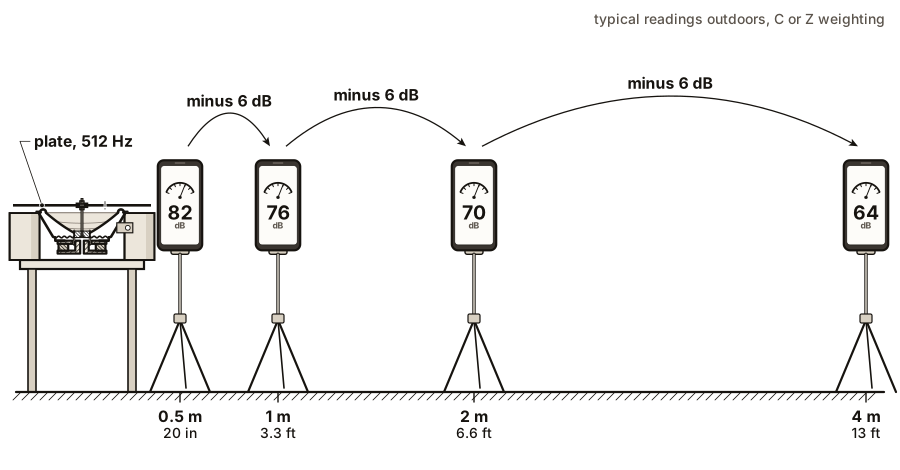
Set the chapter 1 plate going on its twelve-spoke figure near 512 Hz, with the volume where the salt just runs. Put the sound meter app on your phone and hold the phone 1 m (3.3 ft) from the plate. Write down the number. Now step back until the phone is 2 m (6.6 ft) away and read it again.
The number has dropped by about 6. Step back to 4 m (13 ft) and it drops by about 6 more. Walk in to 0.5 m (20 in) and it climbs about 6 above where you started. Every time you double your distance from the plate, the meter loses about 6, and it does not matter which distance you started from.
The number falls by equal steps while the distance grows by doublings, so something in that number counts by multiplication. This chapter takes it apart, then uses the same arithmetic on a claim Nikola Tesla printed in 1919: that he could hear thunder 550 miles (885 km) away.
Section 1: Sound Is a Push in the Air
Sound is a wave of the kind Chapter 4 built on a coil spring, travelling in air. When the plate swings up it squeezes the air above it a little; when it swings down it lets that air spread a little. Each squeeze pushes on the air beyond, and the squeezes travel outwards at 343 m/s (1,125 ft/s) while the air itself only shuffles back and forth.
What your ear and the phone’s microphone respond to is a small, fast rise and fall in the push of the air. That push is pressure: force spread over an area. The air presses on everything from every side, because the whole depth of the atmosphere rests on it. The unit of pressure is the pascal, written Pa, after Blaise Pascal: one newton of force on one square metre. It is a tiny unit. A sheet of printer paper lying flat on a desk presses on it with less than one pascal. The atmosphere at sea level presses with about 101,000 Pa, which is 101 kPa (14.7 psi).
A sound is a ripple riding on top of that enormous steady pressure. The meter ignores the steady part completely. It measures only how far the pressure swings above and below the steady value, averaged in a particular way over a fraction of a second.
IN PLAIN ENGLISH: The air is always pressing on you, hard, from all sides. A sound is that press going very slightly up and down, hundreds or thousands of times a second. Your eardrum and the microphone in your phone are both thin skins that get nudged in and out by those tiny ups and downs.
The quietest 1,000 Hz tone a young, healthy ear can just detect has a pressure swing of about 20 micropascals, 20 millionths of a pascal. Divide that by the steady atmospheric pressure and you get about two parts in ten billion. If the atmosphere were a stack of paper 100 km (62 miles) high, the faintest audible sound would be a change in its height of about 20 µm (0.0008 in), a fifth of the thickness of one sheet.
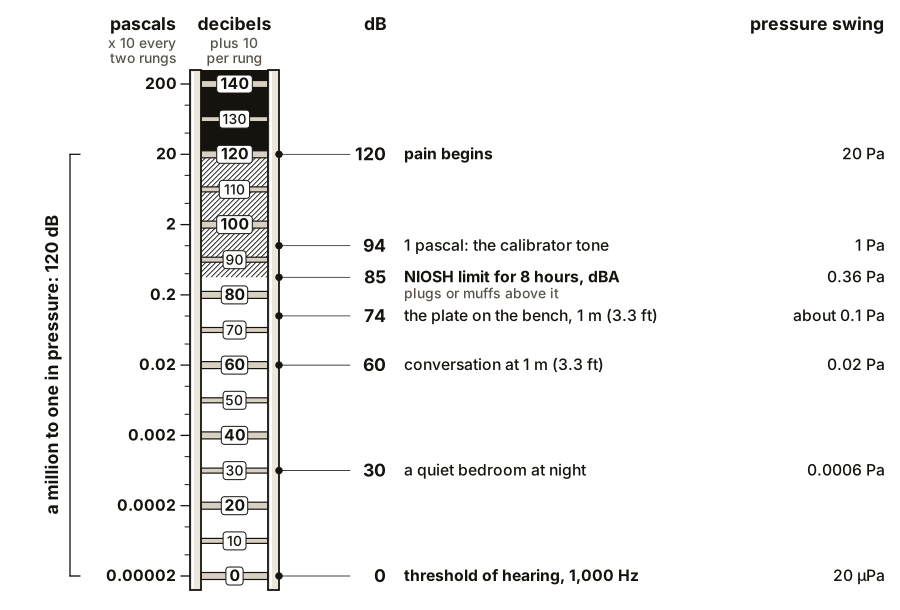
At the other end, a swing of 20 Pa is painful. The chapter 1 plate at a comfortable bench level makes about 0.1 Pa at 1 m (3.3 ft). So the useful range of the ear runs from 0.00002 Pa to about 20 Pa, a ratio of a million to one. Pascals are a clumsy way to write that, and the clumsiness is a hint that the ear does not work in pascals.
Section 2: Why the Meter Counts in Decibels
Play the plate’s tone and have someone double the amplifier’s output voltage, which doubles the pressure swing. It sounds louder, but not twice as loud. Double it again: louder by about the same step. The ear judges loudness by ratios, and the tool for counting ratios is the logarithm, the number of times you multiply by ten to get from one value to another. From 1 to 1,000 is three multiplications by ten, so its logarithm is 3.
The decibel is a logarithmic count of how much bigger one sound is than a fixed reference. The reference is that 20 µPa threshold. The rule for pressure is:
level in dB = 20 × log10(p / 20 µPa)
Section 3 explains the 20 in front. The threshold itself divides by itself to 1, whose logarithm is 0, so the threshold is 0 dB. Ten times the threshold pressure is 20 dB. A hundred times is 40 dB. A million times, which is 20 Pa, is 120 dB.
One value is worth memorising, because it is built into every calibrator in the world: 1 Pa is 94 dB. Divide 1 Pa by 20 µPa and you get 50,000; its logarithm is 4.7; times 20 is 94. Acoustic calibrators made to the standard IEC 60942 play a 1,000 Hz tone at 94 dB for that reason.
| Sound | Pressure swing (Pa) | Level (dB) |
|---|---|---|
| Threshold of hearing at 1,000 Hz | 0.00002 | 0 |
| Quiet bedroom at night | 0.0006 | 30 |
| Conversation at 1 m | 0.02 | 60 |
| NIOSH limit for a full working day | 0.36 | 85 |
| One pascal | 1 | 94 |
| Plate at full drive, close up | 2 | 100 |
| Pain begins | 20 | 120 |
| Kyoto cell study, Chapter 24 | 100 | 134 |
Two rules fall out of the logarithm. Doubling the pressure adds 6 dB. The logarithm of 2 is 0.301, and 20 times that is 6.02. Two equal, unrelated sources together add 3 dB, for a reason Section 3 makes clear. Two plates both making 76 dB at your position make 79 dB together, not 152.
ON THE BENCH: Checking the meter, with a check that can fail
Parts: the chapter 1 plate and drive; the multimeter; your phone’s sound meter app; if you can borrow one, a real sound level meter of Class 2 or better. Cost: nothing. Time: 20 minutes. Hazards: keep the meter below 85 dBA; wear plugs above it. Method: if you can borrow a real meter, put both side by side 1 m (3.3 ft) from the plate on a steady tone and set the app’s calibration offset until they agree. Then the relative check, which needs no borrowed meter. Play a steady 500 Hz tone, put the multimeter on AC volts across the speaker terminals, and set the volume for 2.0 V. Read the app. Turn down to exactly 1.0 V and read it again. What you should see: halving the voltage halves the pressure, so the app should fall by 6 dB, give or take one. Halve again to 0.5 V and it should fall another 6. If it does not work: if the step is 3 or 4 dB, the background noise in the room is close to the tone’s level and is propping up the reading; shut the window and try at a higher starting level. If the steps shrink only at quiet levels, you have found the app’s floor, where it reads its own noise, usually 30 to 45 dB. Below it, trust nothing. Better, if you have one: a generic 94 dB acoustic calibrator, about $50, fits the microphone of a real meter. It does not fit a phone, but it keeps the borrowed meter honest.
The second test is worth the trouble because it can fail. A clipping microphone or a badly written app will not give two clean 6 dB steps. NIOSH tested phone meter apps against laboratory instruments and found the better ones within about 2 dB (Kardous and Shaw, Journal of the Acoustical Society of America 135, 2014). The worse ones were off by much more.
Section 3: Energy, and Why Twenty
The 20 in the decibel formula comes from energy. A sound wave carries energy away from its source, and the rate at which that energy flows through an area, measured in watts per square metre, is the sound intensity. Intensity goes as the square of the pressure swing: double the pressure and you carry four times the power through each square metre.
Telephone engineers devised the decibel in the 1920s to count power ratios, as ten times the logarithm of the ratio. For intensity:
level in dB = 10 × log10(I / I0)
where the reference I0 is a millionth of a millionth of a watt per square metre, the intensity that goes with 20 µPa. Because intensity goes as pressure squared, and the logarithm of a square is twice the logarithm, the 10 becomes 20 when you switch to pressure. The two formulas give the same number of decibels for the same sound. Ten for power, twenty for pressure, one scale.
That also explains the 3 dB rule. Two unrelated sources do not add their pressures neatly, because their swings are out of step at random. They add their energies. Twice the intensity is 10 × log10(2), which is 3 dB. The NIOSH rule you met in Chapter 1 is built on exactly this: every 3 dB above 85 dBA doubles the energy reaching your ear, so the safe time halves. Eight hours at 85, four at 88, two at 91, one at 94, and under 15 minutes at 100 (NIOSH, Criteria for a Recommended Standard: Occupational Noise Exposure, 1998).
The powers are tiny. A person talking puts out around 10 to 20 microwatts of sound. Talking without a pause for a whole year produces about enough sound energy to warm a cup of tea by half a degree, 0.6 °C (1.1 °F).
Your meter app probably shows dBA. The A corrects for the way the ear’s sensitivity changes with pitch: it is most sensitive between about 1,000 and 5,000 Hz and grows steadily deafer below that. A-weighting is a filter in the meter that turns low and very high frequencies down by about as much as the ear does at moderate levels. It is defined in the international sound meter standard, IEC 61672-1. At 1,000 Hz it changes nothing. At 500 Hz it subtracts about 3 dB, at 250 Hz about 9, at 100 Hz about 19, and at 50 Hz about 30. It adds a decibel or so between 2,000 and 4,000 Hz.
So the plate’s eight-spoke figure at 235 Hz reads about 9 dB lower in dBA than the rose window at 1,337 Hz making the same pressure. The hearing limits are written in dBA because damage tracks the frequencies the ear is most sensitive to. For physics, where you want the pressure itself, switch the app to C or Z weighting if it offers them; Z means no weighting at all.
Section 4: The Inverse-Square Law
Back to the opening walk. Why should doubling the distance cost 6 dB?
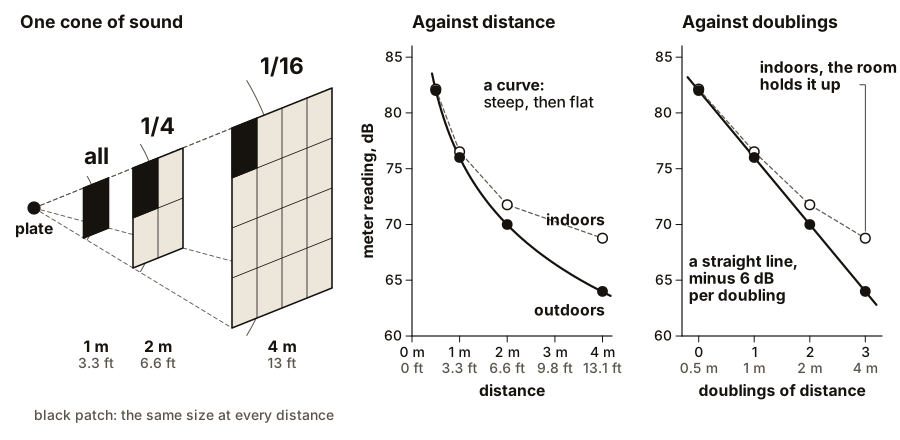
Picture the plate as a small source in open air, its energy spreading outwards like the skin of a growing soap bubble. At 2 m (6.6 ft) the bubble has four times the surface area it had at 1 m (3.3 ft), because the area of a sphere goes as the square of its radius. The same energy is spread over four times the area.
So the intensity at twice the distance is a quarter, at three times the distance a ninth, at ten times a hundredth. Intensity falls as one over the distance squared. That is the inverse-square law, and it holds for anything that spreads freely from a small source: light from a bulb, heat from a fire, gravity from a planet, sound from a plate.
In decibels, a quarter of the intensity is 10 × log10(1/4), which is minus 6 dB. Six decibels per doubling of distance, twenty per tenfold distance. That is the number your meter found.
IN PLAIN ENGLISH: The sound from the plate spreads out like a growing bubble. Go twice as far and the bubble’s skin is four times bigger, so each patch of skin gets a quarter of the sound. On the meter, a quarter always reads 6 lower.
The law has conditions. It needs a source small compared with the distance. It needs open space: indoors, sound bouncing off walls fills the room with a level that does not fall with distance, the subject of Chapter 17. And it ignores the air itself, which over long distances absorbs high pitches and bends sound paths.
ON THE BENCH: Six decibels per doubling
Parts: the chapter 1 plate and drive; an extension lead to take the power brick outdoors or into a garage with the door up; the calibrated phone meter; a tape measure; a stand for the phone, a stack of books or a camera tripod; graph paper or a spreadsheet; ear protection. Cost: nothing. Time: 30 minutes. Hazards: the power brick stays dry and off wet grass. Ear protection above 85 dBA, which you will likely reach at 0.5 m (20 in). Method: put the plate on a table outdoors, or in an open garage doorway, far from walls. Drive it on the twelve-spoke figure near 512 Hz, salt brushed off. Set the app to C or Z weighting if it has them. Choose one straight line away from the plate’s centre, at the height of its top face, and keep to it: the plate sends different amounts of sound in different directions. Read the level at 0.5 m (20 in), 1 m (3.3 ft), 2 m (6.6 ft) and 4 m (13 ft), with the phone still on its stand each time. Then switch the tone off and read the background at 4 m (13 ft). What you should see: four numbers falling by about 6 dB each. Plot them against distance on ordinary axes and they curve down steeply, then flatten. Plot them against the doubling number (the nearest position is step 0, the farthest step 3) and they fall on a straight line with a slope of minus 6. If it does not work: if the farthest reading is less than 10 dB above the background, the background is adding to it; raise the drive. If the step from 0.5 to 1 m is well off 6 dB but the later steps are close, you were too close to a 300 mm (12 in) source for it to look small. Indoors, the two farthest readings sit high and the line bends flat. That is the room, not the law. Better, if you have one: repeat the walk indoors and plot both lines on one graph. Where the indoor line peels away, the room’s echoes start to outweigh the plate.
Section 5: Thunder at 550 Miles
In April 1919, in the third instalment of his autobiography My Inventions in the magazine Electrical Experimenter (p. 907), Nikola Tesla described his hearing:
In 1899, when I was past forty and carrying on my experiments in Colorado, I could hear very distinctly thunderclaps at a distance of 550 miles. The limit of audition for my young assistants was scarcely more than 150 miles. My ear was thus over thirteen times more sensitive.
That is 885 km (550 miles) for Tesla and 241 km (150 miles) for his assistants. Look first at the arithmetic, because it is right. Divide 550 by 150 and you get 3.67. Square it and you get 13.4. “Over thirteen times” is the inverse-square law applied correctly. A thunderclap 3.67 times farther away delivers 1/13.4 of the intensity, so an ear that still hears it is 13.4 times more sensitive. The man knew how sound spreads.
Now put it in decibels. A ratio of 13.4 in intensity is 10 × log10(13.4), which is 11.3 dB. Tesla’s claim, stripped down, is that his hearing threshold was 11 dB better than his assistants’. That part is not outrageous. Healthy young ears vary over a range of about 20 dB, and an 11 dB difference between two people is uncommon but possible.
The impossible part is the premise underneath: that anyone, Tesla or his assistants, heard thunder at 150 miles (241 km), let alone 550. Three pieces of physics stand against it.
The first is the shape of the Earth. Lightning in a storm makes most of its thunder a few kilometres up. From a source 4 km (2.5 miles) high, the horizon is about 226 km (140 miles) away. At 885 km, the curve of the Earth puts the storm about 60 km (38 miles) below a straight line from the listener, higher than any thundercloud reaches. A straight line from that storm to Colorado passes through solid ground.
The second is the way the air bends sound. Air normally gets colder with height, and sound is slower in cold air, so the top of a wave front lags and sound heading sideways curves upwards, over the heads of distant listeners. The meteorologist Robert Fleagle worked this through for thunder in 1949 and concluded that thunder starting about 4 km up is normally audible only within about 25 km (16 miles), less where the wind shears with height (“The Audibility of Thunder”, Journal of the Acoustical Society of America 21, 1949, p. 411).
The third is time. At 343 m/s (1,125 ft/s), sound needs 43 minutes to cover 885 km. Thunder heard that far away would arrive three quarters of an hour after its flash, too late to link to any stroke. How would a listener know it was thunder at all?
SLOW DOWN. Check Your Understanding: Tesla’s assistants’ limit, 150 miles (241 km), is about ten times too far for anyone’s ears. Suppose Tesla had a real, honest measurement of something at those ranges, and simply misremembered what it was. What instrument at Colorado Springs in 1899 could have registered a storm 885 km (550 miles) away, and why would the inverse-square law work for it when it fails for sound? Answer before you read on.
His radio receivers. In Electrical World and Engineer (5 March 1904) Tesla wrote that his Colorado Springs station had registered lightning from distant storms. A lightning stroke is a powerful radio transmitter, and its low-frequency radio waves follow the curve of the Earth, guided between the ground and the upper atmosphere. Sound is a pressure wave in a medium that bends it, absorbs it and runs out of line of sight; radio crosses the same distance in three thousandths of a second. That the 1919 memory merged receiver and ear is a plausible inference; no document confirms it. What the record does show is that thunder at 550 miles (885 km) is not something an ear can hear, because the sound never gets there.
The same paragraph says that in Budapest, during an illness, he heard a watch tick through three rooms. No measurement of that exists or can. The thunder claim is different because it carries numbers, and numbers can be checked. Checked, they show a man who reasoned correctly from an impossible starting point, which is a more interesting thing to know about Tesla than either the legend or the dismissal.
Section 6: What the Meter Cannot Tell You
The meter is no longer a black box. It measures the swing of the air’s pressure, compares it with 20 millionths of a pascal, and reports the ratio as a count of multiplications: six means double the pressure, three means double the energy. A lawnmower at 90 dBA at 1 m (3.3 ft) is 70 dBA at 10 m (33 ft), if nothing blocks it. And 85 dBA, the line Chapter 1 drew on your bench, is a swing of about a third of a pascal: three and a half millionths of the atmosphere’s pressure, and enough to damage your hearing over a working day.
What the meter cannot do is tell a hum from a whistle from the plate. It reports one number for all of them. Your ear detects two parts in ten billion and also tells you which pitches are present, and it does the second by being a bank of resonators of exactly the kind Part II built. That is the next chapter.

Bench Degree
Get the degree without the diploma.
Learn the material, not how to pass the exam.