Bench Degree·CYMATICSchapter
Chapter 28: What You Now Know
Chapter 1 made a promise specific enough to test. This chapter tests it, line by line, and then says plainly what the book left out.
On the first evening you sprinkled a teaspoon of salt on a black disc, climbed slowly through the frequencies, and watched the salt run into a wheel of twelve spokes near 512 Hz. Near 1,337 Hz it came back as a rose window. You wrote down the frequencies, divided each by the first, and got numbers that made no sense: not 1, 2, 3, 4 like a string, but something that climbed roughly as the square of the number of spokes.
The book promised that by the end you could take a plate, a drum or a room you had never measured, predict from its size and material the frequencies at which it would draw its figures, go and find them, and say by how much you were wrong and why. It also promised that you could read any claim about sound, vibration and matter, and say what experiment would test it and whether that experiment had been done.
Here is the test. Do the experiments in this chapter before reading the commentary after each one.
Section 1: The Four Questions, Answered
Chapter 1 left four questions on the table.
Why does the salt go to the still lines? Because a vibrating surface throws every grain that sits on a moving patch. Each grain lands a little to one side and is thrown again, and it wanders until it lands where the surface does not move. Sand leaves the plate when the plate’s acceleration passes one gravity, which on the Chapter 1 disc at 500 Hz takes only a millionth of a metre of motion, 40 millionths of an inch (Chapter 24). Very fine powder does the opposite and gathers where the plate moves most, because the plate stirs the air on its own surface into small circulating currents that carry dust and leave sand behind. Chladni drew that dust in 1787 and did not explain it. Faraday explained it in 1831, then proved it by pumping the air away and watching the dust go to the nodes like sand (Chapter 7).
Why only at certain pitches? Because a surface that rings stores energy from one push to the next, and only a push that arrives in step with the surface’s own swing adds to it. At those natural frequencies the motion grows until damping balances the drive: the amplitude at resonance is Q times what the same push would do slowly (Chapter 9). Your plate’s Q is in the hundreds, so its peaks are about a hertz wide, which is why a generator that steps five hertz at a time can walk straight past a figure.
Why spokes and rings, and why does the hub stay still? Because each natural frequency of a round plate has its own shape, built from waves running round the disc and in and out from the centre, and the still lines of that shape are diameters and circles (Chapters 4 and 5). A mode with six diameters, the twelve-spoke figure, moves near the centre as the sixth power of the distance from it, so the middle third of the plate is nearly motionless. That is the hub. The bolt at the centre adds almost nothing to it.
Why does the frequency go as the square? Because a plate resists bending, and bending stiffness makes short waves travel faster than long ones. Halve the wavelength and the wave speed doubles, so the frequency rises four times rather than twice. Chladni found the rule by counting lines in sand and wrote it in 1802 as pitch proportional to (L + 2K)², with L the number of diameters and K the number of circles (Chapter 5). Kirchhoff’s theory of 1850, as Rayleigh showed, explains why it holds. On your plate it holds as two families, one for figures with spokes only and one for figures with a ring, exactly as Chladni’s own table separated them.
IN PLAIN ENGLISH: The salt is a map of where the plate is still. The plate only moves much at its own favourite pitches, because only then do the pushes add up. Each favourite pitch has its own shape of stillness, spokes and rings. And because a plate is stiff, its favourite pitches spread out as the square, which is why a plate clangs where a string sings.
Section 2: The Promise, Tested
The real test is a surface you have not built yet. You need three numbers and one formula.
The formula is Chapter 5’s. For a round plate held at its centre, the frequency of any figure is a number set by the figure, multiplied by the plate’s thickness, divided by the square of its radius, multiplied by a constant that depends only on the material. On your Chapter 1 disc that worked out at 10.94 Hz for every unit of the figure’s number, λ²: 46.81 for twelve spokes, 122.2 for the rose window. Thickness up, frequency up in proportion. Diameter up, frequency down as the square. Aluminium, steel and window glass have almost the same material constant, so a steel disc of the same size and thickness draws its figures within a percent or two of the aluminium one.
ON THE BENCH: The final examination
Parts: a round metal disc you have not used before: a second aluminium disc of a different size or thickness, a thin steel lid, a brass plate, a saw blade with the teeth ground off; a caliper; the Chapter 1 drive, bolt kit and salt; ear protection. Cost: nothing to about $10. Time: an evening. Hazards: as Chapter 1. File any cut edge. Ear protection on before the first tone. Method: measure the disc’s diameter and its thickness with the caliper. Before you mount it, write down your predicted frequency for the twelve-spoke figure and for the rose window, scaling from the Chapter 1 values: multiply 512 Hz and 1,337 Hz by (new thickness ÷ 1.0 mm, or ÷ 0.040 in) and by (300 mm ÷ new diameter, or 12 in ÷ new diameter)². For steel, use the same constant; for brass, multiply by about 0.7, because brass is heavier for its stiffness. Then mount the disc, find both figures, and write down the measured frequencies. What you should see: both figures within about 5 percent of your prediction, and both off by nearly the same percentage, because the error comes from things that shift every frequency together: the true thickness, the paint, the true stiffness of the alloy. If it does not work: if one figure is close and the other far off, you have probably found a neighbouring figure; count the spokes again. If both are off by the same large amount, measure the thickness at three places; sheet varies. A dished or warped disc will not follow the formula at all, which is itself a finding. The test you have passed: you predicted a figure on a plate you had never built, found it, and can say by how much you were wrong and why. That was the promise.
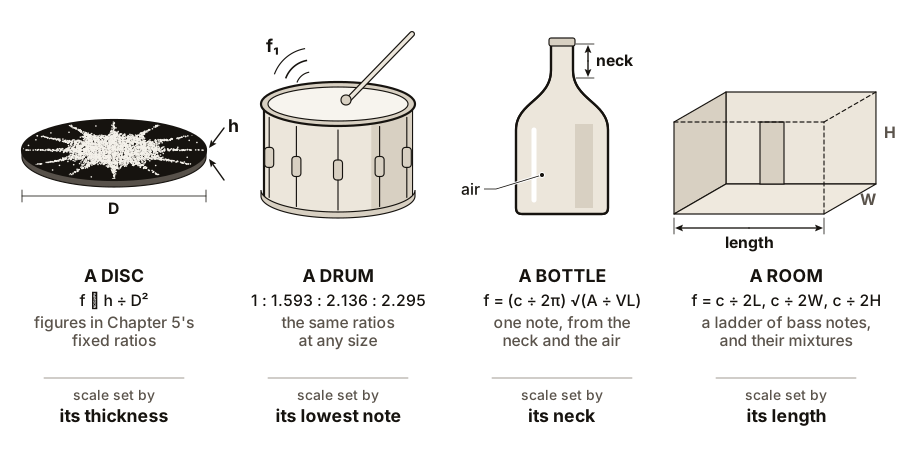
The same move works on every surface in the book. A drum head’s figures follow the Bessel ratios of Chapter 6, 1.000, 1.593, 2.136, 2.295, whatever its size, once you have found its lowest one. A room’s bass notes sit at the speed of sound divided by twice each dimension and their combinations (Chapter 18). A bottle’s note follows the Helmholtz formula of Chapter 13 from its neck and volume. In every case the shape of the answer comes from the physics and one measurement fixes the scale.
Section 3: The Claims, Ledgered
The second half of the promise was about claims. Part IV tested the famous ones. Here they are in one place, each with what was claimed, what the record shows, and the experiment that would settle what is still open.
| Claim | What the record shows | What would settle it |
|---|---|---|
| Chanting OM into Jenny’s tonoscope drew a Sri Yantra | Not in Jenny’s first volume, which has been read in full; no page of the second cited by anyone; the dramatic version first printed in 2002 (Chapter 22) | A published rig, membrane, tension and powder, with a sine-wave control at the same pitch |
| Water forms beautiful crystals for loving words | In the 2008 blind test the distant control water scored slightly higher than the treated water; crystal shape follows temperature and supersaturation (Chapter 23) | A preregistered, blinded test with the photographer and the judges both unaware of the condition |
| Cells can hear | A real 2025 study: about 100 Pa of vibration pressed onto mouse cells in a dish changed 42 genes at 2 hours and 145 at 24, through touch sensing, and slowed fat-cell maturation (Chapter 24) | Nothing to settle about hearing; the open question is what the same stimulus does in a living animal |
| Healing frequencies such as 528 Hz | Nothing on cells at a measured pressure; on people, one 2018 trial of nine volunteers found lower cortisol and higher oxytocin after five minutes of 528 Hz music and no significant change after 440 Hz, with no direct comparison of the two and no independent repeat (Chapter 24) | A preregistered, blinded trial with the same music at 528 Hz and at several nearby pitches, run by a second laboratory, with the outcomes fixed in advance |
| A Rife machine bursts cancer cells by resonance, like a singer breaking a glass | Rife’s device was a radio transmitter, not a sound device; “14 of 16 cured” was first printed in 1953 by the sellers, 19 years after the clinic; a cell is soft, wet and has a Q near 1, and sound from air delivers about a millionth of the strain needed. Ultrasound does destroy tumours (histotripsy, cleared for liver tumours in 2023), by bubbles and heat, not by a cell’s note (Chapter 25) | Cancer and healthy cells in dishes, a measured pressure, the claimed frequency against an off-frequency and silence, blind scoring, repeated by a second laboratory |
| A = 432 is the natural or healing pitch, and 440 was imposed by the Nazis | 440 was proposed at Stuttgart in 1834, adopted by American musicians in 1917, and chosen in 1939 by a five-nation standards conference that Germany did not run; Verdi accepted 432 only as a near-imperceptible change from 435; the French vote for 432 (about 1950) left no count; three small trials from one group found modest calming effects of music at 432, none testing other nearby pitches; on a plate a figure lands where size and thickness put it (Chapter 26) | Blinded trials of 432 against other lower pitches, not only 440, run by a second laboratory, and a multi-plate sweep counting figures near each number |
| Tesla shook his building with a pocket oscillator | No contemporary record; four printed versions, 1912 to 1944, with the date drifting by a decade; a pocket device at a building’s frequency makes a few newtons (Chapter 11) | A police or building record from the time, which nobody has produced |
| “Energy, frequency and vibration” is Tesla’s | First traced to about 1992, decades after his death (Chapter 27) | An earlier printing with a date and a page |
| Rose windows encode sound | Same symmetry, different causes: a compass and straightedge divide a circle into 6, 12 and 24, and a plate’s diameters do the same (Chapter 19) | Any documentary evidence that a medieval builder saw a vibration figure |
Notice what the table does not say. It does not say that sound has no effect on living things: Chapter 24’s study shows that it can, through ordinary mechanics. It does not say that Jenny’s work was worthless: his first volume can be rebuilt from its own captions. It does not say Tesla built nothing: he patented a real mechanical oscillator in 1894. The claims fail where they leave the record, and they fail on the record’s own evidence, which is a better reason to set them aside than anyone’s say-so, including this book’s.
ON THE BENCH: A claim of your own choosing
Parts: any claim about sound, vibration or frequency you find on a poster, a product label or a video; a notebook; the rig. Cost: nothing. Time: an hour, or a weekend. Hazards: none on the bench. Keep the volume sensible. Method: write the claim down in one sentence, exactly as made. Then write four things under it. Where does it first appear in print, with a date and a page (Chapter 27’s method)? What experiment would show it, stated as plate, frequency, level and medium, so someone else could repeat it? What is the control: the same rig with one thing changed? What would you expect from the physics in this book alone, before you run it? Then, if the experiment fits on your bench, run it, control first. What you should see: most claims fail at the first step, because they have no first printing anyone can find. Some fail at the second, because no experiment is stated. The few that reach the bench are worth your evening, and the physics will usually tell you what to expect before the salt moves.
Section 4: What You Can Now Do on a Bench
A list, because it is a long one and you earned every line.
- Build a Chladni plate that works on the first night, and say why black cardboard would not.
- Find a figure to a tenth of a hertz, and know from the plate’s Q why you have to.
- Bow a plate as Chladni did, and silence a figure’s neighbours with a fingertip on a still line.
- Time a vibration with a slow-motion phone and predict a spring’s frequency from how far it sags.
- Make a string stand in its first four harmonics and measure the wave speed that sets them.
- Separate sand from flour on one plate and explain, with Faraday, why they part.
- Raise Faraday waves on milk and catch them oscillating at half the drive frequency.
- Measure the Q of a plate from a single recorded ring-down, and plot its resonance curve.
- Tell a driven oscillator from a self-excited one, and make both: a speaker and a bow.
- Do the arithmetic on a resonance story, as Chapter 11 did on Tesla’s, and say what force it needed.
- Predict a bottle’s note from its neck and its volume, and change it with water.
- Read a decibel, calibrate a phone meter against a check that can fail, and measure the inverse-square law.
- See your own voice’s overtones on a spectrum, and find your upper limit of hearing.
- Measure a room’s reverberation time with a hand clap and change it with blankets, by a predicted amount.
- Find a room’s bass modes with a sine tone and a pad of sticky notes.
- Isolate a vibrating machine, and know why a mount that is too stiff makes things worse.
- Levitate a bead in a standing wave of ultrasound and measure the spacing of the nodes.
- Trace a quotation to its first printing, or to the absence of one.

Section 5: The Ideas Worth Keeping
Strip away the apparatus, and five ideas carry the whole subject.
A figure belongs to the object, not to the sound. A plate, a drum, a room and the whole Earth each have their own natural shapes of vibration, set by their size, their material and how they are held. Any sound with energy at the right frequency raises the shape. A chant, a sine wave and a cello raise the same figure on the same skin at the same pitch. That is the single most useful idea for reading claims about cymatics, and Chapter 22’s control experiment is how you check it.
Ratios outlast absolutes. Your measured frequencies were a few percent off the prediction, and all off together. The ratios between them were not. Paint, sheet tolerance and alloy shift the scale, while the shape of the vibration fixes the ratios. Measure ratios when you can.
Resonance multiplies, and Q is the multiplier. A small push repeated in step does a great deal to a ringing object and very little to a dull one. That cuts both ways: it is why a plate draws with a watt of drive, and why a pocket device cannot shake a building that rings with a Q of 25.
Stiffness raises pitch and mass lowers it. A ruler, a spring, a plate, a bottle’s neck of air, a building and a planet all obey the same balance between the two, and most of the arithmetic in this book is that balance in a different costume.
A claim is only as good as its first printing and its control. Where was it first written down, and what happened when one thing was changed? Those two questions disposed of most of Part IV, and they did it fairly.
SLOW DOWN. Check Your Understanding: A friend shows you a video in which a singer holds one note into a dish of water and the surface forms a beautiful six-fold star. The caption says the note “carries the frequency of the heart”. Using only what is in this book, what is the most likely explanation of the star, and what single change to the experiment would test it? Answer before you read on.
The star is almost certainly a Faraday wave pattern set by the dish, not by the voice. Chapter 8 showed that a liquid layer driven up and down breaks into standing ripples at half the drive frequency, and Chapter 22 showed that the pattern’s shape is fixed by the dish’s size, its edge, the depth and the frequency, which is why a different saucer gives a different “signature” for the same sound. A six-fold star needs a six-fold cause, and a round dish usually supplies a round one, so look for the asymmetry: the shape of the container, the position of the speaker, the lighting. The single change that tests the caption is the control: play a pure sine wave at the singer’s pitch and level into the same dish. If the same star appears, the dish and the frequency made it and the heart was never involved. Notice that the physics in this book predicts the result before the experiment is run, and the experiment can still prove the prediction wrong. That combination is what a good test looks like.
Section 6: What This Book Did Not Cover
An honest ledger of the gaps, so that you know where to go next and do not mistake this book for the whole subject.
Music. This is a book about sound you can see, not about why some sounds please the ear. Scales, tuning systems, harmony and the physics of consonance are a subject of their own. The string harmonics of Chapter 4 are where that subject begins.
Musical instruments in depth. Violins, guitars, bells, pianos, brass and organ pipes each have a literature of their own, and the plate, string, membrane and Helmholtz resonator of this book are only their building blocks. The standard reference is Fletcher and Rossing’s The Physics of Musical Instruments.
The full mathematics. This book gave the results of plate and membrane theory, Bessel functions and the Ritz method, and checked them on the bench, but did not derive them. Rayleigh’s The Theory of Sound (1877 to 1878) is still the place to see them derived, and it is public domain.
Loud and nonlinear sound. Shock waves, sonic booms, the distortion of very loud sound and the physics of explosions are beyond a bench that stays under 24 V and 85 dBA.
Underwater acoustics and sonar, beyond the brief look in Chapter 21 at sound in water and tissue.
Noise control as a profession. Chapter 20 showed why isolation and damping work. Designing a quiet building, meeting a noise regulation or treating a recording studio is an engineering trade with its own standards.
Hearing science and medicine beyond the outline of Chapter 16: how hearing loss is diagnosed and treated, hearing aids, cochlear implants and the research on how the brain decodes sound.
Granular physics. Why sand flows, piles and sorts is a deep research field. This book used one fact from it, that a grain leaves a surface accelerating faster than gravity, and left the rest alone.
Biological effects of sound and vibration, beyond one carefully read paper. Chapter 24 showed how to read such a study. It did not survey the field, and the field is larger and more uneven than any single result.
What you have instead is the method: build the simplest thing that shows the effect, predict it from the physics, measure it, and change one thing at a time. That method is older than Chladni and will outlast every claim in Part IV. Leave the plate set up. There is always one more figure above the last one you found.
Bench Degree
Get the degree without the diploma.
Learn the material, not how to pass the exam.