Bench Degree·CYMATICSchapter
Chapter 27: Did Tesla Say That?
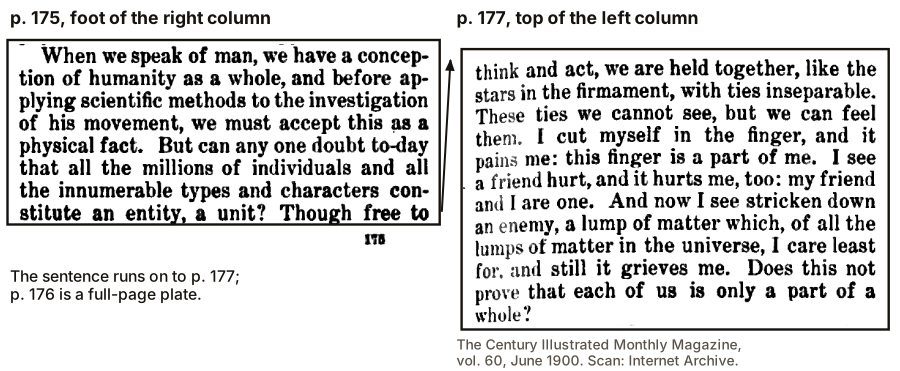
Five sentences about energy, vibration and the mind circulate under Nikola Tesla’s name. One of them is his. The man they are pinned on wrote, in 1935, that man, like the universe, is a machine.
Type this sentence, in quotation marks, into any search engine: “think in terms of energy, frequency and vibration”. You will get page after page of posters, mugs, yoga studios and sound-healing sites, nearly all of them crediting Nikola Tesla. Now open the full-text search of a digital library that holds books and magazines from Tesla’s lifetime, such as the Internet Archive or HathiTrust, and search the same phrase in everything printed before he died in January 1943.
You should find nothing. Not a misquotation, not a near miss. The sentence does not appear in anything Tesla wrote that has been searched, and no printing of it from his lifetime has been found. If you do find one, you will have beaten the published record.
That took five minutes and it is a real result. This chapter does the same thing properly for the five Tesla quotations you are most likely to meet on a wall, shows you where four of them actually came from, and then gives Tesla his due: what he really wrote about vibration, which is more interesting than anything on the mugs.
Section 1: Five Quotations
Here are the five, as they usually circulate.
(a) “If you want to find the secrets of the universe, think in terms of energy, frequency and vibration.”
(b) “My brain is only a receiver, in the Universe there is a core from which we obtain knowledge, strength and inspiration. I have not penetrated into the secrets of this core, but I know that it exists.”
(c) “The day science begins to study non-physical phenomena, it will make more progress in one decade than in all the previous centuries of its existence.”
(d) “Though free to think and act, we are held together, like the stars in the firmament, with ties inseparable. These ties cannot be seen, but we can feel them.”
(e) “The gift of mental power comes from God, Divine Being, and if we concentrate our minds on that truth, we become in tune with this great power.”
The record to set them against is the full text of Tesla’s autobiographical series My Inventions (Electrical Experimenter, 1919), in page scans; his long essay in The Century of June 1900; the 1894 collection of his lectures and writings by T. C. Martin; his 1892 London lecture; his oscillator patents; eighteen further articles and interviews from 1895 to about 1940; and the newspaper coverage of his 1935 birthday press lunch.
Only (d) is his. Two places could still hide an earlier printing of the others: the full texts of Google Books and HathiTrust, which have not been searched exhaustively. So the verdicts below are “not found in any Tesla text searched, and here is where it does come from”, which is the honest form of a negative.
Section 2: The One That Is His
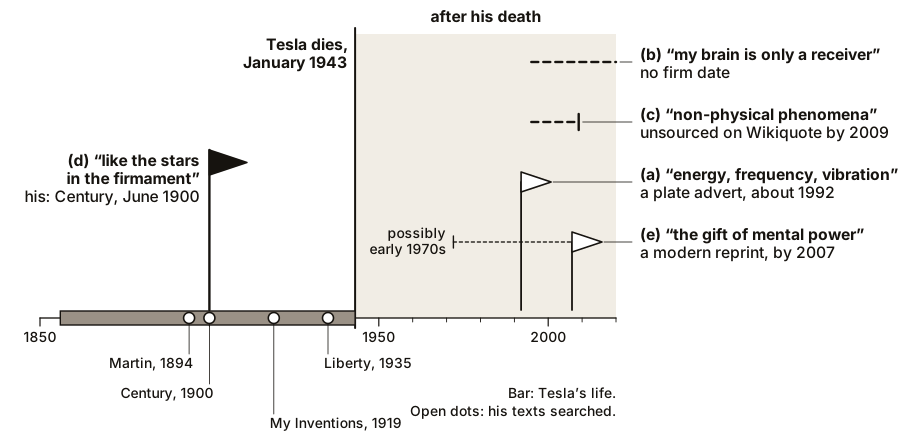
Quotation (d) is genuine, with one small change. It comes from “The Problem of Increasing Human Energy”, Tesla’s long essay in The Century Illustrated Monthly Magazine, volume 60, June 1900, pages 175 to 211, in its opening section: the passage starts at the foot of page 175 and runs on to page 177, past a full-page plate. Here it is with the sentences around it:
But can any one doubt to-day that all the millions of individuals and all the innumerable types and characters constitute an entity, a unit? Though free to think and act, we are held together, like the stars in the firmament, with ties inseparable. These ties we cannot see, but we can feel them. I cut myself in the finger, and it pains me: this finger is a part of me. I see a friend hurt, and it hurts me, too: my friend and I are one.
Notice the small change. The magazine prints “These ties we cannot see”; the poster says “These ties cannot be seen”. The poster wording follows modern online transcriptions of the essay, not the printed page, so even the genuine quotation has drifted on its way to the wall. It is a harmless drift, and a good reason to read the page itself.
Read in place, the ties are moral and social. Tesla is saying that people feel each other’s pain, and that humanity is one body. The very next paragraph credits religion with the same insight: “The Buddhist expresses it in one way, the Christian in another, but both say the same: We are all one.” He then treats humanity as a mass moving with a velocity, and defines “human energy” as half the mass times the square of the velocity, borrowed straight from mechanics. The metaphor is a moving body, not a vibration.
The same essay does contain the sentence a book on acoustics would want, a little earlier on page 175: “every movement in nature must be rhythmical”. He illustrates it with “the movement of a planet, in the surging and ebbing of the tide, in the reverberations of the air, the swinging of a pendulum, the oscillations of an electric current”, and he gives the credit for the idea to the philosopher Herbert Spencer. That is genuine Tesla on vibration: a nineteenth-century physicist’s observation that oscillation is everywhere, honestly attributed to someone else.
Section 3: “Energy, Frequency and Vibration”
Quotation (a) has a traceable origin, and it is not Tesla.
The earliest identifiable source is Ralph Bergstresser, who sold aluminium plates called “Purple Harmony Plates”. A promotional text of his, reproduced on websites, describes the plates as “transceivers” whose atomic structure has been altered to be “in resonance or harmony with the basic energy (free energy) of the universe”. It ends with a footnote:
… a conversation with the famous scientist, Dr. Nikola Tesla, in 1942. Tesla said, If you want to find the secrets of the Universe, think in terms of energy, frequency and vibration. I spent the last 50 years doing just that, and my products are a direct result of this investigation.
Fifty years after 1942 puts the statement at about 1992. So the sentence’s only source is one man’s recollection of a conversation, written down about half a century later, in the advertising for a product said to work by vibration.
Be fair to him. Tesla was alive in 1942, in New York, and did meet visitors, so a conversation is not impossible. Editors on Wikiquote have pointed out that the Tesla museum’s inventory of his correspondence lists no letter to or from Bergstresser, and that a version of the story has the two meeting in Tesla’s laboratory from 1940, when he no longer had one; those points are theirs and remain unverified. But even taken at face value, a sentence remembered across fifty years is a paraphrase at best, and it reached print only when it could sell plates.
And when Tesla himself reached for the phrase, he wrote something else. In My Inventions, describing the moment in 1882 when the rotating magnetic field came to him in a Budapest park, he wrote: “A thousand secrets of nature which I might have stumbled upon accidentally I would have given for that one which I had wrested from her against all odds and at the peril of my existence.” Secrets of nature, wrested by work at the bench. That is the real sentence.
Section 4: The Receiver and the Non-Physical
Quotations (b) and (c) have no identified origin. Neither appears in any Tesla text searched, and neither has a citation anywhere it circulates. The earliest appearances found are on internet quotation sites. Wikiquote moved (c) to its list of unsourced quotations in 2009, and no one has sourced it since.
What makes these two worth a section is that Tesla wrote, in print, the opposite of both.
In the final part of My Inventions, Electrical Experimenter, October 1919, he describes a vision he once had of his mother’s death, and then explains it away as the memory of a painting and a church choir. He concludes:
This occurred long ago, and I have never had the faintest reason since to change my views on psychical and spiritual phenomena, for which there is absolutely no foundation.
In the same part he calls himself “an automaton devoid of free will in thought and action and merely responsive to the forces of the environment.”
And in Liberty magazine, February 1935, in an article titled “A Machine to End War”, he wrote:
To me, the universe is simply a great machine which never came into being and never will end. The human being is no exception to the natural order. Man, like the universe, is a machine.
A few lines later he says that what we call “soul” or “spirit” is “nothing more than the sum of the functionings of the body. When this functioning ceases, the ‘soul’ or the ‘spirit’ ceases likewise.”
A man who wrote that has not said his brain is a receiver for a cosmic core, and a man who wrote that psychical phenomena have “absolutely no foundation” has not urged science to study the non-physical. There is one genuine nuance. In the 1900 essay, Tesla did expect that science would one day confirm human “connectedness” experimentally, once “our means and methods for investigating psychical and other states and phenomena shall have been brought to great perfection.” That is a forecast about better instruments, made by a man who believed everything is physical. The poster turns it inside out.
IN PLAIN ENGLISH: The sayings that make Tesla sound like a mystic are not in anything he wrote. What he did write, more than once and in plain words, is that people are machines that respond to their surroundings, that the soul ends when the body stops, and that there is no foundation for psychic phenomena. You may agree with him or not. But the quotations have him saying the reverse of what he said.
Section 5: The Gift of Mental Power
Quotation (e) is the most interesting case, because it really does appear in a book called My Inventions with Tesla’s name on the cover. It just does not appear in the one Tesla published.
In the circulating version it continues: “My Mother had taught me to seek all truth in the Bible; therefore I devoted the next few months to the study of this work.” Neither sentence is in the 1919 serial in Electrical Experimenter. The original contains no “Bible”, no “mental power” and no “Divine Being”. The phrase “the next few months” does occur, but about travelling through France and Germany repairing power plants for the Edison company.
The sentences do appear in at least one modern reprint, an edition published by NuVision, on page 41. That is an interpolation: text inserted into a later edition of a genuine work, so that it carries the original author’s name and the original title. One Wikiquote editor attributes the alteration to Arthur H. Matthews, and the trail checks out as far as it goes. Matthews’s book The Wall of Light (1973) prints a version of My Inventions as its first part, and the inserted sentences are in it, followed a few paragraphs later by a further study of the Bible in which Tesla finds “the key in Revelation”. That is the earliest printing found. Whether Matthews wrote the sentences or copied them from an altered text now lost is not known.
The fair thing to say about Tesla and religion is that two things are true at once. He was the son of a Serbian Orthodox priest, and in the 1900 essay he wrote warmly of what the Buddhist and the Christian both teach about human unity. He also wrote, in 1919 and 1935, that the soul is the sum of the body’s functions. The inserted sentence gives him a piety his own text does not carry, and it does so inside a book that looks like his.
ON THE BENCH: Find the genuine one in its first printing
Parts: a computer or phone with a browser. Cost: nothing. Time: 30 minutes. Hazards: none. Method: search the Internet Archive or HathiTrust for The Century Illustrated Monthly Magazine, volume 60, May to October 1900. Open the scanned volume and go to the June issue, page 175, “The Problem of Increasing Human Energy”. Read the opening section until you find “like the stars in the firmament”. Then read the next two paragraphs. What you should see: the sentence exactly as quoted in Section 2, in the typeface of 1900, followed by the finger, the friend and the enemy, and then the Buddhist and the Christian. You have now seen the primary source with your own eyes, which no poster and no quotation site can give you. Write the volume, page and paragraph in your notebook. That is a citation. If it does not work: if the scan will not open, the same text is transcribed on Wikisource; use it to find the page, then try the scan again from a different library.
Section 6: What Tesla Did Write About Vibration
None of this makes Tesla less important to a book about vibration. It makes his real work easier to see.
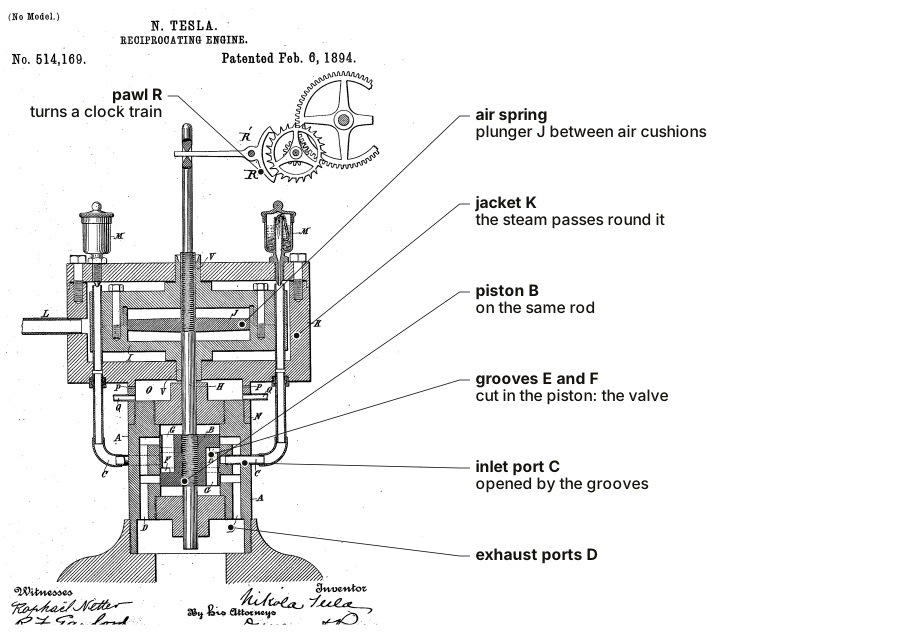
On 19 August 1893 he filed the patent that became US 514,169, “Reciprocating Engine”, granted on 6 February 1894. Chapter 10 read it: a steam engine on a spring of trapped air, whose period stays constant whatever the load, the mass and spring of Chapter 3 written down by an engineer who meant to use it, with a valve timed by the piston itself. Six days after filing, on 25 August 1893, he demonstrated the machine at the Electrical Congress of the Chicago World’s Fair, and a contemporary account records him showing the still points on vibrating steel rods: nodes, the subject of this whole book.
ON THE BENCH: Tesla’s isochronous spring
Parts: a steel ruler 300 mm (12 in) long; a G-clamp; a lump of modelling clay about 50 g (2 oz); the phone’s stopwatch. Cost: nothing. Time: 15 minutes. Hazards: none. Method: clamp the ruler flat to the bench edge with 200 mm (8 in) overhanging, as in Chapter 3, and press the clay onto its tip. Pull the tip down 10 mm (0.4 in), release, and time 20 swings. Then pull it down 40 mm (1.6 in) and time 20 swings again. What you should see: the two times agree to within a few percent, although one swing is four times larger. The period belongs to the stiffness and the mass, not to the size of the push. That is the property Tesla’s patent calls isochronous, and the reason he could promise an engine that kept time like a clock.
Then, on 10 February 1896, he wrote an open letter, printed in the Detroit Free Press on 16 February, about the effects of mechanical vibration on the body. He describes the self-excited platform of Chapter 10, on which he had stood. He reports effects on digestion and sleep. And then he does something that the quotation sites never reproduce:
These observations, though incomplete, are, in my own limited judgment, nevertheless positive and unmistakable …
He says he built a machine with adjustable frequency and amplitude to give “to some medical faculty for investigation”, and he ends by disowning “the extraordinary opinions expressed in some journals which I have never authorized and which … cannot fail to be hurtful by giving rise to visionary expectations.”
That is a careful man in 1896: observations called incomplete, proper investigation proposed, exaggeration disowned. His own later typescript, from about 1940, makes much larger claims for the same platform, including that he cured Mark Twain; those are claims, with nothing recorded to check them against, and Chapter 11 dealt with the earthquake stories that grew in the same way. The 1896 letter is the Tesla worth quoting.
Section 7: How to Trace a Quotation Yourself
The method is short and it works on anyone, not only Tesla.
Find the earliest printing. Search the exact words in quotation marks, then search a distinctive fragment, because quotations drift. Use full-text archives that let you limit by date: Google Books, the Internet Archive, HathiTrust, and for newspapers the Library of Congress’s Chronicling America. Search everything printed in the person’s lifetime first.
Go to the claimed source and read it. If a site gives a book and page, open that book at that page. If it gives a title and no page, search the full text of that title. A citation you have not opened is a rumour with a footnote.
Note who first printed it, when, and why. A sentence that first appears fifty years after the speaker’s death, in the advertising for a product, is telling you something.
Check the person’s own words on the same subject. If the quotation contradicts what they wrote, in print, under their own name, the quotation is the thing in doubt.
Use the people who already did the work, and check them too. Quotation researchers such as the Quote Investigator website, and the talk pages behind Wikiquote entries, record their searches and say where they looked. Their trails are leads; the primary source is the citation.
ON THE BENCH: Trace a quotation from scratch
Parts: a browser; a notebook. Cost: nothing. Time: an hour or two. Hazards: none. Method: pick one inspirational quotation about sound, vibration or energy from a poster, a book cover or a social media post, credited to someone who died before 1960. Write down its wording exactly. Search it, and a distinctive six-word fragment of it, in Google Books with the date range set to end at the person’s death; then in the Internet Archive’s full-text search; then in HathiTrust; then, if the person was quoted in newspapers, in Chronicling America. Write down every hit with its date. Find the earliest. Open it and read the page. What you should see: one of three outcomes. The quotation is in the person’s own text, and you can cite volume and page, as for (d). Or it first appears after their death, attributed without a source, as for (a), (b) and (c). Or it appears inside a later edition of a real work but not in the first edition, as for (e). Whichever you find, you now know more about that sentence than almost everyone who has shared it. If it does not work: if a search finds nothing at all, that is a result too, but a weaker one: write “not found in the archives searched” and list them. A negative is only as good as the places you looked.
SLOW DOWN. Check Your Understanding: Quotation (a) cannot be found in anything Tesla wrote, and its only source is a salesman’s recollection. Does that prove Tesla never said it? Decide before you read on.
No, and the distinction matters. Absence from the record cannot prove a conversation never happened; nobody can search a private conversation in 1942. What the record does show is that there is no evidence he said it, and some evidence against: the wording appears first fifty years later in advertising, and it clashes with how Tesla wrote about such things when he wrote under his own name. The honest label is “attributed, unsourced, almost certainly not his”, and the honest response is to stop putting it in his mouth. Notice that this is the same standard the earlier chapters of Part IV applied to the OM figure, the water crystals and the healing frequencies: a claim is not false because it is unproven, but it is not knowledge either, and it does not get to borrow the authority of a real scientist, or a real experiment, until someone shows the page.
Bench Degree
Get the degree without the diploma.
Learn the material, not how to pass the exam.