Bench Degree·CYMATICSchapter
Chapter 26: Which A?
Many singers say that music tuned to A = 432 is kinder to the voice, and they are right. The salt on your plate has no opinion at all, and that is right too.
Set the tone generator on your phone to 440 Hz and play it for two seconds. That is the A above middle C, the note an orchestra tunes to. Now choose a song you know well whose top note you can only just reach: a hymn, an anthem, the chorus of something you sing in the car. Find its starting note from the A, sing it through once, and notice how the top note feels. Easy, tight, or just out of reach.
Rest for a minute. Set the generator to 432 Hz, find the starting note the same way, and sing the same song again.
Most people find the second time slightly easier. The top note arrives with a little less effort, and a note that cracked may not crack. The difference is small, but singers notice it, and a great many singers who have tried music tuned to A = 432 say they prefer it. This chapter takes that experience seriously, explains it, and then follows the argument that has grown up around it, which reaches from a French government commission of 1859 to the claim that 432 Hz is the frequency of the universe. Then it puts both numbers on the chapter 1 plate and lets the salt decide.
Section 1: A Third of a Semitone
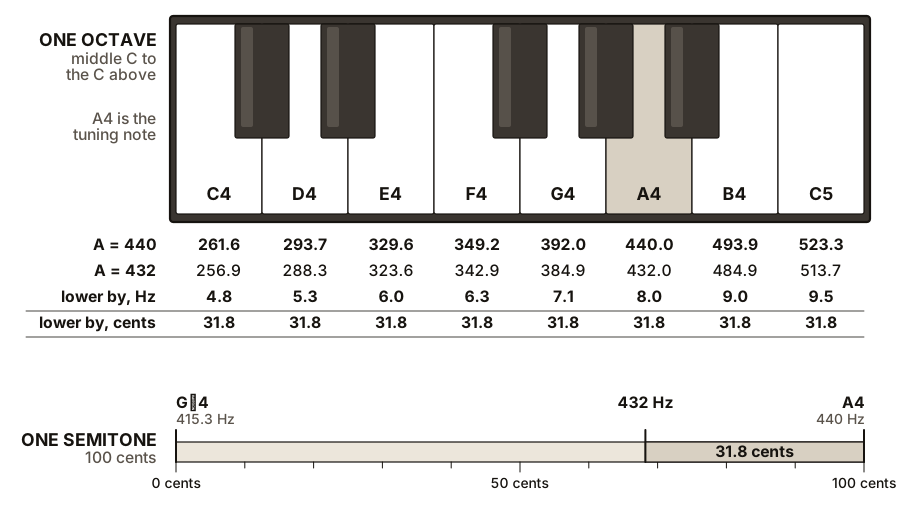
Start with the arithmetic, because it explains the experience. Musicians measure the distance between two pitches in cents: a hundred to each semitone, the step from one key of a piano to the next, and so 1,200 to the octave. Cents count ratios, the way the cochlea does (Chapter 16), so the distance from 432 to 440 is
1,200 × log₂(440 ÷ 432) = 31.8 cents,
a little under a third of a semitone. Retune a piece from A = 440 to A = 432 and every note in it drops by exactly that amount, the lowest bass note and the highest soprano note alike. In hertz the drop grows as you go up: middle C falls by 4.8 Hz, the A by 8 Hz, a soprano’s high C by 19 Hz. In cents it is the same everywhere, because the whole piece has been multiplied by one number, 432 ÷ 440, which is 0.982.
A third of a semitone is small. In one test of 100 people with tones near 528 Hz, musicians could just tell apart two tones 10 cents apart, while non-musicians needed about 38, more than the gap between 432 and 440 (Arndt and colleagues, Experimental Brain Research, 2020). A singer feels it more than she hears it. In the simplest model a vocal fold is a stretched string, and its pitch goes as the square root of its tension, the rule Galileo gave and Chapter 6 applied to a drum. To sing 1.85 percent higher, the folds must be stretched about 3.7 percent harder. That extra pull matters most at the top of the range and on the notes where a voice changes gear from one register to the next, which for each voice fall within a fairly narrow band of pitches. A composer who wrote for a singer at a lower A placed the hard notes just below them. Raise the A and every hard note in the score climbs a third of a semitone further into the difficult zone.
So the experience is real, and it is general: A = 430 would feel easier still, and A = 415 easier again. The ear agrees on how small the change is. On the basilar membrane of Chapter 16, where every doubling of frequency takes 3.5 to 5 mm (0.14 to 0.2 in), a shift of 31.8 cents moves the place where each note peaks by about a tenth of a millimetre (four thousandths of an inch), the width of about ten inner hair cells. The ear has a place for every pitch, and 432 lies a hair’s breadth from 440.
IN PLAIN ENGLISH: Tuning to 432 instead of 440 lowers every note in the music by the same small step, about a third of the distance between two neighbouring piano keys. For a singer that means every high note is a little lower and a little easier to reach. Any lower tuning would do the same; 432 is one of many.
ON THE BENCH: The singing test, blind
Parts: your phone’s tone generator from Chapter 1, or any free tuner app that can play a reference tone and set its A; a friend; a notebook. Cost: nothing. Time: 30 minutes. Hazards: none. Stop if your voice tires; do not push for a note that hurts. Method: choose a song with a high note near the top of your comfortable range. Have your friend set the generator to 440 or 432 Hz by the toss of a coin, out of your sight, and play the A for two seconds. Find the song’s first note from it and sing the song through. Write down how the top note felt, on a scale from 1 (easy) to 5 (could not reach it), and whether you think it was 432 or 440. Rest a minute. Repeat ten times; your friend records which pitch was really played each time. What you should see: this is a prediction from Section 1, not a measured result. If you are like most singers, the top note should score a little easier on the 432 trials, especially late in the session when the voice is tired. Your guesses about which was which will probably be close to chance, and that would be a result in itself: the body noticing a third of a semitone before the ear names it. If you have absolute pitch you may name every trial correctly. If it does not work: if every trial feels the same, choose a song that takes you higher, or sing it a tone higher; the effect only shows near the top of a voice. Better, if you have one: sing at 440, 432 and 415 Hz. If the song gets steadily easier as the A goes down, the cause is the drop in pitch, not anything special about 432.
Section 2: Centuries Without an A
For most of the history of music there was no standard pitch at all. Every organ was tuned where its builder and its choir found convenient, and the other instruments of a town tuned to the organ. Jean-Jacques Rousseau’s Dictionary of Music of 1768 put it plainly: perhaps, since music began, no two places have ever played at the same pitch.
A few of those old pitches survive in metal, because a tuning fork, once filed, keeps its note for centuries. The most famous is a fork that belonged to George Frideric Handel. The English acoustician Alexander Ellis, who spent years measuring old forks and organ pipes, copied it and gave its pitch as A = 422.5 Hz in his paper “On the History of Musical Pitch”, published by the Society of Arts in London in March 1880 (Journal of the Society of Arts 28, p. 319). The inscription on its box says Handel left it at the Foundling Hospital when Messiah was performed there in 1751. That is 70 cents below 440, nearly three-quarters of a semitone. Ellis’s tables run from about A = 374, on an organ of about 1700 in Lille, to about 506 at Halberstadt in Germany, a spread of nearly a fifth.
Then, through the nineteenth century, pitch climbed. Ellis gives the Paris Opera at A = 434 in 1819 and A = 448 in 1858 (p. 311), with provincial French theatres higher still. Brass bands and instrument makers were blamed: sharper sounded brighter. The cost fell on singers, who sang Mozart, Gluck and Handel far above the pitches those parts were written for.
In 1858 the French government did something about it. The Ministry of State appointed a commission to fix a uniform pitch for France. Its printed report, Rapport et arrêtés pour l’établissement en France d’un diapason musical uniforme (Paris, Imprimerie impériale, 1859), was written by the opera composer Fromental Halévy; the chair was a senior official of the ministry, Jules Pelletier. The report, which the Society of Arts printed in English in London that June, lists the members: the composers Auber, Berlioz, Halévy, Meyerbeer, Rossini and Ambroise Thomas; two physicists, César Despretz and Jules Lissajous, the man whose looping figures you may have met on an oscilloscope; and officials, among them those responsible for the army’s bands and the state’s opera houses. Its reasoning was about voices: the composer, it said, hears in his head a singer who “always sings well”, tuned to “a moderate and true pitch”.
The commission chose an A a quarter of a tone below the Opera’s, and on 16 February 1859 the minister, Achille Fould, signed a decree making it compulsory, from 1 July in Paris and 1 December in the provinces, in every institution that took state money. The number in the decree was 870 vibrations. French acoustics then counted every swing in each direction as one vibration, so 870 French vibrations is 435 Hz. The commission had asked for a model fork giving 870 at 15 °C (59 °F). Despretz and Lissajous made it, and it was kept at the Paris Conservatoire. Ellis measured it at 435.4 Hz (p. 312). This was the diapason normal, the first pitch fixed by law for a whole country.
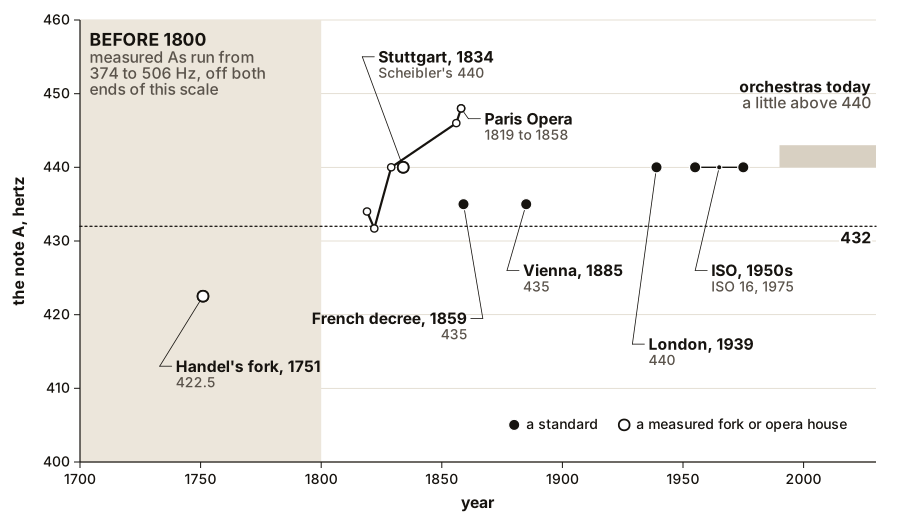
The French A spread. Austria adopted it, and in November 1885 an international conference in Vienna, called by the Austrian government, with delegates from Italy, Hungary, Sweden, Russia and three German states, made 435 the international standard. At that conference the Italian delegation proposed 432, on the grounds that a standard ought to rest on mathematical principle and that 432 gives tidier numbers for the notes of the scale. The other delegates voted for the pitch already in use. The argument for 432 as the “mathematical” pitch was made in Vienna in 1885, and lost.
One more number belongs here. In 1834 Johann Scheibler, a silk manufacturer of Krefeld who measured pitch with 52 forks of his own design, proposed A = 440 to a congress of physicists in Stuttgart, for forks at 69 °F (20.5 °C) (Ellis, p. 325). It had little effect then, but it makes 440 a German proposal of 1834.
Section 3: London, 1939, and the French Referendum
America went its own way. In 1917 the American Federation of Musicians voted for A = 440, and American makers followed. By the 1930s radio carried orchestras across borders, and anyone could hear that nobody agreed.
So in May 1939 the International Standards Association held a conference on pitch at Broadcasting House in London, organised by the British Standards Institution. The report in Nature by its president, the physicist G. W. C. Kaye (Nature 143, 27 May 1939, pp. 905 and 906), records that five countries sent delegates, France, Germany, Great Britain, Holland and Italy, that the written views of Switzerland and the United States were before it, and that the broadcasters’ and the telephone engineers’ international bodies took part. It chose 440. The war delayed everything, and the International Organization for Standardization confirmed 440 after it: as a recommendation in the 1950s and as the standard ISO 16 in 1975, which says simply that the A in the treble stave “shall be 440 Hz”, produced to within 0.5 Hz. The London conference had found European concert broadcasts averaging 443, and many orchestras still tune a little above 440 for a brighter sound.
France did not take it quietly, and this is the record behind the claim that thousands of French musicians voted against 440. On 19 June 1950 the French composer Robert Dussaut had a note read to the Académie des sciences (Comptes rendus 230, pp. 2150 to 2152). It proposed a new fixed sound, G = 384, “hence A = 432”. It said that the London congress had met “at the instigation of German radio”, with instrument makers and radio engineers signing for France and no physicists or musicians invited. And it said this: “By referendum, many French musicians have accepted that the A be brought down to 432.” The note gives no number. The historian Fanny Gribenski, working from the French national archives, confirms the referendum and adds that in August 1951 the government appointed a new pitch commission whose experts leaned towards 432 (“Negotiating the Pitch”, 2018). Neither gives a count.
The count arrives later. In September 1988 Executive Intelligence Review, a magazine of the political movement of Lyndon LaRouche, wrote that the referendum reached “directly or indirectly 23,000” musicians. By the winter of 1991 the Schiller Institute’s magazine Fidelio had it as “a referendum by Professor Dussaut of 23,000 French musicians” who “voted overwhelmingly for A=432”. No figure of 2,000 has been found in print at all. So the referendum was real, it was for 432, and it happened around 1950; its size is not on record, and the 23,000 first appears 38 years later, without a source, in a campaign that wanted the largest number it could find.
Standards name a temperature because pitch depends on temperature. A steel fork falls only about 0.05 Hz per degree, but an organ pipe’s note is set by the speed of sound in its air (Chapter 4), which rises as the air warms: about 3 cents per degree Celsius.
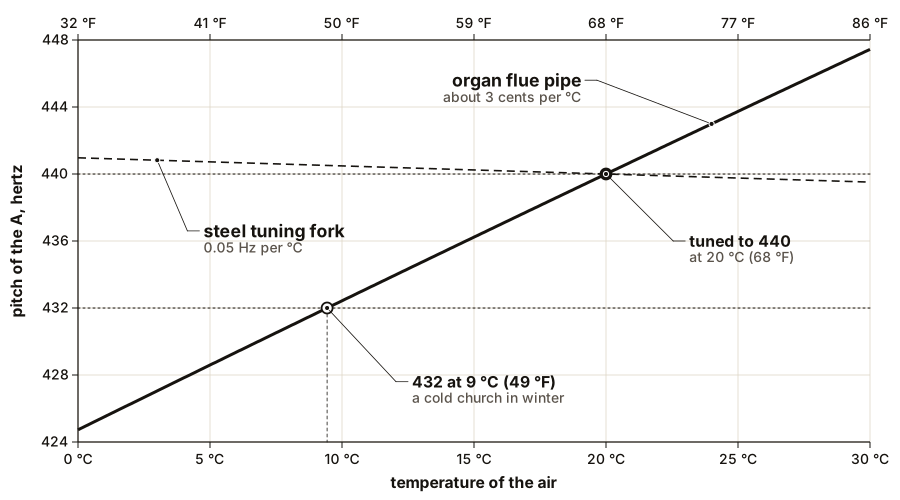
An organ tuned to 440 on a warm afternoon plays at 432 in a church at 9 °C (49 °F). Every choir that sings with an organ through a winter sings at both pitches.
Section 4: Verdi’s A, and the Story of Goebbels
The modern case for 432 rests on three stories. Each has a document under it, and each document says less than the story.
Verdi. Giuseppe Verdi did care about pitch, and for the singer’s reason. In 1881 he sent his friend and later librettist Arrigo Boito to argue for 432 at a congress of Italian musicians in Milan. In a letter of 10 February 1884, printed in the scholarly edition of his correspondence with his publisher Giulio Ricordi and quoted in an Italian Senate bill of 1988, he wrote that if the government’s music commission, “for mathematical requirements”, wished to lower the French pitch from 435 to 432, “the difference is so small, almost imperceptible to the ear, that I gladly agree”. What alarmed him was a proposal from Rome for 450. What he wanted was one pitch for the whole musical world: why, he asked, should the note called A in Paris or Milan become a B flat in Rome? Verdi endorsed the French 435 and accepted 432 as a harmless refinement. The 432 decree of 1884 that the campaign later cited was real but narrow: an act of the War Ministry that August fixing the pitch of the army’s bands, which the historian Ellen Lockhart gives as 432, as the 1913 editors of Verdi’s letters did before her. It was not a law for Italian music, and at Vienna the next year Italy’s delegates argued for 432 and lost.
The Schiller Institute. In 1988 the political movement of Lyndon LaRouche, through its Schiller Institute, launched a campaign for what it called “Verdi tuning”, with middle C at 256 Hz and A at 432. On 9 April 1988 it held a conference at Casa Verdi in Milan, where the soprano Renata Tebaldi spoke and the baritone Piero Cappuccilli sang arias at both pitches. Its petition lists among its signers Joan Sutherland, Birgit Nilsson, Dietrich Fischer-Dieskau and Carlo Bergonzi. Their complaint was the singers’ complaint of 1859, and it deserves the same respect. In July 1988 seven Italian senators introduced a bill to fix A at 432 at 20 °C (68 °F). The law Italy passed, on 3 May 1989, fixed it at 440.
The C = 256 has its own origin. In 1713 the French mathematician Joseph Sauveur measured a C at about 244 vibrations and took 256 in its place because it is a power of two, 2⁸, which makes the arithmetic easy. Put A a Pythagorean sixth above it, 27/16 as high, and A is exactly 432; on an equal-tempered keyboard, C = 256 gives A = 430.5.
Goebbels. The claim that 440 was a Nazi pitch, imposed by Joseph Goebbels, grows from Dussaut’s 1950 complaint that the London congress was held “at the instigation of German radio”. The earliest printing found that names Goebbels is the same Executive Intelligence Review article of 2 September 1988, under the title “How the Nazis ruined musical tuning”, which says that “Dr. Josef Goebbels’s Radio Berlin” organised the conference. Set it against the record. The conference was called by the international standards body, organised by the British Standards Institution, and held at the BBC. Germany was one delegation of five. Gribenski’s research found that every delegation except Italy’s had recommended 440 before it met. 440 was a German number, an American habit and a broadcasters’ convenience; the record shows no sign that it was a Nazi decree.
IN PLAIN ENGLISH: Verdi liked a lower A and said 432 was fine, but above all he wanted one pitch for everybody. The French referendum was real, but nobody recorded how many voted; the 23,000, and Goebbels, first appear in one political magazine in 1988. The London conference of 1939 was standards engineers from five countries.
Section 5: What the Salt Says
Every claim that 432 is special in nature rests on one hidden step: that the number 432 belongs to nature. It belongs to the second.
A hertz is one cycle per second (Chapter 1), and the second is a human unit: 1/86,400 of the mean solar day, the day cut by ancient custom into 24 hours of 60 minutes of 60 seconds. Since 1967 it has been defined as 9,192,631,770 cycles of a radiation from the caesium atom, a number picked to match the old second. Nothing in the universe knows how long a second is. Revolutionary France briefly made a decimal day of 100,000 seconds the law. Counted in those seconds, 440 Hz is 380.2 cycles and 432 Hz is 373.2, and none of the arithmetic said to make 432 “consistent with the universe” works any more. A pitch is a real thing; its number of hertz is a count in a unit people chose.
What has frequencies of its own is matter, set by size, stiffness and mass. The chapter 1 disc draws its figures where Chapter 5’s formula puts them for 300 mm (12 in) of 1.0 mm (0.040 in) sheet. The bottle of Chapter 13 sings near 170 Hz because of its volume and neck; the room of Chapter 18 booms at 34.3, 42.9 and 54.9 Hz because of its walls.
So put both numbers on the plate. The chapter 1 disc draws four spokes and a ring at 385 Hz, and the next figure up is the twelve spokes at 512 Hz. Between them, for 127 Hz, it draws nothing, and both 432 and 440 fall in that gap. Chapter 9 showed that each figure is a resonance only about a hertz wide: 0.8 Hz at a Q of 640. At 432 the salt shivers; at 440 it shivers the same.
Now cut a second disc from the same sheet, 280 mm (11 in) across. Frequency goes as one over the diameter squared (Chapter 5), so every figure rises by (300 ÷ 280)², which is 1.15: the ten spokes move to 415 Hz and the cross and ring to 443 Hz. At 440 the plate is three bandwidths off that peak and the salt barely stirs; at 443 it snaps into a cross and ring. A disc 283 mm (11.1 in) across would put the same figure on 432. A 3 mm (1/8 in) difference in diameter decides which number “makes a pattern”, and so can the sheet: Chapter 24 found that a sheet 3 percent thicker moves every figure 3 percent, here 13 Hz.
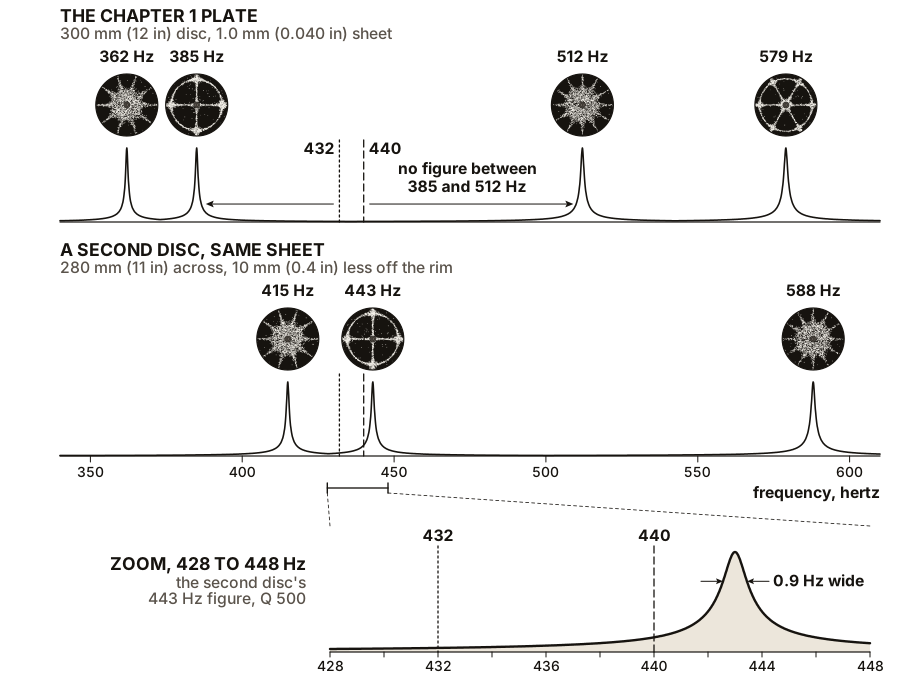
That answers the claim that 432 Hz “makes better cymatic patterns”. A figure appears where a plate has a resonance, and a plate has its resonances where its size and material put them. Change the plate and the answer reverses.
ON THE BENCH: 432 against 440, on two plates
Parts: the chapter 1 rig and salt; a second disc of the same 1.0 mm (0.040 in) aluminium sheet, 280 mm (11 in) across, drilled at the centre and painted like the first; a notebook. Cost: about $10 for the second disc, or nothing if you have an offcut. Time: an hour. Hazards: cut edges are sharp; file them. Ear protection above 85 dBA, as always. These tones sit near the middle of the ear’s most sensitive range. Method: on the chapter 1 disc, sweep from 425 to 445 Hz in steps of a tenth of a hertz, waiting two or three seconds at each step (Chapter 9 explains why); Chapter 24’s sweep already covered this. Play exactly 432.0 Hz for a minute, then 440.0 Hz, at the same volume, and photograph the salt each time. Then bolt on the smaller disc, sweep from 425 to 460 Hz, write down any figure’s frequency to a tenth of a hertz, and play 432.0 and 440.0 on it too. What you should see: these are predictions from Chapter 5’s formula, to be checked on your own plates. On the large disc, nothing at either number. On the small one, the cross and ring somewhere between about 430 and 456 Hz, wherever your sheet’s true thickness puts it. Whatever frequency you found is the plate’s number. Tape a small coin near the rim and sweep again: the figure should move down a few hertz. With patience you can park it on 432, or 440, or any number you like. If it does not work: widen the sweep to 400 to 480 Hz, and work out where to look from Chapter 5’s formula with your measured thickness.
As for 432 that “heals”: Chapter 24 found cells in a dish responding to how hard they were pushed, much the same at 440 Hz, 14,000 Hz and noise. On people there are a few small trials, all from one group in Florence, and they deserve a fair reading.
The first, by Diletta Calamassi and Gian Paolo Pomponi (Explore 15, 2019, pp. 283 to 290), played 33 healthy volunteers the same film soundtracks for 20 minutes, tuned to 440 on one day and 432 on another, and called the design double-blind. At 432, heart rate came out 4.79 beats a minute lower, at p = 0.05; breathing was 1 breath a minute slower, at p = 0.06; blood pressure fell slightly, not significantly; and the listeners reported feeling more focused and more satisfied. In 2020 the same group gave 12 patients with spinal cord injuries their favourite music at each tuning: sleep scores improved after the 432 period (by 3.6 points, p = 0.02) and not after the 440 period. In 2022, 54 emergency nurses took 83 ten-minute breaks with 440 music, 432 music or no music, allocated at random with the data collector blinded: anxiety fell in all three groups, including the one with no music, and only the 432 group showed falls in breathing rate (2.7 a minute) and systolic blood pressure (3.8 mmHg (about 0.07 psi)) from before to after.
Taken at face value, that is a small, consistent lean towards 432 in one laboratory. What the trials cannot show is as plain. Each is small and called a pilot by its authors. All come from one team, and none has been repeated elsewhere. Each measured several things and reported the few that crossed p = 0.05, which is the pattern chance alone produces when enough outcomes are tested. The later two report changes within each group, before against after, more than differences between the tunings; the one direct test of 432 against 440 in the 2022 trial, of how productive the nurses felt, found no difference. And every one compared the same music a third of a semitone apart, so at best they measure a listener’s response to slightly lower music. None tests a property of the number 432, and none could: the same music at 430 or 425 was never played.
Section 6: What Is True
Sort the claims, and a good deal survives.
Lower pitch is easier on voices, for the reason in Section 1, and so is every lower pitch, not only 432. It was the French commission’s reason in 1859.
Lower pitch is easier on old instruments. Gut strings at lower tension last longer, and a violin built for a lower A carries less load on its top.
There is no single historical A. Early-music ensembles commonly play baroque music at A = 415, a semitone below 440, and often play classical-period music at 430, as stand-ins for the many pitches of the time. Handel’s fork and Verdi’s 432 are points in a long scatter.
The choice of A is a convention, and conventions can be argued. An orchestra that tunes to 432 makes a legitimate artistic choice, at a cost: wind instruments built for it, and recordings a third of a semitone flat beside everything else.
What does not survive is the claim that 432 is a frequency of nature. A plate, a bottle, a room or a cell has its own frequencies, set by its own size and material. The salt does not know what an orchestra decided in 1939, and it does not know what anyone decided in 1859 either.
ON THE BENCH: Can you hear 32 cents?
Parts: a computer with a free audio editor that can change pitch without changing speed; a recording of a piece you know well; a friend; headphones. Cost: nothing. Time: 40 minutes. Hazards: keep the volume moderate in headphones. Method: make a copy of a one-minute excerpt and lower its pitch by 1.82 percent, which is 31.8 cents or 0.318 of a semitone (the editor’s pitch tool will take one of those). Export both versions at the same loudness. Your friend plays you one of the two, chosen by coin toss, ten times over, with a minute of something else in between. Each time, say which it was, and which you liked better. What you should see: a prediction, from the thresholds in Section 1. Heard one at a time, most people should score close to five out of ten; people with absolute pitch, or who know the recording well, should score higher. Played back to back, most musicians should hear the change, and some other listeners may not. That is what a 432 recording offers: the same music a third of a semitone lower. A shift to 425 or 445 would pose the same question.
SLOW DOWN. Check Your Understanding: A demonstration shows salt on a vibrating plate forming a crisp, beautiful figure at 432 Hz, and a shapeless scatter when the tone is switched to 440 Hz. Is that evidence that 432 is the better frequency? Decide before you read on.
No. It shows that this plate has a resonance within about a hertz of 432 and none near 440, and you can predict how fragile that is. A plate’s frequencies go as its thickness, so a sheet 1 percent thinner moves the figure to 428 Hz, and one 2 percent thicker moves it to 441 Hz, where the same demonstration would “prove” that 440 is better. Ordinary rolled sheet varies that much from batch to batch. A one-plate demonstration tests the plate, never the number. A fair test takes many plates, chosen before anyone knows their frequencies, and counts how often a figure lands within a hertz of 432, of 440, or of any other number. You already know the result: no number wins.
Bench Degree
Get the degree without the diploma.
Learn the material, not how to pass the exam.