Bench Degree·CYMATICSchapter
Chapter 25: The Rife Machine
A singer can break a wine glass with one held note. For ninety years people have hoped that a cancer cell could be broken the same way. A glass, a grape and a cube of jelly on your bench show what that hope is up against, and a hospital machine shows that sound can destroy a tumour after all.
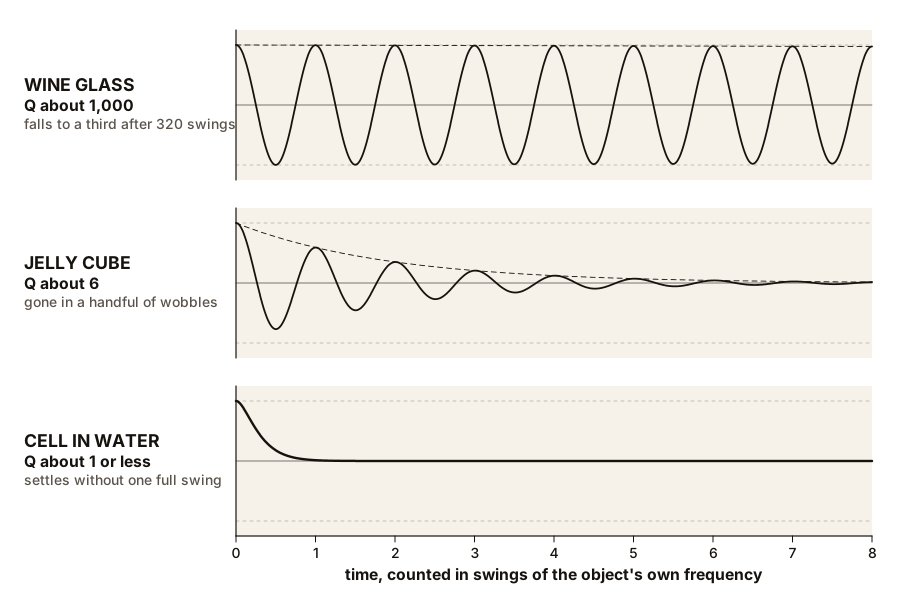
Hold a thin wine glass by its foot and flick the rim with a fingernail. It rings, a clear note that hangs for a second or two after your finger has gone. Chapter 9 measured that ring and found a Q near 1,000.
Now flick a grape. You hear a dull tick, and nothing after it. Flick a cube of firm jelly sitting on a saucer: it wobbles three or four times, each wobble smaller, and stops.
Three objects, one flick each. One keeps the energy of the blow and swings with it hundreds of times. One spends it all at once. The difference is the whole of this chapter, because a living cell is far more like the grape than the glass, and the most persistent health claim in the world of sound depends on its being like the glass.
Section 1: The Claim
Here is the claim, stated as a person who believes it would state it.
Every kind of invading cell, a cancer cell, a bacterium, a virus, has its own resonant frequency, the way a wine glass has its own note. Find that frequency and play it, and the cell will vibrate harder and harder until it bursts, just as the glass shatters when the singer holds her note. Healthy tissue, with different frequencies, is untouched. No drugs, no surgery, no burns. A scientist named Royal Raymond Rife found these frequencies in the 1930s, cured cancer patients with them, and was then silenced by a medical establishment that could not profit from a cure so cheap. His machines are still sold. Lie on a bed of speakers, play the right frequency, and the cancer breaks.
Every link in that chain sounds like physics from earlier in this book. Resonance is real, Q is real, and singers really have broken glasses. So the honest questions are three. What did Rife actually build and claim? Would the physics work on a cell? And if sound can break things, why is nobody using it on tumours? The last has the most surprising answer: people are.
Section 2: What Rife Built
Royal Raymond Rife was born at Elkhorn, Nebraska, in 1888, came to San Diego in 1906, and died at El Cajon, near San Diego, in August 1971, aged 83. He was a skilled, self-taught builder of microscopes.
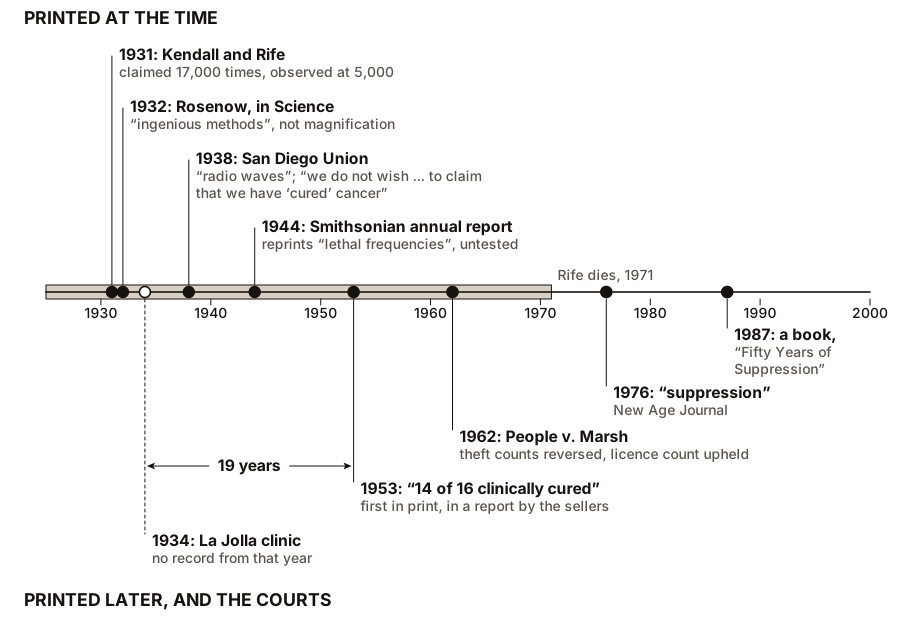
The earliest scientific paper bearing his name appeared in California and Western Medicine in December 1931, written with Arthur Kendall, a bacteriologist at Northwestern University. It reported “small, oval, actively motile, turquoise-blue bodies” in filtered cultures of the typhoid germ, which the authors suggested were a form of the germ small enough to pass through a filter. The paper says Rife’s instrument “magnifies from 5,000 to 17,000 diameters”, and that the observations were made at 5,000. The same issue reports a demonstration in the Pasadena home of Dr Milbank Johnson, a physician who backed Rife’s work, before about thirty doctors.
In August 1932 Edward Rosenow of the Mayo Clinic reported in Science on three days at the microscope in Kendall’s laboratory. He saw what Kendall described, and added a careful sentence: the tiny bodies were visible because of “the ingenious methods employed rather than … excessively high magnification.” That sentence is the physics. Chapter 21 gave the rule that a wave shows detail only about as small as itself. Visible light has a wavelength of 400 to 700 nanometres, so no light microscope can separate details much closer than about 0.2 µm (0.000008 in), however much it magnifies. Beyond about 1,500 times, the picture grows bigger without growing sharper.
The Smithsonian Institution’s annual report for 1944 reprinted an article by R. E. Seidel and M. Elizabeth Winter from the Journal of the Franklin Institute describing Rife’s “Universal Microscope” of 1933: 5,682 parts, 200 lb (91 kg), and a claimed magnification of 60,000 diameters. It also repeats, without examining it, Rife’s claim that microorganisms “succumb when exposed to certain lethal frequencies.” A government annual report reprinted the claim; it did not test it.
The frequencies belonged to a second invention. On 7 May 1938 the San Diego Union reported, under the headline “Dread Disease Germs Killed by Radio Waves”, that Rife and an engineer, Philip Hoyland, were destroying germs “with radio waves tuned to a particular length for each kind of organism”, at what the article calls “mortal oscillatory rates”. It also quotes Rife: “We do not wish at this time to claim that we have ‘cured’ cancer.”
An undated typed settings sheet headed “Rife Ray Machine No. 4”, published by the Rife advocacy site rife.org, lists a setting in kilocycles for each organism; an advocacy history dates that machine to 1935. For the agent he called “BX”, which he believed caused cancer, it gives 1,604 kc: 1,604,000 Hz, a radio frequency around the top of the AM band. Rife’s own testimony in 1961 describes a radio transmitter, modulated at lower rates, driving a glass tube of rare gas that glowed as it ran. A 1953 report by Rife and an associate, John Crane, says of a treatment: “A tube lights up and 3 minutes later the treatment is completed,” and “no noise is audible.”
So the original Rife machine was a radio device. Nothing in the record from his lifetime describes a loudspeaker, or a cell broken by sound. The wine-glass picture, which makes the idea feel like acoustics, was attached later.
Section 3: The Clinic, the Trials and the Silence
The centre of the legend is a clinic said to have run in the summer of 1934, in a house in La Jolla, California, under a committee overseen by Milbank Johnson. Sixteen patients with cancer were treated, and fourteen are said to have been pronounced cured.
The earliest printing of that result found anywhere is in the 1953 report by Rife and Crane, nineteen years later: “16 cases were treated at the clinic for many types of malignancy. After 3 months, 14 of these so-called hopeless cases were signed off as clinically cured.” The report was issued by a San Diego company that sold frequency instruments. No report, patient record or publication from 1934 giving the patients’ outcomes has been found; the nearest thing, a few pages of laboratory ledger from July and August 1934 published by rife.org, records cultures and microscope work, not cures, and Milbank Johnson, who could have published one, died in October 1944 without doing so. That does not prove the clinic achieved nothing. It means the claim rests on a recollection published by the people selling the device.
The courts are on the record. In 1939 Hoyland sued over the control of Beam Rays, the small company formed to sell the instruments, and a San Diego judge refused to put it into receivership; buyers from London claimed that same year that a machine they had paid $2,991 for cost $300 to build. Later Crane, another seller, John Marsh, and a third man were convicted in California of attempted grand theft and two conspiracies. In 1962 the state Supreme Court, in People v. Marsh, recorded that their $175 machine was “identical in design” with a device used by radio and TV repairmen that retailed for $49.95. It set aside the theft convictions because evidence of the defendants’ good faith had been wrongly excluded, and upheld the conviction for conspiring to practise medicine without a licence. Rife was by then living in Tijuana.
The suppression story reaches a wide audience later still. In March 1976 the writer Christopher Bird revived Rife in New Age Journal with “What Has Become of the Rife Microscope?”, and is quoted by later writers as passing on a Milwaukee nutrition foundation’s claim that leaders of American medicine had made Rife’s work taboo. In 1987 Barry Lynes published The Cancer Cure That Worked: Fifty Years of Suppression (Marcus Books, Queensville, Ontario), a book later retellings often cite. In 1994 the American Cancer Society, reviewing electronic cancer devices, found no evidence that any of them gave objective benefit against cancer, and urged people with cancer not to use them.
IN PLAIN ENGLISH: Rife was a real man who built real and unusual microscopes, and some respected doctors were interested in his work in the early 1930s. His “frequency” machine sent out radio waves, not sound. The claim that it cured fourteen of sixteen cancer patients was first written down nineteen years after the event, by people selling the machines. The story that he was silenced spread in the 1970s and 1980s.
Section 4: What It Takes to Break a Glass
Set the history aside. Could sound at a cell’s own frequency break it the way a voice breaks a glass?
Chapter 9 listed what the glass needs. A high Q, near 1,000, so that each small push adds to the swing already there. A stiff shell that stores the energy as bending and gives it back. A mode that strains it, the swinging oval of Chapter 19. Time: from Q = π f τ, the glass at 550 Hz has τ of about 0.6 seconds, and needs three of those to build to full swing. Aim: its bandwidth, f/Q, is about half a hertz. And loudness: 105 dB in the best recorded case, a swing of 3.6 pascals, and that on the twelfth glass the singer tried. Glass cracks when stretched by roughly a thousandth of its length, and Q is what turns a few pascals into that.
Now the cell. A human cell is about 10 to 20 µm across (0.0004 to 0.0008 in): a hundred end to end would span a millimetre (0.04 in). It is soft, about as stiff as a jelly dessert when pressed with a microscopic probe, and in a 2007 study metastatic cancer cells taken from patients’ body fluids were more than 70 percent softer than benign cells from the same sample. And it lives in water, packed against its neighbours.
A soft lump has a natural frequency like anything else, stiffness against mass as in Chapter 3, and a small one has a high one. In 2016 Stefanie Heyden and Michael Ortiz of Caltech modelled a liver cancer cell, with its membrane, nucleus and nucleolus, and found its lowest natural frequency near 80 kHz, and that of their healthy cell near 43 kHz. That is ultrasound, far above anything a speaker in a room plays. Their model left out one thing, and said so: friction, the damping of Chapter 9.
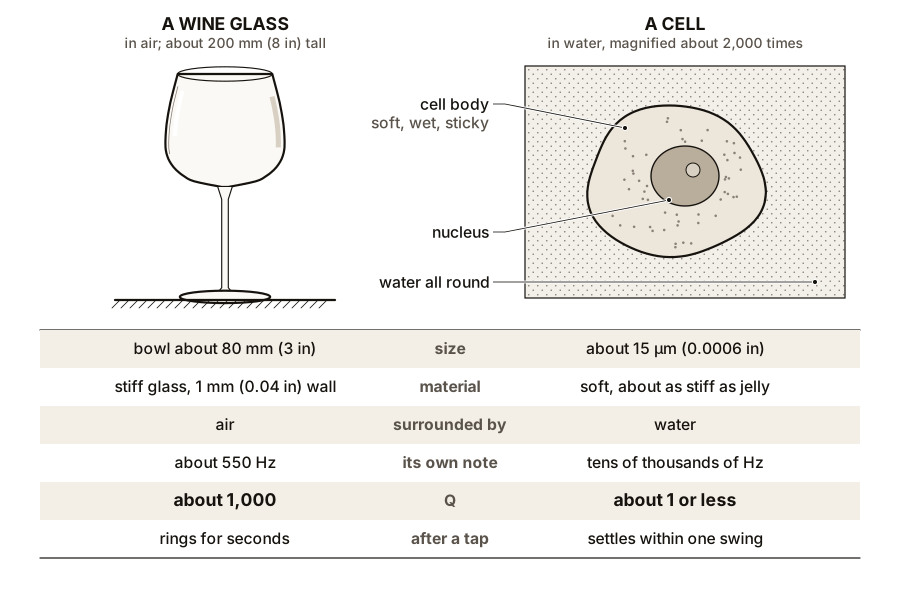
Damping decides it. A cell is wet inside and out, and to change shape it must shove water about. A rough rule for a soft, sticky lump is that Q is about its stiffness divided by 2π × frequency × the viscosity, the stickiness, of the liquid. Take Heyden and Ortiz’s own stiffness for the inside of a cell, about 400 Pa (0.06 psi), their 43 kHz, and the viscosity of plain water, the most favourable choice and close to what many measurements give for the fluid inside a cell. Q comes out at roughly 1.5, an order-of-magnitude estimate, not a measurement. Measurements that include the friction of the cell’s internal scaffolding give far less. And when the Caltech group modelled their own laboratory results, they concluded that cells in liquid are “much more heavily damped than estimated.”
A Q near 1 means there is nothing to build. Push such a thing at its own frequency and it moves about as far as it would if pushed slowly. Stop, and it settles inside one swing, like the grape.
ON THE BENCH: The glass, the grape and the jelly
Parts: a thin stemmed wine glass; a grape; a packet of gelatin dessert made with half the usual water, set in a small square tub and turned out as a cube about 50 mm (2 in) on a side; a saucer; a deep bowl of water; a phone that records sound and films slow motion at 240 frames a second; the audio editor from Chapter 9. Cost: about $2 for the dessert. Time: an evening, mostly waiting for the jelly to set. Hazards: a chipped glass cuts; use a sound one and flick gently. Method: record the glass ringing after a flick and read τ off the trace as in Chapter 9; Q = π × f × τ. Record a flick of the grape held between two fingers. Film the jelly on the saucer in slow motion as you flick its top edge sideways; play it back frame by frame, count the wobbles until one is a third the size of the first, and multiply that count by π. Then lower the cube into the bowl of water and flick it the same way with a spoon handle. What you should see: a glass Q of several hundred to over a thousand. A grape that ticks and gives no tone at all. A jelly that wobbles a few times in air, a Q of perhaps 5 to 10, and under water barely wobbles once. The jelly figures are predictions from the physics, not measurements; your own count is the result. Nothing about the jelly changed except what surrounds it, and its Q collapsed. A cell is smaller and softer than your cube, and it is under water all the time. If it does not work: if the jelly slides, dampen the saucer so it grips. If the film is too blurred to count, add a dot of food colouring to a top corner as a mark.
ON THE BENCH: Try to shake the jelly apart
Parts: the chapter 1 rig; a fresh jelly cube; cling film; a sound meter app; ear protection. Cost: nothing beyond the dessert. Time: 20 minutes. Hazards: at low frequencies the woofer cone moves a long way. Start at zero volume, raise it slowly, and stop at any knocking from the speaker. Method: cover the plate with cling film and set the cube near the centre. Sweep slowly from 5 to 40 Hz at low volume, watching for the frequency where the cube sways most. Note how far either side of that frequency it still sways well. Then hold the frequency and raise the volume in small steps. What you should see: by our prediction, which has not been measured, a sway that peaks somewhere around 10 to 20 Hz, over a band several hertz wide, where the wine glass in Chapter 9 answered only within half a hertz. That width is the low Q, seen directly: the jelly hardly cares whether you are on its note. Turn it up, and long before the cube splits it begins to hop and skate, because the plate has passed 1 g, about 1 mm (0.04 in) of swing at 15 Hz. Any damage comes from landing, not from resonance. A soft, damped thing can be shaken, thrown and bruised; it cannot be rung to pieces.
Section 5: Getting the Sound In
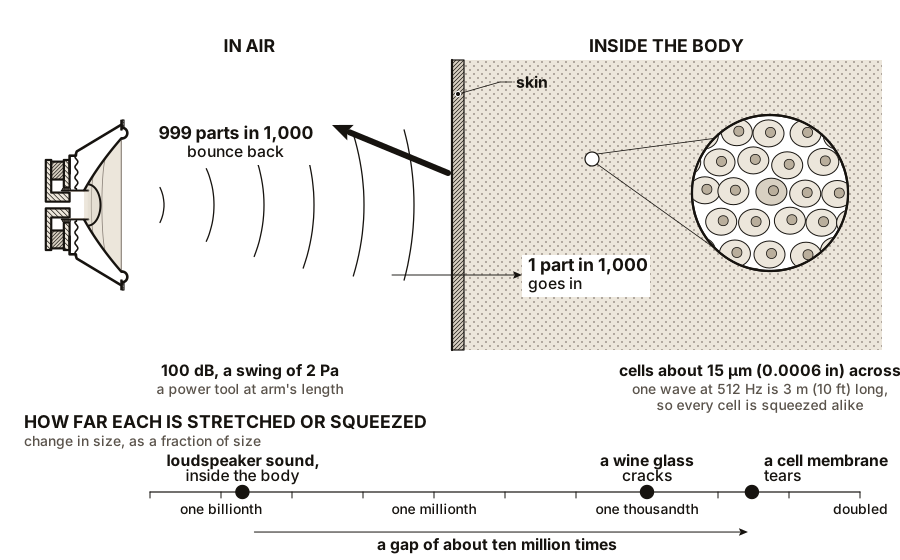
Suppose, anyway, that we try with a speaker in a room. Chapter 24 measured how badly sound crosses from air into water. Every material has an acoustic impedance, its density times its speed of sound: about 415 for air, and about 1.6 million for soft tissue, in the same units. Where sound meets a change of impedance, most of it reflects. The fraction of energy that gets across is 4 × Z₁ × Z₂ ÷ (Z₁ + Z₂)², and from air into tissue that is about 0.001. Nine hundred and ninety-nine parts in a thousand bounce off the skin.
What gets in arrives as a squeeze shared by every cell in the neighbourhood. At 512 Hz a sound wave in the body is about 3 m (10 ft) long, two hundred thousand times the width of a cell, so the cells are pressed and released together, with nothing to set one wobbling against another. A bed of speakers touching the body does better, because contact avoids the air; but Chapter 24’s cells were pushed at 100 pascals by a plate touching their liquid, and they changed the activity of some genes. They did not burst.
ON THE BENCH: How much of the speaker reaches a cell
Parts: a calculator; the sound meter app. Cost: nothing. Time: 15 minutes. Hazards: none. Method: play a tone through the chapter 1 plate at a level you would not want to stand beside and read the meter; suppose 100 dB. Convert to pascals with Chapter 15’s rule, p = 0.00002 × 10^(dB ÷ 20). Work out the fraction of energy crossing into the body: 4 × 415 × 1,600,000 ÷ (1,600,415)². At so hard a boundary the pressure just inside roughly doubles, so take twice your figure as the pressure in the tissue. Divide that by the stiffness of water against squeezing, 2,200 MPa (320,000 psi), to get the fraction by which each cell is squeezed. Repeat with Chapter 24’s 100 Pa, delivered by contact. What you should see: 2 Pa in the air; about 0.001 of the energy crossing; about 4 Pa inside; a squeeze of about 2 billionths. With 100 Pa by contact, about 45 billionths. A cell membrane tears when its area is stretched by a few hundredths. Even the contact case falls short by a factor of about a million, and the glass’s trick of multiplying by Q is not available.
Section 6: Sound That Does Break Things Inside You
Yet sound destroys things inside living bodies every day, in hospitals, and how it does so explains the failure better than any argument.
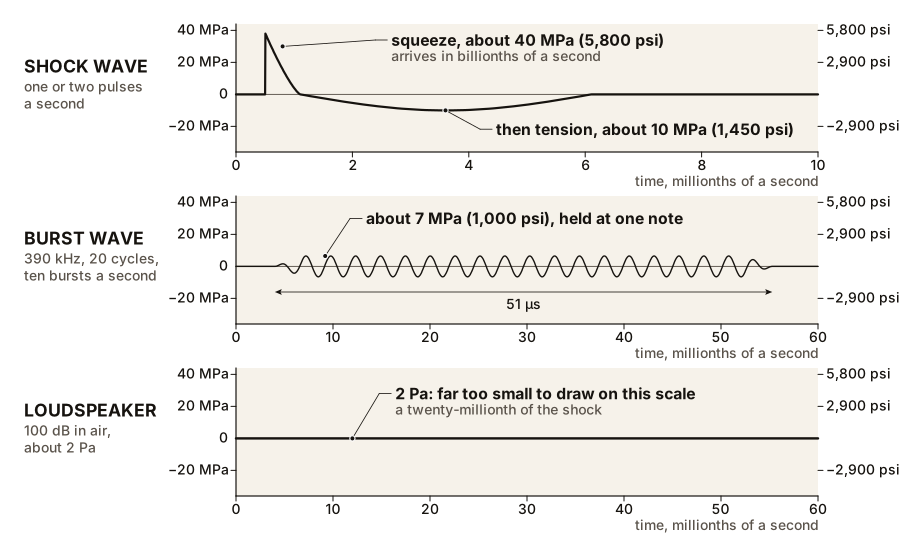
Kidney stones came first. Chapter 21 introduced shock wave lithotripsy: the first patient was treated in Munich on 7 February 1980 on a machine built by the aircraft company Dornier, which the American regulator, the Food and Drug Administration (FDA), approved in December 1984. Each pulse is a single violent squeeze. At the focus of the classic Dornier machine it rises to about 38 MPa (5,500 psi) in a few hundred-millionths of a second, falls away in under a millionth, and is followed by a pull of about 10 MPa (1,450 psi) lasting a few millionths. A treatment delivers about 3,000. There is no note in it: it is one broadband shock, repeated once or twice a second.
The stone breaks by several routes, each studied directly: the shock reflecting off the stone’s back face and pulling it apart there, called spallation; squeezing and shearing as the wave wraps round it; bubbles in the urine that open in the pull and collapse against the surface, pitting it as your foil was pitted in Chapter 21; and fatigue, cracks growing a little with each of thousands of blows. Slower works better. In a randomised trial of 220 patients published in 2005, 60 shocks a minute succeeded in 75 percent and 120 a minute in 61 percent, because bubbles left by one shock soak up the pull of the next.
Burst wave lithotripsy is the nearest thing to tuning. A University of Washington group led by Adam Maxwell and Michael Bailey replaced the shock with bursts of a steady tone, ten cycles or more, at a few hundred kilohertz and about 7 MPa (1,000 psi). In laboratory tests published in 2015 the frequency set the size of the pieces: under 4 mm (0.16 in) at 170 kHz, under 2 mm (0.08 in) at 285 kHz, under 1 mm (0.04 in) at 800 kHz. In 2022 a trial in 19 patients at 390 kHz fragmented 21 of 23 stones, a median of 90 percent of their volume. The group’s own analysis says the bursts do use the stone’s lowest natural mode, but a low-Q one, spread across a wide range of frequencies; the sharper resonances above it are damped away almost completely. A stone is hard and a few millimetres across, so it has a mode to use, and even so no high Q.
One more lithotripter turns the claim inside out. A surgeon can pass a thin hollow metal probe through an endoscope until it touches the stone, and drive it with a piezoelectric crystal at 20 to 26 kHz. The probe is cut to a whole number of half-wavelengths so that it rings strongly, its tip moving most. Here the resonator is the tool, and the stone is the thing being hammered. The probe drills the stone, and the fragments are sucked away through its hollow core.
Tumours are next. High-intensity focused ultrasound gathers sound at one to a few million hertz into a spot a few millimetres across and heats it to 65 to 85 °C (149 to 185 °F) in seconds. The FDA approved such a system for uterine fibroids in 2004 and cleared two for destroying prostate tissue in 2015; the summary for one of them states that its effectiveness against any specific prostate disease has not been established. Histotripsy, named at the University of Michigan in 2004, drops the heat: pulses a few millionths of a second long, with a pull beyond about 26 MPa (3,800 psi), tear the water in tissue into a cloud of bubbles whose collapse turns the target into a fluid of cell fragments. On 6 October 2023 the FDA granted the Edison system, made by HistoSonics, for “the non-invasive destruction of liver tumors”. In its pivotal trial, 42 of 44 treated tumours were destroyed as planned. The same decision says, with care worth copying, that “the safety and effectiveness of the device for the treatment of cancer has not been established”: the trial showed the tumours could be destroyed, not yet that patients live longer.
The resonance idea itself is being tested. Heyden and Ortiz called theirs oncotripsy: pulses near 80 kHz to shake cancer cells apart and spare healthy ones. In 2020 a Caltech team led by David Mittelstein reported in Applied Physics Letters that they had tried it on cells in suspension, at 300 to 670 kHz and under 1.2 MPa (170 psi). With 20-millisecond pulses at 500 kHz, nearly all the cells of two blood-cancer lines broke apart, while more than 80 percent of healthy T cells, a kind of immune cell, survived. That is a striking result. But bubbles were necessary: raise the pressure in the chamber so that bubbles cannot form, and the killing almost stopped. The team’s model explains it as fatigue, damage built up over many cycles in heavily damped cells, not the rapid rupture that pure resonance had predicted. It was done in dishes; animal studies, the authors say, are needed.
So the answer to “why is nobody experimenting with this?” is that many people are. What works is sound millions of times stronger than a speaker’s, aimed into a spot, acting through heat, bubbles, shock and fatigue. What appears nowhere in that work is a speaker playing a cell’s note.
Section 7: What Is Sold, and What Would Settle It
Machines sold today under Rife’s name are mostly signal generators: a box producing a switched electrical signal, usually at audio frequencies and above, delivered through metal cylinders held in the hands, through foot plates, or through a glowing gas-filled tube. They cost from a few hundred to several thousand dollars, and sellers typically state that no medical claim is made. Cancer Research UK describes “low electromagnetic energy waves” delivered “through your hands or feet”, and concludes: “There is no reliable evidence that the Rife machine works as a cure for cancer.” No trial of a Rife device for any condition is registered on ClinicalTrials.gov, the public American register.
None is cleared by the FDA to treat cancer, and the enforcement record is long. In 2001 the Federal Trade Commission ordered a California seller to stop claiming his Rife frequency generators treated cancer and to refund buyers. In 2009 a federal jury in San Diego convicted James Folsom on 26 counts over thousands of unapproved frequency devices sold with Rife’s name in the marketing, and in 2010 he was sentenced to 51 months in prison. The harm that matters most is the one Cancer Research UK names: “You could harm your health if you stop your cancer treatment for an unproven treatment.” Some people have. In Washington State, according to a federal search warrant reported by the Seattle Times, a 32-year-old man with testicular cancer declined surgery, was treated with frequency devices for more than a year, and died in 2004. The man who treated him, who had no medical licence, pleaded guilty in 2008 to a federal charge over an unapproved device used at his clinic.
A separate line of research deserves fairness. TheraBionic, a small company, sends a weak 27.12 MHz radio signal, modulated at chosen lower frequencies, through a spoon held in the mouth. In 2023 the FDA allowed it for advanced liver cancer after other treatments fail, under a humanitarian exemption that asks for probable benefit, not proof; the evidence was survival in ten patients set against earlier trials. It is unproven. It is also published, registered and regulated, which the Rife story never was.
SLOW DOWN. Check Your Understanding: The Machine No. 4 sheet gives the filter-passing form of the typhoid germ 1,445 kilocycles and his cancer agent 1,604, about 10 percent apart. Suppose each were a mechanical resonance. What Q would each need for a machine tuned to one to leave the other alone? Decide before you read on.
Chapter 9’s bandwidth is f/Q. For one target to respond strongly and a neighbour 10 percent away hardly at all, each peak must be much narrower than 10 percent of its frequency: Q well above 10, and for a clean separation nearer 100. A target with Q near 1 has a peak as wide as its own frequency: drive it at half or double its note and it responds almost as well. A chart of frequencies to the nearest kilocycle cannot pick out one soft wet cell from another, which is why the Caltech results turned on pulse length, pressure and bubbles as much as on frequency. Precision on the dial means nothing if the target cannot tell the difference.
What would settle the claim? The experiment is easy to state, and a believer could propose it as readily as a sceptic. Take cancer cells and healthy cells in dishes. Measure, with a hydrophone, the pressure that actually reaches them. Play the claimed frequency, a frequency 20 percent away, and nothing, with the person scoring the dishes not knowing which was which. Count the dead cells. Publish the settings and let a second laboratory repeat it. If the claimed frequency kills cancer cells and the others do not, that is a paper worth reading, and the next steps, animals and then a registered trial, are well trodden. Nobody selling a Rife machine has published that experiment. The people who built sound that destroys tumours published every step of theirs, and the results are in the FDA’s files for anyone to read.

Bench Degree
Get the degree without the diploma.
Learn the material, not how to pass the exam.