Bench Degree·CYMATICSchapter
Chapter 24: Can Cells Hear?
In 2025 a university press office announced that your cells can hear. The paper underneath is careful, real and interesting, and the most useful thing in it is a number you can reproduce on the chapter 1 plate.
Tape a small plastic dish to the chapter 1 plate, near the rim, and pour in water about 10 mm (0.4 in) deep. Set the generator near 512 Hz, where Chapter 1 found the twelve-spoke figure, and sprinkle a few grains of salt on the bare plate beside the dish. Raise the volume until those grains just begin to hop.
Look at the water. Its surface trembles, and if you light it from the side you may see fine ripples shiver across it. Nothing dramatic. But the bottom of that dish is now being pressed and released about 512 times a second, and by the end of this chapter you will be able to say how hard: about 100 pascals. That is the figure in a 2025 paper that went round the world under the headline “Your cells can hear”. Your kitchen experiment and their laboratory experiment are, in the one respect that matters most, the same size.
Section 1: The Headline and the Paper
On 17 April 2025 Kyoto University issued a press release titled “Your cells can hear”. It described a study in which sound changed the activity of genes in cells grown in a dish, and slowed the growth of fat cells. News sites took it from there.
The paper itself had appeared the day before in Communications Biology, a journal of the Nature group, volume 8, article 595. Its authors are Masahiro Kumeta, Makoto Otani, Masahiro Toyoda and Shige H. Yoshimura, of Kyoto University and Kansai University. Its title is “Acoustic modulation of mechanosensitive genes and adipocyte differentiation.” It is open access; anyone can read it, and this chapter recommends you do.
Set the two titles side by side. The press release says hear. The paper says mechanosensitive: genes that respond to being pushed, pulled and squeezed. An adipocyte is a fat cell, and differentiation is the process by which an immature cell becomes one. The paper’s title is the more exact description of what was found, and it is no less interesting for being exact. To see why, you need to know what they built.
Section 2: What They Built
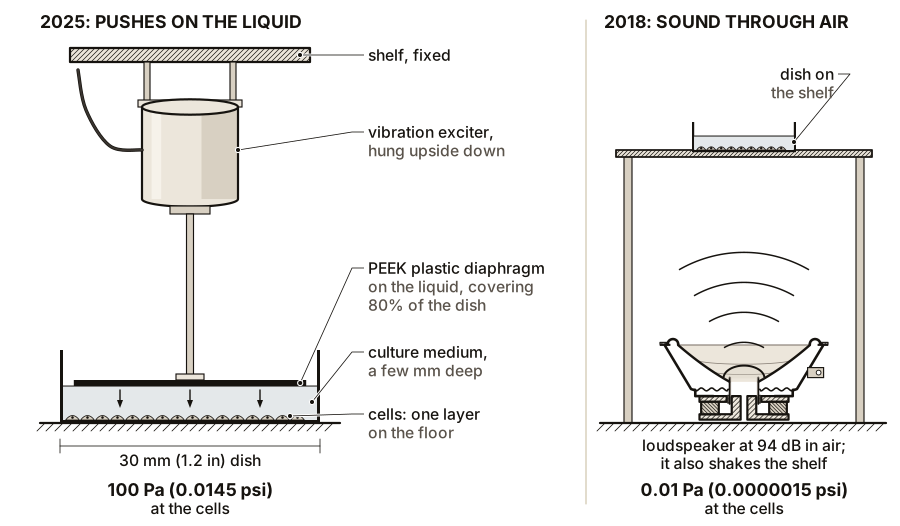
Most sound reaches us through air. Air is thin, and as Chapter 15 showed, even a very loud sound in air is a pressure swing of only a few pascals. Getting sound from air into water is hard. At the same pressure, water moves about 3,600 times less than air does, so most of the sound arriving from air bounces off the surface. The Kyoto group’s earlier attempt, published in PLoS ONE in 2018, played sound from a loudspeaker under a shelf holding the dishes. At 94 dB in air, it delivered roughly 10 thousandths of a pascal to the cells.
So for the 2025 study they built what they call a direct sound emission system. A laboratory vibration exciter, a small precise shaker, was mounted upside down on a shelf above the dish. Fixed to it was a thin diaphragm of a stiff plastic called PEEK, lowered until it touched the surface of the culture medium, the nutrient liquid the cells live in, covering about 80 percent of the dish. When the exciter vibrates, the diaphragm pushes on the liquid directly, and the liquid pushes on the cells lying on the dish’s floor. They measured the result with a hydrophone, an underwater microphone, and set the level to 100 pascals.
They used three sounds: a 440 Hz sine wave, a 14,000 Hz sine wave, and white noise, which has every frequency at once. They ran them for 2 hours and for 24 hours, against dishes left in silence. Later experiments varied the level from 10 to 250 Pa and tried triangle and square waves.
The cells were mouse cells from standard laboratory lines, the kind grown by the billion for research. Most of the work used C2C12 cells, which can become muscle, and 3T3-L1 cells, which can become fat.
How big is 100 Pa? It is 0.0145 psi, about the weight of water pressing on the bottom of a puddle 10 mm (0.4 in) deep, here pushed and released hundreds of times a second. In air, a 100 Pa swing would be a sound of 134 dB, well past the threshold of pain (Chapter 15). In water it is modest, and the authors argue that pressures of this size and larger reach cells inside a living body all the time, from footsteps, heartbeat and movement.
ON THE BENCH: How hard is your plate pushing?
Parts: the chapter 1 plate, amplifier and tone generator; a small flat-bottomed plastic dish, 50 to 90 mm (2 to 3.5 in) across; double-sided tape or a pea of adhesive putty; water; a ruler; salt; a calculator. Cost: nothing. Time: 20 minutes. Hazards: water near the amplifier. Keep the board well away, and wipe up any splash before it reaches the woofer. Method: fix the dish firmly to the plate about two-thirds of the way out from the centre, so it moves with the plate and does not rattle. Fill it to 10 mm (0.4 in) with water. Sprinkle a few grains of salt on the bare plate right beside the dish. Find the twelve-spoke figure near 512 Hz, retuning a few hertz down because the dish adds weight, and raise the volume slowly until those grains just begin to hop, then stop. The Kyoto group used 440 Hz; any figure will do, because the arithmetic below does not depend on frequency. The arithmetic: salt starts to hop when the plate’s acceleration reaches 1 g, 9.81 m/s² (32.2 ft/s²): the plate then falls away under a grain faster than gravity can pull the grain after it. Near 500 Hz that takes a swing of about 1 µm (40 millionths of an inch). The water in the dish is 10 mm (0.4 in) deep, and at 500 Hz a sound wave in water is about 3 m (10 ft) long, so the water does not compress; it rides the plate up and down as one lump. To accelerate that lump, the dish floor must push on it with a pressure equal to density × acceleration × depth: 1,000 kg/m³ (62.4 lb/ft³) × 9.81 m/s² × 0.010 m = about 98 Pa (0.014 psi). What you should see: a water surface that barely trembles, and an answer of about 100 Pa. That is the Kyoto level. Halve the depth and the pressure halves; raise the volume until the salt dances hard, at two or three times that acceleration, and the pressure doubles or triples. If it does not work: if the dish rattles, the putty is too thin; a rattling dish is hammering the water, and the arithmetic no longer holds.
Section 3: What They Found
After 2 hours of sound, 42 genes had changed their activity compared with silent dishes: 33 went up and 9 went down, by at least 20 percent, at a statistical threshold the field uses to keep false alarms rare when thousands of genes are tested at once. After 24 hours, 145 genes had changed, by at least 50 percent. Each condition was run three times independently. The early changes were broadly similar for 440 Hz, 14,000 Hz and white noise.
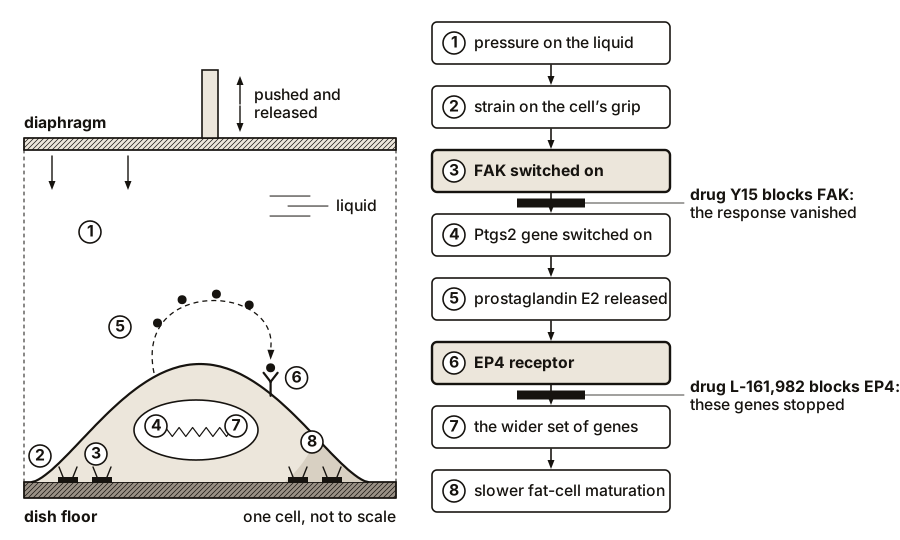
Then the authors did what turns a list into a finding: they traced a mechanism. Cells grip the floor of the dish through structures called focal adhesions, and an enzyme in them, focal adhesion kinase, or FAK, signals when the grip is strained. Within an hour of sound, the cells’ footprint on the dish grew by 15 to 20 percent. A gene called Ptgs2, also known as Cox-2, switched on fast; it makes a hormone-like messenger, prostaglandin E2, which the cells released into the liquid; and that messenger, acting on a receptor called EP4, switched on much of the rest of the gene set. Block FAK with a drug and the response vanished. Block the EP4 receptor and the downstream genes stopped responding. That is a chain with every link tested.
Not every kind of cell cared. Cells that grip hard and crawl, the stromal and connective-tissue types, responded strongly. Epithelial cells, which line surfaces, and nerve-precursor cells responded little.
The result that made the news concerned fat. Mouse 3T3-L1 cells can be coaxed into maturing into fat cells in a dish. Under continuous 440 Hz at 100 Pa during the three days of coaxing, two master genes of fat-cell development fell to about a fifth and a quarter of their silent levels, and the cells stored 13 to 15 percent less fat. Two hours of sound a day for three days gave about a 30 percent drop in those genes.
IN PLAIN ENGLISH: Cells stuck to the bottom of a dish feel it when the liquid above them is pushed and released hundreds of times a second, much as your hand feels a buzzing table. The feeling runs through the parts of the cell that grip the dish. It changes which genes are busy, and in immature fat cells it slows them down from becoming fat. That is a real and careful finding about cells in dishes and pressure on their grip.
Section 4: What It Did Not Show
Now read the same paper for its limits, most of which the authors state themselves.
It did not show hearing. Hearing, as Chapter 16 described, is the cochlea sorting pressure into frequencies and the brain making sense of them. Nothing here sorts frequencies; the early response was much the same for a low tone, a high tone and noise. What the cells responded to was mechanical strain on their grip.
It did not show anything about whole people, music, or sound in a room. Every cell was a mouse cell from a laboratory line, in a plastic dish, under a diaphragm touching its liquid. No animal and no person was tested. No music was played. The pressure was delivered by contact, 100 Pa, which is the 134 dB that no room full of music approaches.
It could not fully separate pressure from flow. At 440 Hz, the authors note, the liquid sloshed, mixing the medium; at 14,000 Hz the oxygen in it fell a little. They argue that the pressure wave dominates, since only 3 of 254 known flow-response genes overlapped with their list, but they write plainly that “it is impossible to experimentally assess the sole effect of the compressional wave free of shear stress”, the sideways drag of moving liquid.
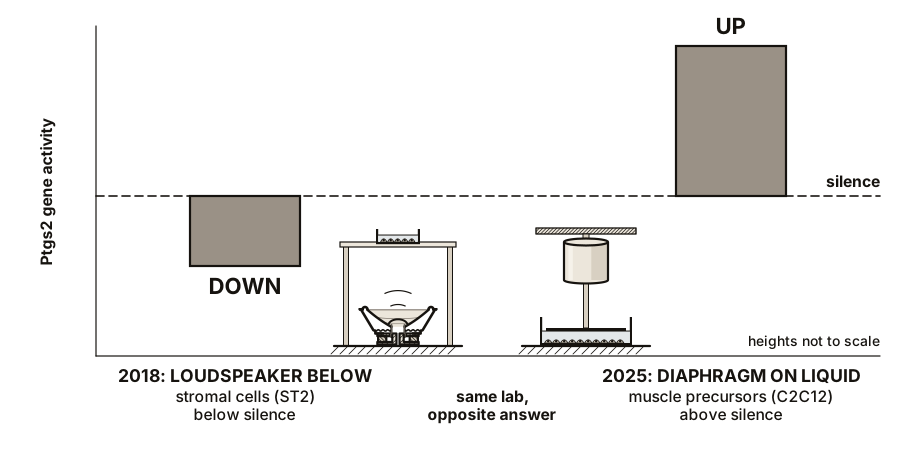
And the sign depends on the rig. The 2018 paper, by Kumeta and colleagues with the loudspeaker under the shelf, found that sound suppressed Ptgs2 and a related gene. The 2025 rig activates them. The 2025 paper traces the difference to how the sound arrived: the loudspeaker also shook the dish and the plate under it, and that path seems to push the genes the other way. Change the coupling and the answer reversed. That is the cymatics lesson of this whole book, met again in biology: what you see depends on how the thing is held and driven, as surely as a Chladni figure depends on whether the plate is clamped at the centre or the edge.
No other laboratory has yet published a replication. The authors’ hope, in the press release, that the work will “likely benefit medicine and healthcare” is a hope; nothing in the paper tests a treatment.
ON THE BENCH: From decibels to pascals
Parts: a phone sound level meter app; the chapter 1 rig; a calculator. Cost: nothing. Time: 15 minutes. Hazards: loud. Ear protection above 85 dBA, as always. Method: play 440 Hz through the plate at a level where salt dances. Hold the phone 300 mm (12 in) from the plate and read the level. Convert it to pascals: pressure = 0.00002 Pa × 10^(dB ÷ 20). Then convert the loudest thing you have ever heard, a concert near the stage at perhaps 110 dB, the same way. What you should see: the plate, at a level that hurts to stand near, gives perhaps 90 to 100 dB, which is 0.6 to 2 Pa. The concert gives about 6 Pa. The Kyoto cells got 100 Pa, in water, by contact, which is between 15 and 150 times the swing of the loudest air you will meet, delivered by a diaphragm resting on their liquid. Sound from a speaker across the room reaches a person’s cells as a far smaller and very different push.
Section 5: Healing Frequencies
Search for “healing frequencies” and you will find long lists. 528 Hz is said to repair DNA and is often called the “love frequency”. 432 Hz is said to be in tune with the universe and better for the body than 440 Hz. Others are assigned to sleep, to organs, to chakras. Recordings of them sell well.
These are claims, and there is no experiment behind them of the kind described in this chapter. No published study could be found that set 528 Hz against a nearby frequency at a measured pressure, on cells, and found a difference. On people there are small trials. In 2018 a Japanese group (Akimoto and colleagues, Health 10, pp. 1159 to 1170) played nine volunteers five minutes of soothing piano music at “528 Hz” on one day and at 440 Hz on another, without telling them which. The “528 Hz” version was the same music with its A raised from 440 to 444 Hz, about a sixth of a semitone, so that 528 falls on a note of the scale. After the 528 Hz music, salivary cortisol, a stress hormone, was lower 30 minutes later and oxytocin was higher, each significant within that session; after the 440 Hz music neither change was significant. That is a real result and a weak one: nine people, mostly women, five minutes of music, many measurements, no direct test of one condition against the other, no statement that the order of the two days was randomised, and no repeat by another laboratory. The authors themselves call the sample small. Trials that set 432 against 440 are taken up in Chapter 26. At the level of cells, the nearest real evidence points the other way. In the 2025 paper the early gene response was similar for 440 Hz, 14,000 Hz and noise. In the 2018 paper the effect showed, in the authors’ words, “in a wave form- and pressure level-specific manner, rather than the frequency.” What mattered to the cells was how hard and in what waveform they were pushed, not which note.
The 432 claim is a different kind of claim, about the tuning of music, and it has a real history inside it. Chapter 26 takes it up in full. For this chapter the point is the same: a plate or a cell has its own frequencies whatever an orchestra decides.
ON THE BENCH: The healing frequency on your plate
Parts: the chapter 1 rig, salt, notebook. Cost: nothing. Time: 20 minutes. Hazards: as for chapter 1. Method: sweep slowly from 425 to 445 Hz, then from 515 to 540 Hz, in steps of a tenth of a hertz near anything that moves. Note every figure and its frequency. Look in particular at 432, 440 and 528 Hz. What you should see: on most plates, nothing special at 432 or 440; the nearest predicted figures are near 385 Hz and 512 Hz. Near 528 Hz you may well see the twelve-spoke figure forming, because 528 is only 3 percent above the predicted 512 Hz, and a sheet 3 percent thicker than nominal moves that figure to about 527 Hz. On that plate, 528 Hz looks magical. On the plate next to it, it does nothing. The figure belongs to the plate. If it does not work: if you see a figure at 432 or 440 Hz, write down what it is and check it against Chapter 5’s predictions for your actual thickness. It will be a mode of your plate, and it will still be there at 431.6 Hz.
Section 6: How to Read a Paper
Everything in this chapter came from one section of a paper that most readers skip: the methods. The abstract tells you what the authors think they found. The press release tells you what the university hopes you will remember. The methods tell you what was actually done, and that is where every limit lives.
When you open a paper about sound and life, look for five things in the methods.
What vibrated, and what touched what? A diaphragm on the liquid, a loudspeaker across a room and a plate under a dish are three different experiments, and in this one changing between them reversed the result.
How big, in units? “Sound” means nothing; 100 Pa in water, measured with a hydrophone, means something you can check, as you did with a dish on your plate.
What was it done to? Mouse cell lines in dishes, human volunteers and patients in a trial are three different levels of evidence, and a claim about the third needs evidence from the third.
What was the control? Here, silent dishes treated identically. Without a control there is no result.
How many times, and by whom? Three independent runs in one laboratory. Strong enough to publish, and waiting for a second laboratory.
Read that way, the Kyoto paper comes out well. It is careful, it states its pressures, it tests its mechanism link by link, and it names its own confound. It is the headline that overreached, and it overreached in a way you can now spot in a minute.
SLOW DOWN. Check Your Understanding: The 2025 cells responded about equally to 440 Hz and to 14,000 Hz at the same 100 Pa. Does that mean the liquid moved the same amount at both frequencies? Decide before you read on.
No, and the difference is large. For a sound wave, pressure and motion are linked through the frequency: at the same pressure, the liquid’s back-and-forth swing is inversely proportional to frequency. At 100 Pa and 440 Hz in water the liquid moves about 24 nanometres, a millionth of an inch; at 14,000 Hz, 32 times less, under a nanometre. The authors point this out themselves, and note that the 440 Hz drive stirred the liquid more. So “the same sound level” can mean very different motions, and a cell that senses strain on its grip may be responding to pressure, to motion, to flow, or to some mix. That is precisely why the authors could not separate pressure from flow, and why any claim that a cell “hears” a particular frequency would need an experiment that holds motion, pressure and flow apart. Nobody has run it yet.

Bench Degree
Get the degree without the diploma.
Learn the material, not how to pass the exam.