Bench Degree·CYMATICSchapter
Chapter 23: Messages in Water
A bestselling book says water that hears kind words freezes into beautiful crystals and water that hears insults freezes ugly. Water from one tap, frozen on one evening, will make every shape in that book for you.
Take a steel or aluminium drink can, empty, and fill it with crushed ice. Stir in a heaped tablespoon of salt and a splash of water, and set it on a dark cloth in a room that is not too dry. Within a few minutes the outside of the can goes misty, then white. Bring a phone with a clip-on macro lens close to the white, or just a magnifying glass, and look.
The white is a forest. Tiny needles, flat hexagonal plates, feathery fern-like branches, all grown from the water vapour in your room’s air onto cold metal. Add more salt and the can gets colder, and the forest changes character. Look at two patches a hand’s width apart and they differ.
Every one of those crystals came from the same air, holding the same water, which heard nothing at all. Keep that can in mind. It is the control experiment for this whole chapter.
Section 1: The Hidden Messages
Masaru Emoto was born in Yokohama on 22 July 1943 and died on 17 October 2014. He studied international relations at Yokohama Municipal University. In 1986 he founded a company in Tokyo, IHM, that later sold a device it called a “Magnetic Resonance Analyzer” and water said to carry hado, a Japanese word he used for a subtle vibration in all things. In 1992 he received a “Doctor of Alternative Medicine” from the Open International University for Alternative Medicine in India, an institution the Indian press later described as a degree mill.
His fame came from books of photographs. The first, Mizu kara no dengon, “message from water”, appeared in Japan in 1999. The English The Hidden Messages in Water (2004) became an international bestseller. The claim is easy to state. Water exposed to words such as “love and gratitude”, to classical music or to prayer freezes into symmetrical, beautiful six-sided crystals. Water exposed to “you fool”, to heavy metal or to anger freezes into broken, ugly ones. Since a person is mostly water, the books suggest, our words shape our bodies.
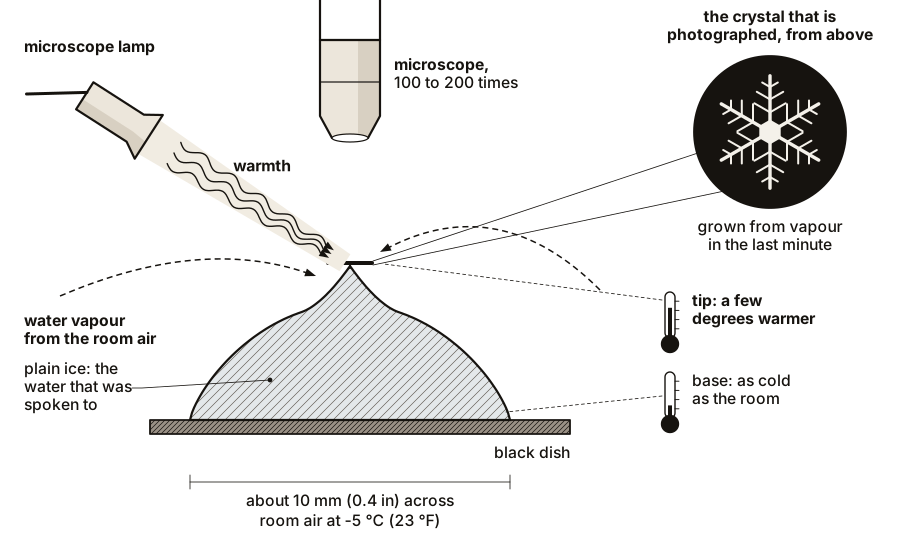
The method, as later described by his own collaborators, ran like this at IHM. About 0.5 mL of water, roughly a tenth of a teaspoon, went into each of 50 small dishes. The dishes went into a freezer at -25 to -30 °C (-13 to -22 °F) for three hours or more. Then a photographer examined each frozen drop at -5 °C (23 °F), under a microscope at 100 to 200 times magnification, and looked for a crystal growing at the top of the drop.
Now ask the obvious questions. Who chose which of the 50 drops to photograph? The photographer. Did the photographer know which water had been told “love” and which “you fool”? In the books, yes. Who chose which photographs to print? The author. Was there a sample of water given no words at all, frozen alongside? Not in the books. Fifty drops from the same water already give a wide range of shapes. A photographer who knows what is hoped for, choosing one from fifty, can find a beautiful crystal for “love” and a broken one for “you fool” from the same tap. That does not mean anyone cheated. It means the method cannot tell a message from a choice.
IN PLAIN ENGLISH: Freeze fifty drops of the same water and you get fifty different crystals, some pretty and some messy. If the person picking which ones to photograph knows which jar was “loved”, the loved jar will tend to end up with the pretty pictures, even if he is trying to be fair. To learn anything, the picker must not know which jar is which.
Section 2: The Blind Tests
To his credit, Emoto agreed to have the claim tested blind, and the tests were published. They were run by Dean Radin, a parapsychologist at the Institute of Noetic Sciences in Petaluma, California, with Emoto and his photographer, Takashige Kizu, as co-authors. Both papers are short and openly written, and both are worth reading for yourself.
The 2006 test. Four bottles of the same commercial water were bought and two were picked at random to be “treated”. On 16 November 2005, Emoto led about 2,000 people in Tokyo in a five-minute prayer of gratitude directed at those two bottles, which sat in an electrically shielded room in California, about 8,000 km (5,000 miles) away. The other two bottles sat in boxes on another floor. Kizu was not told which was which. He froze drops from all four and photographed every drop he judged to contain a crystal: 24 from the treated bottles, 16 from the controls. A hundred volunteers on the internet rated each of the 40 photographs for beauty from 0 to 6, without knowing which was which. The treated water averaged 2.87 and the controls 1.88, and the authors reported p = 0.001.
That looks strong, and two things make it weaker than it looks. Kizu, who knew the experiment’s purpose, still decided which drops “had” a crystal, and he found more in the treated bottles. And the real units of the experiment were four bottles, not forty photographs. The treated and control bottles also sat in different rooms, one of them shielded, which the authors list themselves as a possible cause.
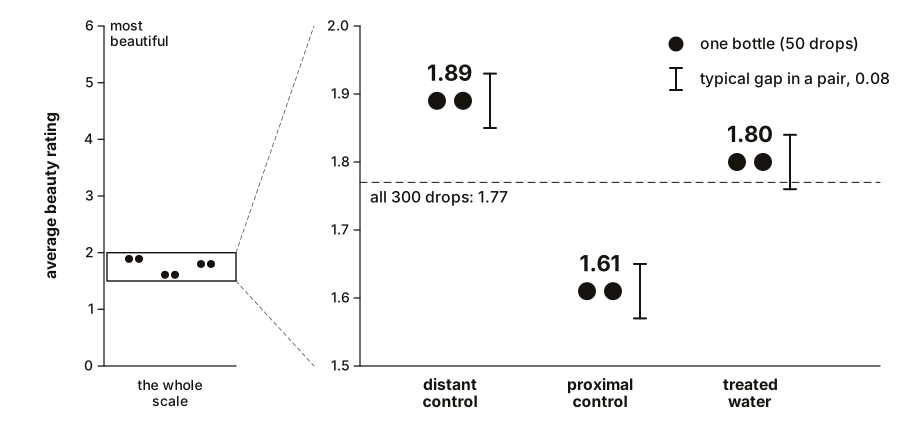
The 2008 replication fixed much of that, and deserves credit for it. About 1,900 people in Austria and Germany directed intention at water in California over five days in May 2006. This time there were six bottles: two treated, two “proximal” controls placed under the very same table, and two “distant” controls on another floor. The proximal controls were added so that treated and control water shared a room, and the people praying were not told they existed. Every one of the 300 drops was photographed, whether or not it seemed to hold a crystal, freezer positions were shuffled, and 2,579 judges made 128,950 ratings.
Here is what came out. The average beauty rating, on the 0 to 6 scale, was low for everything: 1.77. Treated water was rated a little higher than the proximal controls, and the authors report p = 0.03 for the difference between the three conditions. But the distant controls, the bottles on another floor that nobody prayed for, were rated slightly more beautiful than the treated water. When the judges’ rating of how “interesting” each image was went into the analysis, the effect lost significance (p = 0.20). An objective measure of image contrast showed no overall difference (p = 0.25). And a footnote says the analysis was changed from the original plan in response to a reviewer’s comments.
Section 3: What p = 0.03 With Three Degrees of Freedom Means
The paper’s main test is reported as an F statistic of 13.09 with “df 2, 3” and p = 0.03. Those two little numbers after “df” tell you what the evidence actually is, and they are worth learning to read.
A p-value answers one narrow question. If the treatment did nothing at all, and every bottle were really the same, how often would chance alone produce a difference at least this large? Here the answer is about 3 times in 100. That is all it says. It does not say there is a 97 percent chance the prayer worked; that is the commonest misreading of a p-value in print.
The degrees of freedom say how many independent pieces of information the test rests on. The first number, 2, is three conditions minus one. The second, 3, is the important one. The authors correctly treated each bottle as the unit, because drops from one bottle share whatever that bottle has: its water, its plastic, its place in the room. Six bottles in three conditions leave three degrees of freedom to estimate how much bottles differ by chance. The 300 photographs and 128,950 ratings measure each bottle’s average very precisely. They do not add bottles. The question “does prayer change water?” is answered here by six bottles, two per condition.
With three degrees of freedom, a single bottle that happens to freeze a little differently, because of a slightly different cap, a scratch in the plastic or a spot in the freezer, can produce p = 0.03 on its own. That is why the authors themselves wrote of “many uncontrolled degrees of freedom” in the human decisions behind the study, and why Radin later called the result “intriguing but not overwhelming”.
The authors also combined this result with the 2006 test and reported a joint p of 0.0004. A combination inherits the weaknesses of what it combines, and the 2006 half rests on four bottles and on which drops one person judged to contain a crystal.
What would settle it is not hard to describe. Many bottles, not six: thirty per condition would do. Drops chosen and photographed by a machine on a fixed schedule. A laboratory with no connection to Emoto or Radin. No such test has been published. Every published test of the crystal claim has Emoto or Kizu among its authors, and none of the claims in the books about words on labels, music or insults was ever tested blind at all.
ON THE BENCH: The message machine
Parts: a coin; two sticky labels, one reading “love” and one “hate”; 20 small identical photographs or printouts of anything with variety (your frost photographs from the box below are ideal); a friend; pencil and paper. Cost: nothing. Time: 20 minutes. Hazards: none. Method: toss the coin for each picture and write L or H lightly on its back. That randomly gives ten or so to “love” and the rest to “hate”. First, unblinded: look at the backs, then pick the three prettiest “love” pictures and the three ugliest “hate” pictures and lay them out in two rows under the labels. Second, blinded: have your friend shuffle all 20, face up with the backs hidden, and score each from 0 to 6 for beauty. Turn them over and work out the average score for L and for H. Shuffle, toss new labels, and do it twice more. What you should see: the first layout looks like a convincing demonstration every single time, because you chose it. The blinded averages differ by a different amount each run, sometimes favouring “love” and sometimes “hate”, by half a point or more on a 0 to 6 scale. That wandering is chance, and it is what any real effect has to stand clear of. With only ten pictures a side, it wanders a lot. That is why a test with two bottles per condition cannot see a small effect clearly, even with thousands of judges.
Section 4: What Actually Shapes a Snow Crystal
The physics of ice crystals is one of the best-measured topics in this book, and it was worked out by a Japanese scientist long before Emoto.
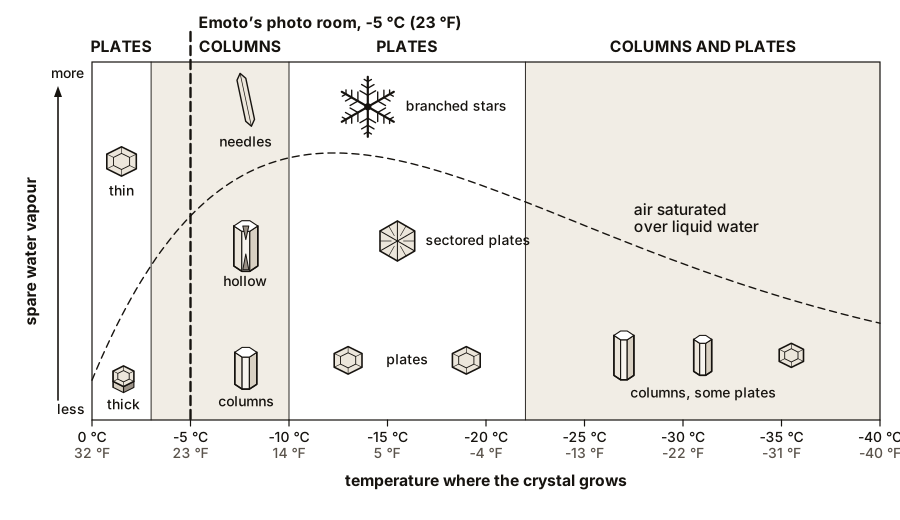
Ukichiro Nakaya, a physicist at Hokkaido University, grew the first snow crystals in a laboratory in the 1930s, in a cold room where he could set the temperature and the humidity. He found that the shape of a crystal is decided by two things: the temperature at which it grows, and how much spare water vapour there is in the air around it, what physicists call supersaturation. His chart of shape against those two quantities, published in his 1954 book Snow Crystals: Natural and Artificial, is called the Nakaya diagram.
The physicist Kenneth Libbrecht at Caltech has spent decades measuring that diagram precisely, including a 2023 paper reporting 206 controlled growths. The pattern, in round numbers:
| Temperature where it grows | Shape |
|---|---|
| near -2 °C (28 °F) | thin flat plates |
| near -5 °C (23 °F) | needles and hollow columns |
| near -15 °C (5 °F) | thin plates and branched, fern-like stars |
| near -30 °C (-22 °F) | columns again |
At each temperature, more spare vapour gives more elaborate shapes: a plain hexagon at low supersaturation, branches and side branches at high. Shift the temperature by a few degrees or the humidity by a little, and the crystal changes family.
Now picture what happens to a drop in Emoto’s method. The drop is frozen solid at -25 °C (-13 °F) or so. It comes out into a room at -5 °C (23 °F), under a microscope lamp. The lamp warms the top of the drop. Vapour from the surrounding air, and from the drop itself, condenses onto the cold peak as new crystal. What grows there depends on the exact temperature at that tip and the exact humidity in the air above it, both of which change from second to second as the lamp warms the drop and the photographer breathes nearby. The crystal that appears is a reading of the local temperature and humidity at the moment of growth. It is not a record of anything that happened to the water before it froze, because the crystal grows from vapour, and vapour carries no history.
Libbrecht has written about Emoto directly on his Caltech pages. He says that “basic physics says the work cannot be correct”, that Emoto probably “grows hundreds of crystals and then selects different shapes”, and that “water does not respond to thoughts and feelings”. It is, in his words, “just water”. He also notes that the work was never published in a reputable scientific forum. That is a physicist’s judgment, but it rests on a measured diagram you can check on your own bench.
ON THE BENCH: The frost can, a Nakaya diagram in the kitchen
Parts: three empty steel or aluminium drink cans; crushed ice; table salt; a kitchen scale; a thermometer that reads below -20 °C (-4 °F), or the temperature probe that comes with many multimeters; a dark cloth; a phone with a clip-on macro lens (about $10) or a strong magnifier. Cost: about $10 for the macro lens, if you need one. Time: 40 minutes. Hazards: salt and ice below about -15 °C (5 °F) can give frost nip to bare fingers held on the can. Handle the cans by the rim. Method: fill all three cans with crushed ice. Into the first stir no salt, only a splash of water. Into the second, about one part salt to ten of ice by weight. Into the third, about one part salt to three of ice. Put the probe in each and wait until the readings settle; expect about 0 °C (32 °F) in the first, somewhere well below freezing in the second, and close to -20 °C (-4 °F) in the third. No mix of salt and ice goes below about -21 °C (-6 °F); the exact numbers depend on your ice, your stirring and the room, so write down what you read. Stand them on the dark cloth in a humid room (a kitchen with a pan simmering is ideal) and photograph the frost on each after ten minutes. What you should see: the first can only sweats; it never gets cold enough for frost. The second grows short needles and stubby columns. The third grows flat plates and, where the air is moist, feathery branched stars. Same room, same air, same water vapour: three families of crystal, sorted by temperature, just as the Nakaya diagram says. If it does not work: if no frost appears, the room is too dry. Breathe gently across the can, or move it near a kettle. If the colder can will not get below -10 °C (14 °F), use more salt and less water and stir harder.
Section 5: Fifty Drops From One Bottle
Emoto’s own protocol gives you the experiment that answers him. Freeze many drops of one water, look at every one, and keep every photograph.
ON THE BENCH: Fifty drops, one bottle
Parts: one bottle of plain water; a plastic dropper or a 1 mL syringe; 50 small black plastic lids, upturned bottle caps or a black ice-cube tray; a household freezer, about -18 °C (0 °F); a ceramic tile chilled in the freezer; a desk lamp; the macro lens; a notebook. Cost: nothing beyond the lens. Time: three hours of freezing, then an hour of photography. Hazards: none. Method: put a 0.5 mL drop, about a tenth of a teaspoon, on each lid, all from the one bottle. Freeze them for at least three hours. Then take out one lid at a time, set it on the chilled tile under the lamp, and watch the peak of the drop through the lens. Photograph every drop at the same moment after it leaves the freezer, say 30 seconds, whether or not you like what you see. Number each picture. Put it back and take the next. What you should see: within the first minute, frost crystals grow on the peak of many drops: needles on some, small plates on others, branched stars on a few, and on some only a blur. Fifty drops of identical water give you a book’s worth of shapes, beautiful and ugly. Now move the tile a little closer to the lamp, so the drops warm faster, and do ten more. The proportion of shapes shifts. That shift is the lamp’s temperature and the room’s humidity, which is all the crystal was ever recording. If it does not work: if no crystals form, the room is too dry or the drop warms too fast. Work near a simmering pan, and move the lamp further off. Better, if you have one: a second freezer or a chest freezer at a different temperature. Drops frozen and photographed at different temperatures make different families of shape, and nothing was said to any of them.
This is the same lesson as the plate in Chapter 1, in a different material. A Chladni figure belongs to the plate: its size, its thickness and how it is held. An ice crystal belongs to the temperature and vapour at the moment it grows. In both cases a beautiful pattern is the system showing you its own physics, and in neither case is it a picture of what someone was thinking.
SLOW DOWN. Check Your Understanding: Suppose a careful laboratory, with no link to anyone involved, ran the 2008 design with 30 bottles per condition and machine-chosen photographs, and found that treated water froze into slightly more beautiful crystals, with p = 0.001. Would that show that water hears prayers? Decide before you read on.
It would show something real and worth explaining: that bottles in the treated condition froze differently. It would not yet say why. A blinded result tells you an effect exists; it does not tell you its cause. The next step would be to look for an ordinary difference between treated and control bottles, and the snow crystal physics tells you where to look first: anything that changes the temperature or humidity at the drop’s tip when it is photographed, such as where the bottles were stored, the order in which drops left the freezer, or how long each sat under the lamp. Only when every ordinary path had been closed would an extraordinary one be left. That is why Radin’s 2008 paper rightly includes the proximal control under the same table, and why its finding, that the bottles on another floor did best of all, matters so much: water that nobody prayed for did at least as well as the treated water.
Bench Degree
Get the degree without the diploma.
Learn the material, not how to pass the exam.