Bench Degree·CYMATICSchapter
Chapter 22: Hans Jenny
The man who gave this subject its name filled a book with figures you can still rebuild from his captions. The most famous thing he is supposed to have shown is on none of its pages.
Take the eidophone you built in Chapter 6, the balloon skin stretched over a pipe coupling with a hose coming in at the side. Put a pinch of salt on the membrane. Put your mouth to the hose and chant OM, long and steady: a round open O that closes into a humming M.
If one of the harmonics of your voice lands on one of the membrane’s modes, the salt will jump and gather. Most likely it makes a ring, or two lopsided lobes, or a ring with a clear patch inside it. Change the pitch a little and the figure changes or vanishes.
What it will not make is a Sri Yantra, the Hindu diagram of nine interlocking triangles inside circles and petals. That claim is printed on posters and attached to the Swiss physician who coined the word cymatics. This chapter is about him: what he actually did, which is substantial and real, and how a claim found in none of his checkable pages came to be pinned to him.
Section 1: A Doctor in Dornach
Hans Jenny was born in Basel on 16 August 1904 and died in Dornach, a few miles outside it, in June 1972. The Swiss historical dictionary gives 23 June; the archive that now holds his papers gives 24 June. Nobody has settled the difference.
He studied natural science and medicine at the University of Basel and passed the state medical examination in 1931. Christiaan Stuten, who assisted him with experiments for fourteen years, records that Jenny taught science at the Rudolf Steiner School in Zurich for four years and then practised as a family doctor in Dornach for more than thirty. He was also a serious painter of animals.
Two influences shaped how he looked at the world, and both are needed to read him fairly.
The first is Rudolf Steiner and anthroposophy, the spiritual philosophy Steiner founded, whose headquarters stands in Dornach. Stuten says that at fourteen Jenny joined a tour of the first Goetheanum led by Steiner himself, and went on to read Steiner extensively. A later publisher says Jenny “personally studied with” Steiner. Stuten, who knew him, says only the tour and the reading, and Steiner died in 1925. The modest version is the one with a witness behind it.
The second is Goethe, the poet, who also wrote about plants and colour. Goethe’s method, which he called morphology, was to look long and patiently at living forms until the underlying pattern shows itself, the Urphänomen or primal phenomenon. Jenny describes his own aim as “judgment based on concrete vision (Goethe)”.
Put those together and you have the key to what follows. Jenny was a physician with a doctor’s habits of careful observation, working inside a tradition that values seeing over measuring. His first volume is mostly the first; his second leans hard towards the second.
Section 2: What Kymatik Volume 1 Shows
In 1967 Jenny published Kymatik, from the Greek kyma, a wave, in German and English side by side: 183 pages and 154 illustrations, from Basilius Presse in Basel. The word cymatics starts here, and that is why he is the person this book is built around. The figures are older, as Chapters 2 and 6 showed. Jenny named the field and set out to survey all of it.
What makes Volume 1 valuable is the method. Chladni stroked his plates with a bow, which meant, Jenny writes, that “the conditions of the experiment did not allow a sufficient range of observation since they could not be freely varied while the experiment was in progress.”
Jenny’s fix was the piezoelectric crystal, a slice of crystal that flexes slightly when a voltage is put across it. He fixed these “crystal oscillators” under steel plates and drove them from a tone generator. Now he could read the frequency off a dial, set the strength of the drive, and change both while watching, photographing the moment one figure dissolved into the next. In modern terms he built what Chapter 1 built, with a crystal in place of a loudspeaker.
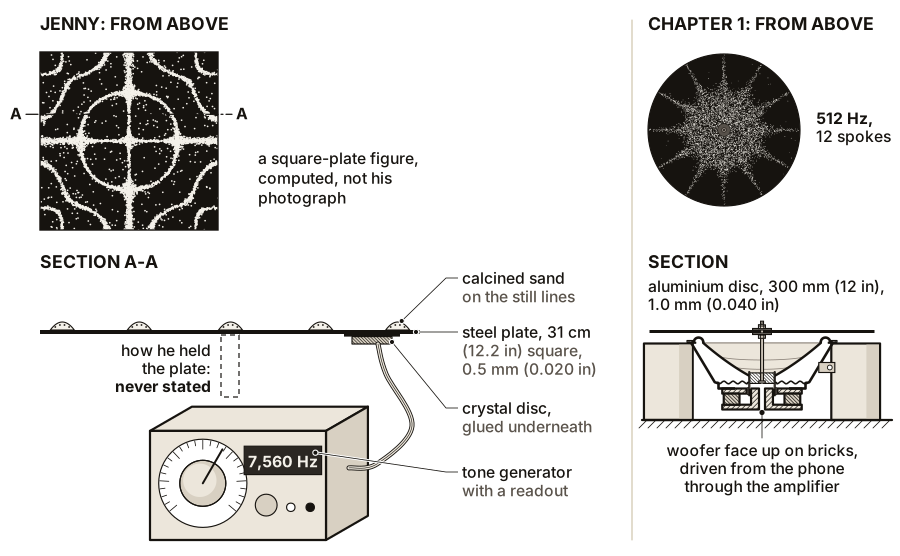
Then he used it on almost everything, and for most figures the caption gives material, size, thickness, frequency and powder. A few of them, in his units (“cps”, cycles per second, is the old name for hertz):
| Jenny’s figure | Plate | Frequency |
|---|---|---|
| 1 to 6, a figure forming | Steel, 31 × 31 cm (12.2 × 12.2 in), 0.5 mm (0.020 in), calcined sand | 7,560 Hz |
| 7 and 11, two tones | Hexagonal steel plate | 800 and 865 Hz |
| 27 to 30, one pattern repeating | Steel, 23 × 23 cm (9.1 × 9.1 in), 1 mm (0.04 in) | 1,690, 2,500, 4,820, 7,800 Hz |
| 78, sand and spores together | Hexagonal steel plate | 3,600 Hz |
| 74 to 85, lycopodium | Diaphragm 28 cm (11 in) across | 50 to 300 Hz |
He used plates from 7 × 9 mm (about 1/4 × 3/8 in), “the size of the ear drum”, to 70 × 70 cm (28 × 28 in), and strewed them with quartz sand or lycopodium, the fine yellow spores of club moss. He vibrated glycerin, water films, pastes and mercury.
Much of what he photographed, this book has already explained. His figure 78 shows sand in the nodal lines and lycopodium in the antinodes of one plate, which is Faraday’s 1831 result from Chapter 7, and his circulating heaps of powder are Faraday’s air currents made visible. His ripple lattices on thin liquid are the Faraday waves of Chapter 8. His rule that “the same formal pattern recurs at increasing frequencies, but that the number of constituent elements also increases” is the plate physics of Chapter 5. That is no criticism. A survey that photographs a hundred and fifty phenomena with their settings written underneath is a gift to anyone who wants to check it.
ON THE BENCH: Jenny’s figures 27 to 30, rebuilt
Parts: an offcut of the 1.0 mm (0.040 in) aluminium sheet from Chapter 1, at least 230 × 230 mm (9 × 9 in); a bare piezo buzzer disc 27 to 35 mm (1.1 to 1.4 in) across, with leads; a 10 Ω resistor rated 5 W; five-minute epoxy; a 5 mm (#10) bolt, washers and lock nut; a hardwood block about 50 mm (2 in) square and 100 mm (4 in) tall; a clamp; the Chapter 1 amplifier and tone generator; salt; ear protection. Cost: about $3. Everything else you own. Time: an evening, mostly waiting for epoxy. Hazards: these frequencies are piercing. Ear protection on before the first tone, and watch the meter app. File the cut edges. Method: cut a 230 mm (9 in) square, file it, and drill its centre. Epoxy the piezo disc, brass side down, to the underside 50 mm (2 in) from the centre along a diagonal. Bolt the plate at its centre to the hardwood block and clamp the block to the bench. Wire the piezo to the amplifier through the 10 Ω resistor, which protects the amplifier from the crystal’s capacitance. Sprinkle a teaspoon of salt, set 1,690 Hz, raise the volume until the salt just moves, and search 50 Hz either side, one hertz at a time, until a figure forms. Photograph it. Repeat near 2,500, 4,820 and 7,800 Hz. What you should see: a figure within a few percent of each of Jenny’s numbers, with far more lines at 7,800 Hz than at 1,690 Hz, which is the rule he states for this series. Steel and aluminium give nearly the same frequencies at the same thickness (Chapter 5), so the aluminium square is a fair stand-in for his steel. If it does not work: raise the volume a little. A piezo disc moves far less than a loudspeaker, though at 7,800 Hz the plate needs only about 4 nanometres of motion to throw salt. If your figures do not look like his, consider how he held his plate. He never says, and a plate clamped at the centre and one resting on its corners draw different figures. That is the one parameter his captions leave out. Better, if you have one: lay your four photographs beside the reproductions in a library copy of Cymatics (MACROmedia, 2001), which reprints Volume 1 in full.
Why “within a few percent”? Above about 1,000 Hz, a 230 mm (9 in) square of this sheet has on average one mode for every 60 Hz of frequency. Search 50 Hz either side of any number and you will almost always find a figure. Finding one proves your rig works. It does not prove you have found his. For that you need his mounting and his drive point, the two things the captions never give.
Section 3: The Tonoscope and the Second Volume
Chapter 4 of Volume 1, “The Tonoscope”, is the chapter people assume contains the OM experiment. Here is what it does contain.
The tonoscope was “a simple apparatus into which the experimentor can speak without any intermediate electroacoustic unit”: the voice vibrates a diaphragm carrying sand, powder or liquid. Jenny’s purpose was medical, and specific. A deaf patient cannot hear their own “O”. On the tonoscope they can see it, compare it with a hearing person’s, and practise “until he has achieved the form of a purer ‘O’ sound.” Jenny reports that as the figure got purer, the vowel did too.
His caption to the three vowel figures he prints is a model of caution:
The material of which the diaphragm is made and the indicators used (powder, sand, liquid, etc.) are also important factors: the pattern also changes according to the quality of the individual voice. But the form remains the same as long as there is no change in the conditions of the experiment.
Read that slowly, because it is most of the answer to the OM story. The figure depends on the skin, the powder and the voice. Given identical conditions it repeats. A figure that changes with the material of the skin and the singer’s own voice cannot be the figure of a word.
The book ends with Jenny’s synthesis, “The Basic Triadic Phenomenon”: every vibrating system shows figure, movement and periodicity together. He is plain about its status. “It must be stressed that this is an inference made from appearances.” He offers it “as a perceptive organ (not as a dogmatic formula)”, and adds: “This does not mean that this basic theme should be inflated to be a model of the universe.” The author of Kymatik warned against exactly the use his name is now put to.
The second volume, German 1972 and English 1974, changes register, and Jenny says so: “we have once more deliberately dispensed with descriptions of experimental design and particularly of the quantitative analysis of parameters.” It has striking photographs of oscillating water jets, pulsating drops and magnetic fluids, and chapters on biology and “Cymatic Effects in a Wider Context”. It is dedicated “to the memory and research of Rudolf Steiner”. By the author’s own choice, its figures cannot be rebuilt from its text.
IN PLAIN ENGLISH: Jenny’s first book says, under almost every photograph, what plate he used, how big, what powder and what frequency. You can copy those. His second book deliberately stopped giving that information and moved towards philosophy. The OM story is supposed to come from somewhere in this work, but nobody who repeats it says which page.
Section 4: How OM Became a Sri Yantra
The claim comes in three layers, and they peel apart in date order.
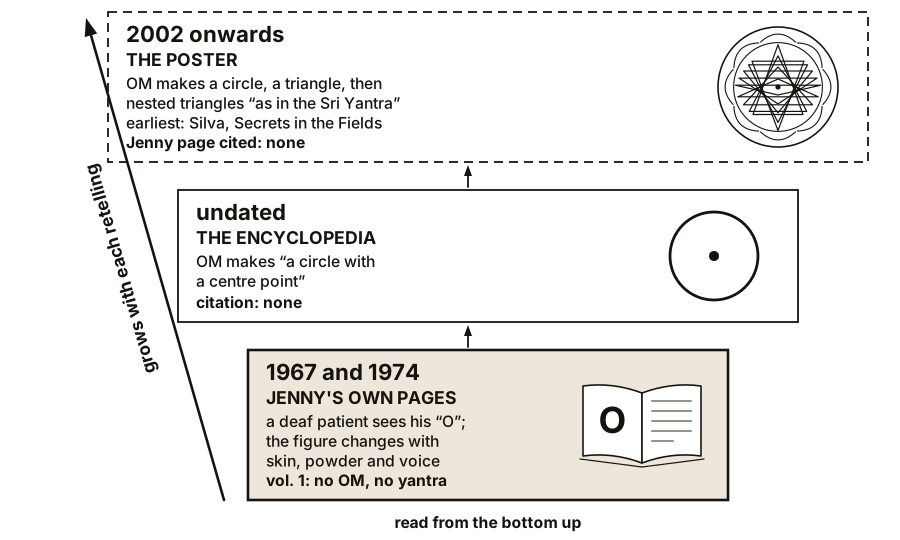
The bottom layer is Jenny’s own pages. The full text of Volume 1 contains no OM, no Sanskrit, no yantra. The first half of Volume 2, read in a scan as far as its figure 63, has none either, and there Jenny writes that “the real work on what might be called melos, or speech, is still to be done.” The rest of Volume 2 has not been searched, so it is not proven that the word appears nowhere in it. But no writer who repeats the claim has quoted a sentence or given a page, and a claim about a book that nobody can find in the book is unsourced.
The middle layer is the encyclopedia. English Wikipedia says that when OM was pronounced into the tonoscope, lycopodium formed “a circle with a centre point”, a traditional sign for OM. It cites nothing for that sentence. Notice how small the claim is: a circle with a dot in the middle.
The top layer is the poster. OM makes a circle, then a triangle, then nested triangles “as found in the Sri Yantra”. The earliest traceable form of that version is in a book on crop circles, Freddy Silva’s Secrets in the Fields (2002), with no page of Jenny’s cited. Nobody has published a reproduction: no rig, no frequency, no photograph a reader could set beside one of Jenny’s.
Now apply the physics you own. A round membrane, clamped at its rim and pushed nearly evenly over its face, favours its ring modes, the ones without spokes (Chapter 6). Fine powder runs to the places that move most (Chapter 7). The (0,2) mode of a membrane has one nodal circle inside the rim, with antinodes at the centre and in a ring outside that circle. Fine powder on that mode makes a heap in the middle and a ring around it.
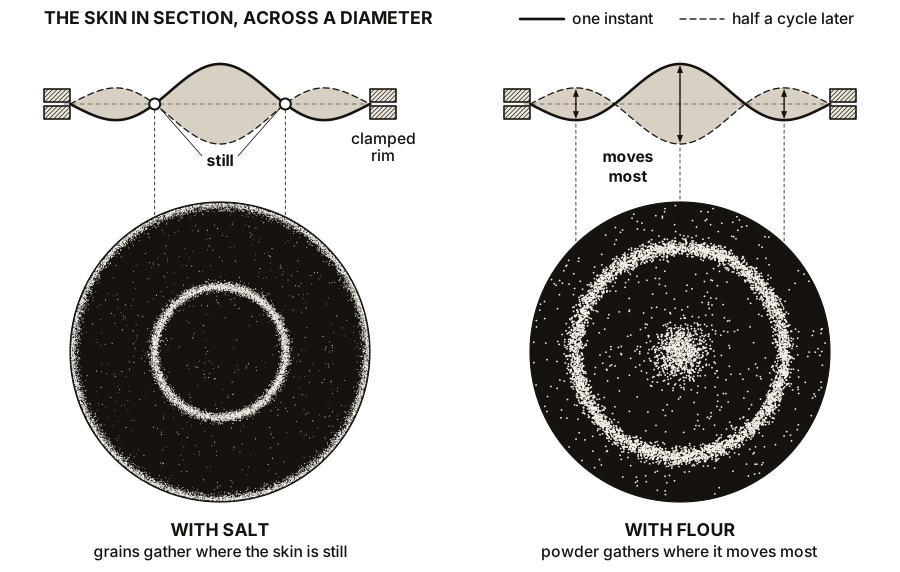
A circle with a centre point is what fine powder does on the second ring mode of any round drum skin, for any sound that excites it: OM, “AH”, a sine wave, a cello. Seeing it when you chant OM is real. Concluding that OM makes it is a step the experiment does not take.
ON THE BENCH: Sing OM, and then do not
Parts: the Chapter 6 eidophone (balloon membrane on a 150 mm, 6 in, pipe coupling, side hose); salt; plain flour; a phone spectrum analyser app (Chapter 16); the tone generator, amplifier and a small speaker to fit the hose end. Cost: nothing beyond what you own. Time: 45 minutes. Hazards: none worth the name. Rest between long chants. Method: put a pinch of salt on the membrane. Chant a long, steady OM into the hose and read your fundamental off the spectrum app; a comfortable chant usually sits near your speaking pitch, which for most men lies between about 85 and 155 Hz and for most women between about 165 and 255 Hz. Slide the pitch slowly until the salt jumps, hold it, and write down the frequency and the figure. At that same pitch, sing “AH”, then “EE”, then hum with your mouth closed. Then fit the small speaker to the hose and play a pure sine wave at your sung fundamental, and at twice and three times it. What you should see: the salt answers at only a few pitches, the membrane’s own modes, and at each one makes the same ring or lobed figure whichever vowel you sing. The figure follows the pitch. The vowel mostly changes how fast it forms, and the quiet closed-mouth M barely moves it. One of the sine waves, usually the one nearest the mode, reproduces your OM figure with no OM at all. Repeat with flour in place of salt and look for a heap in the middle with a ring around it: the encyclopedia’s circle with a centre point. If it does not work: if nothing moves at any pitch, re-stretch the balloon, tap it, and listen for a pitch inside your singing range.
Section 5: The CymaScope
The best-known instrument in cymatics today is the CymaScope, developed by the English acoustic engineer John Stuart Reid, who dates its invention to 2002. It drives a small dish of water with sound and photographs the surface under a ring of light. The images are real, often lovely, and you have already made them. They are Faraday waves, the standing ripples of Chapter 8, lit so that each crest throws a bright point.
The claims attached to the instrument can be graded by what was published.
In 2016 Reid and three co-authors reported, in the Journal of Marine Science: Research and Development, that dolphin echolocation clicks played into a CymaScope made patterns that “clearly matched the shapes of the objects” the dolphin was examining. The paper gives no count of trials, no measure of what “matched” means and no statistics; the clicks were slowed by 10 percent and heavily equalised; replication was “in progress”. That is a report of something seen. It is not yet a demonstration.
In 2019 Reid and two co-authors published in the journal WATER under a title about imaging “cancer and healthy cell sounds”. The methods section says the “sounds” were Raman spectra, measurements of laser light scattered from brain tissue, converted into audio by computer. No cell emitted any sound. The paper reports no blinding, no stated number of samples and no test statistics. The popular claim, that the CymaScope hears a cancer cell, is contradicted by the paper’s own method.
ON THE BENCH: A CymaScope for the price of a saucer
Parts: the Chapter 8 dish rig; a shallow black saucer about 100 mm (4 in) across; water; a ring light or a circle of white LED strip; a phone on a stand above. Cost: under $10 for the light, if you need one. Time: 30 minutes. Hazards: water near a bare amplifier board. Keep the board well away and dry. Method: fix the saucer to the speaker as in Chapter 8, fill it 3 to 5 mm (1/8 to 3/16 in) deep, and light it from directly above with the ring. Sweep slowly upward from 20 Hz with the volume low. What you should see: at certain frequencies the surface breaks into a still, symmetrical lattice of bright points, often with petals or rings set by the dish’s edge. The pattern is set by the dish, the depth and the frequency, which is why a different saucer gives a different “signature” for the same sound.
Section 6: Fair to the Man
Hans Jenny did three things worth remembering. He named the subject. He built a method, a crystal driven by a generator, that let anyone set a frequency, hold a figure and watch the transitions. And he published a first volume whose captions are specific enough to check half a century later with a sheet of aluminium.
He also held a philosophy most physicists do not share, and in his second volume he chose to stop reporting his settings. Both are on the record. Neither makes the first volume less useful.
What does not belong to him is the Sri Yantra. It is in none of his checkable pages, it contradicts his own caption about what a voice figure depends on, and the first person known to print the dramatic version wrote about crop circles thirty years after Jenny’s death. The strongest witness against the poster is Jenny himself, warning his readers not to inflate a way of seeing into a model of the universe.
SLOW DOWN. Check Your Understanding: Suppose someone publishes a careful experiment tomorrow: a stated membrane, a stated tension, lycopodium, and a photograph of triangles made by a sustained OM. Would that show that OM creates the Sri Yantra? Decide before you read on.
No, and the reason is the most useful idea in Part IV. A figure on a membrane belongs to the membrane. It is one of the skin’s own modes, set by its size, its tension and how it is held, and any sound with energy at that frequency will raise it. The test that matters is the control: a plain sine wave at the same frequency and loudness into the same skin. If the triangles appear, the membrane made them. If they appear only for OM, never for a tone or another vowel at the same pitch, that would be new and worth a paper; nobody has reported it. And a triangle on a round skin needs something to break the circle’s symmetry: an off-centre inlet, uneven tension, a clamp. So an honest account of any triangle starts with the asymmetry in the rig.

Bench Degree
Get the degree without the diploma.
Learn the material, not how to pass the exam.