Bench Degree·CYMATICSchapter
Chapter 21: Beyond Hearing
Above the top of your hearing, sound gets short enough to see inside a body, strong enough to pit metal under water, and steady enough to hold a bead in mid-air. The bead sits where your salt would.
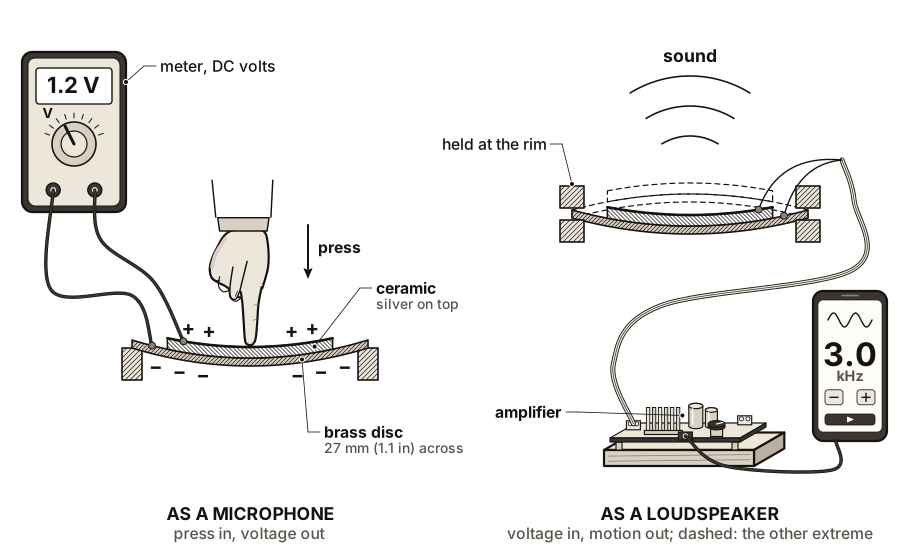
Buy a bare piezo buzzer disc, the kind sold for a dollar: a thin brass disc about 27 mm (1.1 in) across with a pale ceramic layer on one face and two wires. Connect the wires to your multimeter, set to DC volts. Press the ceramic face firmly with a thumb. The meter jumps, a volt or more, and swings back the other way when you let go. Tap the disc on the bench and the reading flickers.
Now unplug the meter and connect the disc to the chapter 1 amplifier, volume at zero. Play a 3,000 Hz tone and bring the volume up slowly. The disc shrieks. The same few grams (a tenth of an ounce) of brass and ceramic that turned a squeeze into a voltage now turn a voltage into motion. That two-way trick is how almost all sound above the range of hearing is made and detected, and this chapter is about what it makes possible.
Section 1: Above the Top of Hearing
Chapter 16 put the top of human hearing at about 20,000 Hz, 20 kHz, for a young ear, and lower with age. Sound above that frequency is called ultrasound. It is the same thing as audible sound: pressure waves in air, water or solid, travelling at the same speeds. Only the ear stops answering.
What changes as the frequency rises is the wavelength. Chapter 4 gave wavelength as speed divided by frequency. In air, at 343 m/s (1,125 ft/s):
| Frequency | Wavelength in air |
|---|---|
| 512 Hz (your twelve spokes) | 670 mm (26 in) |
| 20 kHz (top of hearing) | 17 mm (0.7 in) |
| 40 kHz (cleaners, levitators) | 8.6 mm (0.34 in) |
Sound in water travels at about 1,480 m/s (4,860 ft/s) and in soft body tissue at about 1,540 m/s (5,050 ft/s), so the waves there are longer for the same frequency. At 3 MHz, a typical medical imaging frequency, the wavelength in tissue is about 0.5 mm (0.02 in).
Short waves are the whole point. A wave can only show detail about as small as itself, so short waves make sharp images. Short waves can be focused into small spots, where their energy concentrates. And short waves make standing-wave patterns small enough to fit in your hand, with nodes a few millimetres (a fraction of an inch) apart.
IN PLAIN ENGLISH: Ultrasound is ordinary sound pitched too high for people to hear. Because it is so high, its waves are very short, a few millimetres in air and less than a millimetre in the body. Short waves can draw fine pictures, can be squeezed into small hot spots, and can make patterns of stillness close enough together to trap a small bead.
Section 2: Crystals That Push Back
The disc you squeezed is a piezoelectric element, from the Greek for “press”. Pierre and Jacques Curie announced the effect to the French Academy of Sciences on 2 August 1880 (Comptes rendus 91, 294): certain crystals, among them quartz and tourmaline, develop opposite electric charges on opposite faces when squeezed. The next year Gabriel Lippmann, reasoning from the conservation of electricity and energy, predicted that the reverse must also happen (Annales de chimie et de physique 24, 1881), and the Curies confirmed it: put a voltage across such a crystal and it changes shape.
One part, run in both directions, is both a microphone and a loudspeaker. That matters enormously at ultrasonic frequencies, where a paper cone is far too heavy to follow. A piezoelectric crystal or ceramic changes shape by only a tiny amount, but it does so with great force and it can do it millions of times a second.
The first serious use came from war. Paul Langevin in Paris built a sandwich of quartz between steel plates that sent pulses of ultrasound into the sea and listened for their echoes. His French patent, No. 505,703, was filed on 17 September 1918 for sending and receiving underwater waves using the piezoelectric properties of quartz, with the detection of submarines among its stated uses. It is the ancestor of sonar, and of every medical scanner.
ON THE BENCH: A crystal that works both ways
Parts: a bare piezo buzzer disc with leads, about 27 mm (1.1 in) across; the multimeter and the amplifier from Chapter 1; a tone generator; ear protection. Cost: about $1. Time: 15 minutes. Hazards: the disc is shrill at 2 to 4 kHz. Keep the volume low and wear plugs if the meter app reads above 85 dBA. Turn the volume to zero before connecting or disconnecting. Method: connect the disc to the multimeter on DC volts. Press its centre with a thumb and release; then tap it lightly on the bench. Note the readings. Disconnect the meter, connect the disc to the amplifier’s speaker terminals, and play tones from 500 Hz to 10,000 Hz, stepping slowly at low volume. Then type 30,000 Hz into the generator. What you should see: a jump of a volt or more on the meter when you press, and an opposite jump when you release. On the amplifier, a faint buzz at low frequencies rising to a piercing note around a few thousand hertz, where the disc’s own resonance lies. At 30,000 Hz, probably nothing at all, even from a device that should respond. If it does not work: if the meter shows nothing, try its most sensitive DC range, and press harder; some meters average away a brief spike. Better, if you have one: the silence at 30,000 Hz is not the disc’s fault. A laptop or phone sound output samples 44,100 or 48,000 times a second, and no output sampled that way can carry a tone above half of that, 22 to 24 kHz. Your tone generator cannot make ultrasound. That is why the levitator kit later in this chapter carries its own oscillator.
Section 3: Tearing Water
The most common ultrasonic machine in houses is a jewellery or spectacle cleaner: a small stainless steel tank with piezoelectric transducers bonded under it, driven at a frequency usually close to 40 kHz. Its cleaning power comes from a violent effect called cavitation.
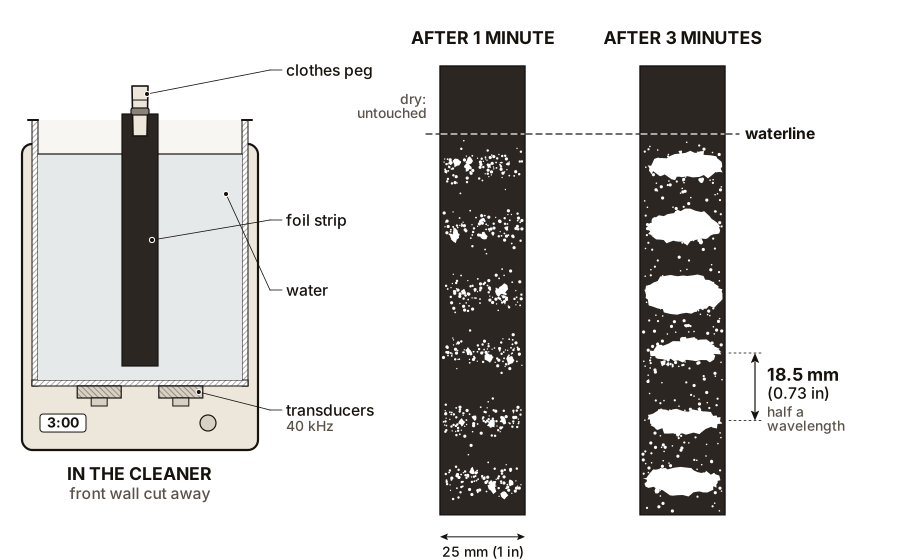
A sound wave in water is an alternation of squeeze and stretch. At high enough intensity the stretching half of each cycle pulls the water apart. Tiny bubbles open, seeded by dissolved gas or specks of dirt, grow for a cycle or a few, and then collapse when the squeeze returns. The collapse is the violent part. Lord Rayleigh calculated it in 1917, in a paper on the collapse of an empty cavity in a liquid (Philosophical Magazine 34, 94), at a time when eroded ship propellers had made the question practical. He showed that the liquid rushing inward reaches enormous speeds and pressures as the bubble shrinks to nothing. Each collapse is a tiny hammer blow, and a cleaner makes millions of them per second at surfaces in the tank, which is what lifts the dirt.
It also attacks soft metal, and that gives a simple and slightly shocking test.
ON THE BENCH: Foil in an ultrasonic cleaner
Parts: an inexpensive ultrasonic cleaner, around 40 kHz and 600 mL or so; kitchen aluminium foil; water with a drop of washing-up liquid; a clothes peg; a lamp. Cost: $25 to $40 for the cleaner, if you do not own one. Time: 20 minutes. Hazards: never put fingers in the running tank. Cavitation at the skin is uncomfortable and manufacturers warn against it. Never run the cleaner empty. Unplug it before reaching in. The tank warms as it runs. Method: fill the tank to its mark and run it empty of objects for five minutes to drive out dissolved air, which cushions the bubbles. Cut a strip of foil a little narrower than the tank and long enough to reach the bottom. Hang it vertically from the peg on the rim, so it stands in the water without touching the walls. Run the cleaner for one minute. Lift the foil out and hold it up to the lamp. What you should see: the foil peppered with pits and pinholes, in places torn right through, and in other places almost untouched. Often the damage falls in patches or bands. Try three minutes on a fresh strip and the patches are holes. If it does not work: if the foil is unmarked, run longer, check the water level, and run the tank empty for longer to degas the water. Some very cheap units run far below their stated power. Better, if you have one: measure the spacing between bands of damage. In water at 40 kHz the wavelength is about 37 mm (1.5 in), so the nodes of a standing wave lie about 18.5 mm (0.73 in) apart. In a small tank with reflections from every wall the pattern is messy, but where you see bands, their spacing is often close to that. The foil is a Chladni figure of the tank, drawn in damage.
Section 4: Seeing Inside, and Breaking Stones
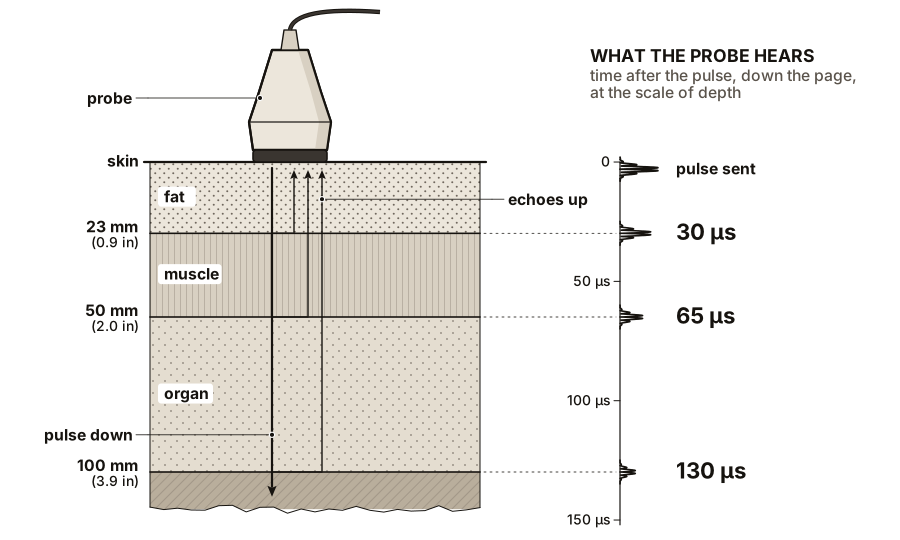
Medical imaging uses the echo idea that Langevin used on submarines. A probe, an array of small piezoelectric elements, sends a short pulse at a few million hertz into the body and listens. Every boundary between tissues, such as fat and muscle or fluid and wall, reflects a little. Sound in tissue covers about 1.5 mm (0.06 in) per millionth of a second, so an echo from 100 mm (4 in) deep returns about 130 millionths of a second after the pulse. Time the echoes along many lines side by side, and the machine draws a picture of the boundaries.
Ian Donald, John MacVicar and the engineer Tom Brown in Glasgow published images of abdominal masses and early pregnancy made this way in The Lancet in June 1958 (volume 1, page 1188), the paper usually taken as the start of obstetric ultrasound, with a machine built partly from an industrial flaw detector, a device made to find cracks in metal by the same echo method.
The safety record since then is good, and it should be stated exactly. The American Institute of Ultrasound in Medicine, in a statement reapproved in 2019 and revised in 2024, says that no independently confirmed adverse effects caused by exposure from present diagnostic ultrasound instruments have been reported in human patients in the absence of contrast agents. The same statement recognises that ultrasound can produce biological effects, by heating tissue and by cavitation, and that effects have been seen in animal studies. Its rule is the engineer’s rule: exposure “as low as reasonably achievable”, by qualified people, for medical benefit. Scanners display two numbers on screen, a thermal index and a mechanical index, so that the operator can see how close the beam is running to each of the two mechanisms.
Lithotripsy turns the same physics into a weapon against kidney stones. A machine outside the body makes short, powerful pressure pulses, shock waves, and focuses them through water and skin onto the stone. Each pulse stresses the stone and drives cavitation at its surface, and after a few thousand pulses it crumbles into grit small enough to pass. Christian Chaussy, Walter Brendel and Egbert Schmiedt in Munich reported treating the first patient this way in The Lancet of 13 December 1980 (volume 2, page 1265). Before then many such stones meant open surgery.
Section 5: Sound That Pushes
A sound wave carries momentum as well as energy, so it pushes on whatever absorbs or reflects it. The push is small, averaged over each cycle, and it is called acoustic radiation pressure. Lord Rayleigh wrote about it in 1902; Louis King calculated the force on a small sphere in 1934 (Proceedings of the Royal Society A 147, 212); and Lev Gor’kov in 1962 gave the compact formula that levitation engineers still start from (Soviet Physics Doklady 6, 773).
In a standing wave the push is not uniform. Chapter 4 built the standing wave: a wave reflected back on itself, with nodes that stay still and antinodes between them. For a small, dense particle in air, such as a bead of polystyrene foam, Gor’kov’s result says the radiation force pushes it toward the pressure nodes, the places where the air pressure hardly changes. If that push upward is stronger than the bead’s weight, the bead hangs there. That is acoustic levitation.
The first report came in 1933: Karl Bücks and Hans Müller in Germany held small drops of liquid in the sound field between a vibrating quartz crystal and a reflector (Zeitschrift für Physik 84, 75). For most of the century levitators were laboratory instruments with a single large transducer. In 2017 Asier Marzo, Adrian Barnes and Bruce Drinkwater at the University of Bristol published TinyLev (Review of Scientific Instruments 88, 085105): two bowl-shaped arrays of 36 small 40 kHz transducers each, facing one another and driven by cheap electronics, which anyone could build. Cheap generic kits now sell on the same principle.
The geometry is the one you already know. Pressure nodes in a standing wave lie half a wavelength apart. At 40 kHz in air, the wavelength is 8.6 mm (0.34 in), so the nodes, and the beads, sit about 4.3 mm (0.17 in) apart, stacked in a column between the two transducers.
ON THE BENCH: Beads in mid-air
Parts: a generic 40 kHz ultrasonic levitator kit, either two opposed transducer arrays or a single transducer facing a reflector, with its own driver board and power supply; a pinch of polystyrene foam beads 1 to 3 mm (0.04 to 0.12 in) across, from a beanbag or broken packing foam; tweezers or a small perforated spoon of card; a ruler; a lamp. Cost: $15 to $30. Time: an hour, most of it building the kit. Hazards: the sound in the gap is intense, even though you hear nothing. Health Canada’s 1991 guideline for airborne ultrasound puts 110 dB as the most a person should be exposed to in the bands from 25 to 50 kHz, a levitator’s 40 kHz among them (Safety Code 24, Table 5), and a levitator works by building a standing wave far stronger than that between its transducers. Keep your ears well away from the gap, never put a head between the transducers, and keep the kit out of reach of small children. Some people hear a faint whine or feel discomfort near a running unit; if you do, switch off. Beads are a choking hazard. Method: build and power the kit as its instructions describe. Using tweezers or the card spoon, place one bead gently into the gap near the middle and let go. Then place more, one at a time, above and below the first. Light the column from the side and photograph it against a dark background with a ruler held beside it. What you should see: the beads hanging motionless in a vertical column, evenly spaced. Measure the spacing over as many beads as you can and divide: about 4.3 mm (0.17 in) between neighbours. Breathe gently near the column and the beads wobble but hold. If it does not work: beads that fall straight through are too heavy or the drive is too weak; use smaller beads. If they shoot out sideways, the transducers are not aligned on one axis; adjust until they face each other squarely. On a single-transducer kit, the spacing from the reflector must be close to a whole number of half wavelengths; adjust it slowly until beads hold. Better, if you have one: put a drop of water in a node with a fine syringe. It hangs, flattened slightly into a lens by the sound.
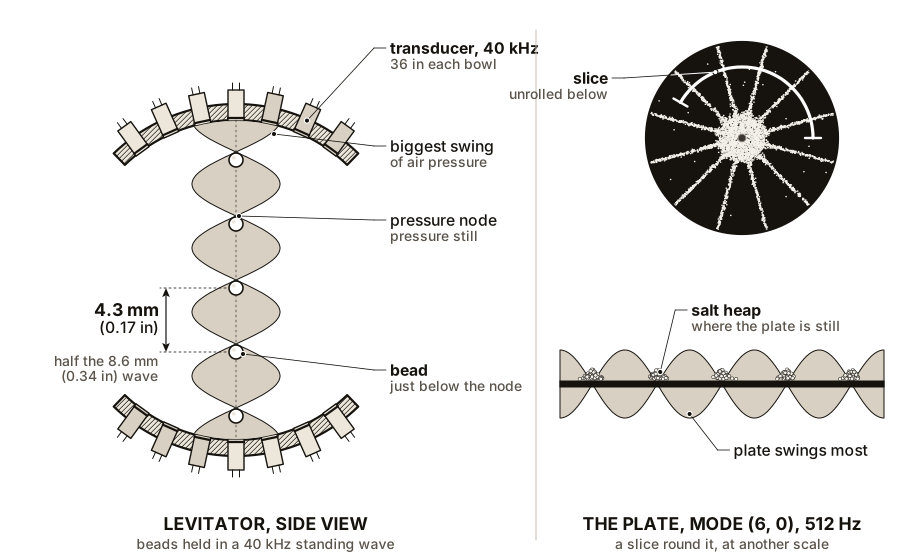
This is cymatics in three dimensions. On your plate, grains thrown off the moving regions collected where the plate stood still, and drew the shape of a mode. In the levitator, beads are pushed out of the regions where the pressure swings and come to rest where it does not. The two mechanisms differ, and so do the nodes. Salt on a plate marks where the surface does not move; a bead in a levitator marks where the air pressure does not change. In both cases, a scatter of small particles is drawing a map of a standing wave’s stillness. With more transducers, each driven with its own timing, researchers can shape the field into traps that move, turn and carry several particles at once, so that the figure is no longer fixed by the shape of the plate.
SLOW DOWN. Check Your Understanding: Your chapter 1 plate, at its twelve-spoke figure, fills the air above it with a strong 512 Hz sound. Could you levitate a polystyrene bead in that sound, given a reflector above the plate? Answer before you read on.
Not in any way that would work on a bench. At 512 Hz the wavelength is 670 mm (26 in), so pressure nodes would lie 335 mm (13 in) apart, and the levitating force depends on how steeply the sound field changes across the bead. Gor’kov’s formula makes the force grow with the bead’s volume and with the wavenumber, which rises in proportion to frequency. Drop from 40 kHz to 512 Hz and, for the same sound intensity, the force on the same bead falls about eighty-fold. To make up for that you would need a far more intense sound, louder than any safe level in a room, and the whole room would become the resonator. Levitation is ultrasonic because short waves make steep fields, and steep fields make strong forces in a small space. It is also why the salt on your plate goes to the nodes by bouncing, which needs only that the plate move faster than gravity can follow, and not by radiation pressure, which at audio frequencies is far too weak to notice.
Section 6: A Ping-Pong Ball Between Two Speakers
Two loudspeakers face each other, a ping-pong ball hangs in the air between them, and the speakers are said to be holding it up with sound. After the beads in the levitator, that sounds possible. The arithmetic is short, so do it first.
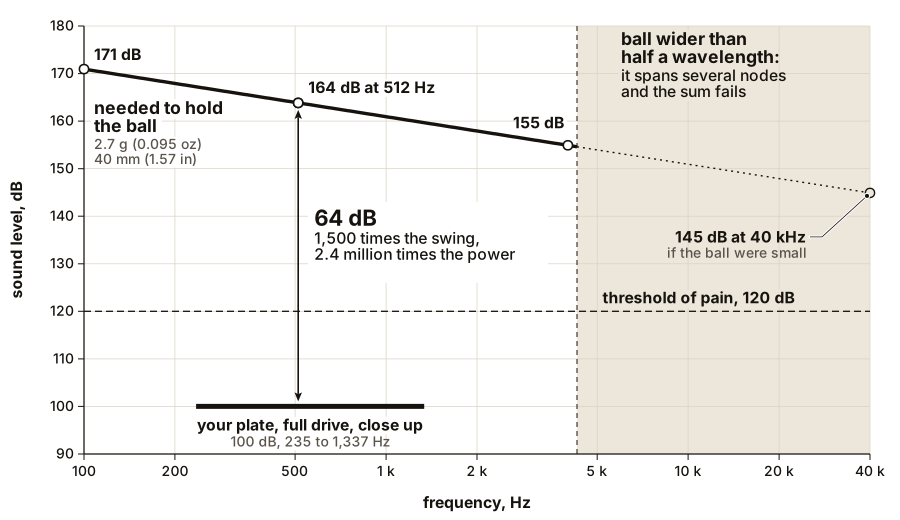
A regulation table-tennis ball is 40 mm (1.57 in) across and weighs 2.7 g (0.095 oz) (ITTF Laws of Table Tennis, 2.3), a pull of 0.026 N (0.006 lbf). For its size it is about 81 kg per cubic metre (5.0 lb/ft³), several times heavier than foam beads, which are mostly air. For a ball much smaller than the wavelength, Gor’kov’s formula from Section 5 says two things. The push grows as the square of the pressure swing, and in proportion to the frequency. Push and weight both grow with the ball’s volume, so size cancels and only heaviness for size counts. Set the strongest push in a standing wave equal to the weight, and the swing needed at the loud places of the wave is roughly as below. These are estimates from the small-ball formula, and the 4,000 Hz row stretches it: there the ball is already nearly half a wavelength across.
| Frequency | Pressure swing needed | Level |
|---|---|---|
| 100 Hz | 7,000 Pa | 171 dB |
| 512 Hz (your twelve spokes) | 3,100 Pa | 164 dB |
| 1,000 Hz | 2,200 Pa | 161 dB |
| 4,000 Hz | 1,100 Pa | 155 dB |
Chapter 15 put the threshold of pain at 20 Pa, 120 dB, and your plate at full drive, close up, at 2 Pa, 100 dB. At 512 Hz the ball needs about 1,500 times the plate’s pressure swing, 2.4 million times its power. The plate’s own sound pushes on a ping-pong ball with about four ten-millionths of its weight. And 3,100 Pa is 3% of the whole pressure of the atmosphere: sound that strong no longer keeps its shape as it travels, and nobody should be in the room with it.
Ultrasound looks better at first. At 40 kHz the same sum asks for only about 350 Pa, 145 dB, within a levitator’s reach. But the formula assumed a small ball, and at 40 kHz the nodes are 4.3 mm (0.17 in) apart. A 40 mm (1.57 in) ball spans nine of them, the pushes on different parts of its surface largely cancel, and no node can cradle it. Marco Andrade, whose work comes next, puts the usual limit for an object held at a node at about a quarter of a wavelength. Audible sound has nodes wide enough for the ball and is far too weak; ultrasound is strong enough and its nodes are far too close together.
It has been done in laboratories, with ultrasound and a great deal of engineering. In 2016 Marco Andrade, Anne Bernassau and Julio Adamowski levitated an expanded polystyrene sphere 50 mm (2.0 in) across, 3.6 wavelengths, on three 25 kHz transducers set below it in a tripod (Applied Physics Letters 109, 044101). Each built a standing wave in the gap between its face and the ball, so the ball was its own reflector. In 2018 Asier Marzo, Mihai Caleap and Bruce Drinkwater at Bristol held a foam ball 16 mm (0.63 in) across, nearly two wavelengths, inside a ring of 192 transducers at 40 kHz (Physical Review Letters 120, 044301), using a beam twisted like a corkscrew round a quiet core whose twist they reversed many times a second. Seki Inoue, Hiroyuki Shinoda and colleagues at the University of Tokyo held a 30 mm (1.2 in) sphere of 0.6 g (0.02 oz) above a flat array of 996 transducers at 40 kHz (preprint arXiv 1708.05988, 2017; published in the Journal of the Acoustical Society of America 145, 328, 2019). None of this is two loudspeakers playing a tone.
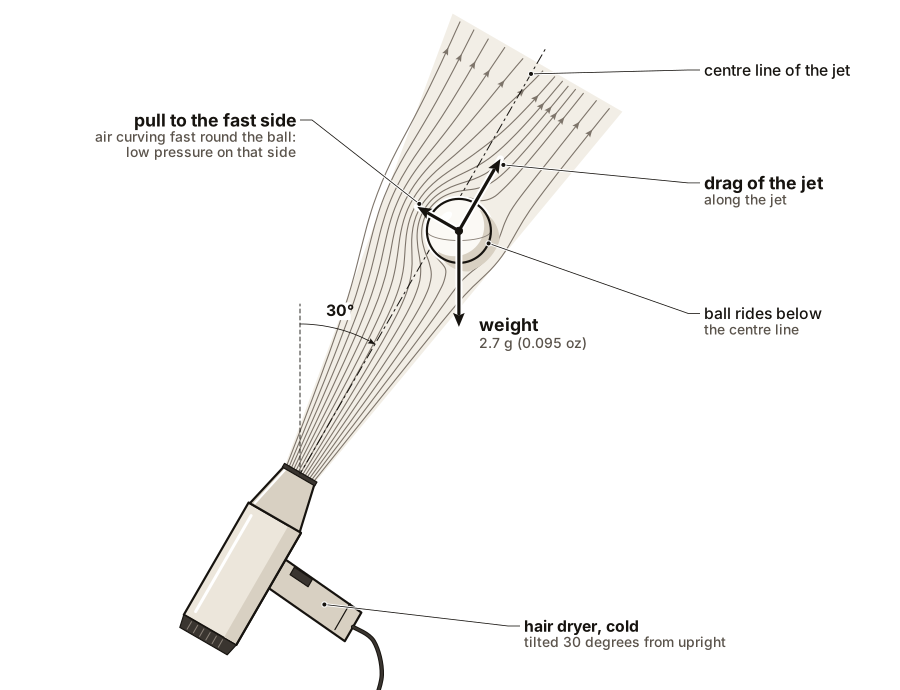
So what floats the ball in the popular demonstration? Usually air. A ball in a fast jet of air is held in place by the jet itself. Air at about 9 m/s (20 mph) carries a ping-pong ball’s weight by drag. If the ball drifts sideways, more of the fast air streams past the side nearer the middle of the jet and curves round it. Air forced to follow a curve has lower pressure on the inside of the curve, so the ball is drawn back. A jet’s habit of following a curved surface is called the Coanda effect; the low pressure that goes with it is Bernoulli’s principle. They are two names for one pressure field.
A loudspeaker makes such a jet when it pushes air through a hole. Each outward stroke shoots a puff that rolls up into a ring, like a smoke ring, and travels away. Each inward stroke draws air back from all round the hole, not out of the departing ring. No air is gained over a cycle, yet a steady wind blows from the hole. Barton Smith and Ari Glezer called this a synthetic jet (Physics of Fluids 10, 2281, 1998). A bass port does it at high volume, and you can feel the wind with a hand. It is the streaming of Chapter 7 at its most vigorous.
ON THE BENCH: A ball in a hair dryer’s jet
Parts: a hair dryer with a cool setting; a ping-pong ball; a strip of tissue taped to a pencil. Cost: about $1 for the ball. Time: 10 minutes. Hazards: use the cool setting. Older balls are celluloid, which burns readily, and hot air softens any plastic ball. Keep the dryer away from water. Method: point the dryer straight up, at full speed, cold, and lower the ball into the jet about 150 mm (6 in) above the nozzle. Let go. Nudge the ball sideways with the pencil. Tilt the dryer slowly towards the horizontal. Then hold the tissue strip close beside the ball. What you should see: the ball hovers, spinning and bobbing, and returns when nudged. Tilted, it still hangs, riding below the jet’s centre line, until at some tilt it drops; expect somewhere around 30 to 45 degrees from upright, though that is an estimate and the angle depends on the dryer. The tissue is drawn in towards the ball, into the air curving round it. If it does not work: if the ball blows away, use the lower speed; if it will not lift, the higher.
The other usual answer is a thread: fine fishing line hardly shows in a photograph. Genuine ultrasonic levitation, by contrast, is silent. Speakers that are audibly playing are not the ones holding the ball.
ON THE BENCH: The woofer as a pump
Parts: the chapter 1 woofer and drive, with the plate unbolted and lifted off; a cardboard box whose open side just covers the woofer’s frame, at least 100 mm (4 in) deep; tape; the tissue strip; the ping-pong ball; the sound meter app. Cost: nothing. Time: 30 minutes. Hazards: at low notes a bare cone can be driven further than it is built to go. Start at zero volume, raise it slowly, and stop at once if you hear clacking. Keep your head back from the cone and the hole, and wear plugs if the meter reads above 85 dBA. Method: with the woofer face up on its bricks, play 30 Hz and raise the volume until the cone visibly moves. Hold the strip 20 mm (0.8 in) above the cone, then rest the ball on it. Next, cut a 25 mm (1 in) hole in the base of the box, off to one side of the bolt, turn the box over the woofer and tape it to the frame all round, so the hole is the only way out. Hold the strip over the hole and sweep slowly from 20 to 150 Hz. What you should see: this is a prediction from the physics above, not a guaranteed result, so treat it as a test. Over the bare cone the strip flaps back and forth and goes nowhere. The ball rattles and hops, thrown whenever the cone drops away faster than gravity can follow, as the sand was in Chapter 1, but it never hovers. Over the hole the strip streams steadily upwards, though the cone only moves back and forth. It streams hardest near one frequency: box and hole are a Helmholtz resonator, Chapter 13’s bottle, and near its note the air in the hole swings fastest. Lay the ball over the hole there. It is pushed up and may dance on the jet: a loudspeaker moving a ball with wind. If it does not work: if the strip only flutters at the hole, air is leaking round the box; tape the seams. A smaller hole, 15 mm (0.6 in), makes a faster jet.
IN PLAIN ENGLISH: Sound pushes on things, but gently. Holding up a ping-pong ball with ordinary sound would take a pressure swing fifty to several hundred times that of the threshold of pain. Ultrasound pushes harder, but its still spots are only a few millimetres (about a sixth of an inch) apart, too close to cradle a ball that big without a laboratory array of hundreds of transducers. When a ball floats between two ordinary speakers, look for the wind, or the thread.
Ultrasound closes Part III. You can now account for sound from a few hertz, in a washing machine’s suspension, to a few million, in a scanner’s probe, with the same ideas: natural frequency, standing waves, nodes, resonance, damping. Part IV takes those ideas to the claims made in the name of cymatics, beginning with the man who named it.

Bench Degree
Get the degree without the diploma.
Learn the material, not how to pass the exam.