Bench Degree·CYMATICSchapter
Chapter 20: Stopping Vibration
A rubber pad under a machine can quiet a room, or it can make the shaking worse. Which one you get depends on a single ratio, and the number that decides it is the square root of two.
Set a phone to vibrate and lay it face down on a bare wooden table. Call it from another phone. The table buzzes loudly enough to hear across the room; the whole top has become a loudspeaker. Now put a folded tea towel under the phone, or a scrap of soft foam, and call again. The buzz almost vanishes. The phone is shaking exactly as hard as before. What changed is how much of that shaking reaches the table.
That is isolation: putting something soft between a source of vibration and the structure around it, so that the vibration stays where it starts. Chapter 9 met a second remedy, damping, which turns vibration into a trace of heat inside the thing that is vibrating. The two are often confused, and they work in opposite ways. Isolation stops vibration crossing a gap. Damping stops it lasting. This chapter builds each in turn, then puts both on the chapter 1 plate.
Section 1: The Buzz and the Towel
The towel experiment is worth doing properly, because it can be measured, and because it can fail in an instructive way.
ON THE BENCH: A phone on a towel
Parts: two phones, one with a sound meter app; a hard table; a folded tea towel; a block of soft upholstery foam about 50 mm (2 in) thick; a hardback book. Cost: nothing. Time: 10 minutes. Hazards: none. Method: set the meter phone on the table about 300 mm (12 in) from where the buzzing phone will lie, and note the room’s quiet reading. Put the first phone on vibrate, lay it on the bare table, and call it. Read the meter. Repeat with the phone on the towel, then on the foam, then on the hardback book. What you should see: on the bare table, a reading 15 to 25 decibels above the quiet room. On the foam, close to the quiet reading. The towel falls in between. The book makes little difference, or makes things louder. If it does not work: if the bare table is quiet, it is too heavy and stiff to be driven well. Try a thin shelf, a tray or an upturned plastic box, which all buzz readily.
The book is the useful surprise. It is hard and heavy, and it passes the buzz straight through. What isolates is softness, and the rest of the chapter is about how soft, and why.
Section 2: A Mass on a Spring, Again
Chapter 3 built the mass on a spring and its natural frequency. Anything that sits on a soft mount is exactly that: the machine is the mass, the mount is the spring. And it has a natural frequency of its own, the rate at which it would bounce if you pressed it down and let go.
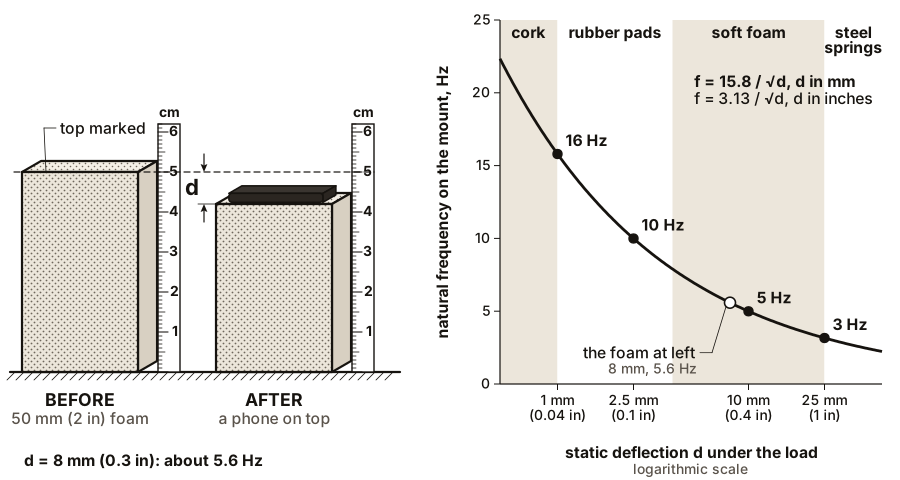
There is a beautiful shortcut for finding it. Put the machine on the mount and measure how far the mount squashes under its weight. That squash is called the static deflection. Because the same spring stiffness and the same mass set both the squash and the bounce, the natural frequency depends on the squash alone:
f = (1/2π) × √(g / d)
where g is the acceleration of gravity and d is the static deflection. In everyday terms: f is about 15.8 divided by the square root of the deflection in millimetres, or 3.13 divided by the square root of the deflection in inches.
| Squash under the load | Natural frequency on the mount |
|---|---|
| 1 mm (0.04 in) | about 16 Hz |
| 2.5 mm (0.1 in) | about 10 Hz |
| 10 mm (0.4 in) | about 5 Hz |
| 25 mm (1 in) | about 3 Hz |
A ruler is enough.
Now drive that mass and spring. The machine shakes at its running frequency, and the question is how much of that shaking the mount passes to the floor. Engineers call the ratio of force out to force in the transmissibility. For a mount with little damping it depends only on the ratio r of the running frequency to the mount’s natural frequency:
transmissibility = 1 / (r² − 1), taking the size and ignoring the sign
Work it through and the whole subject falls out.
- r well below 1: the mount is stiff compared with the running speed. Transmissibility is about 1. The mount passes everything, as if it were not there.
- r near 1: resonance. The running frequency matches the bounce, and the mount passes far more force than the machine makes. With the high Q of Chapter 9, many times more.
- r = √2, about 1.41: transmissibility is exactly 1 again. The mount is back to passing everything.
- r above √2: transmissibility falls below 1, and keeps falling. At r = 2 the mount passes a third of the force; at r = 3, an eighth; at r = 5, about a twenty-fourth.
A mount isolates only when the machine runs faster than about 1.41 times the mount’s natural frequency. Below that it does nothing useful, and near the natural frequency it makes matters worse. That is the whole rule, and it is in every vibration textbook from J. P. Den Hartog’s Mechanical Vibrations onward (fourth edition, 1956, section 2.12, where a mount tuned to a fifth of the running frequency passes “1 part in 24”).
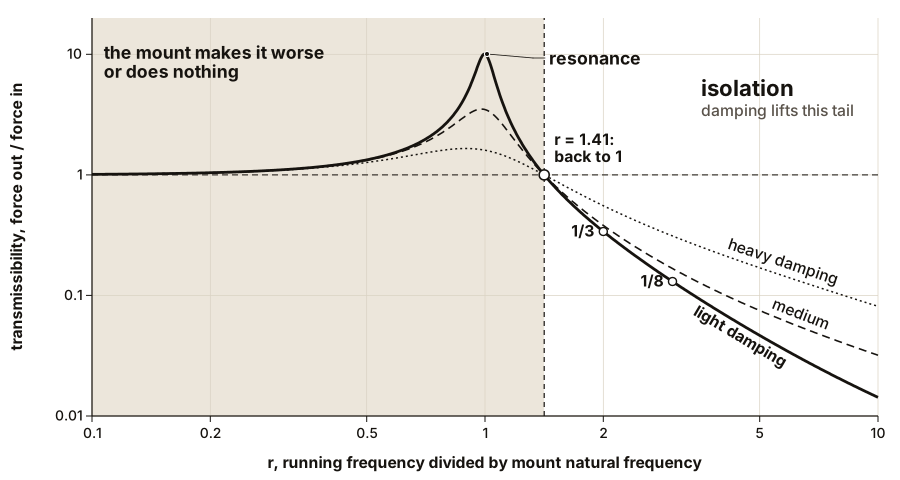
IN PLAIN ENGLISH: A soft mount lets the machine bounce slightly on it. If the machine shakes much faster than that bounce, the mount cannot keep up and the floor feels very little. If the machine shakes at about the bounce rate, the mount joins in and the floor gets more than before. So the mount must be soft enough that its own bounce is well below the machine’s shaking.
The figure shows one more trade worth knowing. Damping inside the mount lowers the resonance spike but spoils isolation above it. A damper is a connection that passes force in proportion to speed, and at high frequencies the speeds are high. So a good isolator is soft and lightly damped, and it relies on the machine getting through the resonance quickly, or never sitting near it.
Section 3: Rubber, Cork, Foam and Mass
The table in the last section is really a guide to materials. To isolate a machine, choose a mount that squashes far enough under that machine to put its natural frequency well below the running frequency divided by 1.41.
Cork is firm. Under a heavy machine it squashes little, so its natural frequency stays high, and it suits heavy equipment that shakes fast.
Rubber in blocks and pads squashes a few millimetres (a tenth of an inch or so) under a sensible load, giving natural frequencies of roughly 8 to 15 Hz. It suits machines running at a few thousand rpm, which shake at tens of hertz.
Soft foam squashes a long way under a light load. Under a phone it gives a natural frequency of a few hertz, which is why it silenced the vibration motor in the first box, running at well over a hundred hertz.
Steel springs reach the lowest frequencies of all for heavy loads, because they can squash 25 mm (1 in) or more without being damaged. Building services engineers put fans and pumps on them.
Mass helps in two ways. A heavy concrete base under a machine, an inertia block, moves less for the same shaking force, simply because it is heavier. And if the mounts beneath it are sized for the combined weight, they squash further and the natural frequency falls.
Each material also has a load it was meant for. Too little weight and a pad hardly squashes; too much and it squashes flat and stiffens.
ON THE BENCH: Isolating an appliance, measured
Parts: a phone with a free accelerometer app that shows vibration and, ideally, a frequency spectrum; a washing machine on spin, a tumble dryer, or a desk fan on a table; a block of soft foam about 50 mm (2 in) thick and at least as big as the phone; a ruler. Cost: nothing. Time: 30 minutes. Hazards: keep clear of moving parts; do not open an appliance or remove its panels; a washing machine on spin can walk, so stay near it. Method: first measure the foam’s static deflection under the phone. Stand the ruler beside the foam, note its height, lay the phone on it and note the new height. The difference is d. Work out the foam’s natural frequency with the phone on it from the formula above. Now start the appliance. Lay the phone flat directly on top and record 30 seconds of acceleration. Then put the foam on the appliance, the phone on the foam, and record again. If the app shows a spectrum, find the peak: that is the running frequency. A washing machine spinning at 1,200 rpm shakes at 20 Hz; a fan at 1,500 rpm at 25 Hz. What you should see: on the foam, a much smaller reading at the running frequency. Divide the running frequency by the foam’s natural frequency to get r, and compare the drop with 1 / (r² − 1). For foam squashed 8 mm (0.3 in), the natural frequency is about 5.6 Hz, and at 20 Hz r is about 3.6, so the foam should pass about a twelfth of the shaking. If it does not work: if the reading barely drops, measure d again. Stiff foam squashed only a millimetre (0.04 in) gives a natural frequency near 16 Hz, an r near 1.27 at 20 Hz, and a transmissibility of about 1.6. Stiff foam makes it worse. Prove it by trying a firmer pad. Better, if you have one: keep recording as a washing machine starts its spin, and catch the brief shudder that Section 4 explains.
Section 4: Engines and Washing Machines
Two machines in most households show the rule at work, and show its costs.
A washing machine spins its drum at up to 1,400 rpm, which is 23 Hz. The drum and its outer tub hang inside the cabinet on springs, braced by friction dampers. The suspension is soft, so its natural frequency is low, well below any spinning speed. That is good isolation at full speed. The price is paid on the way up: as the drum accelerates, it passes through the suspension’s natural frequency, and an unbalanced load of wet towels shakes the whole machine for a few seconds. The dampers are there for that moment. They cut the resonance peak, and the machine accepts slightly worse isolation at top speed in return, the trade drawn in the transmissibility figure.
The rubber feet and anti-vibration pads sold for washing machines are a different matter. Under a heavy machine they squash only a millimetre or two (a few hundredths of an inch), which puts their natural frequency between about 11 and 16 Hz. At a 20 Hz spin, r is between about 1.25 and 1.8, close to the region where the pad does nothing or makes things worse. Pads like these mainly stop a machine walking and stop it rattling against a hard floor; on the arithmetic, they cannot isolate a 20 Hz shake by much.
A car engine sits on mounts too, usually rubber or rubber-and-fluid blocks. A four-cylinder, four-stroke engine fires twice per turn of the crankshaft, so at an idle of 750 rpm it shakes at 25 Hz, and faster as the revs rise. The mounts must be soft enough that the engine’s bounce on them sits well below 25 divided by 1.41, about 18 Hz. They must also hold the engine against its own torque and the jolts of the road, which wants them stiff. Yu, Naganathan and Dukkipati reviewed decades of work on that conflict in 2001 (Mechanism and Machine Theory 36, 123). One answer is a fluid-filled mount, stiff and well damped at the slow shake of the road, soft at the faster shake of the engine. You feel the compromise when an engine stops: for a moment it passes through the mounts’ natural frequency, and the car shudders.
Section 5: Tesla’s Bed
Nikola Tesla gave one of the oddest recommendations for vibration isolation on record. In the third part of his memoir My Inventions, in the Electrical Experimenter for April 1919, page 907, he described a breakdown he suffered in Budapest in 1881, during which his senses became unbearably acute:
A carriage passing at a distance of a few miles fairly shook my whole body. The whistle of a locomotive twenty or thirty miles away made the bench or chair on which I sat vibrate so strongly that the pain was unbearable. The ground under my feet trembled continuously. I had to support my bed on rubber cushions to get any rest at all.
The account is genuinely his, and the bed is his own detail; nothing else confirms it. He wrote it 38 years after the event, in a passage that also has him hearing a watch through three rooms and, in 1899, thunder 550 miles (885 km) away, distances no ear can manage, as Chapter 15 showed. His physician, he says, called the illness unique and incurable. The fair reading is that a young man in great distress felt the world shaking, and did something sensible about it.
Was it sensible? Run the numbers. A bed with a sleeper might weigh 100 kg (220 lb). Four rubber cushions that squashed 2 mm (0.08 in) under it would give a natural frequency of about 11 Hz. That would isolate the bed well from any shaking above about 16 Hz: the tramp of a nearby workshop, the rumble of heavy wheels on stone close by. It would pass slower shaking unchanged, and amplify anything near 11 Hz.
What it could not do is change anything that originated inside the sleeper. A locomotive whistle tens of miles away puts no measurable shaking into a Budapest floor. The cushions were good engineering applied to a cause that was, on the evidence of his own account, not in the ground. Tesla returned to the idea late in life, in an undated typescript of about 1940 called “Mechanical Therapy”, describing a shaking platform of his own “supported on elastic cushions”. Isolating a machine that shook on purpose from the building around it was exactly the right use of the idea. The cures he claimed for it in the same typescript are another matter, and nothing in this chapter supports them.
Section 6: Damping, and the Plate in Tape
Isolation keeps a vibration in its own place. Damping makes it die. Chapter 9 defined damping as anything that turns vibration into heat, and measured it on the plate through Q: the higher the Q, the longer the ring.
Damping is the right tool when the thing vibrating is the thing you care about: a panel that drums, a car door that booms, a machine guard that rings. Most metal structures have very little damping of their own. The aluminium of your plate loses about a ten-thousandth of its energy per radian of swing, which is why it rang for a second or more in Chapter 1.
The most efficient way to add damping to a thin panel was worked out by Edward Kerwin in 1959 (Journal of the Acoustical Society of America 31, 952). It is called constrained-layer damping. Stick a thin layer of soft, sticky viscoelastic material to the panel, and cover it with a thin stiff skin, often aluminium foil. When the panel bends, its surface stretches on one side of each wave and shrinks on the other, but the stiff foil on top barely stretches at all. So the soft layer between them is sheared, back and forth, every cycle. Shearing a viscoelastic layer turns motion into heat efficiently, far more efficiently than merely stretching it, which is what a soft layer stuck on with nothing over it does.
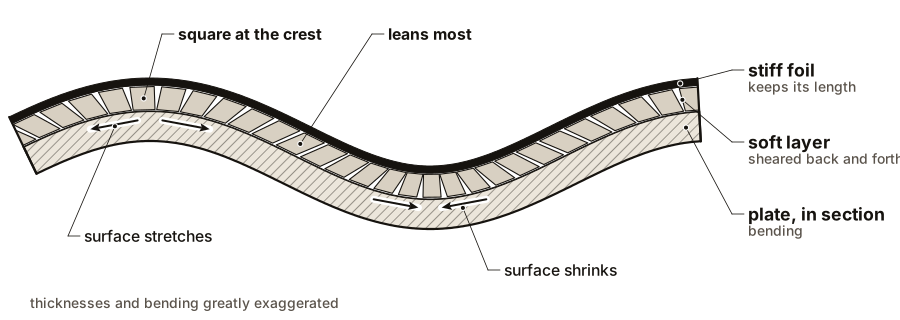
Aluminium foil tape, sold for sealing heating ducts, is a constrained layer straight off the roll: a thin metal skin over a sticky acrylic layer. Masking tape, paper over a rubbery glue, is close to a free layer, with a soft skin that stretches with the plate. Your plate will tell you which works better.
ON THE BENCH: Taping the plate
Parts: the chapter 1 rig; the recording phone and laptop from Chapter 9’s ring-down box; a roll of aluminium foil tape 50 mm (2 in) wide; a roll of masking tape the same width; ear protection. Cost: about $8 for the foil tape. Time: an hour. Hazards: as in Chapter 1; foil tape edges cut, so handle the cut ends with care. Peeling foil tape can lift paint. Method: measure the Q of the twelve-spoke figure near 512 Hz by ring-down, exactly as in Chapter 9: Q = π × f × τ. Then lay four strips of masking tape 100 mm (4 in) long across the plate’s underside, out near the rim, in a cross. Retune to the figure, which will have moved a hertz or two, and measure Q again. Peel the masking tape off and lay four identical strips of foil tape in the same places, rubbing them down hard. Measure again. What you should see: Q falls with either tape, and τ shortens with it. The foil tape should cut Q more than the same area of masking tape. Write down all three numbers. If the bare plate gave the 640 of Chapter 9, a fall to a few hundred with masking tape, and lower still with foil, would be in line with what thin tapes do; your own numbers are the result. If it does not work: if the Q hardly changes, check that the measurement can fail, as Chapter 9 insisted: rest a finger lightly on the rim and τ must collapse. If it does, your tape is too little or in the wrong place. Damping layers work where the plate bends most, which for the spoked figures is out towards the rim and away from the spokes themselves. Better, if you have one: sprinkle salt and raise the figure with the foil tape in place. Note the volume needed. It will take more drive to throw the salt, which is the price of damping that Chapter 9 worked out.
SLOW DOWN. Check Your Understanding: A small compressor runs at 600 rpm, which is 10 Hz. It sits on rubber pads that squash 3 mm (0.12 in) under it, giving a natural frequency of about 9 Hz, and the floor shakes badly. A friend suggests softer pads. You suggest stiffer ones. Which of you is right? Answer before you read on.
Both of you can be. With r = 10 / 9, about 1.1, the compressor is running almost on top of its mounts’ resonance, and transmissibility is several times 1. Anything that moves r away from 1 helps. Softer pads that squash 12 mm (0.47 in) give a natural frequency near 4.5 Hz and r about 2.2, so the floor feels roughly a quarter of the shaking force: real isolation. But stiffer pads that squash only 0.6 mm (0.02 in) give a natural frequency near 20 Hz and r = 0.5, and transmissibility falls to about 1.3, which is far better than the resonance and still worse than no mount at all. The worst mount is the one in the middle, and a mount chosen without measuring is quite likely to land there. Only the soft choice reaches isolation, because isolation lives above √2.
Chapter 21 goes up, past the top of hearing, into vibration that cleans, scans, shatters kidney stones and holds beads in mid-air.

Bench Degree
Get the degree without the diploma.
Learn the material, not how to pass the exam.