Bench Degree·CYMATICSchapter
Chapter 19: Stone and Glass
A Gothic cathedral holds a sung note for seven or eight seconds, and its round window divides a circle the way your plate does. The first fact shaped what was sung there. The second is a coincidence of geometry, and a deeper one than any legend.
Find the hardest, emptiest room you can: a concrete stairwell, a tiled bathroom, an empty garage. Sing one long note, then stop dead and listen. The note goes on without you. Sing a second note a little higher while the first is still hanging, and you are singing a chord with yourself.
Now do the same in a bedroom with a bed, curtains and a carpet. The note stops almost when you do.
Chapter 17 gave that difference a number, the reverberation time: how long a sound takes to fall by 60 decibels once its source stops. A furnished room manages half a second, a stairwell two or three. This chapter goes to the largest hard rooms ever built for the voice, the Gothic cathedrals, and then looks up at their round windows.
Section 1: A Room That Holds a Note
A Gothic cathedral is a vast volume of air enclosed by limestone, marble and glass, and each of those surfaces reflects nearly all the sound that strikes it. Chapter 17’s absorption coefficient, the fraction of sound energy a surface swallows on each bounce, is a few hundredths for dressed stone. A sound in a stone nave can strike fifty walls and still be heard.
Sabine’s formula says the reverberation time grows with the volume of the room and shrinks with the total absorption in it. A cathedral has an enormous volume and almost no absorption, so both terms push the same way.
The measurements bear this out. Two twentieth-century surveys of Notre-Dame de Paris, quoted by Brian Katz and Antoine Weber in 2020, give the empty cathedral about 8.5 seconds around 125 Hz, 6.5 to 7.5 seconds around 500 Hz, and under 3 seconds near 4,000 Hz. Katz and Weber’s own recordings found the cathedral 8% less reverberant in 2015 than in 1987, which they put down mainly to carpet runners laid in between, and 20% less again after the 2019 fire opened three holes in the vault. St Peter’s in Rome, timed by R. S. and H. K. Shankland with a tape recorder, an ear and a stopwatch (Journal of the Acoustical Society of America 50, 1971), came out near 7 seconds at mid frequencies, as Francesco Martellotta reports their result; his own 2016 survey found it longer, about 13.6 seconds at 125 Hz.
IN PLAIN ENGLISH: Stone bounces sound back almost perfectly, and a cathedral is a very big stone box. A note sung inside it bounces around for seven or eight seconds before it fades away, compared with half a second in a living room. The low notes last longest, because the stone soaks up almost none of them.
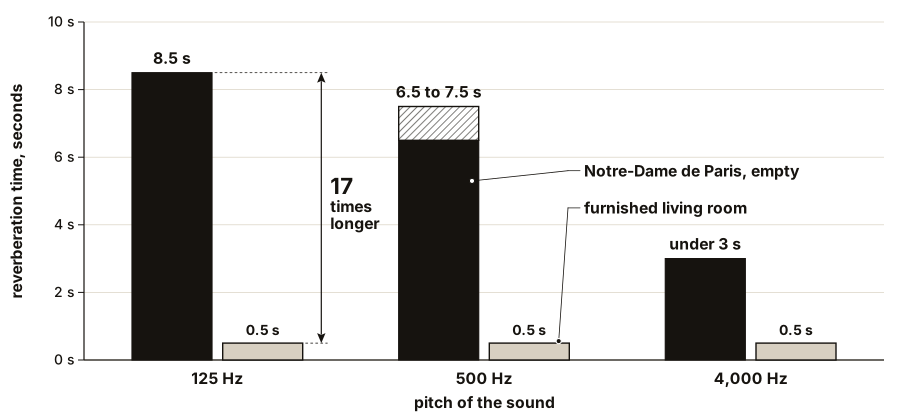
Notice the fall at high pitch. The air itself absorbs high frequencies, and in a room this large a sound travels a long way through air before it dies. In a big enough room the air becomes one of the absorbing surfaces. That is why a cathedral sounds dark: the sparkle of a voice dies in two or three seconds, and the body of the note goes on for eight.
ON THE BENCH: Singing into a long tail
Parts: a hard, empty room (stairwell, garage, tiled bathroom, or a church if you ask first); a phone with a voice recorder; a metronome app. Cost: nothing. Time: 20 minutes. Hazards: none. Ask permission before singing in a church, and do not clap or shout during a service. Method: time the room’s tail with a recorded clap, as in Chapter 17. Then sing a slow rising scale at one note per metronome beat, one beat per second, and record it. Repeat at four beats per second. What you should see: on playback the slow scale is a chain of notes, each overlapping its neighbour a little. The fast scale is a smear. With a 2 second tail and four notes a second, about eight notes are sounding at any moment; in a 7 second cathedral tail, nearly thirty. If it does not work: if you hear no overlap, the room has something soft in it. Find a harder one. Better, if you have one: a spectrum analyser app (Chapter 16). After you stop, the low notes hang on longer than the high ones, as in Notre-Dame.
Section 2: What the Room Lets You Sing
Run that arithmetic at cathedral scale and it is plain what such a room favours. A single line, sung slowly, leaves each note ringing into the next like a halo. Fast music with changing harmony turns to mud, because every chord is still sounding when the next one arrives.
Plainchant, a long unmeasured line paced by breath and text, fits a long reverberation time well. So does the early polyphony of Notre-Dame, which sets slow sustained notes in one voice under moving lines in another; Katz and Weber cite decrees of Bishop Eudes de Sully in 1198 and 1199 that already attest singing in two, three and four parts there.
The tempting story is that the buildings came first and the music adapted. Be careful with it. Chant was sung for centuries before the Gothic cathedrals rose, in rooms of every size. The physics shows a good fit between a kind of music and a kind of room; it does not show which one shaped the other. That is for historians of music to argue. What the physics does say firmly is that a long tail limits how fast distinct sounds can follow one another and still be heard apart, which is why a preacher in a stone church learns to leave a gap after each phrase.
Section 3: The Glass That Sings
Acoustically, a cathedral’s leaded windows are more stone: hard and reflective. The glass with something to teach sits on a dinner table.
A stemmed wine glass is a bell. Chapter 8 made it sing, Chapter 9 measured its Q and Chapter 10 explained the wet finger. Here the question is how its shape compares with the plate’s.
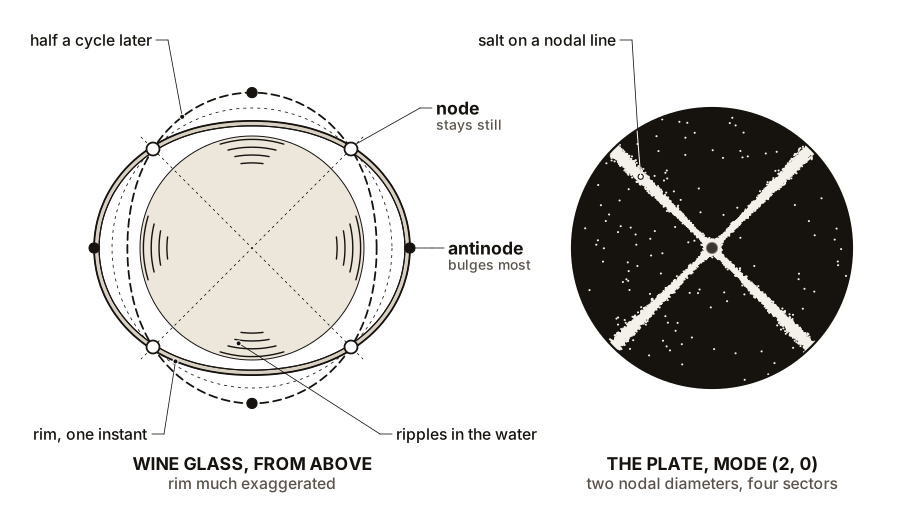
The note is the glass’s lowest bending mode, the swinging oval of Chapter 8, with four antinodes round the rim and four nodes between them. In the mode labels of Chapter 5 it has two nodal diameters, written (2,0), and two nodal diameters always make four sectors. It is the same rule that put twelve spokes on your plate when it had six nodal diameters: m diameters, twice m sectors. A glass and a flat disc obey it alike, because each is a ring of material that must close on itself going round.
Water lowers the pitch, as French’s 1983 study in Chapter 9 showed, and Jundt and colleagues photographed the modes of partly filled glasses by holographic interferometry in 2006 (Journal of the Acoustical Society of America 119, 3793). The liquid lowers the frequencies and leaves the shapes almost exactly as they were, which is what you see: four ripple patches, at every water level you try.
ON THE BENCH: Four nodes in a wine glass
Parts: the singing glass from Chapter 8; water; a tuner or spectrum analyser app. Cost: nothing. Time: 10 minutes. Hazards: as in Chapter 8: light pressure only, and no chipped rims. Method: sound the glass empty, as in Chapter 8, and read its pitch. Fill it a third full and read it again; then two thirds. What you should see: the pitch falls as the water rises, slowly at first and faster near the top, while the ripple patches stay at four at every level. The frequency moves; the shape does not. If it does not work: Chapter 8’s box covers a glass that will not sing; it is nearly always grease.
Section 4: Dividing a Circle
Now look up at the rose.
The great rose windows were laid out with two tools: a compass, which draws a circle and carries a fixed length from place to place, and a straightedge, which joins two points with a line. Robert Bork’s The Geometry of Creation (2011) reconstructs surviving Gothic architectural drawings step by step with these two tools, and the drawings of the period, among them Villard de Honnecourt’s sketch of the Chartres west rose from the 1220s or 1230s, are consistent with it.
With those two tools, some divisions of a circle are easy and some are impossible.
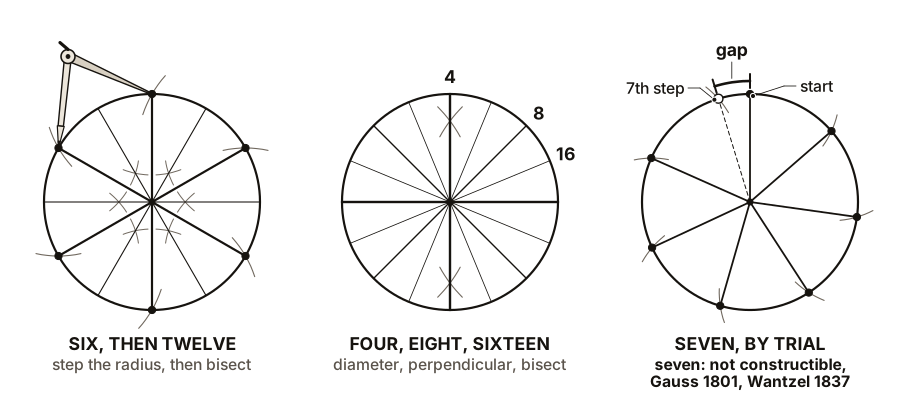
Six is the easiest of all. Draw a circle. Without changing the compass, put its point anywhere on the circle and swing an arc to cut the circle; move to the cut and do it again. The sixth step lands exactly where you started, because a circle’s radius fits round its own circumference six times as chords. Euclid gives the construction as Book IV, Proposition 15. Bisect each of the six angles and you have twelve; bisect again for twenty-four.
Four is next. Draw a diameter, then the perpendicular bisector of that diameter, and you have four. Bisect for eight, again for sixteen.
Five is possible but harder. Euclid’s Book IV, Proposition 11 does it with a page of steps, and from five you can bisect to ten and twenty.
Seven cannot be done at all. Carl Friedrich Gauss showed in 1801 which regular polygons the two tools can construct, and Pierre Wantzel proved in 1837 that the list was complete. Seven, nine, eleven and thirteen are not on it. A mason wanting seven had to step it out by trial with dividers until it closed.
So the easy rose windows come in a particular family: 6, 12, 24, and 4, 8, 16, with 5, 10 and 20 for the ambitious. Twelve, a favourite number for the great roses, sits at the cheap end of the list: one compass setting and one round of bisection. The north rose of Chartres, glazed around 1235, is built on twelve, round a central oculus of the Virgin.
ON THE BENCH: A twelve-fold rose on black card
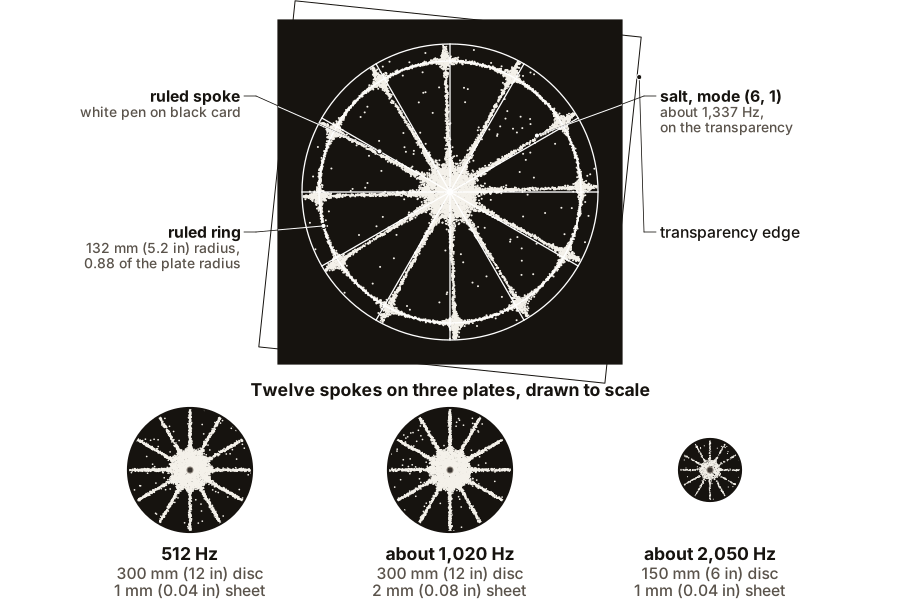
Parts: a sheet of black card at least 350 mm (14 in) square; a pencil compass that opens to 150 mm (6 in), or a pin, a loop of thread and a white pencil; a ruler; a white gel pen or white pencil crayon; your best photograph of the chapter 1 plate at the rose window figure near 1,337 Hz, printed at exactly 300 mm (12 in) across on an overhead transparency or traced onto tracing paper. Cost: about $5 for card and a transparency print. Time: an hour. Hazards: a compass point is sharp. Method: draw a white circle of radius 150 mm (6 in) and mark its centre. Without changing the compass, step round the circle from any point, marking each cut, until you arrive back at the start. Rule through the centre between opposite marks: six spokes. Bisect each sector by swinging equal arcs from neighbouring marks and ruling from the centre through their crossing: twelve spokes. Draw a second circle close to the rim, 132 mm (5.2 in) in radius, where Chapter 5 puts the rose window’s nodal circle. Lay the transparency over the card, centre on centre, and turn it until the spokes line up. What you should see: your twelve white salt spokes sitting on the twelve ruled spokes, and your salt ring lying close to the drawn circle. The ruled figure is exact; the salt figure wanders by a few degrees here and there because the plate is not perfect. Two completely different processes, a compass and a vibrating disc, have drawn the same wheel. If it does not work: if the sixth step misses the start by a millimetre or two (a few hundredths of an inch), the compass slipped; tighten it and start again. If your salt ring sits elsewhere, measure where and redraw. The ring’s radius comes from the plate’s physics (Chapter 5), not from the compass. Better, if you have one: do it again with a square start for sixteen spokes, and compare it with the plate’s sixteen-spoke figure near 884 Hz.
Section 5: The Same Wheel, Twice, 550 Years Apart
Now set the plate beside the mason.
Your plate makes a spoked figure whenever it vibrates with some whole number of nodal diameters, m, and then it shows twice m sectors. Chapter 5 showed why m has to be a whole number: go once round the disc and the motion must join up with itself. So the plate offers every even number of spokes: 4, 6, 8, 10, 12, 14, 16, and on up. Chladni’s own first figure, on a brass disc around 1785, was a star of ten or twelve rays, and in Die Akustik he describes the six-rayed and ten-rayed stars by name.
The mason can construct 4, 6, 8, 10, 12, 16, 20 and 24, and not 14 or 18. The two lists overlap heavily, and they overlap most heavily at twelve.
Why should two such different processes land on the same family of figures? Because both answer one question: how can a circle be divided into equal parts round its centre? A circle has no preferred direction, so anything drawn on it symmetrically, by hand or by wave, repeats a whole number of times going round and mirrors across lines through the centre. Mathematicians call that dihedral symmetry, and a twelve-spoke figure has the same symmetry in stone or in salt. The mason chose twelve because it is cheap to construct and rich in meaning: apostles, months, tribes of Israel. The plate shows twelve at 512 Hz because six nodal diameters is one of its modes.
That is kinship, and it is the whole of the connection. It is in no sense influence, in either direction, and the dates settle it. The Chartres north rose was glazed around 1235. Chladni published his first figures in 1787, about 550 years later. No thirteenth-century mason saw a vibrating plate, and Chladni’s figures owe nothing to rose windows; he found his on a brass disc held in a vice. Two people who never met solved the same geometry problem with different tools, and the problem has only one family of answers.
SLOW DOWN. Check Your Understanding: Your plate draws a fourteen-spoke figure near 686 Hz. Could a thirteenth-century mason, using only compass and straightedge, have laid out an exact fourteen-spoke rose to match it? Answer before you read on.
No. Fourteen equal parts requires seven, and seven is one of the divisions Wantzel proved impossible with those tools. The mason could only creep up on it by trial with dividers until the error fell below the width of a chisel. The plate has no such trouble, because it constructs nothing: it settles into whatever shape joins up all the way round, and seven nodal diameters serve as well as six. This is where the kinship breaks, and it is instructive. A wave can divide a circle into any whole number of parts; a compass and straightedge only into the special numbers on Gauss’s list. The plate’s family of figures is strictly larger than the mason’s.
Section 6: The Claim That Windows Encode Sound
A stronger story circulates: that rose windows encode sound frequencies, or were found by listening to the building, or answer the bells. A magazine column by Jason Stern, “Vibration, Resonance, and the Hudson Valley” (Chronogram, May 2026), prints two versions: that “studies show” the rose windows respond when cathedral bells sound at 64, 128 or 256 Hz, at matching wavelengths of light; and that cymatic experiments rendering the ambient sound of Chartres “produced forms nearly identical to the rose window’s design”. The essay names no study, experimenter or publication for either, and none could be found. Test both with what you own.
Start with the light. Visible light has a frequency between about 400 and 750 million million hertz. A bell at 256 Hz is lower by a factor of more than a million million. Nothing in a pane of coloured glass converts one into the other. The claim puts the word “matching” between two quantities that differ by twelve powers of ten.
Then the plate. Suppose a vibrating plate in Chartres, fed the cathedral’s sound, did draw a twelve-fold figure. Which frequency would that figure encode? Your own plate drew twelve spokes at 512 Hz. A plate of the same metal twice as thick draws the same figure at about 1,020 Hz, and one with half the diameter draws it at four times the frequency. A Chladni figure records the number of nodal lines, which depends on the mode; the frequency of that mode depends on the plate. The figure carries no frequency until you say what it was drawn on. So a window cannot “encode” a pitch by its shape, any more than a twelve-spoke salt pattern can tell you whether it came from a 1 mm (0.04 in) plate or a 2 mm (0.08 in) one.
Then the sound. A cathedral’s ambient sound is footsteps, voices and traffic spread over thousands of frequencies. Feed noise to your plate and the salt shivers everywhere, because many modes are driven weakly at once. Clean figures need one steady tone held at a mode.
A sober question sits nearby: did medieval builders use musical ratios in their proportions? Medieval writers did discuss proportion in terms of octave, fifth and fourth. Much of what circulates, though, is a modern measurement of a finished building, searched until some ratio turns up. One test separates the two. Was the ratio written down before or during construction, or found afterwards by somebody looking for it? Only the first is evidence of intent. With enough measurements and candidate ratios, the second succeeds on any building, including your garage.
The honest story beats the legend. A thirteenth-century mason with a compass and an eighteenth-century lawyer with a violin bow arrived at the same wheel because the circle allows only a few. Chapter 20 turns from making things ring to the opposite problem: how to stop them.
Bench Degree
Get the degree without the diploma.
Learn the material, not how to pass the exam.