Bench Degree·CYMATICSchapter
Chapter 18: Room Modes
Play one low note in an ordinary room and walk slowly across it. Somewhere on the way the note will nearly vanish, and a step later it comes back.
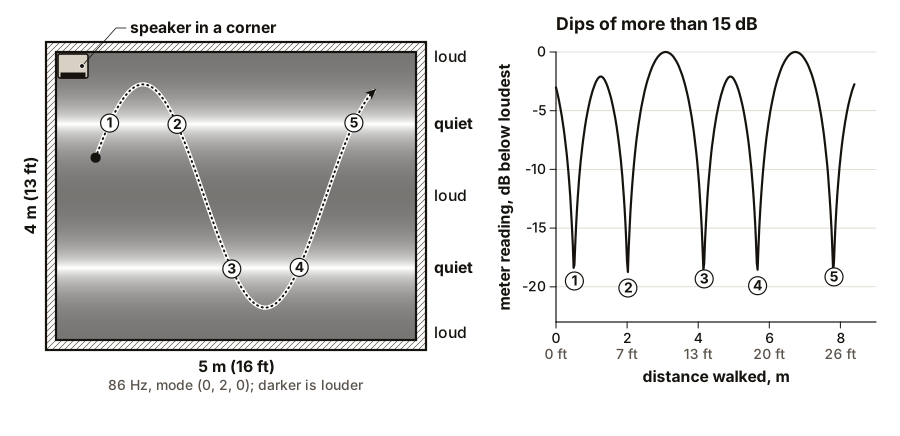
Play a steady low tone through any speaker with real bass: 100 Hz is a good start. Keep the volume moderate, about the level of a television. Now walk slowly across the room with one ear free, or with the phone’s meter app held out in front of you.
The note does not stay the same. In some places it is round and full; in others it is thin; in one or two spots, often a step or two from a wall or near the middle of the room, it almost disappears. Stand still in a quiet spot and lean your head a hand’s width to one side, and the note comes back. Change the frequency by a few hertz and the quiet spots move.
You are walking through a figure: the air is vibrating in a fixed pattern, with still lines and loud regions, as the plate did in Chapter 1. Nothing draws it in salt, so you find it with your ears. This chapter maps it, explains it with the wave arithmetic of Chapter 4, and builds the nineteenth-century instrument that first made such patterns visible in air.
Section 1: A Standing Wave Between Two Walls
Chapter 4 built a standing wave on a string held at both ends. A wave runs along, reflects from the end, runs back, and the outgoing and returning waves add. At certain frequencies they add into a fixed pattern of nodes and antinodes that does not travel at all. The rule for a string of length L was that a whole number of half-wavelengths must fit between the ends.
Two parallel walls do the same thing to sound. A sound wave crosses the room, reflects from the far wall, comes back, reflects again. When a whole number of half-wavelengths fits between the walls, the reflections line up and the air settles into a standing wave. That standing pattern is a room mode. For two walls a distance L apart, the frequencies are:
f = n × c / 2L
where c is the speed of sound, 343 m/s (1,125 ft/s), and n is 1, 2, 3 and so on. For walls 5 m (16.4 ft) apart, the first mode is 343 / 10 = 34.3 Hz, and the series runs 34.3, 68.6, 102.9, 137.2 Hz. For walls 4 m (13.1 ft) apart, it is 42.9, 85.8, 128.6 Hz. Between a floor and a ceiling 2.4 m (7.9 ft) apart, 71.5 and 142.9 Hz. Modes between one pair of facing surfaces are called axial modes.
There is one twist, and it is the key to everything you will measure. A sound wave is two things at once: air moving back and forth, and pressure swinging up and down. At a hard wall, the air cannot move, so the wall is a node for motion. But the air piles up against the wall and pulls away from it, so the wall is an antinode for pressure. The two patterns are offset by a quarter-wavelength. Where the air moves most, the pressure hardly changes, and where the pressure swings most, the air is still.
Your ear and your phone both measure pressure. So in the first axial mode the walls are loud, and the quiet line runs down the middle of the room, halfway between them. In the second mode, the walls and the middle are loud, and there are quiet lines a quarter of the way in from each wall.
IN PLAIN ENGLISH: Sound bouncing between two walls sets up a pattern that stays still, like the salt figures on the plate. At the walls themselves the air is squashed and stretched as hard as it ever is, so the sound is loudest there. Out in the room there are lines where the squashing never happens, and on those lines the note almost disappears.
ON THE BENCH: The corridor
Parts: a hallway or corridor with hard, parallel walls, the narrower the better; a tape measure; the chapter 1 woofer with the disc unbolted, standing face up in its open frame, or any powered speaker with real bass; the amplifier and tone generator; the phone meter. Cost: nothing. Time: 20 minutes. Hazards: keep the level below 85 dBA. Low tones feel quieter than they are; trust the meter. Method: measure the corridor’s width, W. Compute the first width mode, f = 343 / 2W, with W in metres, or 1,125 / 2W with W in feet. For a corridor 1.2 m (4 ft) wide, that is 143 Hz. Put the speaker on the floor against one wall, partway down the corridor. Play the tone. Set the meter app to C or Z weighting if it has them. Stand two or three paces along the corridor from the speaker and move the phone slowly from one wall to the other, at head height, reading the meter. What you should see: loud against each wall, quiet in the middle, with a smooth dip between. Then double the frequency, to 286 Hz for a 1.2 m (4 ft) corridor. Now the middle is loud again, and two quiet lines sit a quarter of the way in from each wall. If it does not work: if the pattern is weak, fine-tune the frequency up and down a few hertz while standing at the middle; the mode is sharpest when the quiet spot is quietest. Doors, alcoves and soft coats on hooks blur it. Try a bare stretch.
Section 2: Three Directions at Once
A real room has three pairs of surfaces, and modes form along each of them. Sound can also bounce round four surfaces in a loop, like a billiard ball, or round all six. The general rule for a rectangular room of length L, width W and height H was worked out in the nineteenth century and is set out in Lord Rayleigh’s The Theory of Sound (1877 to 1878; volume 2, section 267):
f = (c / 2) × √( (p/L)² + (q/W)² + (r/H)² )
where p, q and r are whole numbers, 0, 1, 2 and so on, counting the half-wavelengths along each direction. A mode with only one of them non-zero is axial. Two non-zero, and it is a tangential mode, bouncing round four surfaces. All three non-zero, and it is an oblique mode, using all six.
Take a room 5 by 4 by 2.4 m (16.4 by 13.1 by 7.9 ft). Its lowest modes are:
| Mode (p, q, r) | Kind | Frequency (Hz) |
|---|---|---|
| (1, 0, 0) | axial, length | 34.3 |
| (0, 1, 0) | axial, width | 42.9 |
| (1, 1, 0) | tangential | 54.9 |
| (2, 0, 0) | axial, length | 68.6 |
| (0, 0, 1) | axial, height | 71.5 |
| (1, 0, 1) | tangential | 79.3 |
| (2, 1, 0) | tangential | 80.9 |
| (0, 1, 1) | tangential | 83.3 |
| (0, 2, 0) | axial, width | 85.8 |
| (1, 1, 1) | oblique | 90.1 |
| (1, 2, 0) | tangential | 92.3 |
| (2, 0, 1) | tangential | 99.1 |
That is twelve modes below 100 Hz, spaced unevenly, with gaps of 10 Hz or more at the bottom. Above that the count climbs fast. The number of modes below a given frequency grows roughly as the cube of that frequency, and this room has nearly two hundred below 300 Hz.
That uneven sprinkling at the bottom is why bass in a small room is lumpy. A low note that lands on a mode is boosted, sometimes by 10 or 20 dB. A note that falls in a gap between modes gets little help and sounds weak. And at every seat the note is louder or quieter depending on where that seat falls in the mode’s pattern. Two people on one sofa can hear different bass.
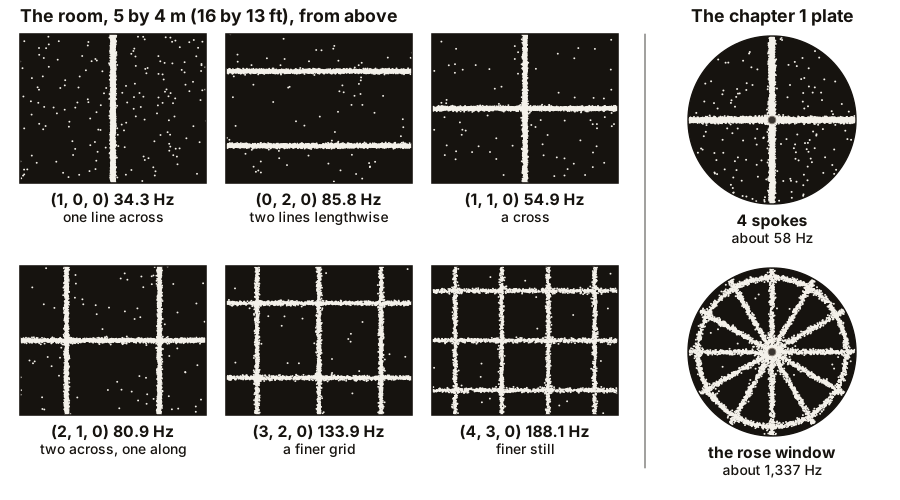
The tangential mode (1, 1, 0) is worth a look in plan. It has a quiet line running down the middle of the room lengthwise and another running across the middle widthwise. Seen from above, its still lines form a cross through the centre of the room, the same shape as the plate’s four-spoke figure near 58 Hz in Chapter 1. The higher modes draw grids, and the oblique ones draw grids in three dimensions. They are Chladni figures in air.
Section 3: Mapping Your Room
ON THE BENCH: A Chladni figure in your living room
Parts: the speaker, amplifier and tone generator from the last box; the phone meter; a tape measure; a pad of sticky notes; a pencil. Cost: nothing. Time: an hour. Hazards: keep below 85 dBA. Warn the household and the neighbours; a long steady low tone is the most irritating sound you can make through a shared wall. Method: measure the room’s length, width and height, and compute its first few axial modes with f = n × 343 / 2L in metres or n × 1,125 / 2L in feet. Choose the second width mode, n = 2, and check it is above 50 Hz; many speakers give little below that. Put the speaker in a corner on the floor, where every mode has a pressure antinode and is driven hard. Play the tone at a moderate level. Then walk a straight line across the room from wall to wall at head height, stopping every 25 cm (10 in) to read the meter, and stick a note on the floor where the level is lowest. Repeat along three or four parallel lines. What you should see: the notes line up. For the second width mode they form two lines running the length of the room, each a quarter of the width from a wall, and the meter reads 10 to 20 dB less on them than at the walls. You have drawn a Chladni figure in air with sticky notes. If it does not work: fine-tune the frequency a hertz at a time while standing on a quiet spot. Furniture and open doorways bend the lines. If you find no pattern at all, put the spectrum analyser from Chapter 16 by the speaker and check it really plays that low. Better, if you have one: do the same at the tangential mode (1, 1, 0). The notes should form a cross through the middle of the room.
Sabine opened his collected papers by mocking the advice that rooms should be built in the proportions 2:3:5, or 1:1:2, or 2:3:4, because those ratios did nothing for reverberation, which is what he was measuring. The ratios do matter, but for modes. A cube is the worst possible shape: its three axial series fall on exactly the same frequencies, piling three modes onto each other and leaving wide gaps between. A room whose dimensions are spread unevenly scatters its modes more evenly. In 1946 Richard Bolt of the Massachusetts Institute of Technology charted which proportions spread the low modes most evenly (“Note on Normal Frequency Statistics for Rectangular Rooms”, Journal of the Acoustical Society of America 18, 1946, pp. 130 to 133).
Section 4: Kundt’s Tube
Mapping a room with sticky notes is slow. Almost forty years after Chladni died, a young German physicist found a way to make the air draw its own figure.
August Kundt was 26 when his paper appeared in 1866 in Annalen der Physik und Chemie, volume 127, pages 497 to 523, under the title “On a new kind of acoustic dust figure, and its use in determining the speed of sound in solids and gases”. It opens with a tribute: “Since Chladni’s beautiful discovery of making the vibration patterns of sounding bodies visible to the eye with strewn sand or other light powders…” Then it does something Chladni never managed. It draws the vibration of the air itself.
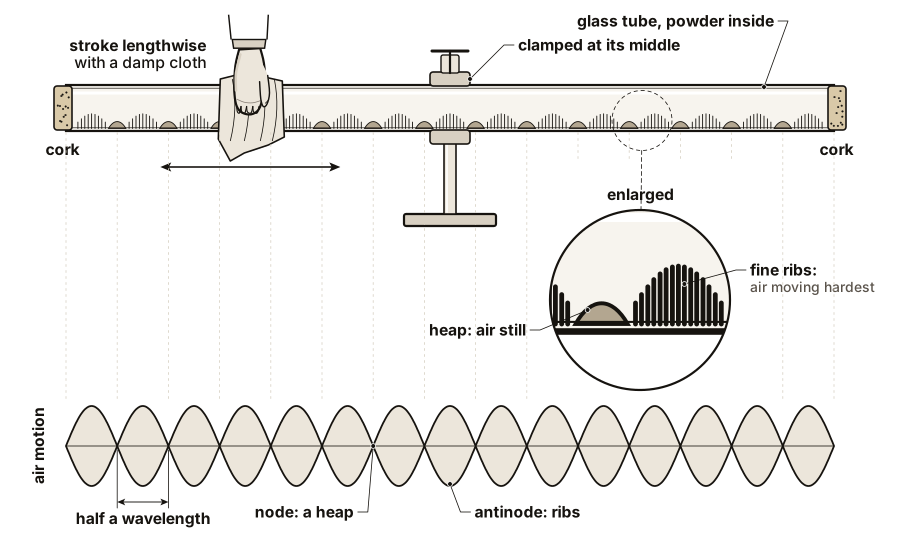
Kundt took a glass tube, sprinkled a little powder inside and shook it so that the powder clung all along the inner wall, and closed both ends with well-fitting corks. Then he clamped the tube at its middle and stroked it lengthwise with a damp cloth. A glass tube stroked that way rings with a high, piercing squeal: the glass itself stretches and shrinks along its length. The cork at the end passes that motion to the air inside, and the air column settles into a standing wave. The powder falls from the walls and settles along the bottom of the tube in a pattern that repeats at regular intervals: bands of fine ribs where the air moves hardest, and small heaps where it is still.
His powder was Semen Lycopodii, the dry yellow spores of club moss, which he chose after trying others. Sand and heavier powders, he wrote, are not moved at all by the waves in the air; the powder must be as light and fine as lycopodium. Classroom versions later used cork dust, which is cheaper.
The heaps are half a wavelength apart, and that turned a pretty figure into an instrument. The glass rod’s own ringing had a wavelength set by its length, and the air’s wavelength at the same frequency could be read off with a ruler from the heaps. Since both vibrate at the same frequency, the ratio of the two wavelengths is the ratio of the two speeds of sound. Kundt measured the speed of sound in glass and metals relative to air, and by filling the tube with other gases, in those too, without timing anything at all.
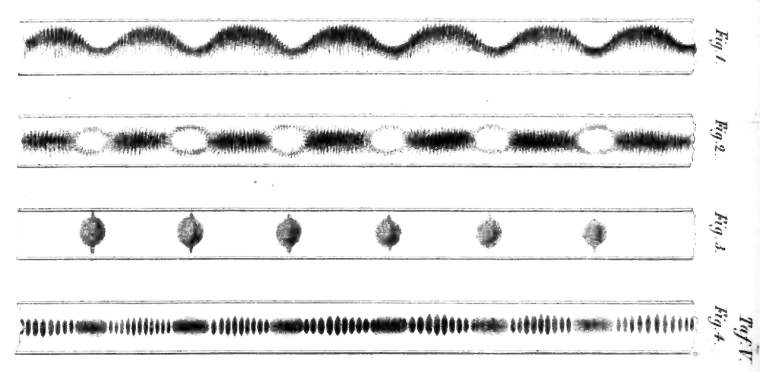
ON THE BENCH: Kundt’s tube in plastic
Parts: a clear plastic tube about 1.2 m (4 ft) long and 40 to 50 mm (1.5 to 2 in) across, such as the clear sleeve sold to protect a fluorescent lamp tube, or a clear poster tube; an end cap or a disc of card taped over one end; a small speaker driver, 50 to 75 mm (2 to 3 in) across, taped over the other end; the amplifier and tone generator; a wine cork and coarse sandpaper. Cost: about $10 for the tube and the small speaker. Time: an hour. Hazards: keep below 85 dBA. Do not substitute lycopodium powder unless you know what you are doing with it: a cloud of it in air is flammable, which is why it was once used for stage flashes. Method: sand the cork over a sheet of paper to make a heaped teaspoon (5 mL) of fine cork dust. Pour it into the tube, lay the tube level, and roll it so that a thin even line of dust lies along the bottom. Seal the ends. The resonances of the tube are at f = n × 343 / 2L with L in metres, or n × 1,125 / 2L with L in feet; for 1.2 m (4 ft) they fall every 143 Hz. Start near 700 Hz and step slowly up and down in 1 Hz steps, with the volume low, watching the dust. What you should see: at a resonance the dust suddenly stirs, then gathers into evenly spaced heaps with fine ribs between them, just as in Kundt’s drawing. At 858 Hz in a 1.2 m (4 ft) tube the heaps sit about 20 cm (7.9 in) apart. If it does not work: raise the volume a little, and roll the tube so the dust sits a little up the side wall, where it falls more easily. If the dust only shivers, you are between resonances. A tube that is not level makes the dust slide; shim it. Better, if you have one: measure the spacing between heaps over as many as you can, divide to get the average, and compute the speed of sound: c = 2 × spacing × f. A spacing of 0.2 m (7.9 in) at 858 Hz gives 343 m/s (1,125 ft/s). This is a check that can fail. If your result comes out at 250 or 450, you have miscounted, or you are not on a resonance.
SLOW DOWN. Check Your Understanding: In the room you found the quiet spots by measuring pressure. In Kundt’s tube the dust collects in heaps. Do the heaps sit where the pressure swings most, or where it swings least? Answer before you read on.
Where the pressure swings most. It feels backwards, so follow it through. The dust is moved by air rushing back and forth, not by pressure. Where the air moves hardest, at the motion antinodes, the dust is thrown about and swept aside. Where the air does not move, at the motion nodes, the dust is left alone and piles up. And Section 1 showed that the motion nodes are exactly where the pressure swings hardest, just as the motion nodes in a room sit at the walls, which are the loudest places. So if you put a tiny microphone inside Kundt’s tube, it would read loudest at every heap. The dust draws the stillness of the air, and the stillness of the air is where the pressure is busiest. In air there are two ways of being still, and you have to say which you mean.
Section 5: Why Small Rooms Boom
At high frequencies a room has thousands of overlapping modes, and the sound is much the same everywhere: the well-stirred room of Chapter 17. At low frequencies a small room has only a few, and the sound changes from place to place by tens of decibels.
The frequency that divides the two behaviours depends on how big and how live the room is. A useful estimate from the acoustician Manfred Schroeder is 2,000 times the square root of the reverberation time divided by the volume in cubic metres. For the 5 by 4 by 2.4 m (16 by 13 by 8 ft) room, 48 cubic metres (1,700 cubic feet) with a reverberation time of half a second, it comes to about 200 Hz. Below about 200 Hz this room is a handful of separate resonators; above it, a well-stirred tub. In a concert hall the same dividing line falls near 20 Hz, below most music, which is one reason a large hall sounds even and a living room does not.
That gives every remedy its logic. The blankets of Chapter 17 do almost nothing to the boom, because thin soft materials absorb little at 50 Hz, where the wavelength is about 7 m (23 ft). What helps is the following, in rough order of cost.
Move the listener. Sitting exactly halfway along a room puts you on the quiet line of every odd-numbered length mode. A seat about a third or two-fifths of the way in avoids the deepest dips.
Move the source. A speaker in a corner drives every mode at full strength. Pulled out from the walls, it drives some modes weakly, and the peaks shrink.
Absorb where the pressure is. At low frequencies the pressure is highest in the corners, where every mode has an antinode. Thick absorbers there, sold as bass traps, work far better than the same material in the middle of a wall.
Use more than one source. Two bass speakers placed so that one sits on a mode’s loud region while the other sits on its opposite-phase loud region can cancel that mode’s pattern, and recording studios and home cinemas use exactly that.
None of these removes the modes. They are the room’s natural frequencies, set by its size and shape as the plate’s are by its own. A room is a three-dimensional instrument with a few dozen low notes that it plays whether you like it or not.
The next chapter goes back to stone: a cathedral, which rings for seconds, and its windows of spokes and rings, drawn centuries before anyone drew those shapes in sand.

Bench Degree
Get the degree without the diploma.
Learn the material, not how to pass the exam.