Bench Degree·CYMATICSchapter

Chapter 17: Rooms
In 1895 Harvard opened a lecture room in which nobody could follow a lecture. The physicist sent to fix it measured the problem with an organ pipe, a chronograph and every cushion borrowed at night from a theatre nearby.
Go into the bathroom, shut the door, and clap once, sharply. Listen to what happens after the clap. There is a hiss of sound that hangs in the room and fades, perhaps for a second, perhaps more. Now go into a bedroom with a carpet, curtains and a bed, and clap again. The clap is almost dry. It stops nearly as soon as your hands do.
Same hands, same clap, two different tails. The tail is the room, not you: sound bouncing from wall to wall, losing a little at every bounce, until there is too little left to hear. How long that takes is the most important single number in the acoustics of a room. It decides whether a lecture can be understood, whether an orchestra sounds rich or thin, and whether a kitchen is pleasant to talk in. This chapter measures it, predicts it with a formula written in 1900, and then changes it with blankets.
Section 1: Every Wall Is a Mirror and a Sponge
When sound reaches a wall, three things happen to it. Some bounces back into the room. Some soaks into the wall and turns into a trace of warmth. A little passes through to the other side. For the sound left in the room, the last two come to the same thing: lost.
The fraction of the arriving sound energy that a surface does not send back is its absorption coefficient, written with the Greek letter alpha, α. A surface that sends everything back has an α of 0. An open window, through which sound leaves and never returns, has an α of 1. Painted plaster, tile and thick glass sit near 0.02 to 0.05: they reflect about 97 percent of what reaches them. A thick carpet on underlay is around 0.3 to 0.6 at speaking pitches, heavy curtains about 0.5, and purpose-made acoustic panels 0.8 or more.
Most materials absorb high pitches better than low ones. Soft, porous stuff, carpet, curtains, clothes, works by making the air inside it rub against fibres, and that works best when the air is moving quickly, which means short wavelengths. A room full of soft furnishings can sound dead at 2,000 Hz and still boom at 100 Hz. Chapter 18 is about the boom.
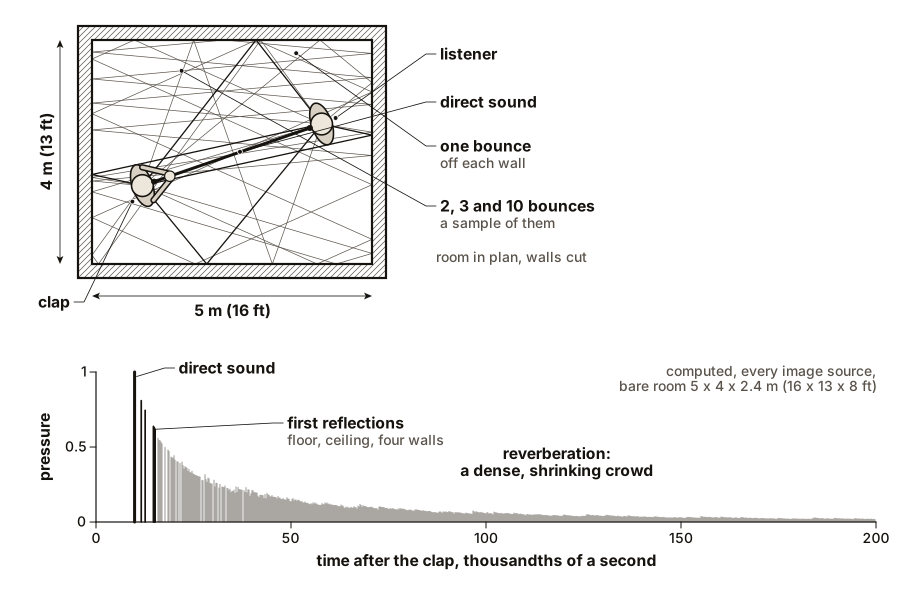
If a single reflection comes back late enough, more than about a twentieth of a second after the direct sound, you hear it as a separate copy: an echo. Sound covers about 17 m (56 ft) in a twentieth of a second, so an echo needs a reflecting surface something like 9 m (28 ft) away or more, a cliff, a gymnasium wall, the back of a church. In an ordinary room the reflections come much faster than that, hundreds of them in the first tenth of a second, piling into a smooth fading wash. That wash is reverberation, and the time it takes to die away is the room’s reverberation time.
Section 2: The Fogg Lecture Room
In 1895 Harvard finished the Fogg Art Museum, and with it a semicircular lecture room modelled on the university’s well-liked Sanders Theatre. The room was a disaster. A lecturer’s words hung in the air and overlapped the next ones, and audiences could not follow. The Corporation of Harvard University handed the problem to Wallace Clement Sabine, a 27-year-old assistant professor of physics with no particular background in sound.
Sabine went first to the books and found nothing usable. In the introduction to his collected papers he lists what passed for advice: build rooms in the proportions 2:3:5, or 1:1:2, or 2:3:4; make every auditorium elliptical; stretch wires, “even now a frequent though useless device.” He noticed that the Fogg room, modelled on Sanders Theatre, was the worst room in Cambridge while Sanders was the best, and that the obvious difference, plaster against wood, explained nothing, because a wood-lined hall in Providence was also bad. Nobody had measured anything.
So he measured. He needed a sound that started and stopped exactly, and a way to time how long it lingered. He used an organ pipe sounding 512 Hz, the same frequency as the chapter 1 plate’s twelve-spoke figure, blown from a wind chest through an electrically operated valve. The valve and a chronograph, a clockwork drum recording marks against time, were wired together, so that the moment the pipe stopped was marked automatically. Sabine sat in the room and pressed a key at the instant he could no longer hear anything. The instrument for the end of the sound was his own ear, and he showed by repeated trials, and by having two colleagues repeat them, that it agreed with itself to a few hundredths of a second.
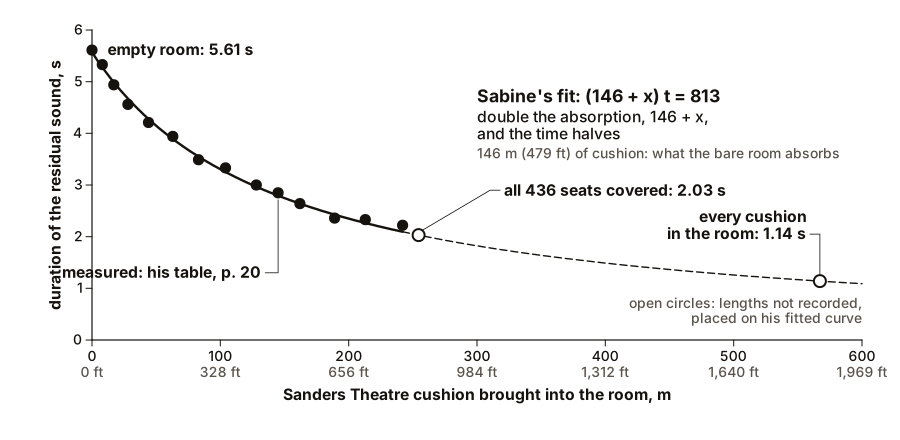
The empty Fogg room held the sound for 5.61 seconds. Then the cushions came in. Sanders Theatre’s seats had long cushions, and Sabine had all of them carried across to the Fogg lobby, working at night when the buildings were quiet and the theatre was not in use. He brought them into the lecture room a few metres at a time, timing the room after each batch. With 8.2 metres (27 ft) of cushion, the sound lasted 5.33 seconds. With 17 metres (56 ft), 4.94. With every one of the 436 seats covered, 2.03 seconds. When every cushion from a theatre seating nearly fifteen hundred people was in the room, on the seats, in the aisles, on the platform and draped up the back wall, the sound lasted 1.14 seconds.
He had turned a pile of cushions into a measuring scale. Any other material could now be brought in and rated by how many metres of cushion it was worth: chenille curtains, three kinds of oriental rug, canvas, felt, and in a smaller room a man and a woman. The Fogg room was finally fixed with felt on particular walls, and Sabine’s verdict on the result was honest: “not excellent, but entirely serviceable.” He published the whole investigation in 1900, in The American Architect and The Engineering Record; it is the first chapter of his Collected Papers on Acoustics (Harvard University Press, 1922, pp. 3 to 68), where the cushion story is told on pages 10 and 11.
Section 3: The Sabine Equation
Plotted, Sabine’s numbers lay on a smooth curve, and he recognised its shape: the time multiplied by the total absorption came out the same every time. Double the absorbing material and the sound died in half the time. Measuring rooms of different sizes, he found that constant grew in proportion to the room’s volume. Put together, that is the equation that carries his name.
T60 = 0.161 × V / A
Here V is the volume of the room in cubic metres and A is its total absorption in square metres. The answer is in seconds. For a room measured in feet, with V in cubic feet and A in square feet:
T60 = 0.049 × V / A
The total absorption A is found by taking every surface in the room, multiplying its area by its absorption coefficient, and adding them up. A wall of 10 square metres (108 square feet) at α 0.03 contributes 0.3 square metres (3.2 square feet) of absorption. People and chairs are counted as so much absorption each. The unit is named after Sabine: one sabin is the absorption of one square metre, or one square foot, of open window. Sabine himself rated everything in open windows, because, as he put it, an open window was “a unit as permanent, universally accessible, and as nearly absolute as possible.”
T60 means the time for the sound to fall by 60 dB, to a millionth of its starting intensity. Sabine’s own measure was the time to inaudibility from a standard starting intensity, which he fixed at a million times the faintest audible sound (Collected Papers, p. 42). A millionfold fall in intensity is a 60 dB fall, so later workers kept his yardstick and replaced his ear with a meter. His own constant, fitted to his rooms, was 0.164 (Collected Papers, pp. 50 to 51). Within a few years W. S. Franklin derived the formula from first principles (Physical Review 16, 1903), and the theoretical constant works out to 0.161 for sound at 343 m/s (1,125 ft/s).
The physics underneath is short. The sound energy stored in a room grows with its volume. The rate at which energy is lost grows with the total absorbing area. Time to empty equals store divided by leak. A big room with hard walls holds a lot and leaks slowly, so it rings for a long time.
Here are Sabine’s own coefficients beside some modern typical values, all near 500 to 1,000 Hz. The modern figures are typical ranges from published tables; a real product can differ with its thickness and how it is mounted.
| Surface | α |
|---|---|
| Plaster on tile (Sabine) | 0.025 |
| Glass (Sabine) | 0.027 |
| Wood panelling (Sabine) | 0.061 |
| Painted brick or concrete | 0.02 |
| Carpet on underlay | 0.3 to 0.6 |
| Heavy curtain, gathered | 0.5 |
| Moving blanket, hung flat (estimate) | 0.3 to 0.6 |
| Open window | 1.0 |
| One seated person (Sabine), sabins each | 0.44 m², 4.7 ft² |
Try the formula on the Fogg room. Sabine gives its volume as 2,740 cubic metres (96,800 cubic feet) and its total absorption, empty, as 75.5 sabins in square metres (813 square-foot sabins). Then 0.161 × 2,740 / 75.5 is 5.8 seconds. He measured 5.6. The formula, put together from cushions and open windows, lands within 4 percent of a room it had never been fitted to in that form.
IN PLAIN ENGLISH: A room is a tub of sound with leaks. The tub’s size is the room’s volume. The leaks are every soft or open surface. Clap, and you fill the tub; the reverberation time is how long it takes to drain. Bigger tub, longer drain. More leaks, shorter drain.
Section 4: Symphony Hall, 1900
Sabine’s timing was lucky. Almost as soon as the Fogg room was done, Boston decided to build a new concert hall to replace its old Music Hall, and the architects, McKim, Mead and White, were asked to model it on the Leipzig Gewandhaus, admired for its sound. Sabine was brought in. The trouble was that Boston wanted far more seats than Leipzig, and the obvious plan, scaling the Gewandhaus up, would scale its volume up faster than its absorbing surfaces.
He did the calculation that became the first chapter of modern architectural acoustics. For the old Boston hall, the Gewandhaus, and the proposed new hall, he listed every surface, its area and its material, added up the absorption of plaster, wood, glass, drapery, audience at 0.44 each and orchestra at 0.48 each, and computed the reverberation time with every seat full (Collected Papers, pp. 60 to 68). The Gewandhaus came out at 2.30 seconds and the old Music Hall at 2.44. The design for the new hall came out at 2.31, with about a thousand more seats than Leipzig. A straight enlargement of the Gewandhaus, he showed, would have given 3.02 seconds, “an amount that would have been very noticeable.”
Boston Symphony Hall opened on 15 October 1900, with a volume of 18,300 cubic metres (646,000 cubic feet). It is still in use, and it is still ranked among the best concert halls in the world. Measured with an audience in it, its reverberation time at mid frequencies is about 1.9 seconds, the figure given in Leo Beranek’s surveys of concert halls and in later measurements reported in Acoustics Today (Spring 2019). The difference from Sabine’s 2.31 is partly the change in the measuring criterion since 1900, partly his estimate of an audience in Edwardian clothes, and partly that his coefficients were for 512 Hz alone. It was the first hall whose sound was calculated before it was built, and the calculation was close enough.
SLOW DOWN. Check Your Understanding: Suppose you build a hall exactly twice the size of another in every direction, with the same materials and the same proportions. Will its reverberation time be the same, double, or something else? Answer before you read on.
Double. Twice the length, width and height gives eight times the volume, because volume is three lengths multiplied. But the surfaces are only four times the area, because area is two lengths multiplied. So V goes up eight times, A goes up four times, and V / A doubles. That is exactly the trap Sabine saw in an enlarged Gewandhaus: the same proportions and materials, scaled up, ring longer. It is also why a cathedral rings for six seconds or more without any special effort by its builders. A large room has more air per square metre of wall, and wall is where sound goes to die. To make a big hall sound like a small one, you add absorption faster than size, and an audience, which scales with floor area, is the absorption a concert hall gets for free.
Section 5: Measuring Your Own Room
Sabine timed rooms with his ear. You can do better with a phone, because the phone records the whole decay and you can measure it at leisure.
ON THE BENCH: Reverberation time from a hand clap
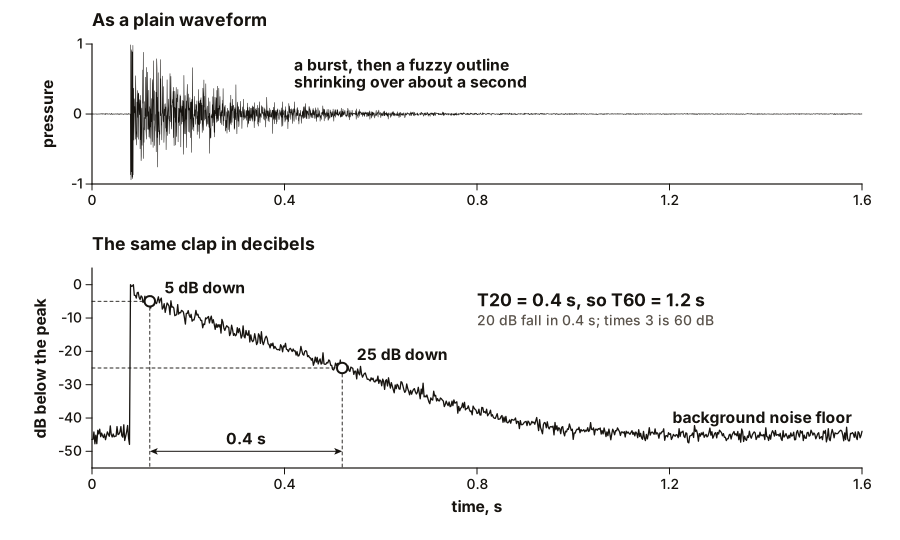
Parts: a phone with a voice recorder that saves uncompressed or high-quality files; a free desktop audio editor that shows the waveform; a tape measure; a balloon, if you have one. Cost: nothing. Time: 30 minutes. Hazards: a balloon popped close to your ear is very loud; pop it at arm’s length. Method: close windows and doors and turn off fans. Put the phone on a chair near the middle of the room and start recording. Stand at least 1 m (3.3 ft) away, clap once, sharply, and keep still and silent for three seconds. Do it three times, then once with a balloon. Copy the file to a computer and open it in the audio editor. Zoom in on one clap. Switch the vertical scale to decibels if the editor allows it. Find the time at which the trace has fallen 5 dB below the peak and the time at which it has fallen 25 dB below. That is a 20 dB fall. Multiply its duration by three to get T60. If the editor only shows a plain waveform, find where the outline of the trace has shrunk to a tenth of its peak height; a tenth in height is 20 dB, so again multiply by three. What you should see: a spike, then a decay that looks roughly like a straight slope on the decibel scale. Typical results: a furnished living room or bedroom 0.3 to 0.6 seconds; an empty room with bare floors 1 to 2 seconds; a tiled bathroom 1 to 2 seconds; a large church 3 to 8 seconds. The three claps should agree to within a tenth of a second or so. If it does not work: if the trace hits the background noise before it has fallen 25 dB, the clap was too weak or the room too noisy; use the balloon. If the decay is curved, steep then slow, the room has two parts, a dead one near you and a live one elsewhere, and a single number describes it poorly. The method of measuring 20 dB and multiplying by three is how the international standard for room measurements, ISO 3382-2, handles rooms where the full 60 dB cannot be seen. Better, if you have one: a free room-acoustics app or analysis plug-in will compute T60 in each octave band. You will see the low bands ring longest, which is what Section 1 said soft furnishings would do.
Section 6: Changing It with Blankets
Now the test that matters: use Sabine’s equation to predict a change before you make it, and then see whether the room agrees.
ON THE BENCH: Predict it, then hang it
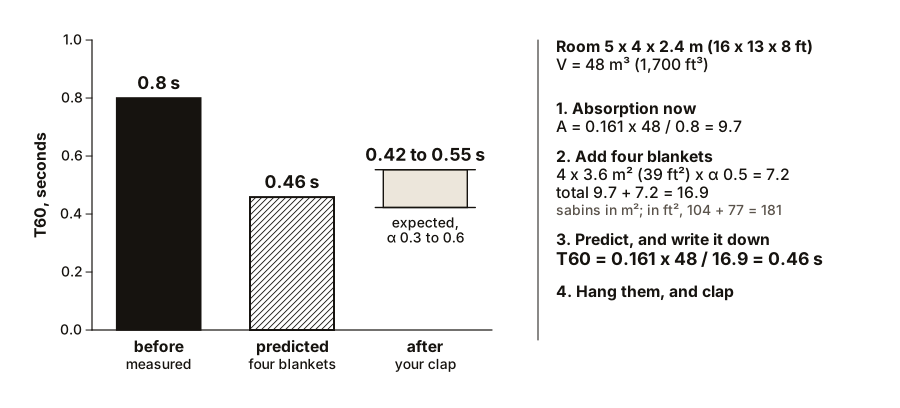
Parts: the clap recording from the last box; a tape measure; four moving blankets or heavy duvets, each about 1.8 by 2.0 m (72 by 80 in); a way to hang them flat against the walls, such as picture hooks, clamps or a curtain rail; a calculator. Cost: nothing if you own blankets; about $10 each for moving blankets. Time: an hour. Hazards: hang them securely; a falling blanket on a hook can bring the hook with it. Method: measure the room and work out its volume. Take your measured T60 and turn the equation round to find the room’s total absorption as it stands: A = 0.161 × V / T60 in metres, or 0.049 × V / T60 in feet. Now predict. Each blanket is 3.6 square metres (39 square feet). At an α of about 0.5, four of them add about 7.2 sabins in square metres (77 square-foot sabins). Add that to A and compute the new T60. Write the prediction down before you hang anything. Then hang the blankets flat on two walls, opposite each other, and measure again with three claps. What you should see: a reverberation time close to your prediction. For a room of 48 cubic metres (1,700 cubic feet) measured at 0.8 seconds, the existing absorption is about 9.7 sabins in square metres (104 square-foot sabins); four blankets bring it to about 17 (181), and the prediction is about 0.46 seconds. You will hear the difference before you measure it: voices go flatter and closer. If it does not work: if the measured drop is much smaller than predicted, the room was already well absorbed, or the blankets are thin; a thin blanket is nearer α 0.2. If the drop is larger than predicted in a nearly bare room, you have met the Sabine equation’s known weakness. It assumes sound wanders evenly everywhere, which is good for live rooms and poor for dead ones. Carl Eyring published a corrected formula for such rooms in 1930 (Journal of the Acoustical Society of America 1, 1930). Better, if you have one: repeat with the blankets bunched in a pile in a corner instead of hung flat. Sabine found in the Fogg room that where an absorber hangs matters little, but how much of its surface is exposed matters a great deal. A pile exposes far less.
There is a link back to Chapter 15. Close to a source the direct sound dominates and falls 6 dB per doubling of distance. Farther away, the reverberant sound, the same everywhere in the room, takes over. The distance where the two are equal is the room’s critical distance, and adding absorption pushes it farther out. That is why the indoor walk in Chapter 15 bent flat, and why, after the blankets, it bends flat a little later.
Sabine’s equation treats the room as a well-stirred tub of sound, the same everywhere. That is a good description at the pitches of speech in most rooms, and it is what made acoustics an engineering subject. It is not the whole truth. At low pitches, in small rooms, the sound is not the same everywhere at all. It stands in fixed patterns between the walls, loud in some places and nearly silent in others, and those patterns are Chladni figures drawn in air. That is the next chapter.

Bench Degree
Get the degree without the diploma.
Learn the material, not how to pass the exam.