Bench Degree·ELECTROMAGNETISMchapter
Chapter 17: What You Now Know
Chapter 1 made five promises and told you to hold the book to them. Here they are, one at a time, with the chapter and the bench work that paid each one.
Faraday gave his Christmas Lectures to an audience of children for nineteen years, in the same theatre where he had discovered most of the material, and the series still runs. His rule, as far as anyone can reconstruct it, was that the demonstration came first and the explanation came second, and that if a thing could not be shown it was not yet understood.
This volume was built the same way. You began by shaking a magnet in a cardboard tube. Everything since has been the explanation.
Now the accounting.
Section 1: The Five Promises, Tested
“Wire a three-phase induction motor and reverse its direction, and explain why swapping two wires is sufficient.”
Paid, with one honest caveat.
Chapter 8’s bench box does it: isolate, swap any two of the three motor leads, restore, and the shaft turns the other way. The explanation is Chapter 7. Three coils reach their peaks in the order A, B, C, and the sequence is what rotates. Swap two leads and the order becomes A, C, B, so the field rotates the other way, and the rotor, which does nothing but chase, chases the other way. There is no forward inside the machine. Direction lives in the supply.
The caveat: most houses have single-phase power, so most readers will have done this through a variable frequency drive making three phases from one, at about $60 to $90 for a small unit. That works and it is the honest route. If you have never opened a motor terminal box, do it beside somebody who has.
“Read a transformer’s nameplate and say what it will and will not do.”
Paid. Chapter 3, Section 6.
The two voltages give the turns ratio directly, without opening anything. The kVA rating is a separate fact entirely, set by the copper cross-section and the core size, and it tells you what the machine can carry continuously without cooking. The frequency is not decoration, because Chapter 5 showed that flux depends on volts divided by frequency, and a 60 Hz transformer run at 50 Hz pushes twenty percent more flux through the same iron.
What it will not do: change frequency, work on direct current, deliver more than its kVA, or step to any ratio other than the one wound into it.
“Compute a motor’s synchronous speed from its nameplate and the frequency of the supply.”
Paid. Chapter 7, Section 4, and you did it on a motor you already owned.
Ns = 120 x f / PA plate reading 1,750 rpm at 60 Hz is a four-pole machine with a synchronous speed of 1,800 rpm and 2.8 percent slip at rated load. A plate reading 3,450 rpm is two-pole. A plate reading 1,140 rpm is six-pole. No nameplate in the world says 1,800 rpm, and you now know exactly why.
“Explain why the grid is alternating current, in terms of hardware rather than personalities.”
Paid, and it took three chapters rather than one.
The short version, in the order the parts arrive. Loss in a wire is
I²R, and I = P/V, so raising the voltage by
ten cuts the loss by a hundred (Chapter 2’s warm extension cord, Chapter
3’s arithmetic). Changing voltage requires a transformer. A transformer
runs on a changing field, so there is no such thing as a
direct-current transformer, which you proved yourself in four
seconds with a 9 V battery. Rotation produces alternating current
naturally, because the geometry of a coil passing a magnet reverses
twice per revolution. And a motor that runs on alternating current with
nothing to wear out exists, which removed the last argument for
delivering DC to a factory floor.
No personalities are required anywhere in that paragraph. Chapter 9 covers what the personalities did, and what they did was decide who got paid, not which physics won.
“Look at any electrical machine and identify which of the two rules it is exploiting, and in which direction.”
Paid, and this is the one that will keep working for the rest of your life.
ON THE BENCH: Classify every machine in the house
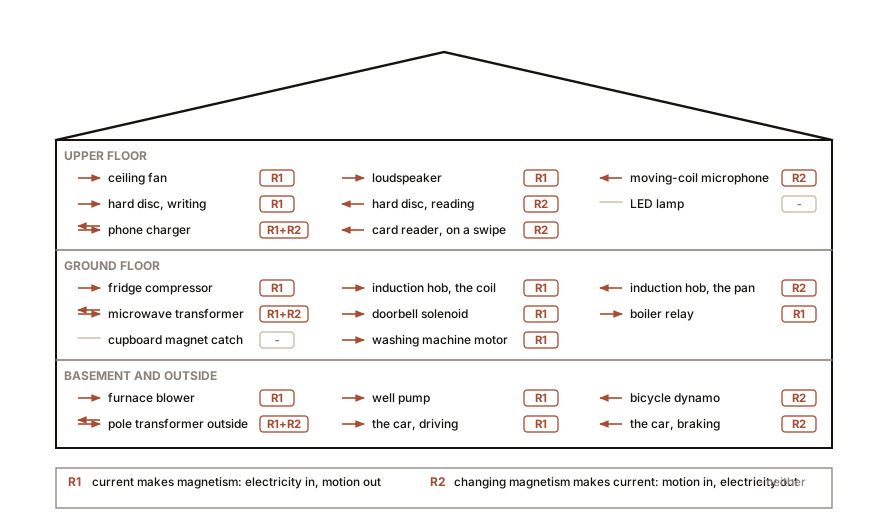
Parts: a notebook and an hour. Cost: nothing. Time: an hour, and it is the most valuable hour in this book. Method: walk the house and for every electrical thing you find, write down which rule it uses and in which direction. Rule One is current making magnetism. Rule Two is changing magnetism making current. What you should find: the fan is Rule One. The loudspeaker is Rule One, driving a cone instead of a shaft. The doorbell solenoid and every relay in the boiler are Rule One. The induction hob is Rule One making a field and then Rule Two dumping eddy currents into your saucepan, which is Chapter 4’s copper pipe used deliberately as a heater. The transformer in the charger is both at once. The dynamo on a bicycle is Rule Two. The microphone in your phone, if it is the moving-coil kind, is Rule Two. The magnetic catch on a cupboard door is neither, being simply a magnet. The three that will make you stop and think: an electric car’s motor, which runs both rules in both directions depending on which pedal you are using. A hard disc drive, which writes with Rule One and reads with Rule Two, at nanometre scale, millions of times a second. And a credit card reader, which is Rule Two operated by your hand at the speed of a swipe, which is why you have to swipe rather than rest. What you should not find: a single machine in the house that is doing something else. That is the claim this volume has been making since page one, and now you can audit it.
Section 2: What You Can Now Do on a Bench
Everything below is something this volume asked you to build or measure, with what it cost.
| What | Chapter | Cost |
|---|---|---|
| Generate electricity by hand | 1 | $15 |
| Map a magnetic field | 1 | under $5 |
| Build an electromagnet and measure turns against strength | 1 | under $5 |
| Distinguish AC from DC on a meter and on a screen | 2 | $16 to $45 |
| Find the voltage drop and heat loss in a real cable | 2 | free |
| Wind a transformer and verify its turns ratio | 3 | about $22 |
| Prove that a transformer will not run on DC | 3 | free |
| Watch Lenz’s law brake a falling magnet | 4 | about $10 |
| Show that induced voltage depends on speed | 4 | free |
| Find a core’s saturation point by hand | 5 | up to $30 |
| Measure standby core loss across a whole house | 5 | $20 to $30 |
| Build a Faraday cage and find where it fails | 5 | free |
| Build two motors, one with a commutator | 6 | about $8 |
| Measure inrush current and back-EMF | 6 | $6 to $25 |
| Rotate a magnetic field with stationary coils | 7 | about $30 |
| Read pole count off a nameplate | 7 | free |
| Dissect an induction motor | 8 | free to $20 |
| Measure slip under load | 8 | $15 to $105 |
| Reverse a three-phase motor | 8 | $75 to $165 |
| Reproduce Great Barrington on a table | 9 | about $42 |
| Weigh Edison’s copper | 9 | free |
| Find a resonance and measure its Q | 10 | $30 to $55 |
| Build a small solid-state Tesla coil | 10 | about $45 |
| Transmit with a barbecue lighter | 11 | under $15 |
| Build a radio with no power supply | 11 | about $20 |
| Measure a wireless charger’s real efficiency | 12 | about $30 |
| Build a resonant coupling pair and detune it | 12 | $40 to $70 |
| Show that dry air insulates better | 13 | under $5 |
| Make the famous photograph yourself | 13 | free |
| Compute a weapon out of existence | 14 | free |
| Compute the atmospheric power resource | 14 | free |
| Measure the world in tesla | 15 | free |
| Feel regeneration in your wrist | 16 | about $15 |
Eleven of those thirty-three cost nothing at all. The whole programme, done once with nothing salvaged and nothing owned in advance, comes to a few hundred dollars spread over the length of a book, and a great deal of it can be done with a magnet, a meter and a length of wire.
ON THE BENCH: The final examination, in one session
Parts: everything you already built. The tube and magnet from Chapter 1, the copper pipe from Chapter 4, the wound transformer from Chapter 3, a multimeter, and any motor with a nameplate. Cost: nothing new. Time: 90 minutes. Hazards: none beyond what each original experiment carried. Method: work through five tasks in order, writing the answer down before checking it. One. Shake the tube and read AC volts. Then predict what the reading will be if you shake twice as fast, and check. You are predicting Faraday’s law with the clock in the denominator. Two. Feed your wound transformer from a battery and predict the output before you connect it. Zero, with a flick at make and break. Say out loud why, and you have explained the grid. Three. Drop a magnet down the copper pipe, then predict whether two magnets stacked will be faster or slower, and check. Slower, because the drag grows as the square of the field and the weight only doubles. Four. Read a nameplate, compute the synchronous speed, and predict the rated speed to within thirty rpm before looking at it. Five. Pick up any powered object in the room and say, in one sentence, which rule and which direction. What you should find: you get all five, and the third one is the only one that needs a moment. If any of them stalls you, the fix is upstream, and the chapter it belongs to is named in the table above.
Section 3: The Ideas Worth Keeping
If everything else goes, keep these six.
One. Changing is the word that does the work. A steady field beside a wire does nothing. This is the difference between a magnet resting in your coil and a magnet shaken in it, and it is the reason the grid alternates and the reason there is no DC transformer.
Two. Loss in a wire goes as the square of the current, and current is power divided by voltage. Almost every decision in electrical distribution, from a pole transformer to an intercontinental link, follows from that one line.
Three. Lenz’s law is the invoice. Electricity out of a generator is paid for in mechanical work, exactly and to the watt, and the drag you feel is the price. Anyone offering you a machine that produces electricity without a corresponding drag is describing something that has never been observed.
Four. A rotating field has no mass. That single property removes the brushes, the commutator, the wear, the sparking, the speed ceiling and the reversing switch, and it is why the machine of 1888 has not been improved on.
Five. Resonance buys you enormous multiplication and charges for it in bandwidth. A high-Q circuit responds hugely to its own frequency and ignores everything else. That trade is the Tesla coil, the radio receiver, and the charging pad on your desk, and its limits are why Wardenclyffe could not work.
Six. Compute the claim. Teleforce died to a calculator in fifteen minutes. The atmospheric energy patent died to a division. The habit of putting a number on an extraordinary claim before deciding how you feel about it is the most transferable thing in this book, and it is worth more than any of the physics.
IN PLAIN ENGLISH: Two rules, one word, and one arithmetic. Current makes magnetism. Changing magnetism makes current. The word is changing. The arithmetic is that heat in a wire grows as the square of the current, so send power as pressure and not as flow. Everything in seventeen chapters is those three sentences with the details filled in.
Section 4: What This Volume Did Not Cover
Named plainly, because a book that hides its edges cannot be trusted at its centre.
Three-phase power systems in depth. You can compute synchronous speed and reverse a motor. You cannot yet size a feeder, calculate fault current, choose protection settings, correct a power factor, or read a one-line diagram of a substation. Star and delta connections appeared here in one sentence and they deserve a chapter. Power factor, which is what industrial customers are actually billed on, was mentioned once.
Power electronics. The inverter in Chapters 8 and 16 was treated as a box that makes any frequency you ask for. How it does that, which is pulse-width modulation, gate drive, dead time, switching loss, snubbing, and the difference between an IGBT and a silicon carbide MOSFET, is an entire discipline and none of it is here.
Antenna theory. Chapter 11 built a receiver and Chapter 12 said an antenna must be an appreciable fraction of a wavelength. Radiation resistance, gain, impedance matching, radiation patterns, and why a quarter-wave vertical over a ground plane behaves as it does were asserted rather than derived.
Semiconductor physics. The germanium diode in the crystal radio was specified by part number and its forward voltage drop, with no account of why a junction rectifies. Everything after the vacuum tube, which is to say everything electronic since 1947, sits outside this volume.
Grid stability and operation. How a continent’s worth of generators stay in step, what inertia is and why replacing spinning machines with inverters changes it, how frequency is held to a fraction of a hertz, how a blackout cascades, and how a grid is restarted from nothing. This is the most consequential gap on the list, and it is the subject people most often want an opinion about.
Magnetic materials in any depth. Chapter 5 gave permeability, saturation and hysteresis as three numbers off a datasheet. Where those numbers come from, and how a rare-earth magnet differs from ferrite at the level of the crystal, is metallurgy and quantum mechanics.
And one thing this volume deliberately declined. It did not attempt to resolve the accounting gap in Chapter 14. It reported what the documents say, said which claims are verified and which are not, and stopped. Naming the measurement that would settle a question is a service. Guessing the answer is not.
SLOW DOWN. Check Your Understanding, one last time: After seventeen chapters, here is a machine that has appeared nowhere in this book. A moving-coil analogue panel meter: a needle on a spring, a coil of fine wire, a permanent magnet, and a scale reading amps. Which rule is it using, and which direction? Answer before reading on.
Rule One, in the motor direction, deliberately prevented from moving very far.
Current through the coil makes a magnetic field, which pushes against the permanent magnet’s field, which turns the coil, which winds up the spring, which pushes back. The needle stops where the electromagnetic torque and the spring torque are equal, and since the spring is linear the deflection is proportional to the current. It is Chapter 6’s motor with a spring bolted to the shaft, and every current measurement made anywhere before the digital meter was made by exactly this machine.
Here is why that is the right question to end on. Nothing in this volume mentioned panel meters, and you were still able to take one apart in your head and place it. That is what a rule is for. The two rules were not a summary of the machines in this book. They were a tool for the machines that were not in it, which is to say all the rest of them, including the ones nobody has built yet.
Section 5: Where to Go Next
Keep the tube, the magnet, the meter and the copper pipe. They cost about forty dollars together and they will settle most arguments.
Then read three primary documents, all free, and none of them long.
US Patent 381,968, the induction motor, filed October 1887. It is short, it is clear, it contains drawings, and you can now read every claim in it and say what the machine does.
US Patent 645,576, the tuned wireless system, filed September 1897. Read it beside the crystal radio you built and find each of the four circuits.
My Inventions, 1919, about ten thousand words. It will tell you how he thought, which no secondary account manages.
And if you can get to it, the Colorado Springs Notes in facsimile: a week of it is enough. Corrections over corrections, dated daily, in the hand of a man who was not performing for anybody.
The generators at Niagara still turn. When the lights come back after an outage, they come back as three-phase alternating current at the frequency argued over in Pittsburgh in 1889, through five transformers, into an induction motor in your basement.
And you can now say, of every one of those, which rule it is using and in which direction. That was the promise. Go and check it on something.
Bench Degree
Get the degree without the diploma.
Learn the material, not how to pass the exam.