Bench Degree·ELECTROMAGNETISMchapter

Chapter 16: The Company That Proved Him Right
The fastest-accelerating production cars ever built run on a motor patented in 1888, fed by a box that does exactly what an industrial pump drive does. Nothing in the drivetrain would have surprised the man whose name is on the badge.
Chapter 8 left an induction motor whose speed follows the frequency of its supply, and a box that can make any frequency you ask for. That is the whole of this chapter, so start by feeling the other half of it: the part where the motor pushes back.
Couple two small DC motors shaft to shaft with a short length of silicone tubing. Spin one with a drill and leave the other’s terminals open. It spins freely. Now short the second motor’s terminals through a 10 ohm resistor.
The drill bogs down. Audibly. You can feel it in your wrist. Put a meter across the resistor and there is real voltage there, and real current, and if you touch the resistor after a minute it is warm.
You have not added friction. You have added a load, and Lenz’s law has sent the bill to your arm, exactly as Chapter 4 said it would. That drag, arranged deliberately and routed back into a battery instead of a resistor, is regenerative braking.
ON THE BENCH: Regeneration you can feel
Parts: two small DC motors of similar size, salvaged or about $12 the pair; a short length of silicone or rubber tubing to couple the shafts; resistors of 100, 47, 22 and 10 ohms, under $2; a multimeter; a cordless drill or a hand crank. Cost: about $15. Time: 45 minutes. Hazards: rotating shafts. Low speed, eye protection, no loose clothing. Method: drive the first motor at a steady speed and load the second through each resistor in turn, from open circuit down to 10 ohms. At each step record the voltage across the resistor and note how hard the drill is working. What you should see: open circuit gives voltage and no drag. As the resistance falls, the current rises, the drag rises, and the voltage across the resistor falls because the machine is being pulled down. Compute the power in the resistor at each step,
P = V²/R, and plot it against resistance. There is a peak, and it is where the resistance roughly matches the machine’s own internal resistance. The number that matters: at the peak you are recovering real watts, and you can feel exactly that many watts leaving your arm. A generator’s drag is not a side effect of generating. It is the same event, described from the mechanical side. Then reverse the roles. Drive the second motor from a battery and let the first spin freely. The same pair of machines works either way round, which is Chapter 1’s Section 8 in your hands.
Section 1: Why the Electric Car Kept Failing
Electric vehicles are older than petrol ones. In 1900 they outnumbered petrol cars on American roads, and Baker, Detroit and Columbia Electric were serious companies. The electric cab was ordinary in New York.
What ended that first era were four problems that stayed unsolved for a century: heavy batteries with low energy density, slow recharge, short range, and a motor that was the brushed DC machine of Chapter 6, with its two carbon blocks wearing away.
The 1990s attempt failed differently. The General Motors EV1, built from 1996 to 1999, used an AC induction motor and was technically credible: about 8 seconds to 60 mph (97 km/h), and 129 to 161 km (80 to 100 miles) on lead-acid, later 257 km (160 miles) on nickel metal hydride. About 1,100 were made, leased only in California, recalled, and crushed. It was a compliance vehicle, built to satisfy a state mandate rather than to be sold.
The Toyota Prius, from 2001, was a hybrid rather than an electric car and it succeeded on its own terms: 51 miles per US gallon (4.6 litres per 100 km), and about 10 seconds to 60 mph (97 km/h). People bought it to demonstrate a commitment, not because driving it was a pleasure.
The common thread is worth naming precisely, because it is the thing that changed. Every specification of every electric car before 2008 was worse than the petrol equivalent, and the customer was asked to accept that as a virtue.
Section 2: The Car That Made the Case
The technical foundation came from a small California company, AC Propulsion, founded by Alan Cocconi, who had worked on the GM prototype that became the EV1 and left to build three-phase induction drivetrains properly.
By 2003 they had a prototype called the tzero: a fibreglass two-seater with a three-phase induction motor and a pack made of standard cylindrical lithium-ion cells, the same 18650 cells then used in laptop computers. It did 0 to 60 mph (0 to 97 km/h) in 3.6 seconds and had a range of about 483 km (300 miles).
That first number is the one that mattered. It was quicker than a Porsche 911, and it ran on laptop batteries.
Martin Eberhard and Marc Tarpenning founded Tesla Motors in July 2003, licensed the drivetrain, and designed a production car around it. Elon Musk invested $6.5 million in 2004, joined as chairman, and later became chief executive.
The bet was simple and it was correct. Lithium instead of lead, a three-phase induction motor instead of a brushed DC one, and a car people would want rather than a car people would approve of.
Section 3: The Inverter, Which Is a Variable Frequency Drive in a Car
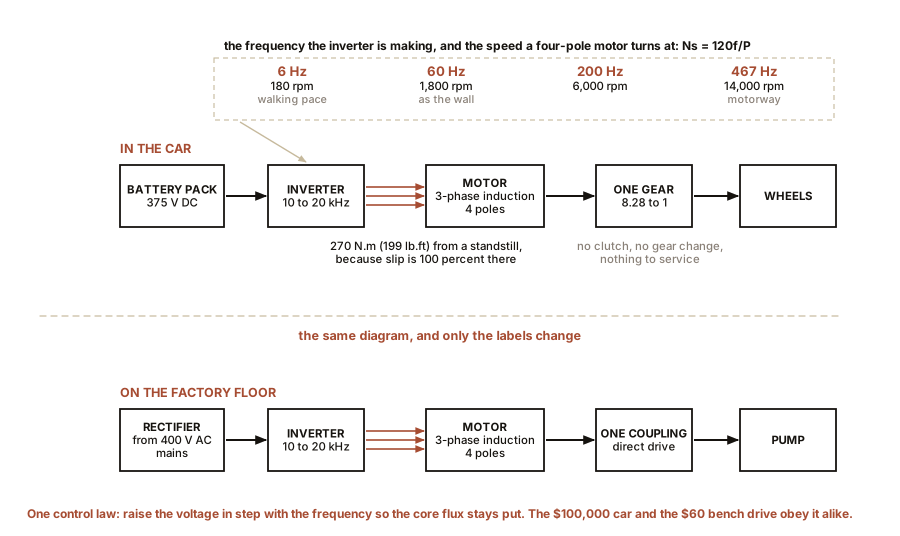
A battery pack produces direct current. The motor requires three-phase alternating current. The box between them is an inverter, and it is the same device Chapter 8 called a variable frequency drive with different packaging.
The Roadster’s pack ran at a nominal 375 V DC. The inverter switches that DC on and off with power transistors at 10 to 20 kHz, in a pattern that averages out to three sine waves 120 degrees apart, at whatever frequency the controller asks for. The motor’s own winding inductance does the smoothing, exactly as it does on a factory pump.
Now use Chapter 7’s formula on a car.
Ns = 120 x f / PThe Roadster’s traction motor is a four-pole machine rated to about 14,000 rpm.
14,000 = 120 x f / 4 so f = 467 HzA wall outlet supplies 60 Hz. The car’s inverter supplies anything from a fraction of a hertz up to about 467 Hz, continuously, adjusting a thousand times a second in response to the pedal. At 6 Hz the motor turns at 180 rpm and holds a car on a hill. At 467 Hz it is at motorway speed.
And it obeys the volts-per-hertz rule from Chapter 8, raising voltage in step with frequency so that the core flux stays constant and the iron does not saturate. The inverter in a $100,000 sports car and the $60 drive on a workshop bench are running the same control law.
Section 4: Full Torque From Zero, Which Is a Property and Not a Slogan
This is the sensation that sold the car, and it is Chapter 8’s torque and slip curve, read at one end.
At zero motor speed the slip is 100 percent. The field is sweeping past the rotor bars at full synchronous speed, the induced current is at its maximum, and the torque is at or near its peak. The induction motor’s best torque is available at a standstill, which is where a vehicle needs it.
Compare a combustion engine. At idle, around 800 rpm, a large petrol engine produces perhaps a tenth of its peak torque, and it must be revved to 3,000 or 4,000 rpm to reach that peak. That is what a gearbox is for: six or eight ratios exist so that the engine can be kept near its useful band whatever the road speed is doing.
The Roadster’s motor produced 270 N·m (199 lb·ft) from a standstill to about 5,000 rpm, then tapered into a constant-power region at speeds the car reached quickly anyway.
So there is no gearbox. A single fixed reduction of 8.28 to 1 connects motor to axle. No clutch, no gear change, no shift shock, no missed shift, nothing to service. The car weighed 1,235 kg (2,723 lb), reached 60 mph (97 km/h) in 3.9 seconds, ran 394 km (245 miles) on a charge, and sold from 2008 at $109,000.
IN PLAIN ENGLISH: A petrol engine has a narrow band of speeds where it is any good, so the transmission’s job is to keep it there. An induction motor is strongest at the bottom and stays useful all the way up, so there is nothing for a transmission to do. The single-speed drivetrain is not a simplification anyone chose. It is what falls out of the torque curve.
Section 5: The Efficiency Chain, and Why It Is Not Close
Chase the energy from its store to the road, in both machines.
ON THE BENCH: Multiply out both drivetrains
Parts: a calculator. Cost: nothing. Time: 10 minutes. Method: multiply the stage efficiencies together for each drivetrain and compare the products. Petrol: thermal efficiency of the engine 25 to 35 percent, transmission losses 3 to 5 percent, drivetrain friction 2 to 3 percent.
0.30 x 0.96 x 0.975is about 0.28, so roughly 20 to 30 percent of the fuel’s energy reaches the wheels. Electric: inverter about 97 percent, induction motor 93 to 95 percent at rated load, single reduction gear about 97 percent.0.97 x 0.94 x 0.97is about 0.88, so roughly 88 to 92 percent of the battery’s energy reaches the wheels. The ratio is three to four. An electric drivetrain delivers three to four times as much of its stored energy to the road, which is why a car hauling a 450 kg (992 lb) battery pack still wins comfortably on energy per mile. Then be honest about what this comparison does not include, because a book that overclaims here loses the reader’s trust everywhere. This is the energy in the store, not the energy that made it. Getting electricity into the pack costs generation and transmission losses, and getting petrol into the tank costs refining and distribution. The drivetrain comparison above is exact and it is not a full accounting of either fuel. Doing that accounting properly is a different book.
Section 6: Regenerative Braking, Which Is the Opening Experiment
Lift off the pedal and the inverter reverses its role. The wheels now turn the motor, the motor generates, and the inverter routes that current back into the pack.
That is your two coupled motors and the 10 ohm resistor, with the resistor replaced by a battery. The braking force you feel is Lenz’s law, and the energy that would have gone into brake pad dust goes into the pack instead.
In stop-and-go city driving, regeneration typically recovers 15 to 25 percent of the energy that a friction brake would have thrown away as heat. On a motorway, where you brake rarely, the recovery is small but the drivetrain efficiency is unchanged.
Which produces the result that confuses everyone who is used to petrol cars: an electric car is more efficient in town than on the motorway. A petrol car is the other way round. The reason is exactly this section: the city cycle is full of braking events, and only one of the two machines can collect them.
The friction brakes remain fitted, for emergency stops and for holding the car still, and on a well-driven electric car the pads can last the life of the vehicle.
Section 7: Permanent Magnets, and Why the Prius Went Another Way
From the Model 3 in 2017, Tesla moved the main traction motor from induction to an interior permanent magnet design, with magnets embedded in the rotor.
The advantage is Chapter 8’s slip, removed. A permanent magnet rotor carries its own flux without any rotor current, so there are no resistive losses in the rotor at all. A good interior permanent magnet motor runs at 95 to 97 percent efficiency across a broad range, against 90 to 94 percent for a comparable induction machine.
The disadvantage is that the magnets never switch off. An unpowered permanent magnet rotor still drags, because its magnets are always trying to align with the stator iron.
The dual-motor solution is elegant and it is worth understanding, because it is a real engineering trade rather than a marketing line. Put the permanent magnet motor on one axle, where peak efficiency matters most, and an induction motor on the other. At a steady motorway cruise, disconnect the induction motor from its electronics entirely and it freewheels with almost no drag, because it has no permanent field to fight. When acceleration is called for, it re-energises in milliseconds.
That is the induction motor doing precisely what it was always best at: producing no torque and no drag until a field is applied, and then producing a great deal of both. It has no magnets and no rotor connections, so it can be switched out of the story and back in at will.
The Prius went a different way for a different problem. Its architecture is a power-split planetary gearset with two permanent-magnet machines and an engine that is always present, tuned to maximise fuel economy from a small battery rather than to deliver electric performance. Given a 1.3 kWh pack, the power-split hybrid is a better answer than a single traction motor. Given an 85 kWh pack, it is not. The architectures are answers to different questions and neither is a mistake.
SLOW DOWN. Check Your Understanding: The Model S Plaid of 2021 reaches 60 mph (97 km/h) in 1.99 seconds, with 1,020 horsepower, for $129,990. A Bugatti Chiron has 1,500 horsepower, costs about $3 million, and takes 2.3 seconds. The Bugatti has half again as much power and is slower. Where does the difference come from? Answer before reading on.
Almost none of it is the motor’s power, and most people guess wrong here. Three things account for it.
Torque at zero speed, which is this chapter’s Section 4. The Bugatti’s engine has to be at several thousand rpm before it makes its power, so the launch depends on the clutch and the tyres surviving a slipping start. The electric car makes peak torque at zero rpm and simply applies it.
No gear changes. In the first two seconds the Bugatti changes gear two or three times, and every change is a gap in the delivered torque. The Plaid has one ratio and no gaps.
Torque distribution, a thousand times a second. The Plaid has three motors, one front and two rear, each independently controlled, so the software allocates torque to each wheel based on measured slip. A mechanical drivetrain cannot do that, because it has one power source and a differential.
The general lesson is the one this whole volume has been building toward. Peak power is the number on the brochure, and it is rarely the number that decides the outcome. What decides it is where in the speed range the torque lives, and how finely it can be controlled, and both of those are properties of the machine’s electromagnetics rather than of its rating plate. Chapter 8 told you that a rotating field has no mass and can be reversed instantly. This is the invoice for that sentence, paid in a driveway.

Bench Degree
Get the degree without the diploma.
Learn the material, not how to pass the exam.