Bench Degree·ELECTROMAGNETISMchapter
Chapter 15: The Man
He designed machines by running them in his head until they broke, and then fixing them there. Westinghouse’s engineers reported that his motors worked the first time they were built, which is not how engineering normally goes.
Open a magnetometer app on your phone. Every phone has the sensor, because the compass needs it, and dozens of free apps expose the reading.
Point it at a doorframe and you will read about 50 microtesla, which is the earth’s own field. Bring a refrigerator magnet close and the number leaps into the thousands and then the app gives up, because the sensor’s range ends.
The unit on that screen is his name. The International Electrotechnical Commission adopted it in 1960. Every MRI machine in every hospital on earth is specified in it, roughly 50,000 machines running at 1.5 or 3 tesla, which is 30,000 to 60,000 times the field you just measured in your hallway.
He died in 1943 with no heirs, about $2,000 in debt, in a hotel room given to him out of charity, in a city that had been running on his inventions for fifty years.
ON THE BENCH: Measure the world in tesla
Parts: a phone; any free magnetometer app. Cost: nothing. Time: 30 minutes. Hazards: none. Method: walk the house and log readings. Open ground away from buildings. Beside a steel doorframe. Next to the refrigerator door. Above a running motor. Beside the consumer unit. Along a wall where mains cable runs. What you should see: about 50 microtesla in open air, which is the planet. Steel structure distorts it noticeably, because steel guides field the way Chapter 5 said it would. Near a running motor or a transformer you will see the reading oscillate at the line frequency, and if the app plots a trace you can count 60 or 50 cycles a second on the screen. Then find the mains cable in a wall by walking the phone along the plaster with a heavy load switched on at the far end. The field around a current-carrying conductor is Chapter 1’s Rule One, and you are now using it as a stud finder. The point of the exercise: the entire subject of this volume is measurable with a device already in your pocket, in a unit named after the man on its cover, and neither of those facts was true within living memory.
Section 1: Total Visualisation
He described his own method in My Inventions, serialised in 1919:
“When I get an idea I start at once building it up in my imagination. I change the construction, make improvements and operate the device in my mind. It is absolutely immaterial to me whether I run my turbine in thought or test it in my shop. I even note if it is out of balance. There is no difference whatever; the results are the same. In this way I am able to rapidly develop and perfect a conception without touching anything.”
That is not a description of inspiration. It is a description of simulation: running a machine mentally for long enough to find bearing wear, thermal gradients and stress concentrations. He claimed he could not work from two-dimensional drawings and needed the complete solid object in his head first.
The corroboration comes from the machines, which is the only corroboration that would count. The AC motor patents filed in 1887 and 1888 are unusually complete, and the machines described in them worked the first time Westinghouse’s engineers built them. Those engineers were experienced professionals with no reason to flatter him, and they said so. The ordinary engineering cycle of build, test, fail, revise is largely absent from the record of the polyphase motor’s development, and the reason is that the debugging had already happened somewhere nobody could see.
The rest of the claims about his mind are harder to check. He spoke eight languages. He had memorised Goethe’s Faust in German and would recite it. He was reported to perform definite integrals mentally. Those come from friends and admirers and cannot be independently verified, and this book leaves them where they are.
ON THE BENCH: Build it in your head first
Parts: the materials for Chapter 6’s paperclip motor, or any small mechanism you have not yet built. Cost: nothing beyond what you already have. Time: an hour of thinking, then an hour of building. Method: before touching anything, sit with the parts list and no drawing. Assemble the machine mentally. Then, and this is the part that does the work, write down three predictions on paper: what will fail first, which dimension is most critical, and what it will do if you get the commutator timing 90 degrees out. Only then build it. What you should find: you will get one prediction right, one half right, and one badly wrong, and the badly wrong one will teach you more than the build itself. The value is not in being right. It is in having committed to a prediction that reality can contradict. Why this belongs in a book of experiments: it is the cheapest laboratory instrument there is and almost nobody uses it. Tesla’s advantage was not that his mental model was magical. It was that he ran it honestly, for weeks, and let it fail before the workshop did.
Section 2: What It Cost
These are documented behaviours, reported by multiple independent witnesses across decades, and they are not amusing eccentricities. They are the shape of a mind organised differently, and they made an ordinary life impossible.
The number three. He would walk round a city block three times before entering a building. He required hotel room numbers divisible by three and would ask for a change. At meals he used exactly eighteen napkins, stacked, and the stack had to be complete before he would begin. These were requirements, not preferences, and social pressure did not move them.
Physical contact. He would not shake hands, which across sixty years of professional life in two centuries’ worth of business culture is a serious disability. He wore gloves at formal occasions and could not tolerate touch.
Food. His diet narrowed steadily. By the 1930s it was warm milk, honey and vegetable broth. He weighed about 50 kg (110 lb) at his death.
Solitude. He never married, was celibate by explicit conviction, and said he believed the choice was connected to his creative capacity. His close friendships were few and intense: the editor Robert Underwood Johnson and his wife Katharine, who were the nearest thing to a family he had in America; George Westinghouse; and Mark Twain, who visited the laboratory repeatedly and was genuinely fond of him.
The pigeons. He fed them in Bryant Park and Madison Square for decades, daily, into extreme old age. One in particular he spoke about, to his biographer John O’Neill, in terms he used for no human being, and O’Neill wrote it down with his approval and without softening. It is easy to make that either comic or pathetic and it is neither. A man who could not shake a hand found something he could love, and he was entirely candid about it in print at the age of eighty.
The clinical vocabulary that might describe this pattern did not exist in his lifetime, and diagnosing the dead from biographies is guesswork. What can be said without diagnosis is that the rituals were consistent, corroborated, and structured his days as firmly as any timetable.
Section 3: The Business Disasters, Which Are Instructive Rather Than Sad
He was not naive about money. He understood contracts and knew what he held. He made several deliberate choices that cost him, and the popular reading of him as a pure scientist exploited by commerce is too simple to be useful.
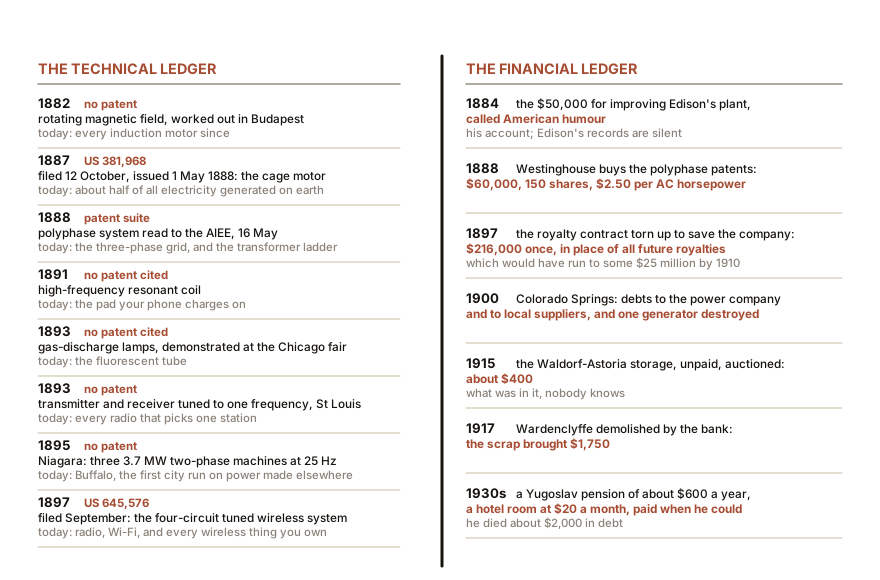
Edison, 1884. He arrived in New York in June with a letter of introduction and was hired within days. His account, given decades later, is that Edison promised $50,000 for a substantial improvement to the DC generating plant, that he delivered it, and that when he asked for payment he was told the offer had been American humour. Edison’s records do not mention the exchange.
The likeliest reading is not villainy on either side. Edison operated on verbal understandings, which worked among American businessmen of his background. Tesla was a European-trained engineer who treated a verbal agreement as a contract. Add severe financial pressure in 1884 and a personality collision, and the outcome needs no villain. He resigned, and dug ditches for $2 a day for several months before finding investors.
Westinghouse, 1897. Chapter 9. He tore up the royalty contract with his eyes open, and said as much to Westinghouse directly. One may argue about the wisdom. Its nature is not in doubt.
Colorado Springs, 1900. He left owing money to the power company and to local suppliers. His financial record from that period is not clean and this book will not tidy it.
The Waldorf-Astoria storage, 1915 to 1917. Years of unpaid storage fees ended with his stored equipment and papers auctioned for about $400. Chapter 14 counts that loss.
Wardenclyffe, 1917. The tower was demolished and sold for scrap by the bank holding the mortgage. He was not present.
The last decade. A Yugoslav government pension of about $600 a year, supplemented by a modest payment from the Westinghouse Company that was a gesture of respect rather than an obligation. The New Yorker Hotel charged him $20 a month, which he paid when he could, against a room worth far more. In 1937, aged eighty-one, he was struck by a taxi crossing the street near the hotel, broke ribs, refused surgery and hospitalisation, and never healed properly. He kept working. The housekeeping staff reported consistently that the desk was always covered in papers.
The pattern across all of it is consistent. He was capable of enormous financial sacrifice for loyalty, generated debts out of genuine ambition rather than carelessness, and never developed either a business instinct or the institutional support that would have supplied one. Compare the man in Chapter 11 who hired Fleming, built a company, and opened a paying transatlantic service. That is the whole difference, and it is not about intelligence.
Section 4: What Runs on His Work This Morning
Not a rhetorical flourish. A walk through the first hour of an ordinary day.
The grid that woke you is three-phase alternating current at 60 or 50 Hz, generated by machines whose polyphase architecture is Chapters 7 and 9, and delivered through the transformer ladder of Chapter 3.
The heating or cooling runs on induction motors: compressor, fans, circulation pumps. Roughly half of all electricity generated on earth is consumed by electric motors, and most of those are squirrel-cage induction machines. That is Chapter 8, patented in 1888.
The fluorescent tube, where you still have one, works by striking an arc through low-pressure mercury vapour to make ultraviolet that a phosphor converts to visible light. He built and demonstrated such lamps in the 1890s, including at the Chicago fair.
The phone on the charging pad is resonant inductive coupling, Chapter 12, at a scale ten thousand times smaller than the one he wanted.
The radio in the car and the Wi-Fi in the house are tuned resonant circuits selecting one frequency out of a crowded band, which is Chapter 11 and US Patent 645,576.
The MRI scanner at the hospital is specified in tesla.
IN PLAIN ENGLISH: He was extremely good at working out what a machine would do, and extremely bad at working out what people would do. The motor arrived finished because he had run it in his head for two years. The money arrived and left because he never ran the contract, the company or the investor through the same simulation. Those are two different kinds of thinking and being world-class at one of them buys you nothing at all in the other.
Section 5: What He Got Wrong
Write this straight, because a serious account owes it.
The ether. He believed in it until he died. Michelson and Morley had shown in 1887, when he was thirty-one, that it could not be detected. He rejected both that result’s interpretation and the theory that replaced it, for fifty-six more years, against evidence arriving from several independent directions.
The dynamic theory of gravity. Claimed in press interviews in the 1930s and 1940s, never published, never described specifically enough to evaluate. It may have been a genuine development he could not finish; it may have been a claim made for attention; it may have been both. What is certain is that no version of it has ever been available for assessment, which makes it a claim rather than an achievement.
The electron. He disputed that it was a discrete particle well into the 1930s, when Thomson’s 1897 measurements, Millikan’s 1909 oil-drop experiment and the whole developing structure of quantum mechanics said otherwise. His wireless theory depended on a continuous, ether-borne picture of electricity that quantum mechanics contradicted, and he did not revise it.
Teleforce. Chapter 14, by the numbers.
These are not peripheral slips. They are sustained rejections of well-confirmed physics. They did not stop him building machines, because his engineering ability was largely independent of his theoretical commitments, and the induction motor does not care what its inventor thought about the ether. They did constrain where his later thinking could go, and they account for the increasingly untethered quality of his final decade’s claims.
SLOW DOWN. Check Your Understanding: He was wrong about the ether, wrong about the electron, wrong about relativity, and wrong about Teleforce by a factor of three hundred. And he designed, in his head, a machine that has been running the industrial world for 135 years and that nobody has meaningfully improved on. How can both of those be true of one person? Answer before reading on.
Because engineering and physics are different activities, and the twentieth century has largely forgotten it.
The rotating magnetic field does not require a theory of what electricity fundamentally is. It requires knowing that a current makes a field, that a changing field makes a current, and that two currents out of step by a quarter cycle produce a field that turns. All three of those are Chapters 1 and 7, and all three can be verified on a bench without any position at all on the ether. He had them exactly right and worked out the consequences further and faster than anyone.
Relativity and the electron are questions about the deep structure of the world, and answering them wrongly costs an engineer nothing until the day he tries to build something that depends on the answer. On the day he did, which was the Teleforce announcement, it cost him everything.
The lesson worth keeping is that a correct mechanism is not evidence of a correct theory, and a wrong theory is not evidence of a broken mechanism. Hold those apart and you can read this whole subject, and most of engineering history, without needing anyone to be either a saint or a fraud.
The last chapter of the story is a company that took his name, bolted his motor to a battery, and drove it into the fastest production cars ever built. Chapters 7 and 8, arriving in a driveway.

Bench Degree
Get the degree without the diploma.
Learn the material, not how to pass the exam.