Bench Degree·ELECTROMAGNETISMchapter
Chapter 14: The Mythology, and What the Documents Say
The test of intellectual honesty is what you do with the sensational claim. The credulous swallow it, the reflexive sceptic waves it away, and the engineer computes it. Every claim in this chapter gets computed.
There is more writing attached to Tesla’s name than he ever produced himself, and most of it is about things he did not build. This chapter takes the four largest claims in turn, does the arithmetic on each, and then goes to the documents about his death, which are a separate matter and a genuinely unresolved one.
The rule throughout is the one this series applies everywhere. A video is a lead and never a citation. A patent is a document you can read. Where a number can be computed, it is computed here so you can check it.
Section 1: Teleforce, and the Factor of Three Hundred
On 10 July 1934, his seventy-eighth birthday, Tesla called a press conference and announced an invention he called Teleforce.
The press called it a death ray. He objected to that repeatedly and on the record, and the objection is technically meaningful: he was describing a particle beam, a stream of charged matter accelerated to high velocity, not a beam of radiation.
His stated specifications, from press interviews of 1934 and 1937 and from a document he prepared in 1935 and sent to several governments, were these. A stream of charged mercury or tungsten particles. Accelerated by 60 million volts of electrostatic potential in a vacuum tube. Projected through open air. Effective range 400 km (250 miles). Cost $2,000,000 per installation.
He filed a Canadian patent application, number 316,944, in 1934. Britain, Yugoslavia and the Soviet Union each received a copy of the 1935 document, and the Soviets paid $25,000 for theirs.
Those are documented facts. Now compute it.
ON THE BENCH: Kill Teleforce with a calculator
Parts: a calculator. Cost: nothing. Time: 15 minutes. Method: the range of a heavy charged particle in air is approximated by
R = 0.5 x (A / Z²) x E^1.75centimetres, where A is the atomic mass number, Z is the charge state, and E is the kinetic energy in MeV. For a singly charged mercury ion accelerated through 60 MV: A is 197, Z is 1, E is 60 MeV. Work it: 60 to the power 1.75 is about 1,295. So R is 0.5 x 197 x 1,295, which is about 127,600 cm, which is 1.3 km (0.8 miles). The claim was 400 km (250 miles). The physics gives 1.3 km (0.8 miles). The gap is a factor of three hundred. Why this is not a rounding argument: the energy loss of charged particles passing through matter is among the best-established quantities in physics. It is the basis of radiation shielding design, of proton beam cancer therapy, and of every particle detector ever built. The approximation above is rough; the full Bethe-Bloch treatment gives an answer in the same order of magnitude. Then do the honest bookkeeping. Where does the 60 million volts stand? That part is hard rather than impossible: the largest electrostatic accelerators reach about 25 MV, and air breaks down above roughly 3 MV per metre, so a 60 MV terminal would be enormous and carefully shaped. The acceleration is an engineering problem. The atmosphere is a physics problem, and it is fatal.
Tesla was partly aware of it. The Teleforce documents describe the particles leaving through a special vacuum terminal into what he called practically vacuum conditions in open air. No mechanism is given, and none exists. A region of open atmosphere cannot be held at near-vacuum over 400 km (250 miles) without an enclosing pipe. That is the unresolved gap in his own technical argument and it is not a small one.
What is directionally valid: a particle beam weapon in vacuum or at very high altitude is physically plausible, and the American Strategic Defense Initiative research of the 1970s and 1980s included exactly that. The concept was ahead of its time. The specifications were never supportable.
There is also a genuine invention buried in the Teleforce papers that almost nobody mentions. US Patent 1,329,559, filed 1915 and issued 1920, describes a valvular conduit: a one-way valve for gases with no moving seals to wear or leak. It is real, it works, and it is the practical kernel around which the impossible superstructure was built. That pattern is characteristic of his late work and it is worth naming: a clever mechanical core carrying a theoretical claim it cannot support.
Section 2: Mechanical Resonance, Which Is Real, and the Story, Which Is Not
Tesla built and sold mechanical oscillators, compact steam-driven devices producing a controllable oscillating force. These were products. He sold them to mining operations for geological survey, using ground vibration to find underground structure, which is what seismic exploration still does.
The earthquake story belongs to 1898 and his laboratory at 46 East Houston Street in New York. His account, given years afterward, has him bolting a small oscillator to an iron pillar, tuning it to the building’s resonance, and shaking the building and its neighbours until the police arrived, at which point he smashed the oscillator with a hammer.
The physics is sound and it is not in dispute. Every structure has natural frequencies set by its geometry, stiffness and mass. Drive it at one of those frequencies and each cycle adds energy, and the amplitude grows until damping or failure limits it. The canonical engineering demonstration is the Tacoma Narrows Bridge, which failed on 7 November 1940 after wind-driven oscillation built up in a torsional mode. Careful analysis, by Billah and Scanlan in 1991, corrected a generation of textbooks that had called it simple resonance when it was aeroelastic flutter, but the underlying phenomenon of resonant accumulation is real either way.
The specific story is not corroborated. New York City building inspection records for 1898 contain no damage reports at or near that address. No contemporary newspaper describes a building shaking itself apart in lower Manhattan, which would have been front-page news. He told the story years later, consistently in the context of promoting the oscillator to investors and journalists.
So: he had a working oscillator, resonance is real, a tuned oscillator on a structural member would produce detectable vibration, and the dramatic version has the character of a sales narrative.
ON THE BENCH: Resonance in a wine glass
Parts: a crystal wine glass; a wet finger; a phone with a free spectrum analyser app. Cost: nothing. Time: 20 minutes. Hazards: a glass under sustained resonance can fail. Do it over a sink. Method: hold the glass by its base, wet a fingertip, and run it slowly round the rim until it sings. Read the frequency off the app. What you should see: 700 to 900 Hz for a red wine glass, 1,000 to 1,500 Hz for a champagne flute. Then add water and read it again: the frequency drops, because you have added mass to the oscillating system, exactly as the swing gets slower with a heavier child on it. What your finger is doing: stick-slip. It grips, releases, grips, releases, hundreds of times a second, and it self-synchronises to the glass’s own frequency. Your hand is not choosing the note. The glass is, and your finger is the energy supply. That is precisely the relationship between Tesla’s oscillator and the building, and it is why so little force is needed.
Section 3: Free Energy, Addressed and Finished
Tesla did not claim free energy, and every machine he built consumed power. The induction motor needs an AC supply. The coil needs a primary supply. Wardenclyffe needed a large generating plant, and he spent years trying to arrange one. The power had to come from somewhere, as it always does.
What he did discuss, especially in the June 1900 Century Magazine article, was large-scale use of environmental energy flows: sunlight, wind, tides, temperature differences in the air and ocean. Those are now called renewable energy. They are real, they are being built, and they are not free in the thermodynamic sense: they are existing flows being tapped, not energy created.
Two things generate the confusion.
The word ether. In the physics of his youth, the luminiferous ether was the proposed medium in which electromagnetic waves travelled. It was the standard vocabulary before relativity, and he used it all his life. Modern free-energy writing reads that usage as referring to a quantum vacuum energy, which requires ignoring the historical context entirely.
Selective quotation. He wrote sweeping sentences in lectures and popular articles, and stripped of their surrounding paragraphs they can be made to mean nearly anything.
Now the worked example, because this series does not settle claims by assertion.
ON THE BENCH: Read US Patent 685,957 and compute what it can deliver
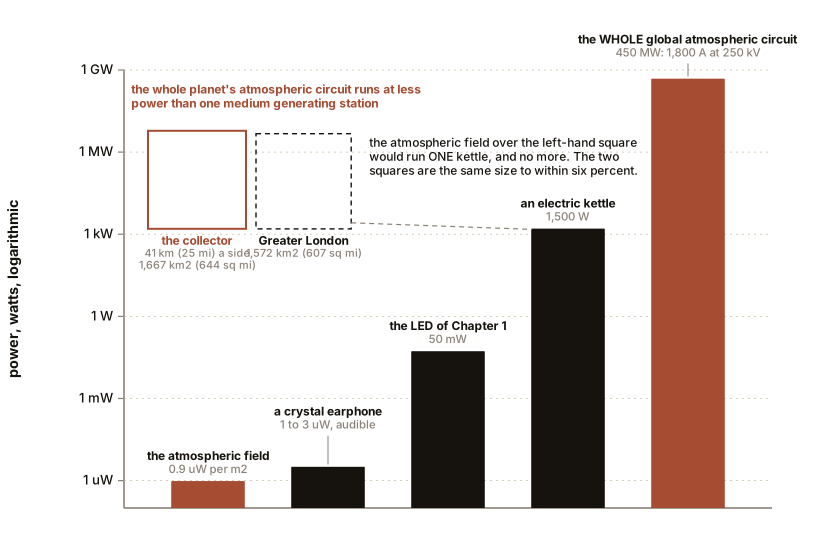
Parts: a web browser. The patent is Apparatus for the Utilization of Radiant Energy, filed 1901, granted 1901, freely readable in full. Cost: nothing. Time: an hour. Method: read the patent. It is short and clear. It describes an elevated insulated plate connected to one side of a capacitor, with the other side grounded, and a switch that discharges the capacitor into a load when it has charged sufficiently. It is real, it is his, and it works. It harvests the earth’s fair-weather atmospheric electric field. Now compute the resource. The global atmospheric electric circuit carries a total current of roughly 1,800 A at a potential of roughly 250 kV, which is about 450 MW for the entire planet. The earth’s surface area is 5.1 x 10 to the fourteenth square metres. Divide. What you should get: about 0.9 microwatts per square metre of ground. Then put that number to work. A collecting plate 3 m (10 ft) on a side intercepts about 8 microwatts, which is a few times what the crystal radio in Chapter 11 delivered to your ear. To run Chapter 1’s 1,500 W kettle you would need a square collector 41 km (25 miles) on a side, ignoring every loss, which is an area larger than Greater London. What this establishes, and what it does not. The patent is genuine, the physics is genuine, and the device charges a capacitor exactly as described. What cannot be true is that it supplies useful household or industrial power, and the reason is not suppression or conspiracy: it is that the entire planet’s atmospheric circuit runs at less power than one medium generating station. You have just checked a famous claim against a public document and an arithmetic you performed yourself, and that is the method this whole series is built on.
IN PLAIN ENGLISH: There is a real difference between tapping an energy flow and creating energy. Sunlight, wind and tides are flows already running past you, and putting a machine in the way of one is ordinary engineering. The atmospheric field is also a real flow, and the patent that taps it is real, and the flow is simply tiny. The whole planet’s atmospheric electricity amounts to less power than one generating station, spread over every square metre of land and sea. A machine that collects it works exactly as described and collects microwatts, and no amount of scaling or secrecy changes the size of the pot it is dipping into.
Section 4: Tesla Against Einstein, Where He Was Simply Wrong
From the 1920s onward he was publicly and persistently hostile to special and general relativity. He believed in the ether, disputed the constancy of the speed of light, and described a dynamic theory of gravity that would supersede Einstein’s. He never published it in any form that could be evaluated.
On this he was wrong, and not provisionally.
Special and general relativity are both required for the satellite navigation in your pocket. Each satellite carries an atomic clock; because it is moving fast relative to the ground and sits higher in the earth’s gravitational field, its clock runs at a different rate, and the system corrects for both continuously. Without the corrections, position errors accumulate at about 11 km (6.8 miles) per day. Every particle accelerator on earth is designed around relativistic behaviour; the Large Hadron Collider runs protons at 0.9999999896 of the speed of light, where the effects are not corrections but the dominant terms.
The right way to read this is not tragedy or secret knowledge. He internalised electromagnetic theory in the 1870s and 1880s when the ether was standard. Michelson and Morley’s failure to detect it came when he was thirty-one; special relativity came when he was forty-nine. He had built an intellectual identity around a physical picture that later evidence contradicted, and he never revised it. That is an ordinary human failure and it happens to very good minds. It is worth stating plainly because his defenders sometimes read the anti-relativity statements as evidence of suppressed insight. They are evidence of a blind spot.
Section 5: What the Documents Say About January 1943
Now a different kind of question, because this one is not settled by arithmetic.
He died in Room 3327 of the New Yorker Hotel on the evening of 7 January 1943, and was found the following evening by a maid, Alice Monaghan, who had come to deliver towels he had asked for. Cause of death: coronary thrombosis. He was eighty-six. The funeral was on 12 January at the Cathedral of Saint John the Divine, about 2,000 people attended, Mayor La Guardia gave a eulogy and the Nobel laureate Robert Millikan gave a scientific address.
Within hours of the death, and before the funeral, agents of the Office of Alien Property Custodian removed his papers and effects from the room, and separately from a storage unit he kept at a Manhattan warehouse.
The legal basis was the Trading with the Enemy Act. Tesla had been a naturalised American citizen since 1891. He had been born in what was then Austria-Hungary, and the office’s theory was that his original nationality rather than his citizenship governed his estate. That theory was contested at the time and was applied anyway. J. Edgar Hoover took personal interest, and the FBI’s file, which is downloadable at vault.fbi.gov, contains material predating 1943, indicating periodic surveillance for years before his death for reasons the declassified portions do not explain.
The FBI needed someone technically competent to assess whether the papers mattered to the war. They used John G. Trump, a professor of electrical engineering at MIT who had built early high-voltage X-ray machines for cancer treatment and held defence clearances. His credentials were real. He was also, by a biographical coincidence irrelevant to the technical question, an uncle of a later American president, and that coincidence has fed a great deal of the mythology.
He examined the material beginning about 26 January 1943, and the review took approximately three days. His report concluded that the papers contained “no discoveries of significance to war efforts or any ideas he had not already published,” and described the late work as the product of a man who had come to equate his ideas with physical reality.
Three observations, each of which cuts in a different direction.
Trump was a high-voltage engineer, not a particle physicist. The most sensitive documents in the pile were the particle beam papers, and whether he was competent to judge them is not established by his record.
Three days is a triage, not a review of decades of accumulated papers. What such a review misses is a question it cannot itself answer.
And his conclusion may simply be correct. Chapter 14’s own arithmetic on Teleforce says the same thing in more detail: the late work was speculative and did not reduce to actionable engineering. Trump’s finding is consistent with the physics.
Section 6: The Accounting Does Not Close, Which Is Not the Same as Suppression
Tesla’s nephew Sava Kosanovic was Yugoslav ambassador to the United States at the time. He pursued recovery of the estate for years, and in 1952 approximately 80 trunks were transferred to Yugoslavia. The Nikola Tesla Museum in Belgrade was established to hold them and has operated since. Its holdings are documented: over 160,000 original documents, over 2,000 books and journals with his annotations, over 1,200 technical exhibits. His ashes were transferred there in 1957. If you want to do original historical work on Tesla, you go to Belgrade.
Between what he possessed on 7 January 1943 and what arrived in Belgrade in 1952 there is a gap, and it has never been closed. It is an accounting problem and the serious researchers who have worked with the primary records say so.
Material was already gone before the seizure. Between 1915 and 1917, unpaid storage fees at the Waldorf-Astoria led to his stored equipment and papers being auctioned for about $400. What was in it, nobody knows.
The seizure inventory is in Record Group 131 at the National Archives. It has been partially declassified and examined. The researchers who have worked most closely with it, Leland Anderson and Marc Seifer, both report that it does not fully account for items known to have been in his possession, and both note redacted sections. Neither has produced a complete accounting.
The FBI file still carries redactions in an 80-year-old file, and the reason is not publicly explained.
What might be missing is most plausibly the developmental work behind the 1935 Teleforce document: calculations, drawings, whatever he did in the eight years afterward. The summary document itself was never uniquely held, because he had posted copies to three governments.
Here is the distinction that matters, and it is the point of the chapter.
SLOW DOWN. Check Your Understanding: “The accounting does not close” and “the papers were suppressed” sound like the same statement. They are not, and the difference is a habit of mind worth acquiring. What is it? Answer before reading on.
An unresolved question is a hole in the record. A suppression claim is a positive assertion about what was in the hole and who put it there. The first requires only that you cannot account for something. The second requires evidence about content and intent, and no such evidence has been produced.
The tell is that a suppression claim makes a prediction and an unresolved question does not. If the papers had been suppressed because they contained working directed-energy physics, then in the eighty years since, somebody somewhere with access to that physics should have built the thing. Nobody has, and Section 1 explains why: the atmosphere stops the beam at 1.3 km (0.8 miles) whoever holds the paperwork.
So both statements are true at once, and they must be held together. The government seized the property of a naturalised citizen on a contested legal theory, within hours of his death, and cannot fully account for what it took. And the physics in the missing pages, whatever the pages say, does not work. A book that admits the first is trusted when it says the second.
There is one more chronological fact and this book offers no interpretation of it. The Supreme Court restored Tesla’s radio priority on 21 June 1943, five and a half months after he died, in the same year that the same government seized his papers. Both are documented. What anyone makes of the juxtaposition is their own business.
Next: the man himself, briefly, because a protagonist earns a portrait and because how he thought turns out to be instructive about how invention happens.
Bench Degree
Get the degree without the diploma.
Learn the material, not how to pass the exam.