Bench Degree·ELECTROMAGNETISMchapter

Chapter 13: Colorado Springs
He worked there for eight months, alone, in a wooden shed on the prairie, and he wrote down what he did every day. Because the notebook survived, this is the one chapter where we can check him against himself.
From May 1899 to January 1900, Nikola Tesla rented a plot east of Colorado Springs, built a wooden laboratory on it, and ran the largest high-voltage experiments anyone had attempted. He kept a daily laboratory notebook. It was published in facsimile in 1978 by Nolit in Belgrade as the Colorado Springs Notes, and it is the single most valuable primary document about him.
Its value is not that everything in it is right. Its value is that it shows what he measured, what he thought he was measuring, and where the gap between those two things opened up. A dated notebook in a man’s own hand, full of corrections over corrections, is worth more than any biography, and it is the reason this chapter can label every claim.
Every claim below is marked verified, plausible, or unverified, and the basis for the label is given.
Section 1: Why That Field, Specifically
The site choice was technical and he wrote down his reasons.
Altitude. Colorado Springs sits at 1,839 m (6,035 ft), where atmospheric pressure is about 82 percent of sea level. Air’s ability to insulate falls with pressure, which is Paschen’s law, published in 1889. So the same apparatus, unchanged, produces longer discharges at altitude than at sea level. For someone studying high-voltage discharge behaviour, that is free experimental range.
Dry air. High-voltage work is defeated by surface leakage across insulators, and surface leakage scales strongly with humidity. A Colorado summer is dry; a New York summer is not.
Space and quiet. He needed room for a large antenna structure and freedom from the electrical noise that even 1899 New York produced.
Free electricity. A local attorney named Leonard Curtis arranged the land, and the El Paso Power Company agreed to supply power at no charge, reportedly against a future demonstration of wireless lighting for the town. That arrangement mattered, because his apparatus drew enough current to be noticed.
ON THE BENCH: Prove that dry air insulates better
Parts: a piezo barbecue lighter or a gas grill igniter, about $3; a ruler; a bathroom with a shower. Cost: under $5. Time: 20 minutes. Hazards: none. A piezo igniter delivers a few thousand volts at negligible current. Method: in a dry room, bend the igniter’s electrodes apart until it just barely stops sparking, and measure that gap with the ruler. Note it. Then run a hot shower until the bathroom is thoroughly steamed, take the same igniter in, and try the same gap. What you should see: in humid air the spark either fails or becomes weak and erratic at a gap that fired reliably in the dry room. The reverse experiment also works: in a very dry room in winter you may find you can open the gap further than the manufacturer intended. What you have measured: the same effect that made Tesla move his laboratory 3,000 km (1,900 miles) west. He was buying gap length with geography, and he wrote it down as a design decision rather than as a preference. Then think about the altitude half. Anyone living above 1,500 m (4,900 ft) can compare the same igniter against a reading taken at sea level, and light aircraft ignition systems are derated for exactly this reason.
Section 2: The Machine, and What Made It Different
Tesla was careful to distinguish his Colorado Springs apparatus from an ordinary Tesla coil, and called it a magnifying transmitter. The difference is one extra resonator.
Chapter 10’s coil has two resonant circuits: a primary with the capacitor and spark gap, and a secondary with its top load. The magnifying transmitter adds a third, an extra coil: a tall thin solenoid, physically separated from the secondary, connected to it at the base, and tuned to the same frequency.
His argument for it was that in a two-circuit machine energy oscillates back and forth between primary and secondary, and some is recaptured by the primary before it can be usefully transmitted. A separate third resonator, he reasoned, lets the energy leave before the recapture cycle comes round. Whether the argument is right in detail occupied coil researchers for decades. The qualitative claim, that an added resonant stage improves transfer, is consistent with modern coupled-resonator analysis, and the practical result is well established: a three-coil machine gives more output voltage for the same input energy. The reason is Chapter 10’s Q: the extra coil is a high-Q resonator whose top voltage rises roughly as Q times the voltage at its base, and it does that independently of how tightly the first two coils are coupled.
The dimensions, from the notebook: the primary coil was about 15.7 m (51.5 ft) in diameter with 15 turns of heavy cable. The secondary was smaller in diameter. Above the building rose a mast about 61 m (200 ft) tall carrying a copper sphere, reached through a retracting section of roof for photography.
From the recorded coil dimensions and capacitance values, the primary resonant frequency was about 150 kHz (verified by calculation from the notebook). At 150 kHz the wavelength is 2,000 m (6,560 ft). Remember that number for Section 4.
He reported output voltages of 10 to 12 million volts and streamers over 12 m (40 ft) long (plausible: consistent with the documented apparatus and with Chapter 10’s energy arithmetic, and not independently measured).
Section 3: The Standing Waves, Split Into Two Claims
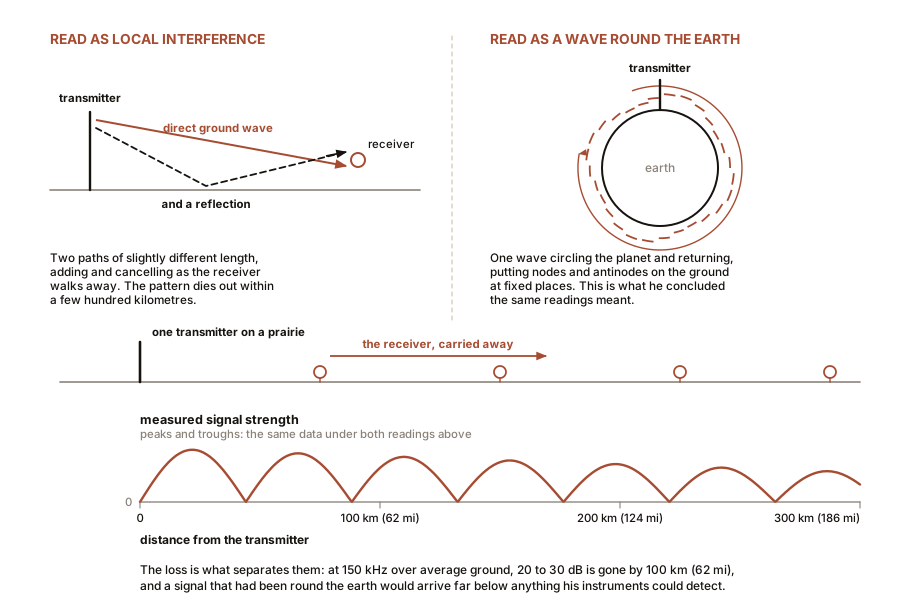
His most significant experimental claim from Colorado Springs was that he had observed standing waves in the earth: that he transmitted from the laboratory, measured at remote points, and found voltage maxima and minima that he read as the nodes and antinodes of a wave which had gone round the planet and come back.
That claim has to be split in two, because one half is almost certainly true and the other is not supported.
The first half: he was detecting real propagation and real interference. (Plausible, indeed likely.) Ground-wave propagation at 100 to 200 kHz is well established. Moving a receiver away from a transmitter at those frequencies through a pattern of direct and reflected waves gives exactly the alternation of strong and weak signal he recorded. There is nothing doubtful about the measurements.
The second half: that the waves were global. (Not supported.) At 150 kHz over average ground, standard propagation curves give roughly 20 to 30 dB of loss at 100 km (62 miles), and at intercontinental range the signal from even a megawatt transmitter falls far below anything his instruments could have detected. The standing waves he found were local.
The honest summary is that his data were good and his interpretation outran them. That is a specific and common failure and it is not a character flaw; it is what happens when one person is the only observer, at one site, with instruments nobody else has.
ON THE BENCH: Watch a coil notice the ground
Parts: the air-core coil and capacitors from Chapter 10; a signal generator and scope, or the combined USB unit at about $50; a copper ground stake or access to a cold water pipe; a length of wire. Cost: nothing new if you did Chapter 10. Time: 30 minutes. Hazards: none. Method: find the coil’s resonant peak exactly as before and record the frequency and the sharpness. Then connect the bottom of the coil to a real earth: a stake driven 300 mm (12 in) into damp soil, or a cold water pipe. Sweep again. What you should see: the resonant frequency shifts, and Q changes, because the earth connection has added capacitance and a lossy path. Wet the soil around the stake and it shifts again. Use a short wire to the stake and then a long one and it shifts again. What that is: the measurement Tesla made hundreds of times. He drove iron pipes into the ground at both Colorado Springs and Wardenclyffe and spent weeks optimising the ground coupling, and this is the shape of what he was watching on his instruments. The earth is a circuit element, and a bad one, and you can measure its effect on a bench in half an hour.
IN PLAIN ENGLISH: He put a very large radio transmitter on a prairie and walked away from it with a detector, and the signal got stronger and weaker as he went, in a regular pattern. That much is exactly what a transmitter on the ground does, and anyone with a receiver can watch it happen today. What he then concluded was that the pattern he was seeing had come back to him from the far side of the planet, and the arithmetic of how much signal survives that journey says it had not. The measurements were good. The interpretation was one enormous step further than the measurements could carry, and he was the only person on site to argue with him about it.
Section 4: Three Claims, Three Different Verdicts
X-rays: verified priority, correctly stated
Wilhelm Röntgen announced X-rays in November 1895 after systematic investigation and took the first Nobel Prize in Physics for it in 1901.
Tesla was producing X-rays in his New York laboratory by late 1895 or early 1896, independently, with different apparatus: evacuated Crookes tubes driven by his high-frequency coils, which is precisely the mechanism, since electrons accelerated across a strong field into a target emit X-rays. He called the images shadowgrams. He sent photographs of them, including one of his own hand, to Röntgen in January 1896 with technical correspondence, before he knew of Röntgen’s announcement. That correspondence is held at the Nikola Tesla Museum in Belgrade. This is verified.
What he did not do is publish first, investigate the phenomenon systematically, or identify what the radiation was. Röntgen’s priority is correctly assigned on the criterion that matters scientifically. But Tesla independently produced X-rays, described the shielding properties of various materials accurately, and raised concern about skin burns from prolonged exposure early. “Tesla did not discover X-rays” is true and incomplete, and this book prefers complete.
Ball lightning: phenomenon real, his claim unverified
He described luminous spheres forming near the apparatus during high-power operation, a few inches across, floating briefly, then vanishing silently or bursting with a report. He believed he had produced them deliberately.
Ball lightning is real. Several hundred credible independent accounts exist, including from pilots, meteorologists and military observers, geographically spread across every continent and consistent in description: a luminous sphere 50 to 500 mm (2 to 20 in) across, lasting one to ten seconds, moving slowly, ending quietly or explosively. The standard collections are Singer’s 1971 monograph and Stenhoff’s of 1999.
Its mechanism is unknown. Nothing has reproduced it reliably in a laboratory. Plasma vortex models fail because atmospheric plasma decays in microseconds without a power source. Microwave cavity models require an implausible internal source. Oxidising-nanoparticle models cannot supply the energy density for the observed lifetime. None is accepted.
So: Tesla’s description matches the accumulated witness record in physical detail, and his claim to have produced it at will is unverified and has never been reproduced. Some researchers note that ball lightning reports cluster where strong radio-frequency fields are present, which would make his laboratory a favourable place, and that observation is speculative.
Two hundred lamps at 40 km (25 miles): unverified
In the Century Magazine article of June 1900 he described lighting 200 incandescent lamps wirelessly at about 40 km (25 miles) from the Colorado Springs apparatus.
There is no independent corroboration. No contemporary newspaper account, no third-party witness, no measurement by anyone else. It appears in his own writing, in a serious publication, with technical context, written after the fact from his notes.
The physics does not forbid it. Ground-wave propagation at 150 kHz reaches 40 km (25 miles) with detectable signal, and a well-tuned resonant receiver of his design would have been close to optimal for extracting power from it. His transmitter was drawing hundreds of kilowatts, as the next section establishes.
Unverified is the correct label and it should not be quietly upgraded in either direction. It is neither a fabrication nor a result.
Section 5: The Generator He Burned Out, Which Is the Best Number in the Chapter
During high-power operation, Tesla drew enough current from the El Paso Power Company to destroy one of its generators. The company billed him for it. The incident appears in the notebook and in the utility’s records. Verified.
This is worth more than any of the dramatic claims, because it is a measurement made by a disinterested party with a financial motive to be accurate. It establishes that the apparatus was consuming power at a scale capable of damaging commercial generating plant, which puts hundreds of kilowatts through the machine and makes the 12 m (40 ft) streamers entirely credible on Chapter 10’s arithmetic.
It also ended the free power arrangement, which is part of why he left in January 1900.
Section 6: The Photographs, and How to Make One Yourself
The most famous photographs in electrical engineering show Tesla sitting calmly in the Colorado Springs laboratory reading a book while enormous discharges arc around him. They are in almost every account of his life.
They are multiple exposures, and this is verified and was never concealed. Dickenson Alley, a commercial photographer, shot them for Century Magazine. The discharge was photographed in one exposure with the room dark and Tesla absent. Tesla was photographed in a separate exposure on the same plate, in the same chair, with the machine off.
That is not a fraud, it is a technique, and it was standard, understood and expected in 1900. You cannot sit in a room while 12 million volt discharges cross it, for the same reason you cannot pose in front of a running flywheel. The discharges in the photographs are real and were photographed directly. Tesla is real and was photographed in that room. They were not both there at once, and the photograph accurately depicts the scale of the discharges while depicting an event that did not happen.
ON THE BENCH: Make the famous photograph
Parts: a phone with a manual or long-exposure camera mode, or a camera with a bulb setting; a dark room; a small light source; a friend; a tripod or a stack of books. Cost: nothing. Time: 30 minutes. Hazards: none. Method: in a dark room, put the camera on the tripod and open the shutter for 20 or 30 seconds. In the first ten seconds, have your friend sit in a chair, lit briefly by a lamp you switch on and off. Then have them leave, and in the remaining time draw shapes in the air with a small torch where they were sitting. What you should see: one photograph containing a solid seated person and luminous streaks passing through the space their body occupies. Nobody was ever there while the light was moving, and nothing in the image is faked. Why do this: because the argument about the Tesla photographs is used in both directions, by people claiming the discharges were painted on and by people claiming he really sat in the lightning. Once you have made one yourself you will never again need anyone’s opinion about how such an image was produced. Learning to read a photograph is a laboratory skill, and it costs nothing to acquire.
Section 7: The Status Table
| Claim | Status | On what basis |
|---|---|---|
| Site chosen for altitude, dry air, space | Verified | His own written reasons; physics of Paschen’s law |
| El Paso Power supplied free electricity | Verified | Utility and notebook records |
| Three coupled resonant circuits | Verified | Colorado Springs Notes |
| Primary resonance about 150 kHz | Verified | Calculated from recorded dimensions and capacitance |
| Discharges over 12 m (40 ft) at 10 to 12 MV | Plausible | Consistent with the apparatus; not independently measured |
| Standing waves observed in propagation | Plausible | Local interference at medium-wave frequencies is expected |
| Those standing waves were global | Not supported | Propagation loss at 150 kHz forbids it |
| X-rays produced before Röntgen’s announcement | Verified | Correspondence, Tesla Museum, Belgrade |
| Systematic X-ray investigation or publication | Not established | Röntgen’s priority stands |
| Ball lightning observed near the apparatus | Unverified | Consistent with credible witness accounts; never reproduced |
| 200 lamps lit at 40 km (25 miles) | Unverified | His own account only; physics does not forbid it |
| Burned out a utility generator | Verified | Notebook and utility records |
| The famous photographs are composites | Verified | Photographer’s method, documented |
SLOW DOWN. Check Your Understanding: Look down that table. Six verified, two plausible, three unverified, one not supported. Now the question: which single item, if a document turned up tomorrow, would change the most in this chapter? Answer before reading on.
Not the 200 lamps. That one is dramatic and it would change little, because Chapter 12 has already shown that a receiver 40 km (25 miles) away could plausibly pull a few watts out of a ground wave from a several-hundred-kilowatt transmitter. Confirming it would move one line from unverified to verified and disturb nothing else.
The item that would change everything is the frequency. If a notebook page showed that the extra coil was genuinely delivering substantial power at a few hertz rather than at 150 kHz, then the global standing wave claim would move from “not supported” to “open”, and Wardenclyffe’s whole design rationale would have to be reassessed rather than dismissed. Everything in Chapter 12’s arithmetic hangs on the mismatch between the frequency he theorised about and the frequency his hardware ran at.
That is what it means to say what would settle a question. Naming the measurement that would move the verdict is more useful than restating the verdict, and it is the difference between a chapter that argues and a chapter that can be checked.
The eight months in Colorado produced one more thing, and it is the reason there was a tower at all. His Century Magazine article of June 1900, “The Problem of Increasing Human Energy,” summarised what he believed the experiments had proved: global wireless power, universal energy access, the end of national conflict over resources. J. P. Morgan read it, saw a commercial opportunity in wireless communication, and wrote to him. Without that article there is no Wardenclyffe. Reading it alongside the notebook is the only way to see, in one man’s own words, the distance between what he measured and what he concluded.

Bench Degree
Get the degree without the diploma.
Learn the material, not how to pass the exam.