Bench Degree·FLUID POWERchapter
Chapter 1: Two Syringes
Ten dollars of plastic, and in ten minutes you will lift a stack of books with two fingers. Then you will swap the fluid inside for air, and watch the same machine become useless.
Buy two plastic syringes with no needles. A small one of 5 mL and a large one of 60 mL. A pharmacy sells them, a pet shop sells them, and a hardware store sells them for injecting glue into cracks. Then buy 300 mm (12 in) of soft aquarium tubing that is a tight push fit over both syringe tips. The lot costs about $10, and if there is a fish tank or a diabetic in the house you may already own all of it.
Push both plungers fully in. Fit the tubing over the small syringe’s tip. Fill the large syringe with tap water, connect it, and work the water back and forth until both barrels and the tube hold water and nothing else. No air. Not one bubble. This is fiddly. It takes several minutes of tilting, tapping and squirting into the sink, and that fiddliness is the first lesson of this book rather than an obstacle to it.
Now you need to stand the large syringe up, nose down, and that takes thirty seconds of thought rather than none. A syringe will not stand on its own, and its nose has the tube on it, so it cannot simply sit on the table. You have to hold the barrel while leaving the nose and the tube hanging free underneath.
The version with no tools at all. Build two stacks of books about 150 mm (6 in) high, and set them side by side with a gap between them of about 20 mm (0.8 in), which is a little narrower than the large syringe’s barrel. Lower the syringe nose-first into the gap. It wedges where the barrel tapers into the nose, sitting square with the nose and the tube hanging in the space below. The two stacks also brace the barrel against tipping, which is the part that matters once there is weight on top.
The version if you have a drill. In a scrap of 18 mm (3/4 in) board, drill a hole a little larger than the nose and smaller than the barrel, so the syringe drops in and seats on its own shoulder. Rest that board across two blocks so the tube has room underneath, and you have a rig you can use for the rest of the volume.
Then spread the load before you stack anything. A hardback balanced directly on a 26 mm (1 in) plunger flange is a wobble waiting to happen. Lay a CD case, a coaster or a square of stiff card on the plunger first, centre the books on that, and keep the stack low and square.
With the rig standing and the load spread, push the small syringe’s plunger with your thumb.
The book goes up.
Add another book. It still goes up. Keep stacking until you have four or five hardbacks, 9 or 10 kg (20 lb) of paper, sitting on a plastic plunger, and it is still going up, and the only thing you are doing is pressing a small plunger with one thumb. Stop adding books when the stack starts to feel unsteady rather than when the plunger stops rising, because the syringe will lift more than the stack will stand.
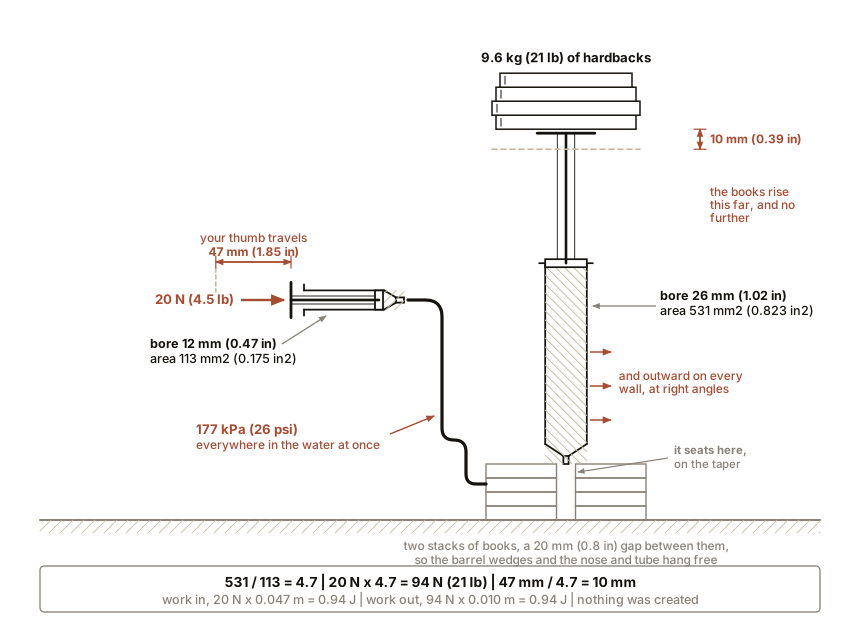
Then notice the second thing, which is stranger than the first. Your thumb travelled a long way and the books barely moved. You pushed the small plunger through most of its barrel, perhaps 47 mm (1.85 in), and the stack of books rose about 10 mm (0.39 in). You got a large force and you paid for it in distance.
That is a hydraulic press. You are holding one. It cost ten dollars and it has no moving part more sophisticated than a rubber seal.
ON THE BENCH: The two-syringe press
Parts: one 5 mL syringe, one 60 mL syringe, both without needles; 300 mm (12 in) of soft aquarium or silicone tubing sized to grip both tips; tap water; four or five hardback books; a ruler; digital kitchen scales. For the stand: either two more stacks of books set 20 mm (0.8 in) apart, or a scrap of board with a hole drilled in it resting on two blocks. To spread the load: a CD case, a coaster or a square of stiff card. Everything else: every part this book asks for is listed once, at the back, in Appendix A: The Bench. Nothing is specified by brand, so it can be ordered from anyone. You do not need any of it yet. Cost: about $10, and often nothing. Time: 30 minutes, most of it getting the air out. Hazards: none worth the name. The pressures here are around 200 kPa (29 psi), about the same as a car tyre, and the failure mode is that the tube pops off and you get wet. Do it over a sink or a towel. Do not fit needles. Method: fill the rig completely with water. Stand the large syringe nose-down in the gap between two book stacks, or in a drilled board on blocks, so the nose and tube hang free below it. Lay a CD case on the plunger, centre the books on that, and press the small plunger. Measure how far your thumb moved and how far the books rose. Do the measurement on the scales too, and do it first if you own scales. Stand the large syringe nose-down on the kitchen scales, press the small plunger, and read the force straight off in kilograms. Then press the small plunger against the scales on its own. The ratio of those two readings is the answer, it takes a minute, and nothing can fall over. The books are the demonstration; the scales are the measurement. What you should see: the books lift under a thumb push you would describe as gentle, and the ratio of the two travel distances comes out somewhere between four and five to one. If it does not work: the tube blew off, so use a smaller tube or a zip tie. Or you still have air in it, in which case the plunger goes in a long way and feels soft before anything happens. Go back and bleed it properly. Or the tube is pinched between the syringe nose and whatever it is standing on, which gives exactly the same soft, dead feel as air. Lift the rig and look. Better, if you have one: stand the large syringe on the kitchen scales instead of using books, press the small plunger, and read the force directly in kilograms. Then press the small plunger against the scales on its own and read that force too. The two numbers are the whole chapter.
Section 1: Measure It, Then Predict It
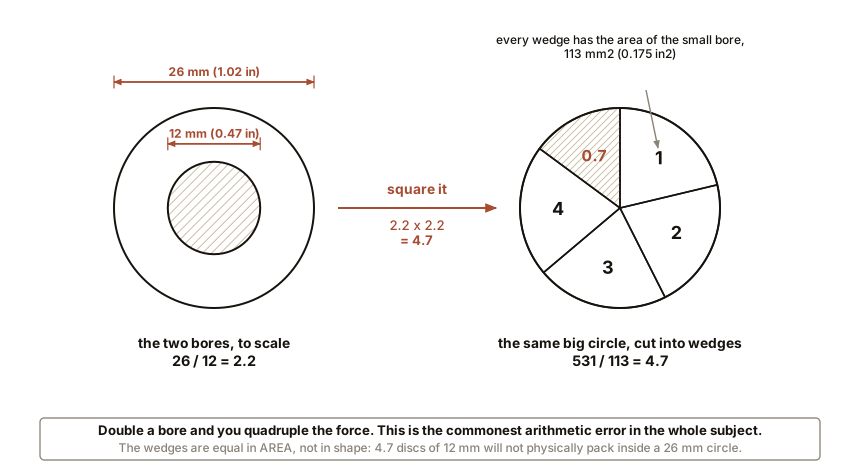
Take the ruler to the two barrels and measure the inside diameter of each. On the common medical sizes you will find something close to 12 mm (0.47 in) on the 5 mL syringe and 26 mm (1.02 in) on the 60 mL one.
Those are diameters. What matters is area, and area goes as the square of the diameter.
area  =  pi / 4  x  diameter squared

small:   0.7854 x 12 x 12  =  113 square millimetres
large:   0.7854 x 26 x 26  =  531 square millimetres
Those are diameters of 12 mm (0.47 in) and 26 mm (1.02 in), and the areas they give are 113 mm² (0.175 in²) and 531 mm² (0.823 in²). Divide the second by the first and you get 4.7.
Now predict, before you test. If the ratio of areas is 4.7, then the force at the large plunger should be 4.7 times the force at the small one. Push the small plunger against the kitchen scales and note the reading. Say it is 2.0 kg (4.4 lb), which is a force of about 20 N. Then the large plunger should push with about 94 N, which the scales will report as 9.6 kg (21 lb).
Do it. It will agree to within the accuracy of your ruler, which is to say within a few percent, and the few percent is mostly seal friction and the fact that you cannot read a syringe barrel’s bore to better than half a millimetre.
You have just verified a law of physics in your kitchen with a ruler and a bathroom-scale substitute. That is worth more than reading the law, and it is the method of this entire series.
Section 2: The One Line the Whole Book Rests On
Here it is, and it is short.
Pressure applied to an enclosed fluid is transmitted undiminished to every part of the fluid and to the walls of the container, and it acts at right angles to those walls.
Blaise Pascal wrote that down in the 1650s, and he is on the cover of this book because of it. Everything in the next twenty chapters is a consequence.
Follow what it means in your rig. You pressed 20 N, which is 4.5 lb, onto 113 mm² (0.175 in²) of water. The pressure you created is force divided by area:
P = F / A = 20 N / 113 mm2 = 0.177 N per square millimetre = 177 kPaThat is 177 kPa, or 1.77 bar, or 26 psi. And by Pascal’s statement, that same 177 kPa (26 psi) exists everywhere in the water: in the small barrel, in the tube, in the bend of the tube, and pressing outward on every square millimetre of the large barrel.
The large plunger, 26 mm (1.02 in) across, has 531 mm² (0.823 in²) of face for that pressure to push on. So the force on it is pressure times area:
F = P x A = 0.177 N per square millimetre x 531 mm2 = 94 NNinety-four newtons, which is 21 lb, or 9.6 kg, and which is your stack of books. Two arithmetic steps, one law, and the answer matches the scales.
IN PLAIN ENGLISH: Squeezing a trapped liquid raises its pressure, and the pressure goes everywhere equally, like the loudness of a shout filling a room. Pressure is force spread over area. So if you create the pressure on a small area and collect it on a big area, you get out more force than you put in, in exact proportion to the two areas. A big piston is simply a place where the same pressure has more surface to push on.
Section 3: What You Paid For It
You did not get something for nothing, and the rig tells you the price if you watch the distances.
The water is incompressible, which means the volume that left the small barrel is the volume that arrived in the large one. Push the small plunger 47 mm (1.85 in) and you have shifted:
47 mm x 113 mm2 = 5,300 cubic millimetres = 5.3 mLThat 5.3 mL has to go somewhere, and it goes into the large barrel, where 531 mm² of area, the face of a piston 26 mm (1.02 in) across, swallows it in:
5,300 / 531 = 10 mm of travelTen millimetres, which is 0.39 in. The distance ratio is 47 to 10, which is 4.7, which is exactly the force ratio upside down.
Multiply force by distance and you get work, in joules. At the small end: 20 N through 0.047 m is 0.94 J. At the large end: 94 N through 0.010 m is 0.94 J. The same number. Nothing was created. You traded stroke for force at a fixed exchange rate, and the rate is the ratio of the two areas.
This is a lever. Not like a lever, not analogous to a lever. It is a lever whose fulcrum is a law about pressure instead of a lump of steel, and whose two arms can be in different rooms.
Section 4: Now Empty It and Do the Whole Thing Again With Air
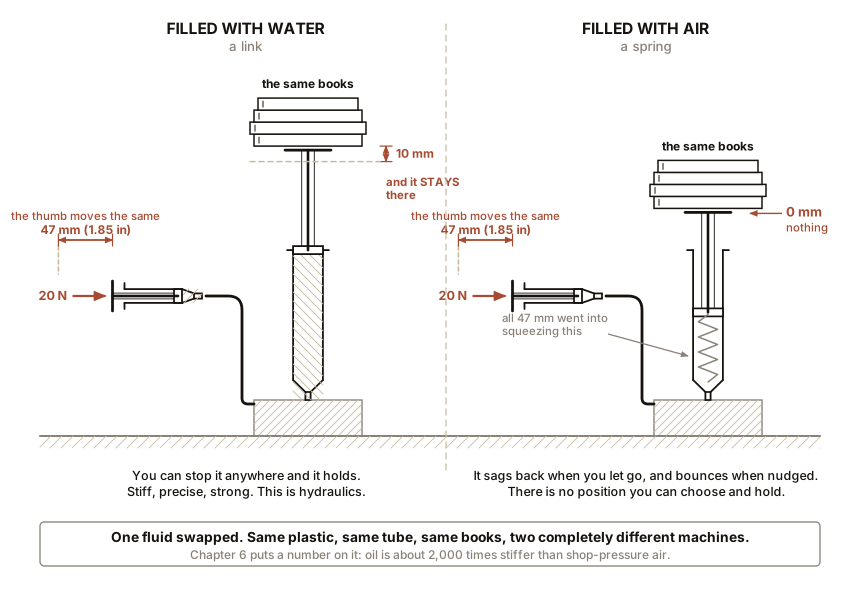
Squirt the water out. Shake both syringes dry. Reconnect them, with both plungers part way out so there is air in the system, and set the rig up exactly as before: large syringe upright, books on the plunger, thumb on the small plunger.
Push.
Almost nothing happens.
The small plunger sinks in. It keeps sinking. It feels like pressing a spring, and it gets harder as it goes, and the books do not move. Push harder and eventually they shift a little. Let go and they sag straight back down. Nudge the stack and it bounces.
Try to make it stop halfway. You cannot. There is no position you can choose and hold; the whole thing settles wherever the load and the springiness happen to balance, and that point moves the instant the load changes.
One fluid swapped. The same plastic, the same tube, the same books. A completely different machine.
Water is a link. Air is a spring. That single sentence is the spine of this volume, and everything the two halves of this subject disagree about is downstream of it. Hydraulic machines are stiff, precise, and enormously strong. Pneumatic machines are fast, springy, forgiving, and safe to stand next to. Neither is better. They are answers to different questions, and by Chapter 7 you will be able to say which question a given machine was answering.
ON THE BENCH: One syringe, one thumb, two fluids
Parts: one syringe, either size. Nothing else. Cost: nothing. Time: two minutes. Hazards: none. Method: fill the syringe with water, block the tip hard with a thumb, and lean on the plunger with real force. Note how far it moves. Then empty it, fill it with air, block the tip again, and lean on it with the same force. What you should see: with water, the plunger does not move. Not a little; not at all, beyond a fraction of a millimetre you cannot see. With air, it goes down to roughly a third of its length without much effort. Write both numbers down. That ratio is a material property called bulk modulus, and it is roughly two thousand to one between oil and shop-pressure air. Chapter 7 is entirely about it. Better, if you have one: put a bathroom scale under your hand so you know what force you applied. Then you can compute the stiffness of each fluid in newtons per millimetre and compare them honestly.
Section 5: The Vocabulary, Introduced Once
Five words, and they are used in exactly this way for the rest of the book.
Pressure is force divided by the area it is spread over. Measured in kilopascals, bar, or pounds per square inch. It is what a gauge reads.
Flow is volume moved per unit of time. Litres per minute, or gallons per minute. It is what a pump makes.
Force is what an actuator delivers, in newtons or pounds. It comes from pressure acting on an area.
Speed is how fast an actuator travels. It comes from flow arriving into an area.
An actuator is the part that does the job: a cylinder that pushes, or a motor that turns.
Two pairs, and keeping them apart is the whole of Chapter 6. Pressure and area give you force. Flow and area give you speed. Confusing those two sentences is the single most common error in this field, and people who have worked in it for thirty years still make it.
SLOW DOWN. Check Your Understanding: Your rig gave you 4.7 times the force. Suppose you are not satisfied and want 50 times. You could machine a bigger large syringe, but there is a cheaper route: connect the output of one two-syringe rig to the input of a second one. Does that give you 4.7 times 4.7, or 4.7 plus 4.7, or neither? Answer before reading on.
Neither, and the reason is the useful part. You cannot cascade them, because the second rig’s small plunger has to be driven, and the only thing available to drive it is the first rig’s large plunger, which has already spent its stroke. The first stage moved 10 mm (0.39 in). The second stage would multiply that by 4.7 again, giving a 2 mm (0.08 in) output, and then a third stage would give 0.5 mm, and very soon your machine multiplies force beautifully and moves a distance you cannot see. Stroke is the currency, and cascading spends it faster than it buys force. This is why real hydraulic machines do not cascade areas. They do something better: they replace the stroke with a pump that keeps sending more fluid. A pump is what turns a one-shot lever into a machine that can push a long way and keep pushing, and Chapter 10 is about pumps for exactly this reason.
Section 6: Where This Book Is Going
Somewhere near you there is a machine with hoses on it. An excavator on a building site, a scissor lift in a warehouse, a bin lorry, a car on a garage ramp, an assembly line squeezing rivets with air.
By the last page of this book you will be able to walk up to any of them and do all of the following.
- Find the circuit diagram, which is usually on the inside of an access panel, and read it, because the symbols are pictures of what the parts do and Chapter 14 takes them apart.
- Say what force each cylinder makes, from its bore and the system pressure, and what speed it makes, from the pump’s flow.
- Say which number the pump sets and which number the load sets, and why the pressure gauge reads low when nothing is happening.
- Say why the designer chose oil or air, in terms of the difference you just felt in your thumb.
- Point at where the heat is going, because in a hydraulic system there is always heat and it always has an address.
- Point at the one component that could kill you, and say why. There are two of them in this subject, and Chapter 22 is blunt about both.
And there is a specific promise, because this volume’s tagline is a claim and claims should be paid for. You are going to work out, with a tape measure and arithmetic, how your own foot stops your own car. Your car weighs perhaps 1,800 kg (3,970 lb). Your foot presses the pedal with maybe 220 N (50 lb), which is less than your own body weight. Chapter 18 chains together a lever, a diaphragm, a small bore and a large one, and arrives at a number, and the number will be roughly 80 to 1 at each front wheel and a total braking force at the road of about 14,000 N, or 3,150 lb, on a car of 1,814 kg (4,000 lb). That is enough to stop two tons at eight tenths of gravity, which is as hard as the tyres will allow.
One foot. Two tons. And you will have measured the four numbers that make it work.
Keep the syringes. They come back in Chapter 2, where you will deliberately put one bubble into them, and in Chapter 14, where you will draw them as a proper circuit diagram.

Bench Degree
Get the degree without the diploma.
Learn the material, not how to pass the exam.