Bench Degree·FLUID POWERchapter

Chapter 2: Pascal to Bramah, and the 142 Years In Between
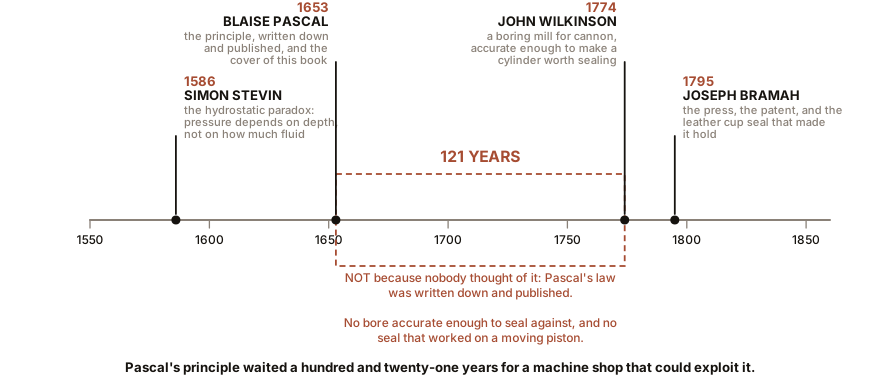
The law was written down in the 1650s and the machine did not exist until 1795. Nobody was being slow. They could not make anything that would hold the pressure in.
Pascal’s statement is one sentence long and requires no equipment to understand. A bright fourteen-year-old can follow it in a minute. From it, the hydraulic press follows immediately: small piston, big piston, connect them, and you have a force multiplier limited only by how much pressure you dare put in the fluid.
So the obvious question, and the one this chapter exists to answer, is why the machine took 142 years to appear.
Not because nobody thought of it. Pascal himself described it. In the treatise usually dated to 1653, Traité de l’équilibre des liqueurs, he explicitly notes that a vessel full of water with two openings, one a hundred times the area of the other, lets one man push as hard as a hundred, and he says in as many words that this is a new kind of machine for multiplying force. The idea and its application were published together, and then nothing happened for a century and a half.
The reason is not conceptual. It is that everybody who tried it got wet.
Section 1: What Pascal Actually Established
Pascal’s contribution was not the observation that water presses on things. It was the demonstration that pressure in a fluid at rest depends only on depth and not at all on the shape of the vessel, and that pressure applied at one point appears undiminished everywhere.
The second half of that is genuinely counterintuitive, and there is a classic demonstration of it called the hydrostatic paradox. Take two vessels holding the same depth of water, one a narrow tube and one a wide barrel. The pressure at the bottom is identical. The barrel contains a hundred times the water and pushes on its base with a hundred times the total force, because the base is a hundred times the area, but the pressure, the force per unit of area, is the same number.
Simon Stevin in Bruges had worked out the essentials of this before 1600, and it is sometimes called Stevin’s law for that reason. Pascal’s own account is the one that got read, and the one that connected it to a machine.
There is a famous story attached, and it should be told with a caveat. Pascal is said to have burst a strong barrel by fitting a long thin vertical tube to its lid and pouring in a few cups of water, the tall column raising the pressure inside far beyond what the barrel could stand. It is a perfect demonstration and it appears in a great many books. The primary evidence that Pascal performed it is thin. Treat it as an illustration rather than as history, and note that you can do the equivalent yourself with a garden hose and a plastic bottle, which is Chapter 5’s business.
ON THE BENCH: The shape of the vessel does not matter
Parts: two plastic drinks bottles of very different diameters, a nail, and a sink. Cost: nothing. Time: 10 minutes. Hazards: none. You will get the counter wet. Method: punch an identical small hole low in the side of each bottle, tape over the holes, and fill both to the same height with water. A 500 mL bottle and a 5 L water carrier are ideal because their diameters are so different. Untape both holes at once. What you should see: the two jets shoot out the same distance, because the pressure at the hole is set by the depth of water above it and nothing else. The big bottle holds ten times the water and does not push any harder. As the levels fall, both jets shorten together as long as the levels stay equal. What it tells you: pressure is not about how much fluid you have. It is about force per unit of area, and that is why a thumb on a small syringe can hold up a stack of books.
Section 2: The Real Obstacle Was a Seal
Here is the problem in one sentence. A high pressure inside a container is a force trying to push its way out through every joint, and the harder you push the more determined it gets.
Consider a piston sliding in a cylinder. The fit cannot be perfect, because if it were perfect it could not slide. So there is a gap, and the gap runs all the way around the piston, and the fluid inside is at pressure and the fluid outside is not. Fluid squirts through the gap. The tighter you make the fit, the more the piston binds; the looser you make it, the faster it leaks. A press that leaks does not merely waste fluid. It cannot hold pressure at all, because the leak grows with the pressure, so the machine finds its own ceiling somewhere embarrassingly low and stays there.
In 1650 there was no way out of this. The available sealing materials were hemp packing, tallow, and leather cut flat like a washer. A flat leather washer is squeezed between two faces and works reasonably well on a static joint at low pressure. Against a sliding piston at high pressure it is hopeless, because it must be clamped to seal and clamped means it cannot slide.
There was also no way to make a straight round hole. A cylinder bore in the seventeenth century was cast, then reamed by hand, and it was neither round nor parallel nor smooth. The first machine capable of boring a large cylinder accurately was John Wilkinson’s cannon-boring mill of 1774, and Watt’s steam engine waited on it for precisely the same reason.
So the hydraulic press needed two things that did not exist: a bore accurate enough to seal against, and a seal that would work on a moving piston without being clamped.
Section 3: Bramah, and the Idea That Fixed It
Joseph Bramah was a Yorkshire cabinetmaker who became one of the most inventive engineers of his century and is almost unknown today. Three things came out of his London workshop.
The practical flush toilet, patented in 1778, with a hinged flap valve at the bottom of the pan that held water and sealed against smell. Bramah’s design is the ancestor of the fitting in your bathroom and it made him his first money.
The Bramah lock, patented in 1784, a cylindrical lock with sliding wafers of a design so good that he displayed one in his shop window with a reward of 200 guineas to anyone who could pick it. It stood unpicked for 67 years. In 1851, at the Great Exhibition, the American locksmith Alfred Hobbs opened it after roughly fifty hours of work spread over sixteen days. Bramah’s firm paid.
And the hydraulic press, patented in 1795, which is the subject of this book.
The press itself was exactly the machine Pascal described: a small pump piston worked by a hand lever, a non-return valve, and a large ram. Bramah’s contribution was not the arrangement. It was making it hold.
The enabling invention was a leather cup seal, and the man usually credited with it is Henry Maudslay, who was Bramah’s foreman and later became the most important machine-tool builder of the age. Instead of a flat leather washer clamped between faces, the cup seal is a ring of leather formed into a U-shaped section, like the brim of a hat, fitted around the piston with the open side facing the pressure.
And now the pressure does the sealing for you. Fluid pushes into the U and forces its two lips outward, one against the piston and one against the bore. Raise the pressure and the seal presses harder. The thing that was destroying every previous attempt has been recruited to do the job. That is one of the most elegant ideas in mechanical engineering, it is the reason this chapter exists, and every hydraulic seal made since, in leather, rubber, polyurethane or PTFE, is a refinement of it.
A note on the attribution. The credit to Maudslay comes mainly from Samuel Smiles’s Industrial Biography of 1863, written some sixty years after the event and drawing on recollection. Bramah’s patent is the primary document and it is the patent that survives. The cup seal is certainly Bramah’s workshop; whether the specific idea was Maudslay’s hand is a secondary-source claim, and a book that is careful about this sort of thing should say so.
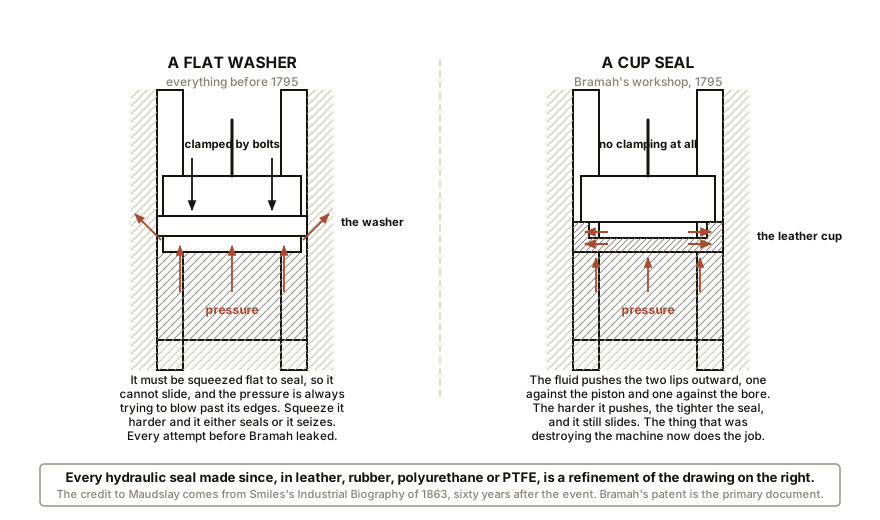
IN PLAIN ENGLISH: An old-fashioned seal is a gasket squeezed flat by bolts, and the pressure inside is always trying to blow past it. A cup seal is shaped like a shallow cup facing into the pressure, so the fluid pushes the cup’s rim outward against the wall. The harder the fluid pushes, the tighter the seal gets. The history of fluid power is largely the history of that trick, and everything before it leaked.
Section 4: One Bubble, Measured
Now the experiment that pays for the rest of the volume, because it is the same experiment you will do again in Chapter 18 with your car’s brakes.
Take the two-syringe rig from Chapter 1. Bleed it perfectly, load the books, and note carefully how far the small plunger travels before the books begin to rise. On a well-bled rig the answer is essentially zero. The plunger takes up a fraction of a millimetre of seal squash and then the load moves.
Water’s bulk modulus is about 2.2 GPa. The pressure in the rig is around 177 kPa (26 psi). So the water in the system compresses by:
change in volume / volume  =  pressure / bulk modulus
                           =  0.000177 GPa / 2.2 GPa
                           =  0.00008,  which is 0.008 percent
Across the 5 mL in the rig that is 0.0004 mL, which spread over the small piston’s area is a plunger movement of 0.004 mm, four thousandths of a millimetre, or 0.00016 in. You cannot see it and no ruler in your house can find it. Water is a solid rod that happens to bend round corners.
Now let one bubble in. Deliberately: draw 1 mL of air into the small syringe before connecting, so the system holds 1 mL of air along with the water.
Air’s stiffness at these pressures is not a material constant at all. It is simply the absolute pressure. Compress 1 mL of air from atmospheric, 101 kPa (14.7 psi) absolute, to the rig’s working pressure, 278 kPa (40.3 psi) absolute, and its volume falls to:
1 mL x 101 / 278 = 0.36 mLThe bubble shrank by 0.64 mL. That 0.64 mL had to come out of the small syringe, so the plunger moves an extra:
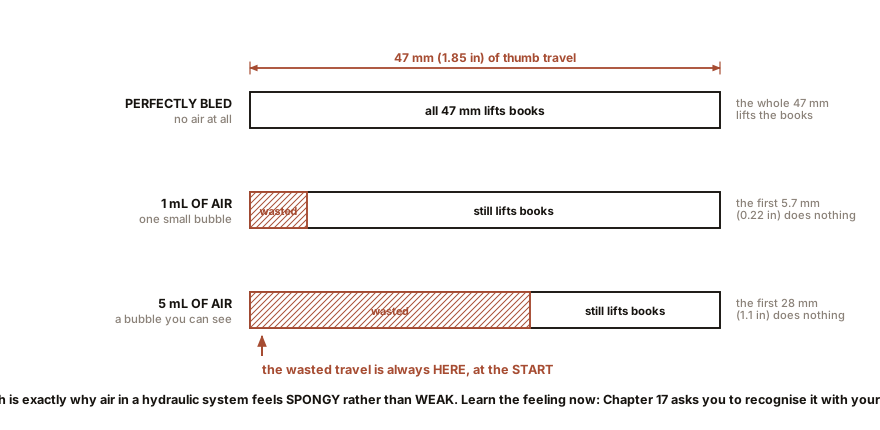
640 cubic millimetres / 113 mm2 = 5.7 mmNearly 6 mm (0.23 in) of plunger travel now goes into squashing a bubble instead of lifting books. Out of a total available stroke of 47 mm (1.85 in), that is one stroke in eight, gone. And it is worse than the numbers make it sound, because the lost travel arrives first: the plunger sinks softly, the books sit still, and only after the bubble is squashed does anything useful happen.
Do it with a bigger bubble. Five millilitres of air, and 3.2 mL disappears into compression, which is 28 mm out of the 47 mm stroke, or 1.1 in out of 1.85 in. The machine now spends most of its motion achieving nothing, and it feels exactly like a car with air in its brake lines, because it is the same fault.
ON THE BENCH: Measure what a bubble costs
Parts: the Chapter 1 rig; a fine felt pen; a ruler. Cost: nothing. Time: 20 minutes. Hazards: none. Method: bleed the rig completely, load two books, and mark on the small barrel exactly where the plunger sits at the instant the books first move. Now disconnect, deliberately draw in 1 mL of air, reconnect, and repeat. Mark again. Then do it with 5 mL of air. What you should see: the two marks about 5 to 6 mm (0.2 to 0.25 in) apart for the 1 mL bubble, and roughly 25 to 30 mm (1.0 to 1.2 in) apart for the 5 mL one. The prediction and the measurement should agree within a couple of millimetres. What you should feel: with air in the system the plunger has a soft first half and a firm second half. Learn that feeling now. It is what a spongy brake pedal is, and Chapter 18 will ask you to recognise it with your foot. If your numbers come out low: you probably lost some of the bubble into the tube where the plunger cannot reach it, which is exactly why bleeding a real system means chasing air out of every high point.
Section 5: What Bramah’s Press Could Actually Do
Numbers, so the invention stops being an anecdote.
Take a press with a ram 200 mm (8 in) in diameter and a pump piston 20 mm (0.79 in) in diameter. The ram area is 31,400 mm² (48.7 in²) and the pump piston’s is 314 mm² (0.49 in²), so the area ratio is 100 to 1, which is Pascal’s own hundred-fold example built in iron.
Work the pump handle on a 10 to 1 lever with a heave of 300 N, which is 31 kg or 67 lb of push, so the pump piston sees 3,000 N. The pressure that produces is:
3,000 N / 314 mm2 = 9.55 N per square millimetre = 9,550 kPaWhich is 9,550 kPa, or 1,385 psi. On the ram’s 31,400 mm² that gives:
9.55 x 31,400 = 300,000 NThree hundred kilonewtons, or 30 tonnes-force, or 67,000 lb. One man on a hand lever, thirty tonnes of squeeze, and the total mechanical advantage from his hand to the work is 1,000 to 1.
And the price, as always, is stroke. Each full pump stroke of 50 mm (2 in) moves 15.7 mL of fluid, which raises the ram by half a millimetre. A hundred strokes to move the ram 50 mm (2 in). That is why a bottle jack takes so long and why the handle is so easy, and it is the same trade you measured with your thumb in Chapter 1.
Presses like this are what made it possible to bale cotton, forge iron, test structures and, eventually, lift Robert Stephenson’s Britannia Bridge tubes into place in 1849, which was done with hydraulic presses of exactly this lineage.
SLOW DOWN. Check Your Understanding: The cup seal seals harder as pressure rises. That sounds like a free lunch, and it suggests that a cup-sealed press has no upper pressure limit at all. It does have one. What is it, and where does it come from? Think about what the leather is being pressed against rather than about the leather.
The limit is that the seal is now pressing on the bore with real force, and force on a sliding surface is friction and wear. At 9,550 kPa (1,385 psi) the seal lip is loaded against the cylinder wall at that same pressure, so it drags, it heats, and it abrades. Push the pressure up and three things fail in turn: the lip wears out in hours instead of years; the leather is squeezed hard enough to extrude into the clearance gap and be sheared off, which is a real failure mode called seal extrusion and appears again in Chapter 21; and finally the metal itself yields. The self-sealing property does not remove the limit, it relocates it, from leakage to wear. Which is why modern high-pressure seals are made in graded sets, a soft sealing element plus a hard backup ring whose only job is to stop the soft one squeezing into the gap. You solved the leak and inherited a friction problem, and that trade is what engineering usually looks like.
Bramah gave the world a machine that could hold pressure. What it could not do was hold pressure overnight, or deliver power to a machine in the next street. Fixing that took another fifty years, produced one of the strangest utilities ever built, and is the subject of Chapter 3.

Bench Degree
Get the degree without the diploma.
Learn the material, not how to pass the exam.