Bench Degree·FLUID POWERchapter

Chapter 24: What the Humanoid Got Right
The compliance everyone praises is not coming from the fluid, and the approach that should have won is sixty years old and was abandoned twice.
Section 1: The Road Not Taken, and Why It Should Have Won
A chapter about choosing fluid needs one honest comparison, and the best rival is the one that looks unbeatable on paper.
A shape memory alloy wire contracts when heated. Nitinol, an alloy of roughly equal parts nickel and titanium, has two crystal structures, and it switches between them at a transformation temperature that can be tuned by composition. Heat it past that temperature and it contracts. Let it cool and it can be stretched again.
It pulls like a muscle. It needs no gearbox, no pump, no valve, no plumbing, and it is completely silent. Run a current through it and it heats itself, so the actuator and its power delivery are the same wire.
And its specific work is the highest of any actuator ever built:
| Actuator | Specific work |
|---|---|
| Electric motor with gearbox | about 100 J/kg |
| Biological skeletal muscle | 20 to 40 J/kg |
| Fluid artificial muscle, per Section 3 | about 50 J/kg |
| Shape memory alloy | 1,000 to 10,000 J/kg |
Ten to a hundred times better than anything else, on force per gram. It beats motors, it beats hydraulics, and it beats biological muscle by two orders of magnitude.
It has never once been used in a walking robot, and it loses on two things, neither of which is a materials problem that better chemistry will fix.
Loss one: efficiency of 1 to 3 percent, and the reason is Carnot.
An SMA actuator is a heat engine. It takes in heat, does mechanical work, and rejects heat, and no heat engine can beat the Carnot limit set by the temperatures it works between. Nitinol’s transformation happens over a span of perhaps 20 degrees, and a typical actuator works between an ambient of 20 °C (68 °F) and a hot state of 90 °C (194 °F). In kelvin, 293 and 363:
Carnot limit = 1 - 293 / 363 = 0.19Nineteen percent is the absolute ceiling, before any real loss whatever. And the measured figure is 1 to 3 percent, because the transformation’s own hysteresis dissipates most of the rest and because a wire loses heat to the air continuously while you are trying to hold it hot.
So an SMA actuator holding a position is consuming electricity to stay warm, continuously, which is Chapter 20’s argument about electric actuators, only worse. Compare Chapter 20’s hydraulic actuator holding a load at zero power.
Loss two: the bandwidth is set by cooling, not by heating, and there is no way around it.
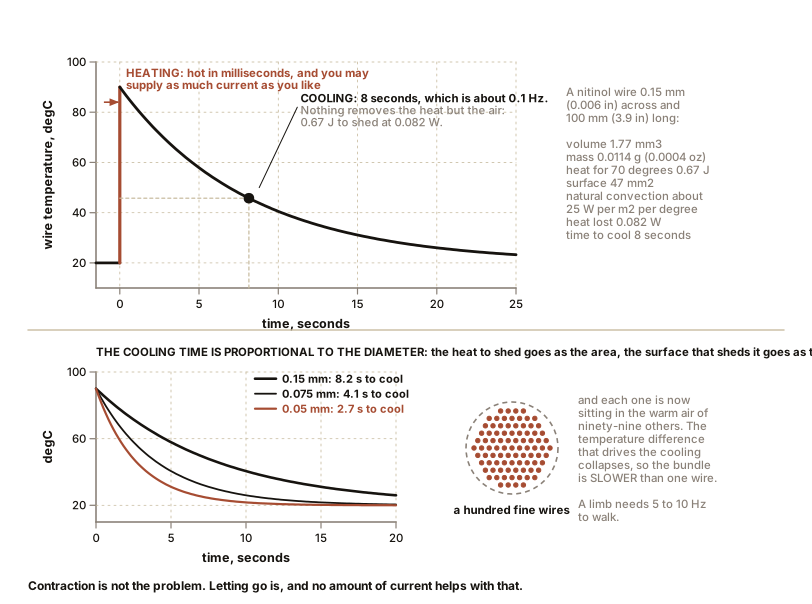
Current heats a wire in milliseconds and you can supply as much current as you like. But nothing cools it except the surrounding air, at a rate set by its surface area, the air’s movement, and the temperature difference. So contraction is fast and relaxation is slow, and the relaxation sets the cycle rate.
Work an example, and treat it as an order of magnitude rather than a precise figure. A nitinol wire 0.15 mm (0.006 in) in diameter and 100 mm (3.9 in) long:
volume        =  1.77 mm3,  mass  =  0.0114 g  (0.0004 oz)  at 6,450 kg/m3
heat to raise it 70 degrees  =  0.0000114 kg x 840 J/kg/K x 70  =  0.67 J
surface area  =  47 mm2  =  0.000047 m2
natural convection from a thin wire, roughly 25 W per m2 per degree
heat lost at 70 degrees above ambient  =  25 x 0.000047 x 70  =  0.082 W
time to cool  =  0.67 / 0.082  =  8 seconds
Eight seconds to relax, which is a cycle rate of about 0.1 Hz.
And notice the scaling, because it is the whole story. The heat to be shed goes as the volume, which goes as the diameter squared. The surface available to shed it goes as the diameter. So the cooling time is proportional to the diameter: halve the wire and you halve the time. Which is why real SMA actuators are bundles of hair-fine wires, and why published bandwidths for bare fine wires in still air are around 0.5 to 2 Hz, rising to perhaps 10 Hz with forced air or liquid cooling.
And then the bundle defeats itself. Put a hundred fine wires side by side to get useful force and each one is now surrounded by ninety-nine other hot wires. The temperature difference driving the cooling collapses, and the bundle is slower than a single wire. A limb needs 5 to 10 Hz to walk.
Two more limits, briefly, and both are geometric.
Usable strain is 4 to 8 percent, against biological muscle’s 20 to 40 and the fluid muscle’s 30. So an SMA actuator must be five times longer than the motion it produces, or work through a lever that multiplies its displacement and divides its force.
And the transformation has hysteresis: the temperature at which it contracts on heating is 10 to 30 degrees above the temperature at which it relaxes on cooling. So its position depends on its history, which means open-loop position control is impossible and closed-loop control needs a sensor and a model of where the wire has recently been.
The verdict is clear and it is not close: excellent for one strong quiet motion occasionally, hopeless for continuous limb motion.
Which is exactly the pattern of where it has succeeded, and it has succeeded spectacularly:
- Self-expanding vascular stents, which deploy once, at body temperature, and then never move again. Millions of patients.
- Spacecraft and satellite release mechanisms, replacing explosive bolts, because they are one-shot, silent, and produce no shock or debris.
- Variable-geometry engine nacelle chevrons, which change shape slowly with altitude to trade takeoff noise against cruise efficiency.
- Eyeglass frames, orthodontic archwires, and thermostatic mixing valves.
Not one of them cycles quickly, and not one of them is a limb.
And this is precisely why the fluid machine wins. Look at the two failures again and notice that fluid answers both with the same property.
Fluid separates power generation from actuation, so the inefficiency lives in the torso where there is room for a motor and a fan, rather than in a finger.
And the working fluid carries the power out and the heat back. The pump’s losses and the muscle’s losses are both washed away by the circulating water, to wherever the machine chooses to reject them.
An SMA actuator must generate its heat and dump its heat at the actuator, which is the one place in a limb with neither room nor airflow. That is not a manufacturing problem and no amount of development effort will remove it. It is the geometry of a limb.
One more thing, stated plainly because it is worth more than another survey of what might work someday. Artificial muscle from shape memory alloy was being built in laboratories in the 1980s, with the specific work figures above already known and already impressive. Forty years later there is still no walking machine driven by it. Not because nobody tried, and not because the alloys are worse than advertised: they are exactly as good as advertised. The two reasons above were true then, are true now, and are consequences of thermodynamics and surface area rather than of technology. A negative result of that age, explained properly, tells you more about how to choose an actuator than any number of demonstrations.
Section 2: Build One, and Then Say What Would Settle It
ON THE BENCH: Build a McKibben artificial muscle for fifteen dollars
Parts: 300 mm (12 in) of expandable braided cable sleeving, 15 to 20 mm (0.6 to 0.8 in) nominal, about $5; 300 mm (12 in) of latex or silicone tubing that fits loosely inside it, or a length cut from a bicycle inner tube, about $4; two stainless hose clamps or several heavy cable ties, $3; a tyre valve or a barbed hose fitting, $3; your bicycle pump with a gauge; a bucket, some water, and a spring balance or luggage scale. Cost: about $15. Time: an afternoon. Hazards: keep to 300 kPa (44 psi) and no more, and use air rather than water for the first tests, outdoors or over a sink. A latex bladder that bursts inside a braid makes a loud bang and throws the clamp. Wear eye protection. Do not stand over it. Do not use a compressor without a regulator: use the bicycle pump, so that your arm is the pressure limit. Method: slide the tubing inside the braid. Fold the braid over the tubing at each end and clamp both together, hard, with the fitting entering one end. Blank the other end completely. Hang it up, hang a weight from the bottom, and pump. What you should see: as the pressure rises, the muscle fattens and shortens, and the weight rises. A 20 mm (0.8 in) muscle 250 mm (9.8 in) long at 250 kPa (36 psi) will typically lift a few kilograms through 30 to 50 mm (1.2 to 2.0 in). Now do the measurement that is the point of the chapter. Hang the muscle from a fixed point with the spring balance and a rope below it, and arrange to hold it at a chosen length. Measure the pull at several lengths, at constant pressure: at zero contraction, at 5 percent, 10 percent, 15 percent, 20 percent. What you should find: the force falls steadily as it contracts, reaching zero somewhere around 20 to 30 percent. Plot it. Then plot a cylinder’s force on the same axes, which you measured in Chapter 11, and which is a flat horizontal line. Those two lines are the whole of Section 3. One actuator gives you the same force everywhere and the other gives you a force that depends on where it is, and every difference in how you design with them follows from the shapes of those two curves. If it will not contract: the braid is probably too tight a fit, so it is already at its maximum diameter and has nowhere to expand to. Use a larger braid. If the bladder bulges out through the braid, the braid’s weave is too open; double it up or use a finer one.
ON THE BENCH: Feel the SMA bandwidth limit for yourself
Parts: a metre of nitinol muscle wire, 0.15 mm (0.006 in) diameter, about $12 from a hobby electronics or educational supplier; a small weight of 50 to 100 g (1.8 to 3.5 oz); a stopwatch; a low-voltage bench supply or a 1.5 V cell and a resistor, or simply a cigarette lighter. Cost: about $12. Time: 30 minutes. Hazards: the wire gets to 90 °C (194 °F) and will burn a fingertip. Do not exceed the supplier’s stated current, because an overheated SMA wire is permanently ruined and can glow. If using a flame, do it over a sink, and note that a flame heats far above the transformation temperature and will degrade the wire after a few cycles. Method: hang a 200 mm (7.9 in) length of wire vertically with the small weight on the bottom and a mark on the wall beside the weight. Heat the wire, either by passing the rated current or by running a lighter flame quickly along it. Time two things separately: how long it takes to contract, and how long it takes to return. What you should see: contraction is immediate, well under a second, and the weight visibly jumps. The return is slow, and on a 0.15 mm wire in still air it will be several seconds, in the region the arithmetic in Section 5 predicts. Then blow on it. The return time falls dramatically, which is the whole of the cooling argument in one breath. Then hold two lengths of wire side by side, a few millimetres apart, and cycle both together. The return is slower than for one wire alone, because each is now sitting in the other’s warm air. That is the bundle problem, demonstrated with two wires and a stopwatch. What you have measured: the actuator with the highest force-to-weight ratio ever built, and the specific reason it has never moved a limb. The contraction is not the problem. The letting go is.
IN PLAIN ENGLISH: A muscle is a bag in a sock. Pump fluid in and the bag gets fatter, and because the sock cannot get longer it has to get shorter instead, so it pulls. Thousands of those, run off one pump in the chest, gives you a machine with hundreds of light actuators and all the heavy machinery in one place. It uses water rather than oil because a machine that lives in a house will eventually leak, and water is a towel while oil is a disaster. And the rival technology, a metal wire that shortens when you heat it, is stronger for its weight than anything else ever made and is useless for a limb, because you can heat a wire in a millisecond and you can only cool it as fast as the air will take the heat away.
SLOW DOWN. Check Your Understanding: This chapter has argued that fluid wins here because it separates power generation from actuation and carries heat away. An electric humanoid also has to get power to its joints, and it does so with wires, which are lighter than tubes and carry no fluid. So why does the argument not apply just as well to electricity? Answer before reading on.
Because electricity separates power generation from the joint and does not separate power conversion from the joint. A wire delivers energy beautifully, at almost no mass and almost no loss. But the thing at the far end of the wire has to convert electrical energy into a large force at a low speed, and that means a motor plus a gearbox, and the gearbox is the mass and the gearbox is where the heat appears. An electric humanoid’s knee contains its own energy converter. A fluid humanoid’s knee contains a bag.
And that is why the heat argument is asymmetric. In the electric machine, the losses occur in the motor windings and the gear teeth, in a joint, with no coolant and no airflow, which is Chapter 20’s argument about a stalled electric actuator and Section 5’s argument about SMA. In the fluid machine, the losses occur in the pump, and the working fluid then flows past them and carries the heat back to the torso, where a radiator can be put. The fluid is doing two jobs at once, and the second job is invisible on a specification sheet.
Now the honest counter, because this is not a settled argument. High-torque direct-drive motors with no gearbox at all, the “quasi-direct-drive” actuators used in the current generation of legged robots, remove the gearbox and therefore most of the mass and most of the loss. They are heavier per newton-metre than a geared motor and they are backdrivable, efficient, and cool much better because the losses are spread over a large stator rather than concentrated in gear teeth. That architecture is winning at the moment, and it wins by attacking exactly the weakness identified above rather than by being better at everything. The question this chapter cannot answer is whether a thousand cheap bags beat forty expensive motors, and the reason it cannot answer it is that nobody has yet published an independent measurement of the first option.
Which is the right note to end a frontier chapter on: name the measurement that would settle it. For this machine, five numbers would do it. Payload at the hand, measured. Endurance on a charge, walking. Positional repeatability at a joint, in millimetres. Muscle life in cycles to failure, with the distribution and not just the mean. And the pump’s actual electrical input while the machine walks, which is the number that would resolve Section 2’s arithmetic in one afternoon. Until somebody outside the company measures those, the concept is demonstrated and the engineering is not, and saying so is not scepticism. It is the difference between a specification and a result, and this whole book has been about learning to tell them apart.
One chapter left, and it is the ledger.

Bench Degree
Get the degree without the diploma.
Learn the material, not how to pass the exam.