Bench Degree·FLUID POWERchapter
Chapter 23: The Fluid Humanoid
Three hundred pages arguing that fluid power means stiff, precise and enormously strong, and then a machine appears that wants to be compliant, backdrivable and safe to stand next to. The inversion is instructive rather than contradictory, and working out why is the best exercise in this book.
Everything so far has said the same thing. Hydraulics is chosen when you need force in a small package and a machine that holds its position. Chapter 7 made stiffness the whole argument. Chapter 16 showed 396,000 N out of a cylinder you could carry, and Chapter 20 showed a control surface held motionless at zero energy cost.
Now consider what a humanoid robot needs. It must be compliant, because a rigid machine near a person injures the person. It must be backdrivable, so that a push moves it rather than fighting it. It must be light, because it carries its own actuators. And it needs hundreds of independent degrees of freedom rather than a dozen.
That is close to the opposite specification, and the obvious answer is electric motors. So it is worth understanding why at least one serious attempt has gone back to fluid.
Section 1: What the Machine Is, and Where the Numbers Come From
Clone Robotics, based in Wrocław, Poland, builds a musculoskeletal android called the Protoclone, and a planned product called Clone Alpha. Its actuators are not motors and they are not conventional cylinders. They are fluid-filled artificial muscles the company calls Myofibers, driven by water.
Before any numbers, a statement about their provenance, because this volume takes that seriously.
Everything in the list below is the developer’s own published figure. It is not an independent measurement, and as far as can be established, no third party has instrumented this machine and published results. So these are specifications in the sense that a datasheet is a specification: a claim by the person selling it, useful for reasoning and not evidence. Where a number below is checkable by arithmetic, Section 2 checks it, and where it is not, it is labelled.
The published figures for Protoclone V1:
- About 1,000 Myofiber muscles.
- A polymer skeleton with 206 bone analogues, matching the human count.
- Over 200 degrees of freedom, of which about 164 are in the upper torso, including 20 in the shoulder, 6 per vertebra in the spine, and 26 across the hand, wrist and elbow.
- Around 500 sensors.
- A single 500 W electric pump as the circulatory source, quoted at 40 litres/min (10.6 gal/min) and 690 kPa (100 psi).
And for one Myofiber:
- Mass about 3 g (0.11 oz).
- Contraction force at least 1 kgf, which is 9.8 N or 2.2 lbf.
- Contraction of over 30 percent of its length, unloaded.
- Response time under 50 ms.
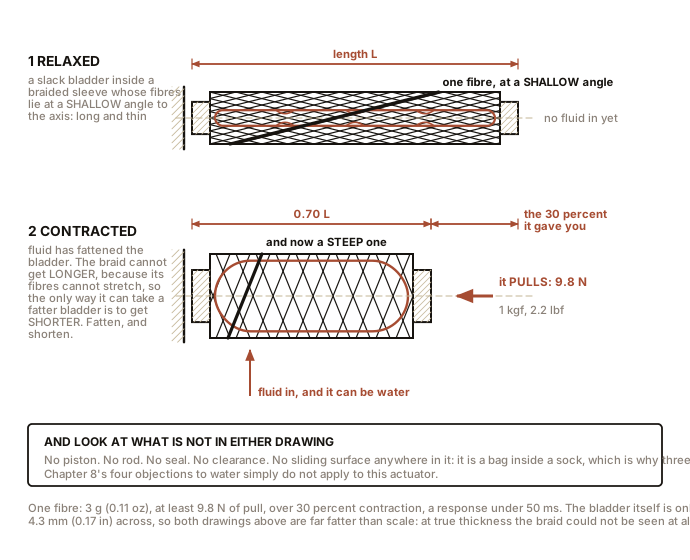
The actuator’s construction is the oldest idea in artificial muscle and it is worth naming properly. A Myofiber is, geometrically, a McKibben muscle, invented in the 1950s for orthotics: an elastic bladder inside a braided sleeve of inextensible fibres set at an angle. Pressurise the bladder and it tries to expand in every direction. The braid cannot get longer, because its fibres cannot stretch, so the only way it can accommodate a fatter bladder is to get shorter. Fatten and shorten. That is the whole mechanism, and it is why you can build one on a bench for fifteen dollars, which Section 5 does.
Section 2: Checking the Datasheet, Which Is Now Something You Can Do
A reader who has got this far can audit those numbers, and doing so is the point of the exercise.
Check one: does the pump’s arithmetic close? Chapter 8’s equation:
power = bar x litres/min / 600 = 6.9 x 40 / 600 = 0.46 kW = 460 WFour hundred and sixty watts of fluid power out of a pump rated at 500 W. That is 92 percent, and no pump of this size is 92 percent efficient; Chapter 10 put a good gear pump at 85 percent overall at full pressure, and a small pump of this class would be well below that.
So the three numbers cannot all be simultaneous. Either the 500 W is the hydraulic output rather than the electrical input, or the 40 litres/min (10.6 gal/min) and the 690 kPa (100 psi) are separate peak ratings that are never achieved at the same time, which is the ordinary and honest way that pump datasheets are written. This is not an accusation and it is not a criticism. It is what a specification sheet looks like before anybody has measured the machine, and spotting it in ten seconds is exactly the skill this book set out to give you.
Check two: is the muscle force plausible? A pull of 9.8 N, which is 1 kg or 2.2 lb, at 690 kPa needs an effective area of:
9.8 N / 0.69 N per mm2 = 14.2 mm2 (0.022 in2)Which is a bladder about 4.3 mm (0.17 in) across. Entirely plausible for a fibre of that size, and consistent with the published mass. That number checks out.
Check three, and this is the one that reveals the real engineering problem. How many muscles can one pump actually feed?
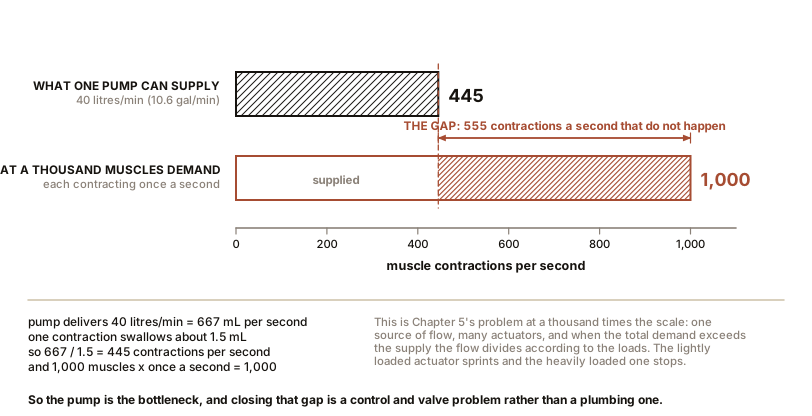
Estimate the volume a single Myofiber swallows per contraction. A 14 mm² (0.022 in²) bore fattening enough to shorten a 100 mm (3.9 in) fibre by 30 mm (1.2 in) needs on the order of 1 to 2 mL. Call it 1.5 mL. Then:
pump delivers  40 litres/min  =  667 mL per second
contractions supportable  =  667 / 1.5  =  445 per second
And there are a thousand muscles. If every muscle needed to contract once a second, which is a modest rate for walking, the demand is 1,000 contractions per second against a supply of 445.
So the pump is the bottleneck, and it is exactly the bottleneck of Chapter 6. One source of flow, many actuators, and when the total demand exceeds the supply the flow divides according to the loads. Chapter 16’s excavator solves that with pressure-compensated valve sections and flow sharing, and Chapter 6’s Slow Down box explained what happens if you do not: the lightly loaded actuator sprints and the heavily loaded one stops.
A thousand-muscle machine has that problem a thousand times over, and solving it is not a plumbing question. It is a control question. Which brings us to the four inversions.
Section 3: Four Things This Machine Turns Upside Down
Inversion one: contraction, not extension, and the force curve changes shape.
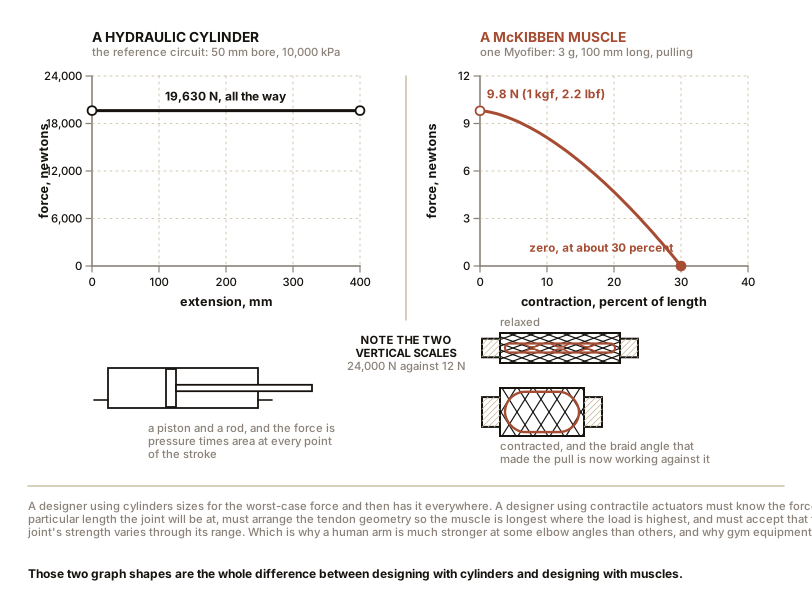
A cylinder pushes, with a force of pressure times area, and that force is constant through the whole stroke. Chapter 11’s arithmetic gave 19,630 N at the start of the stroke and 19,630 N at the end.
A McKibben muscle pulls, and its force is highest at zero contraction and falls to zero at maximum contraction. The braid angle changes as it shortens, and the geometry that produces the pull becomes progressively less effective. So the force-displacement curve slopes steeply downward.
That is not a defect. It is what biological muscle does too, and it changes the entire kinematic argument of Chapter 11. A designer using cylinders sizes for the worst-case force and gets it everywhere. A designer using contractile actuators must know the force at the specific length the joint will be at, must arrange the tendon geometry so that the muscle is longest where the load is highest, and must accept that a joint’s strength varies through its range. Which is precisely why a human arm is much stronger at some elbow angles than others, and why gym equipment has cams in it.
Inversion two: power density, which is the actual reason to choose fluid here.
Compare specific work, meaning joules of work per kilogram of actuator, and be careful, because the interesting comparison is not the obvious one.
Take one Myofiber at the published figures: 3 g (0.11 oz), pulling 9.8 N, contracting 30 mm (1.2 in). Because the force falls as it contracts, the work is roughly half of force times distance:
work  =  0.5 x 9.8 N x 0.030 m  =  0.147 J
specific work  =  0.147 / 0.003 kg  =  49 J/kg
Forty-nine joules per kilogram, which is worse than an electric motor’s hundred. So on specific work the fluid muscle loses.
Now compute specific power instead, using the published 50 ms response:
power  =  0.147 J / 0.050 s  =  2.9 W
specific power  =  2.9 / 0.003  =  980 W/kg
Nearly a kilowatt per kilogram at the actuator, and that is where it wins. An electric motor with the gearbox needed to produce useful joint torque manages a few hundred watts per kilogram at the joint, and the gearbox is most of the mass.
But the decisive advantage is neither of those numbers. It is that the pump is somewhere else.
Fluid separates power generation from actuation. One motor and one pump live in the torso, where mass is cheap because it is close to the centre of gravity and does not have to be swung. The actuators in the limbs are light bladders and braid. An electric humanoid must put a motor, a gearbox, a driver and a means of cooling at every single joint, and every gram of that is mass at the end of a lever, which must be accelerated and decelerated by everything upstream of it.
And the honest deduction against it: the fluid in those thousand muscles is not weightless. A thousand muscles at 1.5 mL each is 1.5 litres (0.4 gal), which is 1.5 kg (3.3 lb) of water distributed through the limbs, plus the tubing and the fluid in it. So “all the mass in the torso” is an overstatement, and the real claim is the more modest and still substantial one that the machinery is in the torso and only the working fluid is distributed.
Inversion three: water instead of oil, which reverses Chapter 9.
Chapter 9 gave four reasons hydraulics uses oil and not water: water lubricates badly, it is a hundred times too thin for the clearances, it rusts steel, and it grows things.
Look at where each of those objections actually bites, and it is always at a precision sliding surface. Lubricity matters at the pump’s gear tips and the valve spool. Viscosity matters because clearances were designed for a thick fluid. Corrosion matters because the precision surfaces are steel.
A McKibben muscle has no sliding surface at all. No piston, no rod, no seal, no clearance. It is a bag inside a sock. So three of Chapter 9’s four objections simply do not apply to the actuator.
They do still apply to the pump and the valves, and that is where the real work is. Water-hydraulic pumps and valves exist as a mature product category, built with ceramic and stainless components and clearances designed for a 1 cSt fluid, and they are more expensive than their oil equivalents.
And in exchange you get the one property that decides it: a machine intended to work beside people, indoors, in a kitchen or a hospital, will eventually leak. A leak of hydraulic oil in a living room is a serious event. A leak of water is a towel. The trade runs the other way when the failure mode is a person rather than a pump, and this is the clearest example in this volume of a design constraint that is not about performance at all.
Inversion four: the valve count, which turns plumbing into manufacturing.
Conventional hydraulics is a few large valves. Chapter 16’s excavator has perhaps eight main spools. This machine needs one valve per muscle, or close to it, which is around a thousand tiny valves.
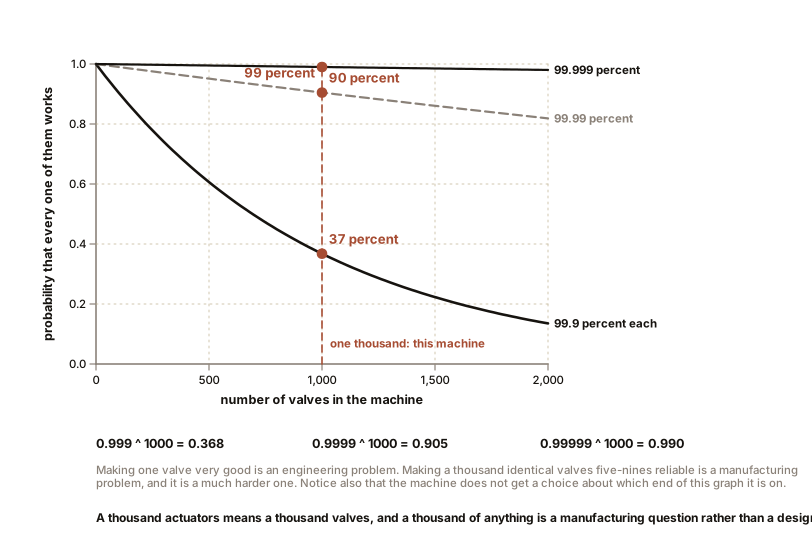
That changes the nature of the problem completely, and the arithmetic is unforgiving. Suppose each valve is 99.9 percent reliable over some period. The chance that all thousand work is:
0.999 ^ 1000 = 0.368A machine that works 37 percent of the time. To get 99 percent system reliability from a thousand series-critical components you need each one at:
0.99999 ^ 1000 = 0.990Five nines per valve. That is a manufacturing and quality-control problem of a completely different character from anything else in this book, and it is much harder than making one valve very good. It is also why every serious attempt at high-degree-of-freedom fluidic actuation ends up making its own valves rather than buying them: at a thousand units per machine, the cost, size, power and failure rate of the valve dominate everything else.
Section 4: The Compliance Is Structural, Not Fluidic, and That Matters
It would be easy to read this chapter as saying that a humanoid needs compliance, and air is compliant, so this is really pneumatics with water in it. That is wrong and the correction is the most interesting thing in the chapter.
There are two completely different ways to make an actuator compliant.
Fluidic compliance, which is what a pneumatic actuator has. The working fluid is a spring, so the actuator gives, always, whether you want it to or not. Chapter 7’s 43 mm (1.7 in) of sag for a 20 percent load change. You get compliance for free and you cannot switch it off, which is why a pneumatic actuator cannot hold a chosen position.
Controlled compliance, which is what a water-filled muscle with a fast valve has. The fluid is stiff, so with the valve shut the actuator holds firmly. The compliance comes from the valve deciding to let fluid out when the actuator is pushed. Which means the machine can be soft when a person leans on it and firm when it is holding a cup, and the difference is software.
That is a genuinely better place to be, and it costs one thing: bandwidth. Controlled compliance is only as good as the control loop. If the valve and the sensing cannot respond faster than the disturbance, the machine is stiff during the first few milliseconds of an impact, which are the milliseconds that break fingers. A pneumatic actuator’s compliance needs no computation and never fails. So the honest position is that water plus fast valves is the more capable architecture and the one with a failure mode air does not have, and that is a real engineering trade rather than a clear win.
And notice that the fluid’s stiffness, the property this entire volume has been about, is now being used for the thing it is always used for: transmitting force precisely. What changed is not the fluid. It is that the actuator’s structure, the braid and the elastomer, provides the give. The compliance was moved out of the fluid and into the mechanism, which is what biology does too: your tendons are the springs, not your blood.
So much for what the machine claims. What it actually got right, and what it quietly borrowed from an abandoned idea, is next.

Bench Degree
Get the degree without the diploma.
Learn the material, not how to pass the exam.