Bench Degree·FLUID POWERchapter

Chapter 22: The Two Things That Kill People
A pinhole you cannot see, and a machine that is switched off and still armed. Everything else in this field ruins equipment. These two ruin people.
Section 1: Injection Injury
This section is the reason this chapter exists.
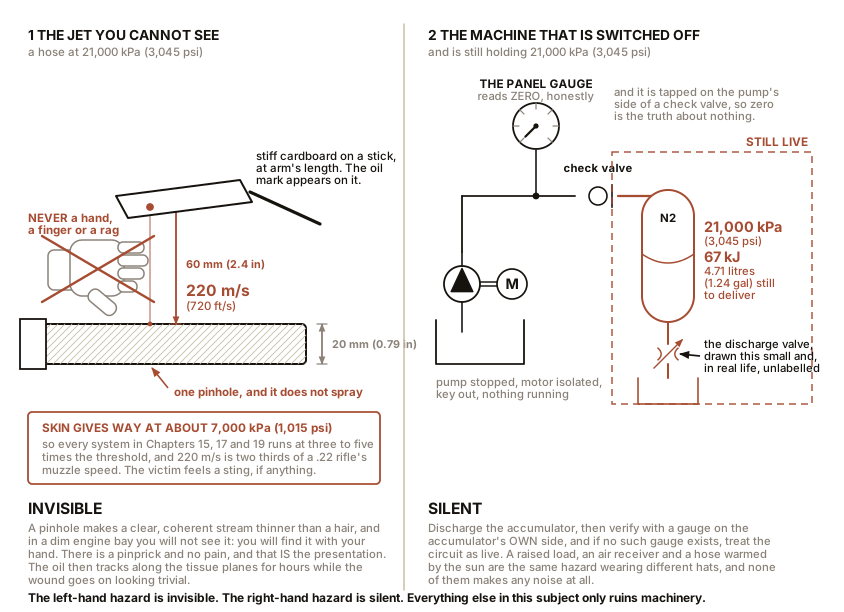
A pinhole in a high-pressure hydraulic hose produces a jet. Compute its speed:
velocity  =  square root of ( 2 x pressure / density )
          =  square root of ( 2 x 21,000,000 / 870 )
          =  220 m/s   (720 ft/s)
Two hundred and twenty metres a second, 220 m/s or 720 ft/s, about two thirds the muzzle velocity of a .22 rifle.
Skin is penetrated by a fluid jet at somewhere around 7,000 kPa (1,015 psi). Below that a jet stings and bruises. Above it, the jet goes through, and every hydraulic system in Chapters 16, 18 and 19 works at three to five times that threshold.
Here is what makes it uniquely dangerous, and it is four things at once.
The jet is invisible. A pinhole does not spray. It produces a fine, coherent, transparent stream a few centimetres long, thinner than a hair, and in a dim engine bay you will not see it. You will find it with your hand, which is exactly what must never happen.
The victim feels almost nothing. The commonly reported sensation is a sting, like a wasp, or a sharp knock. There is no wound to speak of: a pinprick, sometimes with a small bead of oil. The absence of pain is not reassurance. It is the characteristic presentation.
The damage is deep and it progresses. The fluid is driven into the tissue and travels along the planes between muscles and tendons, sometimes the whole length of a finger or up a forearm. Then three things happen in sequence: the oil is chemically toxic to tissue and causes necrosis; the volume of fluid raises the pressure inside the closed compartments of the limb, cutting off its own blood supply, which is compartment syndrome; and the wound is contaminated with whatever was in the oil, so it becomes infected.
And the outcome, if treatment is delayed, is frequently amputation. The reported amputation rates in the clinical literature for high-pressure injection injuries to the hand run from roughly a fifth to nearly half of cases, and delay to surgery is the strongest predictor. Hours matter.
So the rules.
Never run a hand, a finger or a rag along a hydraulic line to find a leak. Not ever. Not at any pressure.
To find a leak, use a piece of stiff cardboard or a sheet of thin plywood held at the end of a stick, at arm’s length, and watch for the oil mark appearing on it. Better still, look for the wet patch, the drip trail, or the clean stripe washed into the dirt, and look with the machine at rest. Better again, look with the machine at its lowest pressure that still leaks.
Wear eye protection and gloves. Gloves do not stop a jet, and they do reduce the chance of an unnoticed contact.
And if it happens, this is a surgical emergency and it does not look like one.
- Go to a hospital immediately. Not tomorrow, not when it hurts. Immediately.
- Say the words “high-pressure injection injury”. An emergency department looking at a pinprick on a finger will not guess, and the wound looks trivial. You must tell them what the mechanism was.
- Take the fluid’s safety data sheet with you, or a photograph of the drum’s label, because the treatment depends on what was injected.
- The treatment is surgical exploration and debridement, and it is time-critical. Antibiotics alone are not treatment.
And the same hazard is not confined to hydraulics. In fact most injection injuries seen in emergency departments come from equipment that amateurs own:
- Airless paint sprayers, at up to 20,000 kPa (2,900 psi).
- Pressure washers, at 10,000 to 20,000 kPa (1,450 to 2,900 psi), and a pressure washer’s fan jet is more forgiving than its pencil jet, which is not forgiving at all.
- Diesel fuel injection systems, which on a modern common-rail engine run at 150,000 to 250,000 kPa (21,750 to 36,250 psi). Never crack a diesel injector line to check for fuel with the engine running.
- And a grease gun. A hand-lever grease gun develops 70,000 to 100,000 kPa (10,000 to 14,500 psi) with an ordinary pull on the handle. It is one of the highest-pressure devices most people will ever hold, it costs twenty dollars, it comes with no warning worth reading, and grease injected into a finger through a worn coupler is a well-documented and frequently reported injury. The most dangerous fluid power device in a typical garage is the grease gun.
ON THE BENCH: Practise the cardboard drill at a pressure that cannot hurt you
Parts: a garden hose; a pin; a piece of stiff cardboard about 300 mm (12 in) square; a length of stick or a broom handle; tape; eye protection. Cost: nothing. Time: 20 minutes. Hazards: at 400 kPa (58 psi) a water jet cannot penetrate skin. This experiment exists specifically so that the habit is learned at a pressure that is harmless. Wear eye protection anyway, because habits are the point. Method: with the hose depressurised, put one pin hole in it. Tape the cardboard to the stick. Pressurise the hose, and then find the pinhole using only the cardboard, held at the end of the stick, at arm’s length, moving it slowly along the hose and watching for the wet mark. What you should notice, and it is the whole lesson: at 400 kPa (58 psi) the water from a pin hole makes a fine jet perhaps 100 mm (4 in) long that is surprisingly hard to see, and you will be tempted to find it by feel within about thirty seconds. Resist that, deliberately, and notice how strong the temptation is. At fifty times the pressure the jet is thinner, faster, invisible, and the temptation is identical. Then look at the wet mark on the cardboard and note how small and precise it is. That is what a jet capable of going through a hand looks like from a safe distance. Do this once, with your own hands, and the instruction in this section stops being a warning you have read and becomes a habit you have practised. That is the difference between the two, and it is worth twenty minutes.
Section 2: Stored Energy, and the Machine That Is Switched Off
The second killer, and its characteristic is that everything looks safe.
Three sources, and the third one surprises everybody.
The accumulator. Chapter 13 gave the numbers: a 10 litre (2.6 gal) unit precharged to 9,000 kPa (1,305 psi) working to 21,000 kPa (3,045 psi) holds about 67 kJ and can deliver 4.71 litres (1.24 gal) of oil after the machine has stopped. Every gauge on the panel may read zero. Discharge it, then verify with a gauge on the accumulator’s own side of the circuit, and if you cannot find such a gauge, treat the circuit as live.
The air receiver. A 200 litre (53 gal) receiver at 900 kPa (130 psi) gauge holds about 236 kJ, the energy of some 56 g (2.0 oz) of TNT, and releases it by becoming fragments. Its failure mode is internal corrosion from undrained water, which is invisible.
And trapped incompressible fluid, warmed by nothing more than the weather.
Hydraulic oil expands by about 0.07 percent per degree Celsius, which is 0.04 percent per degree Fahrenheit. Trap it in a rigid closed volume, so it cannot expand, and heat it. The pressure rise is:
pressure rise  =  temperature rise  x  expansion coefficient  x  bulk modulus
               =  20  x  0.0007  x  1,500 MPa
               =  21 MPa  =  21,000 kPa   (3,045 psi)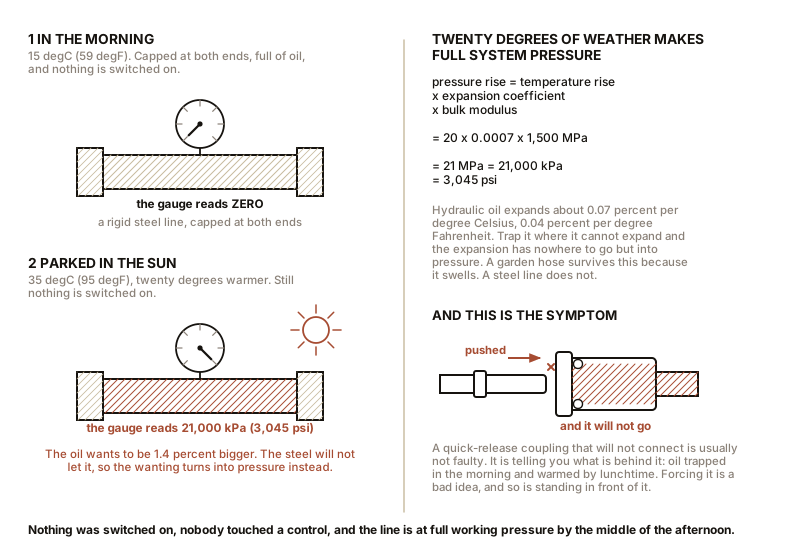
Twenty degrees of temperature rise in a closed rigid volume produces full hydraulic system pressure. Twenty degrees is a machine parked in the sun, or a hose left connected in a workshop after the heating comes on, or a quick-release coupling disconnected in the cool of the morning and reconnected at noon.
Which is why:
- A quick-release coupling that will not connect is often not faulty. It is telling you there is pressure trapped behind it, and forcing it is a bad idea.
- A trapped cylinder line on a machine left in the sun can lift a load without anybody touching a control.
- And the garden-hose warning in Chapter 3 was not fussiness. A garden hose survives it because it is elastic and swells, which Chapter 7 measured. A steel line does not.
The fourth kind of stored energy is not fluid at all: it is the load. A raised boom, a tipped body, a platform, a bucket in the air. A hydraulic machine’s suspended load is held by seals, and the correct procedure before working underneath any of them is to lower it to the ground or to block it mechanically. Not to trust the holding valve of Chapter 16, however good it is.
And on the air side, two specific hazards.
Hose whip. An air hose that comes off its fitting is driven by the thrust of the escaping air. For a 12 mm (0.47 in) bore hose at 700 kPa (102 psi):
thrust = 0.7 N per mm2 x 113 mm2 = 79 N (18 lb)Eighteen pounds of thrust on a whipping steel-coupled hose end, at head height, moving fast. The fix is a whip check, a short cable or lanyard across every coupling, and they cost a few dollars.
And compressed air into the body, which is lethal and is not widely understood. Air blown into a cut, into an eye, into an ear, into the mouth or into any body opening can be forced into the bloodstream, where it forms an air embolism that can block the circulation to the brain or heart. There are documented fatalities from a few seconds of horseplay with a blow gun.
So: never use compressed air to clean skin or clothing, never direct it at another person, and never at yourself. Occupational rules in most jurisdictions limit a blow gun’s dead-ended pressure to around 207 kPa (30 psi) for exactly this reason, and a compliant blow gun achieves it with a relief hole in the nozzle that vents if the tip is blocked. Look at your own blow gun and see whether it has one.
ON THE BENCH: Audit a real machine for stored energy
Parts: a notebook; access to any hydraulic or pneumatic machine; a torch. Cost: nothing. Time: 40 minutes. Hazards: the point of the exercise is to find the hazards, so do not undo anything. Machine off, isolated, key out, and hands in pockets. Method: with the machine shut down and isolated, find and write down every one of these that exists on it. 1. Every accumulator. They look like a steel bottle or a short thick cylinder, often with a gas valve cap on one end and a label giving the precharge pressure. Then find its discharge valve, and find a gauge that reads the accumulator’s own pressure. If either is missing, that is the finding. 2. Every air receiver, and check whether its drain has been opened this year. Look at the safety valve and whether it has been painted over. 3. Every suspended or raised load, and identify the mechanical means of blocking it. If there is none, that is the finding. 4. Every spring, because a spring-applied brake or a spring-return cylinder is stored energy too. 5. Every quick-release coupling, which is a potential trapped-fluid point. What you should conclude: a small machine typically has three or four stored energy sources and a documented procedure for one of them. The gap between those two numbers is what this section is about, and writing it down for a machine you actually use is worth more than reading any amount of general advice.
IN PLAIN ENGLISH: Two things in this subject hurt people who were being careful. The first is a hole so small you cannot see the oil coming out of it, moving fast enough to go through your skin without your noticing much, after which the damage happens over hours inside your hand. The rule is that you never look for a leak with any part of yourself. The second is that a machine which has stopped is not a machine with no energy in it: an accumulator, an air tank, a raised load, or a hose warmed by the sun all still hold everything they held before, and none of them make any noise.
SLOW DOWN. Check Your Understanding: A machine’s hydraulic pump is replaced. On restart it makes a loud crackling noise, and the noise disappears after ten minutes and does not come back for the rest of the day. The following morning it does it again. Nothing leaks, the oil level is correct, the oil looks clear with no foam. Name the fault, name the two most likely specific causes, and say what would happen if it is ignored. Answer before reading on.
It is cavitation, not aeration, and the evidence is in three details. The sound is a crackle rather than a knock, which Section 2 assigns to cavitation. The oil is clear with no foam, which rules out aeration, because aeration always shows in the reservoir. And it clears as the machine warms and returns when cold, which is the definitive cavitation tell: the fault is the oil’s ability to reach the pump, and warm oil reaches it more easily.
The two likely causes, both created by the pump replacement. First, the suction line or strainer was disturbed and not correctly reinstated: a strainer left partly clogged, a suction hose kinked during the fit, or a suction line replaced with one of the same size as the pressure line, which per Chapter 8 is half the diameter it needs to be. Second, the new pump may be a different type with a stricter inlet requirement: Chapter 10’s Slow Down box made this point about cleanliness, and the same applies to inlet conditions, because a piston pump will not tolerate an inlet a gear pump lived with happily.
If it is ignored, the pump is destroyed, and it will be destroyed in the same way and within a similar time as the last one. Cavitation erodes metal at a rate that removes visible material within days of running. And here is the part worth remembering: the previous pump probably failed of exactly this cause, and the fault was diagnosed as “the pump failed” and treated by replacing the pump. A component that fails twice in the same way was never the fault, and that sentence is worth more than any specific piece of hydraulic knowledge in this book.
Two chapters remain. The next one is the current frontier of this subject, and it inverts almost everything this volume has argued for, which is why it is instructive rather than contradictory.

Bench Degree
Get the degree without the diploma.
Learn the material, not how to pass the exam.