Bench Degree·FLUID POWERchapter

Chapter 21: How Fluid Power Breaks
Most failures are dirt. Most of the rest are the inlet side of the pump. And two specific things in this subject maim and kill people who did nothing careless: a pinhole leak, and a machine that has been switched off.
This is the chapter to read before touching anything in this volume that runs above garden-hose pressure. It is in two halves. The first half is how these machines wear out and misbehave, which is a maintenance subject. The second half is about two hazards that are genuinely lethal, and they are lethal in ways that give no warning and produce no pain at the moment of injury.
Read the second half even if you never intend to own a hydraulic machine, because one of the two hazards is present in a grease gun and the other is present in every workshop with a compressor.
Section 1: Contamination, Which Is Most of Everything
Chapter 9 gave the figure: contamination is the largest single cause of hydraulic component failure, with estimates between 70 and 90 percent depending on who counts and how, and Chapter 9 also gave the reason, which is that the clearances that matter are 1 to 5 µm (0.00004 to 0.0002 in) and the eye cannot see below 40 µm (0.0016 in).
The five ways dirt gets in, in rough order of quantity:
The breather. A reservoir must inhale as the oil level falls, and it inhales whatever is in the workshop air. On a mobile machine that is dust from the job. This is the largest ingression path on most machines and it is a $15 filter that nobody changes.
Past the rod seals. Every cylinder’s rod goes out into the world dirty and comes back in. The wiper seal removes most of it and not all of it.
In new oil. Which arrives at around ISO 4406 20/18/15 or worse, out of a drum, through a hose, and is often dirtier than the oil it is replacing.
During service work. Opening a system, using a rag that sheds fibres, leaving a port uncapped for an hour, or topping up from an open can.
And generated internally. Every wearing surface makes particles, and here is the vicious part: a particle causes wear, wear makes more particles, and more particles cause more wear. Contamination is autocatalytic, which is why a system that goes slightly dirty tends to go very dirty.
The four wear mechanisms, named because the names tell you what to look for.
Abrasion, a hard particle dragged across a surface, leaving parallel scratches in the direction of sliding. This is what you saw on the spool in Chapter 12.
Adhesion, metal-to-metal contact where the fluid film has failed, producing smeared and torn surfaces rather than scratches. A symptom of oil that is too thin, which per Chapter 9 usually means too hot.
Fatigue, particles rolled into a loaded contact producing pits and spalls, typically on bearings and on piston pump slippers.
Erosion, high-velocity fluid carrying particles across a surface, which rounds off the sharp edges of valve spools and orifices. A rounded metering edge is why an old valve gives poor fine control, and it is not fixable.
Section 2: Cavitation and Aeration, Which Are Not the Same Thing
Both put bubbles in the oil. They have different causes, different sounds, and different fixes, and confusing them wastes a great deal of time.
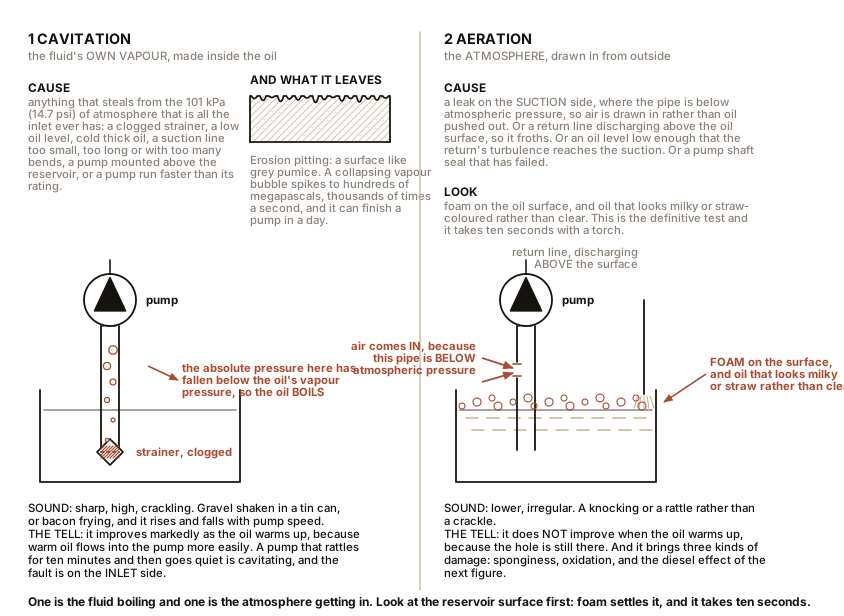
Cavitation is the fluid’s own vapour. The absolute pressure somewhere, almost always at the pump inlet, has fallen low enough that the oil boils. You made this happen with a syringe in Chapter 15.
- Cause: anything that steals from the 101 kPa (14.7 psi) of atmosphere that is all the inlet has. A clogged suction strainer, a low oil level, cold thick oil, a suction line too small or too long or with too many bends, a pump mounted above the reservoir, or a pump run faster than its rating.
- Sound: sharp, high-pitched, crackling. Like gravel being shaken in a tin can, or bacon frying. It rises and falls with pump speed.
- Damage: erosion pitting, and it is severe. A collapsing vapour bubble against a metal surface produces a local pressure spike of hundreds of megapascals, and it does it thousands of times a second. Cavitation removes metal, leaving a surface like grey pumice, and it can destroy a pump in a day.
- The tell: it improves markedly as the oil warms up, because warm oil flows into the pump more easily. A pump that rattles for the first ten minutes and then goes quiet is cavitating, and the fault is on the inlet side.
Aeration is atmospheric air, drawn in from outside.
- Cause: a leak on the suction side, where the pipe is below atmospheric pressure so air is drawn in rather than oil out. Or a return line discharging above the oil surface so it froths. Or an oil level low enough that the return’s turbulence reaches the suction. Or a pump shaft seal that has failed.
- Sound: lower pitched, irregular, a knocking or a rattle rather than a crackle.
- Look: foam on the oil surface in the reservoir, and oil that looks milky or straw-coloured rather than clear. This is the definitive test, and it takes ten seconds with a torch.
- Damage: three kinds. Chapter 7’s sponginess, from one percent of bubbles making the oil sixteen times softer. Accelerated oxidation, because you have introduced oxygen at temperature. And the diesel effect.
- The tell: it does not improve when the oil warms up, because the hole is still there.
The diesel effect deserves its own paragraph, because the number is remarkable.
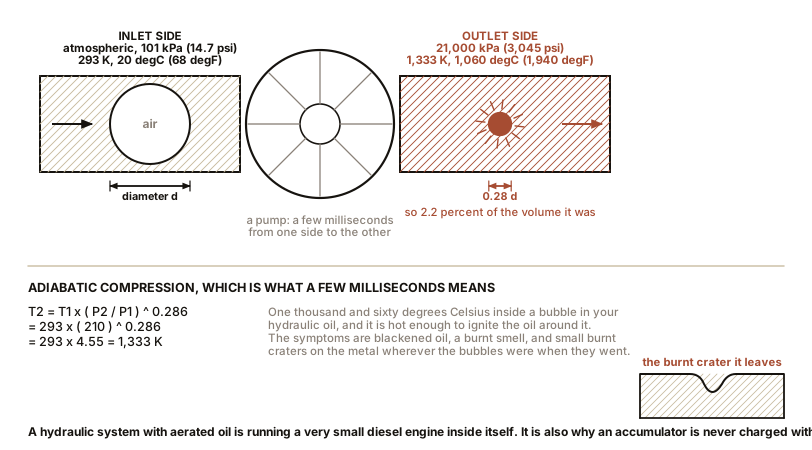
Take an air bubble at atmospheric, 293 K, and compress it to 21,000 kPa (3,045 psi) rapidly, which is what happens when it passes from the inlet side to the outlet side of a pump in a few milliseconds. Adiabatic compression:
T2  =  T1 x ( P2 / P1 ) ^ 0.286
    =  293 x ( 210 ) ^ 0.286
    =  293 x 4.55  =  1,333 K
One thousand and sixty degrees Celsius, 1,940 Fahrenheit, inside a bubble in your hydraulic oil. That is hot enough to ignite the oil locally, and it does: the symptom is small burnt craters on the surfaces where bubbles collapse, blackened oil, and a distinctive burnt smell. A hydraulic system with aerated oil is running a very small diesel engine inside itself, and the same phenomenon is why Chapter 13 said never to charge an accumulator with air.
Section 3: Pressure Spikes, and Why Your House Bangs
Fluid in a pipe has momentum. Stop it suddenly and that momentum has to go somewhere, and where it goes is pressure. The result is called water hammer in plumbing and a pressure spike or surge in hydraulics, and it is the same physics.
The equation is Joukowsky’s and it is simple:
pressure rise = density x speed of sound in the fluid x change in velocityTake hydraulic oil at 4 m/s (13 ft/s) in a steel tube, where the effective speed of sound is about 1,400 m/s (4,600 ft/s), brought to a stop by a fast solenoid valve:
870 x 1,400 x 4 = 4,872,000 Pa = 4,872 kPa (707 psi)Nearly five thousand kilopascals of spike, on top of whatever the pressure already was. In a system working at 21,000 kPa (3,045 psi) that is a momentary 26,000 kPa (3,770 psi), and the relief valve cannot help because the relief valve takes milliseconds to open and the spike is over.
Repeated a hundred times an hour for ten years, that is what breaks fittings, cracks manifolds and fatigues hoses.
And now notice the four fixes, all of which come straight out of the equation.
Reduce the velocity, by using a larger pipe. Halve the velocity and you halve the spike. This is why Chapter 8’s velocity guidelines exist and why the temptation to fit a smaller line to save money is expensive.
Reduce the rate of change, by closing the valve more slowly. On a proportional or solenoid valve this is a ramp in the electronics, and it is free.
Reduce the speed of sound in the line, which is what a length of rubber hose does. A hose’s compliance drops the effective speed of sound from 1,400 m/s to perhaps 400 m/s (1,300 ft/s), which cuts the spike to:
870 x 400 x 4 = 1,392 kPa (202 psi)A third of the spike. So a short length of hose deliberately inserted into a hard-piped system is a shock absorber, and Chapter 7’s complaint about hoses being the soft part of the system turns out to have a use.
Or fit an accumulator, which is the same idea done properly: a small diaphragm accumulator near the valve gives the fluid somewhere to go for the few milliseconds it needs.
ON THE BENCH: Water hammer in your own kitchen
Parts: any tap in your house; a hose-bib pressure gauge if you have one; your ears. Cost: nothing. Time: 10 minutes. Hazards: none, though repeatedly slamming a lever tap is not kind to it. Method: run a single-lever mixer tap at full flow and then close it as fast as you can with one movement. Then do the same to a traditional screw-down tap, closing as fast as you can turn it. What you should hear: a distinct bang or a knock in the pipework from the lever tap, and nothing from the screw-down. The lever tap stops the flow in a few tens of milliseconds; the screw-down takes a second, which per the equation reduces the rate of change by a factor of thirty. The arithmetic, for a copper pipe: mains water at 400 kPa (58 psi) through a 13 mm (0.51 in) hose at 20 litres/min (5.3 gal/min) is moving at 2.5 m/s (8.2 ft/s). In copper the effective speed of sound is around 1,300 m/s (4,270 ft/s), so:
1,000 x 1,300 x 2.5 = 3,250,000 Pa = 3,250 kPa (471 psi)Eight times mains pressure, for a few milliseconds, every time somebody shuts a lever tap. That is why plumbing codes require arrestors on fast-acting valves and why washing machines, whose solenoid valves close in milliseconds, are a common cause of banging pipes. Then do the fix and confirm it: fit a metre of flexible hose between the tap and the pipework, or find a tap that already has a flexible tail, and repeat. The bang is much quieter, and the reason is the third fix in this section.
Section 4: Seals and Hoses
Seals fail in six distinct ways and the appearance tells you which.
Extrusion. A soft seal squeezed by high pressure into the clearance gap it is supposed to be sealing, and then sheared off. Chapter 2’s Slow Down box predicted this. The fix is a backup ring, a harder ring behind the soft seal whose only job is to occupy the gap.
Nibbling. Small bites taken out of a seal’s edge, caused by the seal being repeatedly pinched into a gap by pressure cycling. Same cause, same fix.
Spiral failure. A long rod seal that twists as it slides, tearing along a spiral path. Caused by inadequate lubrication or a seal that is free to rotate, and characteristic of long-stroke cylinders.
Explosive decompression. A seal that has absorbed gas under high pressure over a long period, then had the pressure released quickly, blisters and tears from the inside as the gas expands within the rubber. Common in gas-charged systems and in accumulator seals.
Hardening. Heat, over time, per Chapter 8. A hard, glazed, cracked seal has been cooked.
Chemical attack. Swelling, softening, or turning to jelly, from the wrong fluid. Chapter 9 and Chapter 18: nitrile in phosphate ester, EPDM in mineral oil.
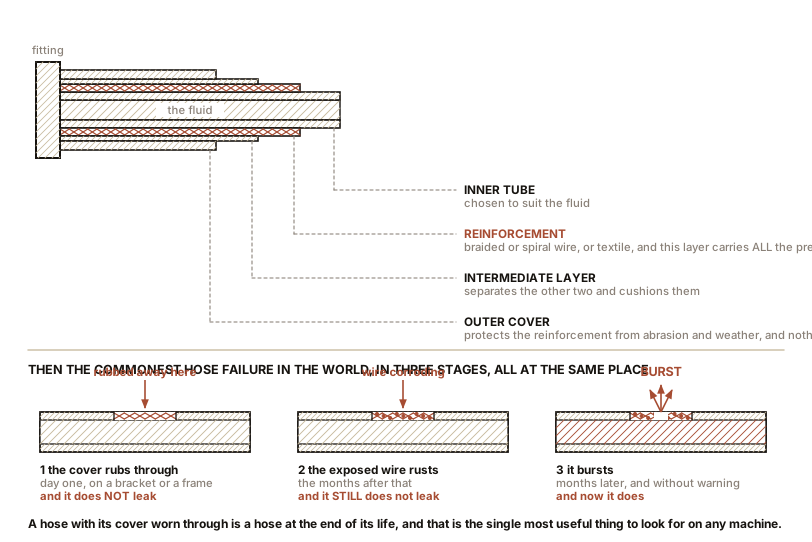
Hoses have four layers and each one has its own failure.
An inner tube compatible with the fluid; a reinforcement of braided or spiral wire or textile, which carries the pressure; sometimes intermediate layers; and an outer cover whose only job is to protect the reinforcement from abrasion and weather.
So the commonest hose failure in the world is abrasion of the cover, which does not leak and does not affect performance, followed some months later by corrosion of the exposed wire, followed by a burst. A hose with its cover worn through is a hose at the end of its life, and this is the single most useful thing to look for on any machine.
Four rules, and they are all about installation rather than about the hose.
Respect the minimum bend radius, which is printed on the hose and is typically eight to twelve times the outside diameter. A hose bent tighter than that at the fitting is the classic installation failure, and the fix is usually an elbow fitting.
Allow for length change. A hose changes length under pressure, typically anywhere from 4 percent shorter to 2 percent longer depending on its construction. So never install a hose taut, and never install it so that machine movement stretches it.
Never twist a hose. Torsion on a braided hose cuts its life dramatically, because it unwinds one layer of braid and overtightens the other. Route so that flexing happens in one plane.
And treat hoses as a time-based replacement item. Rubber ages whether it works or not. Manufacturers and standards bodies commonly recommend replacement at four to six years of service and no more than ten years from the date of manufacture, which is moulded onto the hose. A twenty-year-old hose that has never leaked is not proven; it is overdue.
Everything so far ruins equipment. The next chapter is about the two failures that ruin people, and they get a chapter to themselves because burying them at the end of a long one is exactly how they get skipped.

Bench Degree
Get the degree without the diploma.
Learn the material, not how to pass the exam.