Bench Degree·LASERSchapter

Chapter 3: Absorb, Emit, and the Trick in Between
Throw table salt into a gas flame and it turns orange. That orange is one exact wavelength, chosen by the sodium atom and by nothing else, and understanding why is the first half of understanding a laser.
Light a gas ring or a camping stove, get the flame as blue and clean as it will go, and flick a few grains of table salt into it.
The flame turns a hard orange-yellow. Not a warm glow. A specific, saturated, slightly unpleasant orange, exactly the colour of an old sodium streetlamp, because it is the same thing happening.
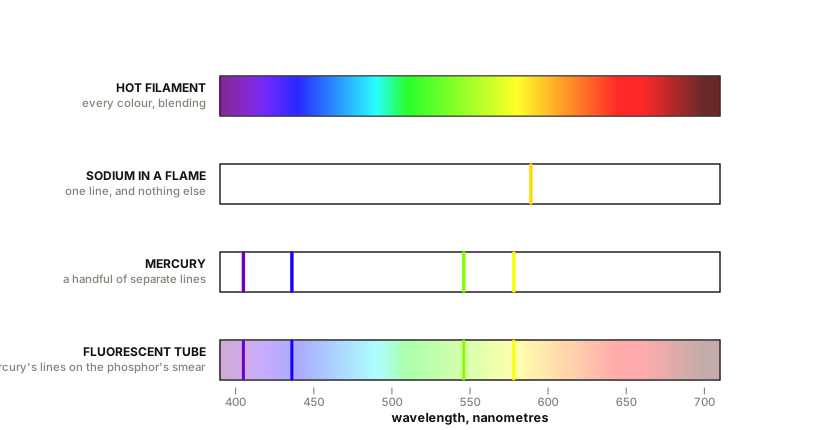
Now look at that flame through a diffraction grating, or through the edge of a CD held at a shallow angle, and compare it with a look at an ordinary incandescent bulb.
The bulb fans out into a continuous rainbow, every colour blending into the next with nothing missing.
The salted flame does not. It gives you one bright line, or on a good grating a close pair of them, sitting in near-blackness. There is no rainbow. There is one colour and almost nothing else.
ON THE BENCH: One atom, one colour
Parts: a gas flame; table salt; a diffraction grating, or a CD or DVD; an incandescent or halogen bulb for comparison; a fluorescent tube or CFL if you have one; a neon indicator lamp if you have one. Cost: nothing. Time: 20 minutes, and it is worth doing properly in a dark room. Hazards: an open flame. Nothing else. Method: hold the grating close to your eye and look toward each source in turn, slightly to one side of it, so you see the spread-out spectrum rather than the source itself. What you should see: the bulb gives a continuous band. The salted flame gives a single strong yellow line. A fluorescent tube gives a mixture: a few sharp bright lines from the mercury inside, sitting on a broad smear from the phosphor coating. A neon indicator gives a fistful of separate red and orange lines. What it proves: hot solids emit every colour. Individual atoms emit particular colours and refuse the rest, and each element’s set of colours is its own and no one else’s.
Section 1: Why an Atom Has Favourite Colours
An electron bound to an atom cannot have any energy it likes. It is restricted to a set of specific values, and the values are fixed by the atom’s own structure. Nothing in between is available.
That is the fact from which everything else here follows, and it is worth stating without dressing it up: the allowed energies are a list, not a range.
So when an electron drops from a higher allowed energy to a lower one, the energy it sheds is not arbitrary. It is exactly the difference between two entries on that list. And it leaves as a single particle of light, a photon, carrying exactly that much energy.
Photon energy and wavelength are the same statement twice:
photon energy in eV = 1240 / wavelength in nmSo sodium’s orange line at 589 nm is a photon of about 2.1 eV, and that is the size of one particular step in sodium’s own list of energies. Every sodium atom in the universe has the same list, so every sodium atom emits the same orange. Which is why the streetlamp and the salted flame are the same colour, and why a spectrum identifies an element as reliably as a fingerprint.
A hot filament gives every colour because it is not doing this at all. In a solid, the atoms are crowded so tightly that their individual energy levels smear into continuous bands, and the light comes out as thermal radiation across the whole spectrum. Isolated atoms give lines. Crowded ones give a rainbow. That distinction is worth carrying, because a laser needs the line.
Section 2: Three Things a Photon and an Atom Can Do
There are exactly three interactions, and a laser is built entirely out of the third.
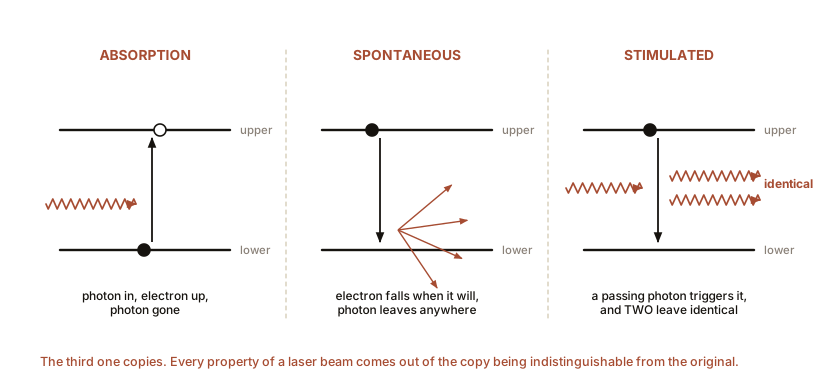
Absorption. A photon arrives at an atom in a low state, its energy happens to match a step in that atom’s list, and it is taken up. The photon is gone. The electron is now in a higher state. If the energy does not match a step, nothing happens at all and the photon carries on, which is why glass is transparent and why a green laser passes through a red filter poorly and through window glass perfectly.
Spontaneous emission. An atom sitting in a raised state does not stay there. After some characteristic time it drops back down and emits a photon. Two things about that photon matter enormously and are almost always glossed over:
It leaves in a random direction. Nothing about the atom favours one way over another.
And it leaves at a random moment, with no relationship to any other photon. Its phase is its own.
That is every lamp in history. A candle, a filament, a fluorescent tube, an LED, the sun. Countless atoms independently deciding to drop, each throwing a photon somewhere with no reference to its neighbours. The result is light going everywhere, out of step with itself, which is exactly why Chapter 1’s flashlight spreads and does not speckle.
Stimulated emission. This one is not obvious and it took Einstein to see it, in 1917.
An atom is sitting in a raised state, and a photon happens by whose energy matches the step that atom is about to take anyway. The passing photon can trigger the drop. The atom emits, and now there are two photons where there was one.
And here is the entire subject in one word: the new photon is identical to the one that triggered it.
Same wavelength. Same direction of travel. Same phase. Same polarisation. Not similar. Indistinguishable.
IN PLAIN ENGLISH: A photon passing an excited atom can knock its light loose, and the light that comes out is a perfect copy of the photon that knocked it. One becomes two. Two become four. That is amplification of light, it is where the word laser comes from, and the copies are what make the beam march in step.
Section 3: The Copying Is Why the Beam Behaves
Every property Chapter 1 observed now has a cause, and they all come from that one word.
One colour, because a copy has the same wavelength as its original. Amplify by copying and you cannot drift in colour.
One direction, because a copy travels the way its original was travelling. Chapter 5 exploits this hard: put mirrors at each end and only the photons already going along the axis get amplified, because those are the ones that make the trip again and again. Everything travelling at an angle leaves through the side and is lost. The beam is not aimed. It is what survives.
In step, because a copy shares its original’s phase. Which is coherence, and it is why the dot speckled on your wall.
Three observations from a wall and a keychain, one mechanism underneath all of them.
Section 4: Why It Is Not Easy
If stimulated emission copies photons, why is not every lamp a laser? A fluorescent tube has plenty of excited atoms and plenty of photons rattling about inside it.
Because absorption is the same process running backwards, and normally it wins.
Look at what each requires. Stimulated emission needs a photon to meet an atom that is already excited. Absorption needs a photon to meet an atom in the ground state. The two are in direct competition for the same photons, and the winner is decided by simple arithmetic: whichever population is larger.
In any ordinary material, at any ordinary temperature, the great majority of atoms are in the ground state. Overwhelmingly so. So a photon travelling through it is far more likely to meet an unexcited atom and be swallowed than to meet an excited one and be copied.
Light passing through ordinary matter is therefore attenuated, which is the universal experience and the reason a thick pane of glass is dimmer than a thin one.
To amplify light instead of absorbing it, you need to arrange something that does not happen anywhere in nature by itself: more atoms excited than not.
That arrangement has a name, it is the subject of the next chapter, and it is the hard part of building a laser. Stimulated emission is free. Getting the population the wrong way up is what all the engineering is for.
SLOW DOWN. Check Your Understanding: A fluorescent tube is full of excited mercury atoms and full of photons at exactly the wavelengths mercury emits. Stimulated emission must therefore be happening inside it. Why does it not turn into a laser? Think about the two conditions before reading on.
Stimulated emission is happening, continuously, and it contributes a trickle of copied photons. It loses on both counts that matter. First, the excited atoms are still a small minority of the whole population, so absorption dominates and any amplification is more than cancelled. Second, and just as important, there is nothing sending the light back through the gas. A photon crosses the tube once and hits the glass. Amplification needs a long path, and Chapter 5 is about buying one with two mirrors. A laser is not a different phenomenon from a fluorescent tube. It is the same phenomenon with the population turned over and the light made to go round again.

Bench Degree
Get the degree without the diploma.
Learn the material, not how to pass the exam.