Bench Degree·LASERSchapter

Chapter 4: Population Inversion, and Why It Is Hard
Nature keeps the majority of atoms in the ground state, always. Every laser ever built is a machine for holding that fact upside down, and the whole difficulty is that it will not stay there on its own.
Chapter 3 ended with the requirement: more atoms excited than unexcited, or light passing through gets absorbed rather than amplified.
Start with why that is such an unnatural thing to ask for.
At equilibrium, the split between two energy levels follows one relationship, and the only quantities in it are the energy gap and the temperature. The higher level always holds fewer atoms than the lower one, and for a visible-light-sized gap at room temperature it holds vastly fewer. Not a bit fewer.
Put a number on it. A red photon is about 2 eV, and room temperature is about 0.025 eV in the same currency. The ratio of populations goes as an exponential in the quotient of those two, which is 80. The excited population is smaller by a factor of e to the minus eighty, which is a number with thirty-five zeros after the decimal point before anything interesting happens.
So in a red-emitting material at room temperature, essentially nothing is excited. Not a minority. Effectively nothing.
IN PLAIN ENGLISH: Left alone, matter puts almost every atom in its lowest state and keeps them there. A laser needs the opposite, so a laser is never left alone. Something has to be pushing energy in continuously, and the moment it stops the material reverts within microseconds.
That state, more atoms up than down, is called a population inversion, and the word inversion is doing honest work: it is the natural order turned over.
Section 1: Why Two Levels Cannot Work
The obvious approach is the one that fails, and seeing exactly how it fails explains the shape of every real laser.
Take a material with two energy levels. Shine light of the right energy at it to push atoms from the lower to the upper. Pump hard, and up they go.
But the same light also triggers stimulated emission back down, because Chapter 3’s third process works in both directions and with equal probability per atom. Every photon you send in is as likely to knock an excited atom down as to lift a ground-state atom up.
So as the upper population grows, the downward rate grows with it. The two rates converge, and they meet when the populations are equal.
Equal is not inverted. At exactly fifty-fifty, absorption and stimulated emission cancel: the material has become perfectly transparent and amplifies nothing. And no amount of extra pumping gets past it, because the harder you pump the harder the pump itself knocks atoms back down.
A two-level system saturates at transparency and can never amplify. It is not a matter of insufficient effort. It is arithmetically closed.
Every real laser therefore has at least three levels, and the reason is always the same: to separate the level you pump into from the level you lase from, so that the pump is not fighting itself.
Section 2: Three Levels, and Ruby
The first working laser, Maiman’s in 1960, was a rod of synthetic ruby, and it is a three-level system.
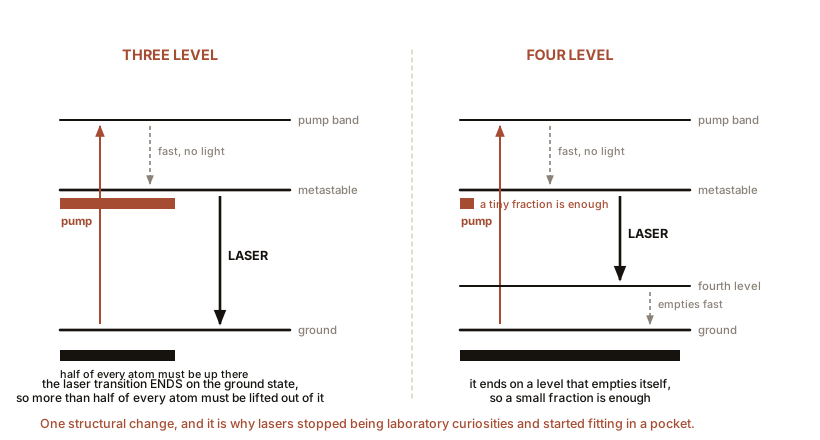
The route. Pump from the ground state up to a high, short-lived band. From there the atom drops quickly and without emitting useful light into an intermediate level. That intermediate level is metastable: it holds atoms for an unusually long time, milliseconds rather than nanoseconds. Atoms accumulate there. The laser transition is from that metastable level back down to the ground state.
Why the separation helps. The pump acts on the ground-to-high transition. The lasing acts on the metastable-to-ground transition. They are different energies, so the pump light cannot stimulate the laser transition, and Section 1’s trap is avoided.
Why it is still hard, and this is the point. The lower laser level is the ground state, which is where nearly every atom starts. To get more atoms in the metastable level than in the ground state, you must lift more than half of every atom in the rod out of the ground state and park it upstairs.
That is an enormous pumping requirement, and it is why Maiman’s laser used a photographic flashlamp coiled around the rod and fired in a brief pulse. Continuous operation was out of the question at first: you cannot hold half a crystal excited indefinitely without destroying it.
SLOW DOWN. Check Your Understanding: A three-level laser needs more than 50% of its atoms excited before it produces any light at all. Below that threshold it emits nothing useful, however hard you pump. Why “nothing useful” rather than “a little”? Think about what the un-inverted majority is doing.
Because below inversion the material is a net absorber. Photons produced by stimulated emission are more likely to meet a ground-state atom and be swallowed than to meet another excited atom and be copied, so the light dies before it can build. There is no gentle onset. The material is opaque, then transparent, then amplifying, and the transition through those states is abrupt, which is Chapter 5’s threshold.
Section 3: Four Levels, Which Is Why Lasers Became Ordinary
The fix arrived quickly and it is elegant. Add a fourth level, just above the ground state, and lase into that instead.
The route. Pump from ground up to a high band. Drop quickly to a metastable level. Lase from the metastable level down to a fourth level that sits a little above the ground state. Then let atoms fall from that fourth level back to ground, fast.
And now look at what has changed. The lower laser level is no longer the ground state. It is a level that empties itself almost instantly, so it is essentially always nearly empty.
Which means the inversion condition is trivial. You do not need more atoms upstairs than in the ground state. You need more atoms upstairs than in a level that holds almost nothing. A tiny fraction of the total population is enough.
That single structural change is why lasers stopped being laboratory curiosities. A four-level system reaches threshold on a small fraction of a percent of its atoms rather than on half of them, which means modest pumping, continuous operation, and a device that runs off a battery in your pocket.
Almost everything you will meet is four-level: helium-neon, neodymium-YAG, most dye lasers, and the semiconductor diodes of Chapter 7 by an analogous argument. Ruby is three-level and is now a museum piece for exactly this reason.
Section 4: The Metastable Level Is the Whole Trick
Both schemes depend on one thing being true, and it is worth isolating because it is easy to read past.
Ordinary excited states are short-lived. An atom lifted up drops back down by spontaneous emission in something like a nanosecond. If every level behaved that way, atoms would never accumulate anywhere and no inversion could be built at any pumping rate.
A metastable level is one the atom is reluctant to leave. For quantum-mechanical reasons the ordinary route down is suppressed, so its lifetime is a thousand to a million times longer than usual: microseconds to milliseconds.
That long lifetime is a reservoir. Atoms flow in from the pump faster than they leak out on their own, so the population there climbs.
And it is also what makes pulsed lasers possible, which is Chapter 9’s subject in full. If a level can hold energy for a millisecond, you can spend a whole millisecond filling it and then release everything in a nanosecond. A million-to-one concentration in time, and it is the reason a device drawing less than a kettle can produce a gigawatt.
So when a specification quotes an upper-state lifetime, that number is telling you how much energy the material can bank and therefore what kind of pulse it can produce. Neodymium-YAG’s 230 microseconds is the reason it dominates pulsed work.
Section 5: Pumps
Getting energy in is a separate engineering problem from what the material does with it, and there are four ways in practice.
Flashlamp. A high-voltage discharge in a xenon tube alongside or coiled around the gain medium. Brutal, broadband, inefficient, and it wastes most of its output at wavelengths the medium cannot use, which appears as heat in the rod. This is what Maiman used and it dominated solid-state lasers for decades.
Electrical discharge. Run a current through a gas and the collisions of Chapter 6 of the Plasma volume do the exciting. Helium-neon and carbon dioxide lasers work this way, which makes them, structurally, glow discharges with mirrors on the ends.
Another laser, which is called diode pumping. Use a cheap high-power diode emitting exactly the wavelength the medium absorbs best. Nothing is wasted on wavelengths that only heat the rod, so efficiency improves several-fold and the waste heat problem largely goes away. This is what killed the flashlamp, and it is also what is inside your green pointer: an 808 nm diode chosen because neodymium absorbs 808 nm strongly.
Direct current injection. In a semiconductor there is no separate pump at all. Run current across a junction and the carriers arrive already in the right states. The pump and the gain medium are the same object, which is why a laser diode is a component rather than an apparatus, and why it costs cents.
IN PLAIN ENGLISH: A laser is a leaky bucket you are filling faster than it drains. The metastable level is the bucket, the pump is the tap, and the leak is spontaneous emission. Turn off the tap and the bucket is empty within a millisecond.
Section 6: What You Now Have, and What Is Still Missing
Amplification is available. A material with an inversion will copy a photon into two, and Chapter 3 established that the copy is indistinguishable.
And it is not enough. The gain per pass through a typical medium is small: a photon crossing a helium-neon tube once might have its chances improved by a few percent. That is nowhere near enough to turn a spontaneous flicker into a beam.
The missing piece is path length. If one pass gives a few percent, then a hundred passes give a great deal, and a thousand passes give a beam.
Buying a thousand passes out of a tube 300 mm (12 in) long is the subject of the next chapter, and the answer is two mirrors. It also delivers, as a side effect that turns out to matter more than the amplification, the reason a laser beam is a beam at all.

Bench Degree
Get the degree without the diploma.
Learn the material, not how to pass the exam.