Bench Degree·LASERSchapter

Chapter 5: The Cavity
Two mirrors facing each other, one of them slightly leaky. That is the whole apparatus, and it does two jobs at once: it makes the light travel far enough to be amplified, and it throws away every photon that was not going straight.
Chapter 4 left an amplifying medium and a problem. One pass through it multiplies the light by a few percent, and a few percent is not a beam.
The fix is to send the light through again. And again. Put a mirror at each end and a photon travelling along the axis bounces back and forth, being amplified on every crossing.
A helium-neon tube 300 mm (12 in) long, with mirrors reflecting 99.9% and 99%, will pass a photon back and forth something like a hundred times before it leaves. A hundred passes at a few percent each is not a few percent. It is a factor of many.
That is the obvious job, and it is the less important of the two.
Section 1: The Job Nobody Mentions
Consider what happens to a photon emitted not along the axis.
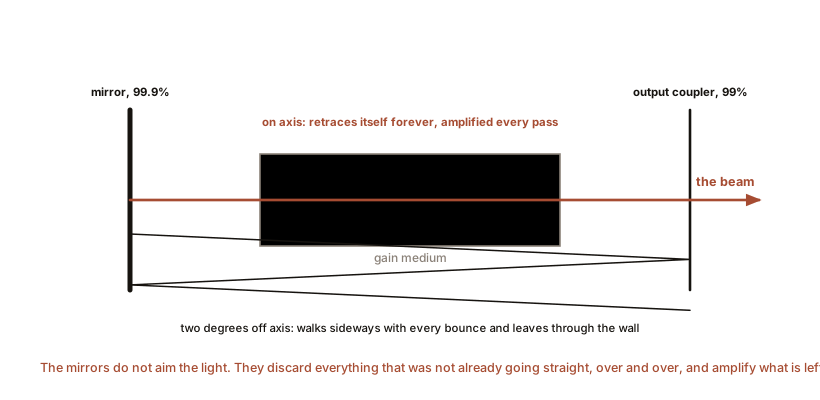
It is produced by spontaneous emission, so its direction is random. Say it leaves at two degrees off-axis. It crosses to the far mirror, reflects, comes back at two degrees the other way, and after a handful of round trips it has walked sideways out of the tube and is gone.
A photon travelling exactly along the axis retraces its own path forever.
So the cavity is a filter, and it is a brutally selective one. Only light travelling almost exactly parallel to the axis survives enough round trips to be amplified. Everything else leaves through the side before it can build.
Which is the real answer to why a laser beam is a beam. Not because anything aims it. Not because a lens collimates it. Because the cavity kills everything that was not already going straight, and the surviving photons then copy themselves, and Chapter 3 established that a copy travels the way its original was travelling.
IN PLAIN ENGLISH: The mirrors do not point the light. They discard, over and over, every photon that is not going the right way, and amplify the ones that are. The beam is a survivor, not a product.
That is also why a laser can be collimated to a degree no lamp and no lens can match. A lens can only reshape the light it is given. The cavity selects, and selection can be arbitrarily strict.
Section 2: Threshold, and How Abrupt It Is
The cavity gives gain per round trip. It also has losses: the mirrors are not perfect, the medium scatters a little, and the output mirror is deliberately leaky because otherwise no light ever gets out.
Balance those and you get the condition every laser lives or dies by:
Gain per round trip must exceed loss per round trip.
Below that, light dies out faster than it builds, and the device is a faintly glowing tube. Above it, light builds until something else limits it. And the crossing is not gradual.
Here is why it is sharp. Below threshold the light in the cavity is whatever spontaneous emission happens to produce: random, weak, going nowhere. Cross threshold and the round-trip multiplication is greater than one, so the light grows exponentially with each pass. Within a few hundred round trips, which is microseconds, it has grown by many orders of magnitude and saturated the gain medium.
A fraction of a percent more pump takes you from a dim lamp to a laser, and the change is visible with the naked eye: the light leaps in brightness, collapses to a small spot, and starts to speckle.
ON THE BENCH: Watch a threshold, using a pointer and a freezer
Parts: a cheap green laser pointer; a freezer or a bag of ice; a warm room. Cost: nothing. Time: 30 minutes, mostly waiting. Hazards: Class 2 rules from Chapter 2 throughout, and point it at a wall. Method: shine the pointer at a wall at room temperature and note the brightness. Now put it in a freezer for fifteen minutes, take it out and shine it immediately, watching for the first few seconds as it warms. Then warm it in your hands to well above room temperature and try again. What you should see: the output changes markedly with temperature, and on many cheap units it drops sharply or flickers when hot and is at its brightest somewhere cool. You are watching the device move toward and away from threshold. Why it happens, which is Chapter 8’s subject: a green pointer relies on a crystal converting one wavelength into another, and that conversion is exquisitely sensitive to temperature. Warm it and the conversion falls off, the light in the cavity drops, and the device slides back toward threshold. This is also why a cheap green pointer is unreliable in cold weather and dies on a hot dashboard. A caution that matters: on a unit missing its infrared filter, the green falling off does not mean the output has fallen off. It means the visible part has. Chapter 2, Section 5.
Section 3: The Output Mirror Is a Compromise
One mirror is made as reflective as possible, typically 99.9%. The other, the output coupler, is deliberately partially transmitting, and choosing how transmitting is a genuine design trade.
Let too little out and the beam is feeble even though the light inside the cavity is intense. All that circulating power is doing nothing for you.
Let too much out and the round-trip gain no longer exceeds the round-trip loss, and the laser drops below threshold and stops entirely.
The optimum is somewhere in between and depends on how much gain the medium provides. A high-gain medium can afford a leaky output coupler, sometimes 50% or worse. A low-gain medium like helium-neon needs a very good one, around 99%, which is why a helium-neon tube is full of bright light and emits a milliwatt.
Which explains an experience anyone who has opened a laser will have had. The light inside the cavity is far more intense than the beam that comes out. A 1 mW helium-neon has perhaps 100 mW circulating between its mirrors. Opening a cavity, or getting a finger into one, is a different hazard from standing in the output beam, and it is one that Chapter 2’s classification does not describe, because classification is about the accessible beam.
Section 4: Modes, and What They Look Like
Two kinds of structure appear in the light, and they are named for the two directions in which the cavity has a shape.
Along the axis: longitudinal modes
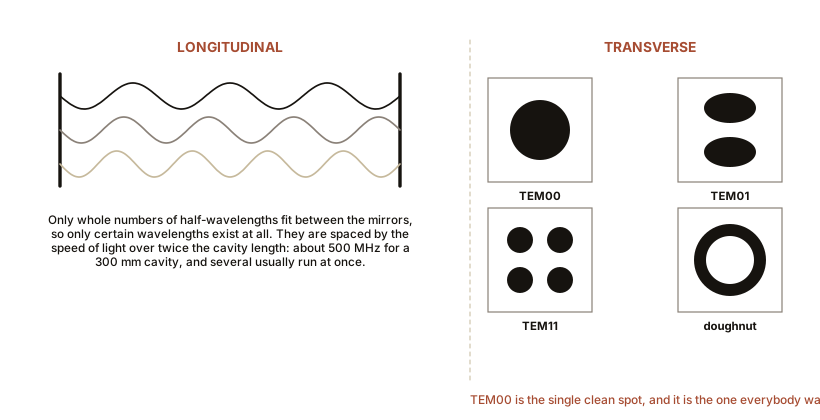
The light bouncing between two mirrors is a standing wave, and a standing wave only fits if a whole number of half-wavelengths spans the gap. So only certain wavelengths can exist in the cavity at all, spaced by:
mode spacing in Hz = speed of light / (2 × cavity length)For a 300 mm (12 in) cavity that is about 500 MHz between adjacent modes. The gain medium will amplify a band of wavelengths some gigahertz wide, so several of these modes are usually running at once, and a laser’s output is often a comb of a few closely spaced wavelengths rather than one.
Which is why coherence has a length. Chapter 1’s speckle worked because the light interferes with itself, and how far apart two paths can be and still interfere is the coherence length. A multi-mode laser has a coherence length of centimetres. A single-mode one can have kilometres. Chapter 11’s interferometer cares enormously about this, and it is the reason a cheap pointer will show you fringes over a short path and not a long one.
Across the axis: transverse modes
The beam also has structure across its width, set by the cavity’s mirror shapes and aperture, and these are labelled TEM with two numbers.
TEM00 is the fundamental: a single spot, brightest in the middle, falling away smoothly, with a Gaussian profile. It is the one everybody wants, because it diverges the least and can be focused the smallest.
Higher modes have dark lines through them and look like two spots, or four, or a doughnut. They carry more power for a given cavity but they focus badly and spread faster.
Getting TEM00 is done by making the cavity narrow enough that nothing else fits, which throws away power in exchange for beam quality. That trade has a number attached to it, and it is Chapter 6.
Section 5: What the Cavity Cost
Every good thing in Chapter 1 came from this chapter’s two mirrors, and each has a price attached.
Monochromatic, because only wavelengths that fit the standing wave survive, and only where the medium has gain. Cost: the exact wavelength drifts if the cavity length drifts, so a laser stabilised to a fixed frequency is a temperature-controlled instrument.
Collimated, because off-axis light is discarded. Cost: most of the light the medium produces is thrown away, which is a large part of why lasers are inefficient.
Coherent, because the surviving photons are copies of each other and of a standing wave. Cost: it holds only over the coherence length, which is set by how many longitudinal modes are running.
Three properties, two mirrors, and every one of them a compromise you can read off a specification sheet once you know what the numbers are for.
Next: the beam itself. No beam is truly parallel, the limit is fundamental rather than a manufacturing failure, and the number that describes how close a real beam gets to it is the single most useful figure on any laser’s datasheet.

Bench Degree
Get the degree without the diploma.
Learn the material, not how to pass the exam.