Bench Degree·LASERSchapter

Chapter 6: What Sets the Beam
Measure your pointer’s dot at two distances and you can compute, with a tape measure, how close its beam comes to the best any beam is permitted to be. No beam is parallel, and the reason is not poor manufacturing.
Tape a sheet of paper to a wall, put the pointer on a stack of books 1 m (3.3 ft) away, and mark the edges of the dot with a pencil. Then move the whole stack back to 5 m (16 ft) and mark it again.
The dot is bigger. Not dramatically. On a decent pointer it might go from 2 mm (0.08 in) to about 8 mm (0.31 in), which is easy to miss and is the whole subject of this chapter.
Divide the growth by the distance you moved and you have the beam’s divergence, the angle at which it opens out:
divergence = (far diameter − near diameter) / (far distance − near distance)(8 − 2) mm / 4000 mm = 0.0015 radians = 1.5 milliradians
ON THE BENCH: Measure divergence, and then the beam waist
Parts: a laser pointer; a tape measure; paper and a sharp pencil; a hallway or a garden. Cost: nothing. Time: 45 minutes. Hazards: Chapter 2’s rules. Beam horizontal at bench height, aimed at a wall, nobody in the path. Method: mount the pointer so it cannot move. Mark the dot at two well-separated distances, the further the better; 1 m and 10 m (3.3 and 33 ft) is much better than 1 m and 3 m. Measure the dot as the width across which it is clearly bright, and be consistent about it rather than precise, since the same judgement at both distances cancels out. What you should get: somewhere between 0.5 and 3 milliradians for a consumer pointer. Then compute the beam waist, which is Section 2’s formula rearranged:
waist = wavelength / (pi × divergence). For a 650 nm pointer at 1.5 mrad, that is650 / (3.14 × 0.0015)nanometres, or about 0.14 mm (0.005 in). Now the interesting part. Open the pointer and look at the aperture the beam leaves through. On most units it is more like 1 to 3 mm (0.04 to 0.12 in). Your computed waist is much smaller than the real aperture, which means the beam is diverging faster than the diffraction limit allows for its size. That discrepancy is Section 3, it has a number, and it is on every datasheet.
Section 1: Why Nothing Can Be Parallel
Take a perfectly collimated beam and pass it through a hole. Common sense says you get a narrower beam. What you actually get is a beam that spreads more than it did before.
That is diffraction, and it is not an imperfection in the hole. Light passing any aperture spreads by an angle in the region of the wavelength divided by the aperture width, and this is a property of waves rather than of optics.
Which sets up a trade you cannot escape. A narrow beam has, in effect, passed through a narrow aperture, so it spreads fast. A wide beam has passed through a wide one, so it spreads slowly.
You cannot have both small and parallel. Squeeze the beam and it fans out. Let it be broad and it stays together. This is the same relationship that limits telescopes, microscopes and radio dishes, and it is the reason the diameter of a lens is the thing that matters most about it.
IN PLAIN ENGLISH: Light spreads because it is a wave, and the narrower you confine it the harder it pushes back. A perfectly parallel beam would have to be infinitely wide. Every real beam is a compromise between how small it is and how far it will go without opening up.
Section 2: The Best Any Beam Is Allowed to Be
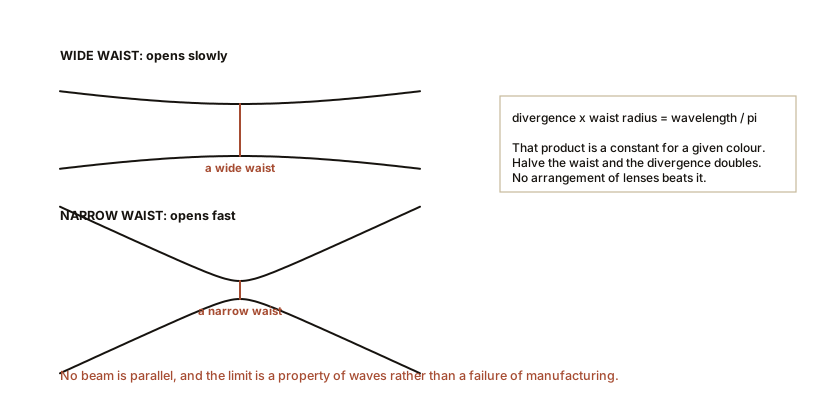
For the ideal case, the TEM00 Gaussian beam of Chapter 5, the relationship between a beam’s narrowest point and its far-field divergence is exact:
divergence × waist radius = wavelength / piThat product is a constant for a given colour of light, and it is the whole content of the diffraction limit in one line. Halve the waist and the divergence doubles. There is no arrangement of lenses that beats it.
Three consequences worth having.
A bigger aperture always wins at distance. To send a beam a long way, expand it first. This is why a laser rangefinder has a lens on the front, why the moon-ranging experiments used telescopes to transmit, and why Chapter 2’s hazard distance depends on divergence so strongly.
Blue goes further than red, all else equal. Shorter wavelength, smaller product, less divergence for the same aperture.
And the beam has a waist rather than an origin. A laser beam converges to its narrowest point and then diverges again, like an hourglass. The waist may be inside the cavity, or metres in front of it, and the “size of the beam at the laser” is not a meaningful number on its own.
Section 3: M-Squared, the Most Useful Number on the Sheet
Real beams do worse than the limit, and the amount by which they do worse is quoted as a single figure called M squared, written M².
M² = (actual divergence × actual waist) / (ideal divergence × ideal waist)A perfect TEM00 beam has M² = 1. Nothing can be below 1; it is a floor, not a target.
A good single-mode helium-neon is around 1.05. A decent diode-pumped solid-state laser is 1.1 to 1.3. A bare laser diode is often 1.5 to 3, and asymmetric: worse in one axis than the other, because the emitting facet is a rectangle rather than a square. A high-power multimode fibre laser for cutting might be 5 to 20, deliberately, because for melting steel you want power and do not care about focusing to a point.
Why it is the most useful number: it tells you what the beam can be made to do, which power alone does not. M² sets the smallest spot a lens can focus the beam to, and therefore the highest intensity you can reach. A 100 W beam at M² = 10 cannot be focused as tightly as a 20 W beam at M² = 1, so for cutting thin material the weaker laser may cut better.
And it cannot be improved. No lens fixes M². A lens can trade waist against divergence along the curve, but the product is conserved, and M² is that product. You can only reshape a bad beam, never repair it, which is why beam quality is decided in the cavity and paid for in the pump.
SLOW DOWN. Check Your Understanding: A supplier offers two fibre lasers for cutting sheet metal, both 500 W. One is M² = 1.2 and costs three times as much as the other at M² = 8. For cutting 10 mm (0.4 in) mild steel, is the expensive one worth it? Think about what the cut actually needs before reading on.
Probably not, and this is where beam quality stops being a virtue and becomes a specification to match to a job. Cutting thick steel needs a wide kerf sustained through the depth of the plate, not a needle-fine focus at one plane. A very low M² beam focuses to a tiny waist and then diverges fast, so it is intensely hot in one plane and less so above and below it, which cuts thin material beautifully and struggles to keep a thick cut open. The higher M² beam has a longer usable depth of focus. For thin sheet, fine marking or engraving, the low number wins outright. For thick plate it can actively lose. Buy the beam for the job, and be suspicious of anyone selling beam quality as an unqualified good.
Section 4: Focusing, and Where the Intensity Comes From
One more relationship and this chapter has given you everything needed to reason about the industrial chapters.
Send a beam of diameter D through a lens of focal length f and it comes to a waist whose diameter is roughly:
spot diameter ≈ M² × wavelength × f / DRead that and three things fall out.
A shorter focal length gives a smaller spot, which is why cutting heads sit close to the work.
A wider input beam gives a smaller spot, which is counterintuitive and correct: expand the beam before the lens and the focus tightens. Every serious system therefore contains a beam expander.
And M² multiplies the whole thing directly, which is why it appears on the sheet.
Now put a number on why this matters. A 5 mW pointer spread over a 2 mm (0.08 in) dot is about 160 W/m², which is roughly bright sunlight. Focus that same 5 mW to a 10 µm (0.0004 in) spot and it is about 64 MW/m², which is four hundred thousand times sunlight, from a keyring.
Nothing was added. The power is identical. Intensity is power divided by area, and the whole of laser engineering is about the denominator. It is also, precisely and unavoidably, why Chapter 2 is where it is: your eye is a lens with a short focal length and a wide aperture, and it performs exactly this calculation on any beam that enters it.
Section 5: What to Read Off a Datasheet Now
Six numbers, and you can now say what each one will do.
| Figure | What it tells you |
|---|---|
| Wavelength | what it will be absorbed by, and how tightly it can focus |
| Power, or energy per pulse | how much there is |
| M² | how small a spot it can be focused to, and how far it will carry |
| Divergence | the far-field spread, and with it Chapter 2’s hazard distance |
| Beam diameter, and where | meaningless without the where, because of the waist |
| Pulse duration | Chapter 9’s subject, and the difference between a watt and a gigawatt |
Next: the families of laser, what each one is made of, and why the industry replaced its own workhorse inside fifteen years.

Bench Degree
Get the degree without the diploma.
Learn the material, not how to pass the exam.