Bench Degree·LASERSchapter
Chapter 7: Gas, Crystal, Dye, Diode
Four ways to build a gain medium, and the industry replaced its own hundred-year workhorse with one of them in about fifteen years.
Everything in Chapters 3 to 6 applies to any laser. What differs between them is what the excited atoms are sitting in, and that single choice sets the wavelength, the efficiency, the power available and the price.
Four families, and it is worth knowing which one you are holding.
Section 1: Gas
A tube of gas with mirrors on the ends and a discharge running through it. Structurally this is the glow discharge of the Plasma volume with the addition of two mirrors, and the excitation is done by electron collisions exactly as described there.
Helium-neon, at 632.8 nm red, was the laboratory standard for thirty years and is still the reference against which beam quality is judged. Helium is excited by the discharge and passes its energy to neon by collision, which is a neat trick: the gas that takes the energy in is not the gas that emits. Efficiency is dreadful, around 0.1%, so a 1 mW beam costs several watts at the wall. But the beam is superb, M² close to 1, and the wavelength is stable enough to use as a length standard. If you find one in a skip, keep it.
Argon ion gives blue and green at high power and was the workhorse of laser light shows and eye surgery. It is also a monster: kilowatts in for watts out, water cooling, and a tube with a finite life measured in hundreds of hours. Solid-state devices have displaced it almost entirely.
Carbon dioxide is the important one. It emits at 10.6 µm, deep in the infrared, and it is efficient by laser standards at 10 to 20%. It scales to kilowatts, and for four decades it was how industry cut and welded. Two consequences of that wavelength are worth carrying:
It is absorbed by almost everything organic, which is why a CO₂ laser cuts wood, acrylic, leather, paper and fabric beautifully. The energy is taken up right at the surface.
And it is reflected by bare metal, especially copper and aluminium, which is why CO₂ struggled with exactly the materials industry most wanted to cut. Section 4 is about how that ended.
It is also completely invisible, which is Chapter 2 Section 5 in its most industrial form. A CO₂ beam gives no warning whatsoever, and the cutting head has a visible pilot laser bolted alongside it purely so that a human can tell where the real beam is going.
Section 2: Crystal, or Solid-State
A transparent host crystal with a few atoms of something else scattered through it. The host holds the active atoms apart and conducts heat away; the dopant does the lasing.
Ruby, aluminium oxide doped with chromium, 694 nm. The first laser, and three-level, which is why it is now historical. Chapter 4 explains why.
Neodymium-YAG is the one that matters. Neodymium in yttrium aluminium garnet, emitting at 1064 nm. Four-level, so it reaches threshold easily. Its upper-state lifetime of 230 microseconds makes it the natural choice for pulsed work, which is Chapter 9. It runs continuous at hundreds of watts and pulsed at gigawatts of peak power. And it is in your pocket, because a green pointer is a neodymium laser with a conversion crystal, which is Chapter 8.
Ytterbium in fibre is Section 4.
Titanium-sapphire deserves a mention for one reason: it amplifies over an enormous band, roughly 650 to 1100 nm, and a laser can only make pulses as short as its bandwidth allows. Wide bandwidth means extremely short pulses, and titanium-sapphire is why femtosecond science exists.
Section 3: Dye
A fluorescent organic dye dissolved in a solvent, pumped by a flashlamp or another laser, and circulated because the dye degrades in the beam.
They are messy, involve pumping toxic solutions round a bench, and they have one property nothing else had: they tune. A dye laser can be adjusted continuously across tens of nanometres, and swapping the dye moves you to a different band entirely.
For decades that made them indispensable to spectroscopy, because the whole point there is to sweep a wavelength across a sample and see what it absorbs. Titanium-sapphire and optical parametric oscillators have taken most of that work, and dye lasers are now a specialist tool rather than a standard one. Worth knowing about mainly because tunability is the property to look for, and everything else on this page is essentially fixed in colour.
Section 4: Diode, and the Fifteen Years That Changed the Industry
A semiconductor junction. Run current across it and the carriers recombine, emitting light. The pump and the gain medium are the same object, which is the whole reason this family won.
No flashlamp. No discharge tube. No water cooling. No separate optical pump to align. A laser diode is a component, and it costs what components cost.
Nearly every laser a reader will own is one: the pointer, the barcode scanner, the fibre transceiver, the pump inside a green pointer, and the diode from a DVD burner that is the single most dangerous object in most hobbyists’ drawers.
The trade-off is beam quality. The emitting facet is a rectangle a few micrometres by a few hundred nanometres, so the beam is asymmetric and diverges hard, giving M² between about 1.5 and 3 and often much worse in one axis than the other. Chapter 6’s arithmetic says that limits how tightly it can be focused, and no lens repairs it.
The fibre laser, and how CO₂ lost
The development that reorganised industrial cutting was to combine the two families.
Take a long glass fibre, dope its core with ytterbium, and pump it along its length with a bank of cheap diodes. The fibre is the gain medium and also the waveguide, so the light is confined to a core a few micrometres across over tens of metres of path. Chapter 5’s cavity problem solves itself: the path length is enormous and the transverse mode is set by the fibre’s geometry rather than by mirror alignment.
The consequences were decisive.
Wavelength around 1064 nm rather than 10.6 µm. Ten times shorter, which by Chapter 6 means a spot ten times smaller for the same optics. And critically, metals absorb it far better than they absorb 10.6 µm, so copper and aluminium stopped being the problem they had always been.
Efficiency of 30 to 40% against CO₂’s 10 to 20%.
Nothing to align, no gas to replace, no mirrors to clean. A sealed fibre and a box of diodes.
And it delivers down a fibre, so the laser can sit in a cabinet and the cutting head can be on a robot arm across the room.
Industry changed over between roughly 2008 and 2023. A metal fabrication shop bought CO₂ in 2005 and fibre in 2020, and CO₂ is now largely confined to the organic materials it was always better at, which is why the laser cutter in a maker space is a CO₂ tube and the one in a steel shop is not.
Section 5: The Comparison, on One Page
| Family | Typical wavelength | Efficiency | M² | Where you meet it |
|---|---|---|---|---|
| Helium-neon | 632.8 nm | 0.1% | ~1.05 | old lab benches, alignment |
| Argon ion | 488, 514 nm | 0.03% | ~1.1 | historic light shows, surgery |
| Carbon dioxide | 10.6 µm | 10 to 20% | 1.1 to 2 | cutting wood, acrylic, fabric |
| Nd:YAG | 1064 nm | 1 to 5% flashlamp, 10 to 25% diode-pumped | 1.1 to 1.3 | marking, pulsed work, green pointers |
| Ti:sapphire | 650 to 1100 nm, tunable | few % | ~1.1 | femtosecond research |
| Dye | tunable, dye-dependent | few % | ~1.2 | spectroscopy |
| Diode | 405 to 1550 nm | 30 to 60% | 1.5 to 3 | almost everything you own |
| Ytterbium fibre | ~1064 nm | 30 to 40% | 1.1 to 20, by design | cutting and welding metal |
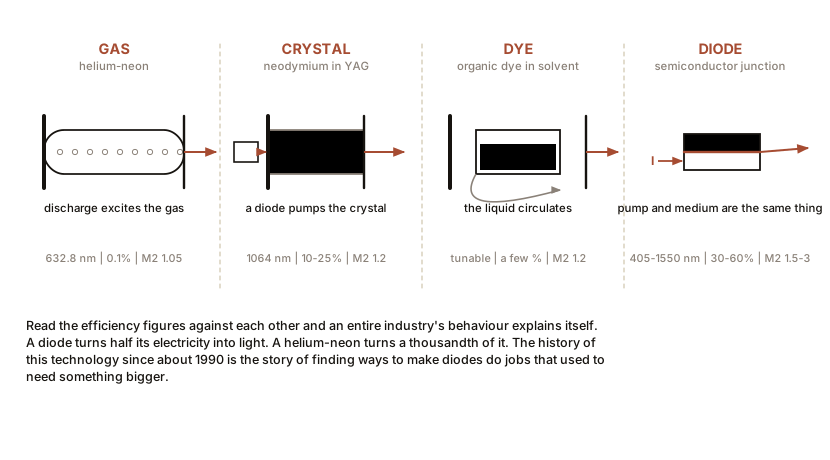
Read that efficiency column once more, because it explains an entire industry’s behaviour. A diode turns half its electricity into light. A helium-neon turns a thousandth of it. Everything else being equal, the diode wins, and the history of this technology since about 1990 is the story of finding ways to make diodes do jobs that used to need something bigger.
Next: the single best teardown in this series. That eight-dollar green pointer is four separate devices in a tube, one of them doing genuine nonlinear optics, and one of them is missing from the cheap ones.
Bench Degree
Get the degree without the diploma.
Learn the material, not how to pass the exam.