Bench Degree·LASERSchapter

Chapter 8: Inside a Green Laser Pointer, Which Is Four Devices
The green pointer on your desk contains an infrared laser, a second laser it pumps, a crystal that halves the wavelength of light, and a filter to clean up after them. The cheap ones leave out the filter, and that is the part that can hurt you.
Get a dead green pointer, or buy the cheapest one you can find and be willing to sacrifice it. Unscrew the head and tip the contents into your palm.
There is more in there than anyone expects. A brass or aluminium barrel, and inside it a stack: a small can with two wires, a slab of something transparent, a second slab of something else, and possibly a tiny disc of coloured glass. Then a lens.
That is not one laser. It is two lasers, a frequency converter and a filter, in a package smaller than your little finger, sold for about the price of a sandwich.
ON THE BENCH: Take one apart
Parts: a green laser pointer you are prepared to destroy, ideally a dead one; a small screwdriver; tweezers; a magnifier or a phone macro lens. Cost: under $10. Time: an hour. Hazards: remove the batteries and keep them out. A bare diode with power applied and no lens in front of it emits a wide, invisible, extremely intense beam, and it is the most dangerous configuration this book will describe. Do not power any part of this while it is disassembled. Take it apart cold, look at it, and leave it apart. Method: unscrew the head. The stack usually pushes out from the front. Lay the parts out in order and photograph them before you lose track of which way round they went. What you should find, front to back: a collimating lens; sometimes a small coloured filter disc; a slab with one mirrored face; a second slab; a diode can with two leads and a tiny window. What it proves: the visible green is manufactured in three stages from something you cannot see, and Section 5’s warning is a physical part you can look for and often fail to find.
Section 1: Stage One, the Pump Diode
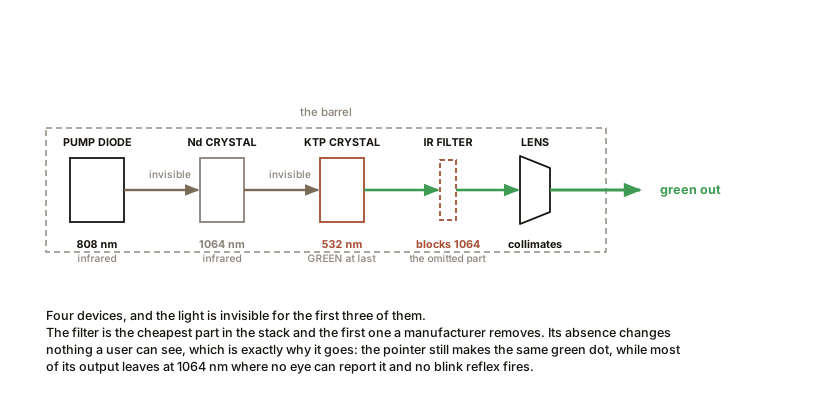
At the back is an ordinary semiconductor laser diode of the kind Chapter 7 described, emitting at 808 nm. That is infrared. It is invisible.
808 nm is not an arbitrary choice. It is where neodymium absorbs most strongly, so essentially all of the diode’s output is taken up by the next stage rather than wasted as heat. This is the diode pumping of Chapter 4 Section 5, and it is why the whole assembly can run off two watch batteries.
Everything else in the tube exists to turn this invisible infrared into visible green, and it does so with considerable losses at every step, which is why the green you get is a small fraction of the infrared you started with.
Section 2: Stage Two, the Neodymium Crystal
The 808 nm light lands on a slab of neodymium-doped crystal, usually neodymium-doped yttrium orthovanadate, and it does what Chapter 4 described: absorbs the pump, accumulates atoms in a metastable level, and lases.
It lases at 1064 nm. Also infrared. Also invisible.
The front face of this crystal, or a separate mirror against it, is one end of the laser cavity. So this is a complete Nd laser: a gain medium, a pump and a cavity, doing exactly what a laboratory Nd:YAG does, in a slab a couple of millimetres across.
And we are two devices in with nothing visible yet. Both stages emit only infrared, and if the tube stopped here you would have a pointer that appeared to be dead while emitting a hazardous invisible beam. Hold that thought until Section 5, because it describes a real failure mode rather than a hypothetical one.
Section 3: Stage Three, Which Is Real Nonlinear Optics
Now the interesting part, and the reason this chapter exists.
The 1064 nm light passes into a crystal of potassium titanyl phosphate, universally called KTP. What comes out is 532 nm, which is green, and 532 is exactly half of 1064.
That is not a coincidence and it is not a filter. Two photons went in and one came out carrying the energy of both. Twice the energy per photon means half the wavelength. The process is called second harmonic generation, or frequency doubling, and it is the same idea as an octave in music: the second harmonic is twice the frequency.
Why it needs a special crystal. In ordinary materials, a light wave’s electric field pushes electrons back and forth in proportion to the field. Push twice as hard, get twice the response. That is linearity, and a linear response cannot create a new frequency; it can only pass the ones it was given.
Some crystals, at high enough field strengths, respond disproportionately. Push twice as hard and you get slightly more than twice the response. That distortion is what generates the new frequency, in the same way that overdriving an audio amplifier generates harmonics that were not in the input. A frequency-doubling crystal is a deliberately non-linear optical element, and KTP is the cheap one that works well at 1064 nm.
Two consequences a reader will actually notice.
It needs intensity, not just power. The non-linearity only shows up at high field strength, which is why the doubling crystal sits inside the laser cavity, where Chapter 5 Section 3 said the circulating light is far more intense than the output beam. Put the same crystal in the output and it would produce almost nothing.
And the conversion is exquisitely temperature-sensitive, because the two wavelengths have to stay in step through the crystal’s thickness for the harmonic to build. Thermal expansion of a few micrometres destroys that. This is the direct cause of every cheap green pointer’s misbehaviour: dim when cold, dim when hot, flickering in between, and dying on a hot dashboard. It is also the experiment in Chapter 5 Section 2, and you now know what you were watching.
IN PLAIN ENGLISH: Two infrared photons go into a special crystal and come out as one green photon carrying both their energies. Nothing was filtered and nothing was selected. The colour was manufactured, and it only works when the light is intense and the crystal is at the right temperature.
Section 4: Stage Four, the Filter, and the Lens
The conversion is not complete. A well-made pointer converts perhaps 20% of the 1064 nm into 532 nm, which means around 80% of the infrared comes straight through the KTP crystal unconverted and heads out of the front of the device along with the green.
So a filter is fitted: a small disc that blocks 1064 nm and passes 532 nm. Then a lens collimates the beam, and you have a green pointer.
That filter is the last part in the stack and the first one a manufacturer removes to save money. It costs a few cents.
Section 5: What Happens When the Filter Is Missing
This is the section the chapter is for.
Consider a pointer sold as 5 mW green with no infrared filter. The 1064 nm getting through might be several times the green, so the total output could be 20 or 30 mW, of which the green is a small part.
The user sees a 5 mW green dot. By Chapter 2’s table that is Class 3R, low risk, and their blink reflex is a reasonable line of defence.
What is actually leaving the aperture is tens of milliwatts, most of it at 1064 nm. By Chapter 2 that is Class 3B territory, and the 1064 nm portion sits squarely in the retinal hazard region, is focused by the eye as efficiently as the green, and produces no sensation at all. There is no brightness to provoke aversion. No dazzle. No blink.
So the device is more hazardous than it appears, and its appearance is what a user calibrates against. A green dot that looks unimpressive reads as a weak laser, and the person forms habits accordingly: pointing it casually, not thinking about reflections, letting a child hold it.
How much of this happens in practice is not something this book can tell you. It is widely reported, it has been measured by independent testers, and it is consistent with the teardowns published by people who buy these devices in quantity and put meters on them. But we have not tested a statistically meaningful sample, and anyone who tells you a precise percentage of pointers on the market is probably guessing. What can be said with confidence is that the filter is a few-cent part with no effect on apparent performance, which is exactly the sort of part that gets left out, and that its absence is undetectable to the user without deliberate testing.
Which is why Chapter 2 gave you the test. A phone camera and something to block the visible green will tell you whether your own pointer leaks. It will not tell you how much.
Two practical positions follow.
Treat any cheap green pointer as though it emits infrared until you have checked. The check costs nothing.
And if you buy laser eyewear for a green laser, buy it rated for 1064 nm as well as 532 nm. Chapter 2 Section 6 explained why the alternative is worse than nothing: goggles that block only the green remove your caution and leave the invisible hazard untouched.
SLOW DOWN. Check Your Understanding: Two green pointers, both genuinely 5 mW of green. One has the infrared filter, one does not. Held at arm’s length and shone at a wall, can you tell which is which by looking? And which is more dangerous to a bystander thirty metres away? Answer before reading on.
You cannot tell by looking, and that is the entire problem. Both produce an identical 5 mW green dot, because the filter removes only light you could never see. Every visible cue is the same. As for the bystander: the unfiltered one, and by a wide margin, because Chapter 2’s hazard distance scales with the square root of power and the unfiltered device may be putting out four to six times as much total power. It is also worse in a way the arithmetic does not capture. The visible portion is what makes a person on the receiving end turn away. A beam that is mostly invisible reaches the retina of someone who never knew it was there, and their reflex was never given anything to respond to.
Section 6: What the Teardown Taught
Four devices, and the light is invisible for three of them. 808 nm in, 1064 nm in the middle, and only at the third stage does anything appear that a human eye can report.
Genuine nonlinear optics in a keyring. Frequency doubling was a laboratory technique in 1961 and it is now a two-dollar crystal in a pointer, which is a reasonable summary of what this whole technology did over sixty years.
And the cheapest part in the stack is the safety-critical one. That is worth generalising beyond lasers: when a component costs cents, affects nothing a customer can perceive, and protects against a hazard with no immediate symptom, it is the part to check first.
Next: how a device that draws less than a kettle produces a gigawatt, which is the distinction between energy and power and is the idea that unlocks every large laser in the rest of this book.

Bench Degree
Get the degree without the diploma.
Learn the material, not how to pass the exam.