Bench Degree·LASERSchapter

Chapter 9: Pulsed, and Where the Peak Power Comes From
A camera flash draws less power than a kettle and briefly outshines the sun. Understand why and you understand every large laser in the rest of this book.
Find a camera with a real xenon flash, or any cheap flashgun, and fire it in a dark room.
It is blinding. For an instant the room is brighter than daylight. Then nothing.
Now look at what it ran on. Two AA cells, or a small lithium pack. Those cannot deliver more than a few watts. A kettle uses two thousand.
So how did a few watts light a room brighter than the sun?
It did not. It spent a long time collecting a small amount of energy into a capacitor, and then released the whole lot in about a thousandth of a second. That is the entire trick, it has nothing to do with lasers specifically, and every large laser in existence is a more extreme version of it.
Section 1: Energy Is Not Power
Two quantities, constantly confused, and the confusion is what makes big numbers seem impossible.
Energy is a quantity, measured in joules. It is how much there is.
Power is a rate, measured in watts, and a watt is one joule per second. It is how fast you are spending.
power = energy / timeThe denominator is the whole game. Fix the energy and shrink the time, and the power goes up without limit, because you have not created anything, only concentrated it.
Run the flashgun. Say the capacitor holds 10 joules and dumps it in 1 millisecond:
10 J / 0.001 s = 10,000 W
Ten kilowatts from two AA cells. Nothing was invented. The cells spent five seconds charging the capacitor at a couple of watts, and the flash spent it a thousand times faster.
Now do the same arithmetic for a laser, with a shorter time.
One joule in one nanosecond:
1 J / 0.000000001 s = 1,000,000,000 W = 1 gigawatt
A gigawatt is roughly the output of a large power station, from a device that sipped one joule. One joule is what it takes to lift an apple a metre.
IN PLAIN ENGLISH: Peak power is not a measure of how much energy a laser has. It is a measure of how fast it was willing to let go of it. A gigawatt for a nanosecond is a smaller amount of energy than a reading lamp uses in a second.
Which is why every specification for a pulsed laser quotes three numbers and why you cannot skip any of them:
Energy per pulse, in joules or millijoules. How much. Pulse duration, in nanoseconds or femtoseconds. How fast. Repetition rate, in hertz. How often.
From those, peak power is energy divided by duration, and average power is energy multiplied by repetition rate. Those two numbers can differ by a factor of a million for the same device, and a supplier quoting only the flattering one is telling you something about themselves.
Section 2: The Reservoir Was Already There
Chapter 4 established the piece this depends on without dwelling on it: the metastable level is a store.
Neodymium-YAG holds atoms in its upper level for about 230 microseconds before they leak away by spontaneous emission. So if you pump for 230 microseconds you can accumulate a large inverted population before losing much of it.
That is a capacitor made of excited atoms. Fill it slowly, hold it briefly, and then find a way to make it discharge all at once.
The obvious problem: a laser above threshold does not accumulate. It lases, continuously, spending the inversion as fast as the pump builds it. The light in the cavity keeps the population pinned just at threshold and no higher.
So to store energy you must stop the laser from lasing while you pump it. Which is exactly what the next section does, and the method is elegant enough to be worth the page.
Section 3: Q-Switching, or How to Hold the Door Shut
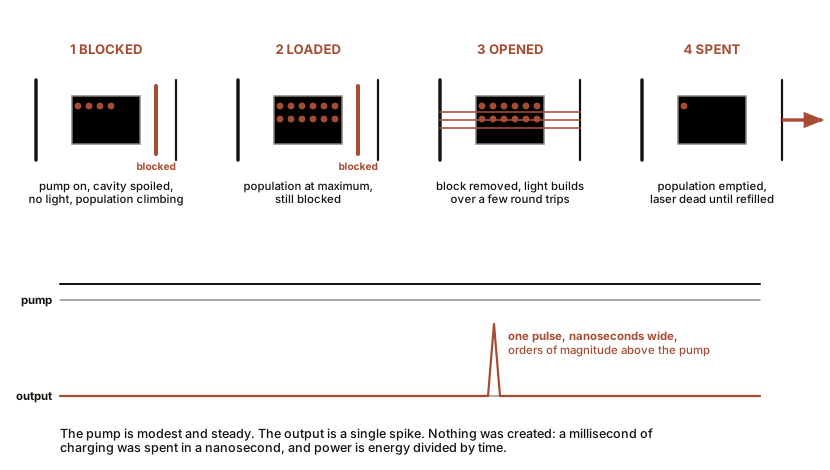
The trick is to spoil the cavity while pumping and then repair it suddenly.
Chapter 5 said a laser runs when round-trip gain exceeds round-trip loss. So introduce a deliberate, enormous loss inside the cavity. Block it. Now no amount of gain reaches threshold, and the pump piles atoms into the metastable level with nothing spending them.
Then, when the inversion is as large as the material will hold, remove the block in a few nanoseconds.
The cavity is now vastly above threshold, by a factor of many, and the light builds explosively. Chapter 5’s exponential growth runs its course in a handful of round trips, which for a 100 mm (4 in) cavity is a few nanoseconds. The entire stored inversion is converted to light in one burst and the laser drops dead until the pump refills it.
The name comes from Q, the quality factor of a resonator: low Q means lossy, high Q means good. You hold Q low, then switch it high. Q-switching.
Four ways to do the switching, and the progression is a good short history:
A spinning mirror. The earliest method: one cavity mirror on a motor, so the cavity is only aligned once per revolution. Crude, slow, and it worked.
Acousto-optic. A crystal with an ultrasonic wave in it, which diffracts the beam out of the cavity while the sound is on. Switch off the sound and the cavity is restored. Fast, and the standard for moderate rates.
Electro-optic, using a Pockels cell. A crystal whose polarising behaviour changes when a high voltage is applied to it, paired with a fixed polariser. Nanosecond switching, and the choice where timing must be exact.
Passive, using a saturable absorber. The elegant one. A material that is opaque at low light levels and becomes transparent when hit hard enough. It blocks the cavity while the inversion builds; when the light finally overcomes it, it bleaches clear and lets the pulse through, then recovers. No electronics, no timing, no trigger. The laser Q-switches itself, and this is what is inside a cheap laser pointer module sold as pulsed.
Section 4: Mode-Locking, Which Goes Very Much Further
Q-switching gives nanoseconds. To get picoseconds and femtoseconds you need a different idea, and it uses something Chapter 5 introduced as a nuisance.
Chapter 5 Section 4 said a cavity supports many longitudinal modes at once, spaced by the speed of light over twice the cavity length, and that several run together. Normally their phases are unrelated, so they add up to noise.
Force them all into step and something remarkable happens. Many waves of slightly different frequency, all in phase at one instant, add to a single sharp spike and cancel everywhere else. The more modes you can get in step, the sharper the spike.
That is mode-locking, and the result is a single
very short pulse circulating inside the cavity, emitting a burst each
time it hits the output mirror. The repetition rate is therefore fixed
by the cavity: one pulse per round trip, so c / 2L,
typically tens to hundreds of megahertz.
And the pulse length is set by bandwidth. This is the key relationship and it is a hard limit:
The shortest pulse a laser can make is roughly the reciprocal of the width of its gain band. A medium that amplifies a narrow range of wavelengths simply does not have enough modes to add up into anything sharp.
Which explains a fact from Chapter 7 that otherwise looks like trivia. Titanium-sapphire amplifies from about 650 to 1100 nm, which is an enormous band, which is why titanium-sapphire produces pulses of a few femtoseconds and why femtosecond science is built on it. Neodymium-YAG’s band is narrow, so mode-locked Nd:YAG gives tens of picoseconds and no better.
A femtosecond is worth pausing on. Light travels about 0.3 µm (0.000012 in) in one femtosecond. A ten-femtosecond pulse is a burst of light about three micrometres long, front to back. It is shorter than a red blood cell is wide.
Section 5: Why Short Pulses Are Not Just Impressive
Peak power is the headline, and it is not the reason short pulses matter industrially. The reason is that heat takes time to move.
When light is absorbed by a solid, the energy first goes into the electrons and then, over picoseconds to nanoseconds, spreads into the lattice as heat, and from there diffuses outward over microseconds.
A pulse shorter than that diffusion time deposits its energy and leaves before the heat can go anywhere. The illuminated material is torn off, vaporised or ionised, and the surroundings never get warm.
A pulse longer than the diffusion time melts a region much larger than the spot, and the melt refreezes as a rim of altered material.
That distinction has a name, cold ablation against thermal ablation, and it decides what a pulsed laser can be used on:
Machining materials that must not be heated. Thin films, medical stents, brittle ceramics, explosives.
Corneal surgery, which is Chapter 15. Reshaping a cornea requires removing tissue in fractions of a micrometre with no thermal damage to the tissue beside it, and only an ultrashort pulse can do it.
Marking without distortion, on thin or heat-sensitive parts.
And Chapter 13’s laser-induced breakdown, where the pulse is short and intense enough to ionise the material into a plasma directly, without a melt stage at all.
SLOW DOWN. Check Your Understanding: Two lasers, both 10 W average power at 100 kHz repetition rate, so both deliver 0.1 mJ per pulse. One has a 100 ns pulse, the other 10 ps. Their peak powers differ by a factor of ten thousand. Which would you choose to drill a clean hole in a 50 µm (0.002 in) plastic film, and why? Think before reading on.
The 10 ps one, and not principally because of peak power. At 100 ns the pulse lasts far longer than heat needs to diffuse across 50 µm (0.002 in), so the film melts well beyond the spot, the hole has a raised melt rim, and on a thin film it will very likely blister or deform. At 10 ps the energy is deposited and gone before the lattice can pass heat along, so the material is removed and the edge is sharp. The average power is identical, the energy per pulse is identical, and only one of them makes a usable hole. Which is why pulse duration is on the datasheet, and why “10 W laser” is not a specification.
Section 6: The Numbers, So the Rest of the Book Reads Easily
| Energy | Duration | Peak power | |
|---|---|---|---|
| Camera flash | 10 J | 1 ms | 10 kW |
| Q-switched Nd:YAG, tabletop | 100 mJ | 10 ns | 10 MW |
| Mode-locked Ti:sapphire pulse | 5 nJ | 10 fs | 500 kW |
| Amplified femtosecond system | 1 J | 30 fs | 33 TW |
| The National Ignition Facility | 2 MJ | 3 ns | 670 TW |
Read the last two rows against each other, because they make the point of the chapter better than any explanation. The tabletop femtosecond system reaches within a factor of twenty of the world’s largest laser facility on peak power, while holding two-millionths of its energy. One of them fits on a bench and plugs into the wall. The other occupies a building the size of three football pitches and is Chapter 14.
Peak power is cheap. Energy is expensive. That single sentence explains the architecture of every large laser installation on earth.
Next: what happens when you point this at metal for a living.

Bench Degree
Get the degree without the diploma.
Learn the material, not how to pass the exam.