Bench Degree·LASERSchapter
Chapter 10: Cutting, Welding, Marking
The same beam that slices 20 mm (0.8 in) steel will bounce harmlessly off a copper coin. A material’s colour, at the wavelength you are using, decides everything.
Put a black-painted steel offcut and a bright copper offcut side by side under a heat lamp, or in strong sunlight, and come back in ten minutes.
The black one is hot and the copper one is barely warm. Both received the same energy. One absorbed it and one sent it back.
That is the whole of this chapter, and it is why an industry spent forty years unable to cut the metal it most wanted to cut.
Section 1: Absorption Decides Everything
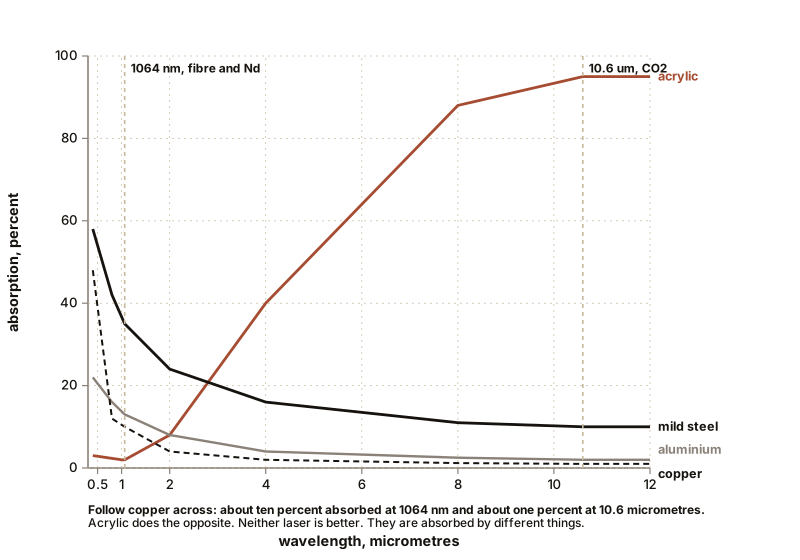
Light that is reflected does no work. Only absorbed light heats anything, and how much a material absorbs depends on both the material and the wavelength, sometimes drastically.
Approximate absorption of common metals, at the two wavelengths that matter industrially:
| Material | at 10.6 µm (CO₂) | at 1064 nm (fibre and Nd) |
|---|---|---|
| Mild steel | ~10% | ~35% |
| Stainless steel | ~10% | ~35% |
| Aluminium | ~2% | ~13% |
| Copper | ~1% | ~10% |
| Brass | ~2% | ~15% |
| Acrylic | ~95% | ~2% |
| Wood, paper, leather | ~90% | low |
Read the copper row. At 10.6 µm, copper absorbs about one percent and reflects ninety-nine. A kilowatt arriving means ten watts absorbed, and the other 990 W goes somewhere, quite possibly back up the beam path into the machine. Copper did not merely resist CO₂ cutting; it endangered the laser doing the cutting.
Now read the same row at 1064 nm: about ten percent, a tenfold improvement. Combined with the tighter focus that Chapter 6 says a ten-times-shorter wavelength permits, that is why the fibre laser took the metal industry and why the changeover described in Chapter 7 happened as fast as it did.
And read the acrylic and wood rows the other way. At 10.6 µm they absorb almost everything; at 1064 nm they are nearly transparent. This is why a CO₂ laser is still the right machine for a sign shop and a maker space, and why pointing a fibre laser at a sheet of acrylic mostly heats whatever is behind it. Neither laser is better. They are absorbed by different things.
IN PLAIN ENGLISH: A laser does not cut by being powerful. It cuts by being absorbed. Choose the wavelength the material drinks, or nothing you do to the power will help.
Section 2: Three Things That Look the Same and Are Not
Cutting, welding and marking use the same hardware and differ in intensity and dwell time, which is another way of saying Chapter 6’s denominator and Chapter 9’s clock.
Marking puts in enough energy to change the surface and not enough to remove much of it.
Welding melts two pieces so they flow together and solidify as one.
Cutting melts or vaporises a narrow line and then physically removes the material.
Roughly where each lives:
| Process | Intensity |
|---|---|
| Annealing and colour marking | 10⁵ to 10⁶ W/m² |
| Conduction welding | 10⁶ to 10⁷ W/m² |
| Keyhole welding | 10⁸ to 10⁹ W/m² |
| Cutting | 10⁹ to 10¹⁰ W/m² |
| Cold ablation, femtosecond | above 10¹³ W/m² |
The same 3 kW laser does all of the middle rows, just by changing the focus position and the speed. Which is why a fabrication shop buys one machine, and why the operator’s skill is in the parameters rather than in the hardware.
Section 3: Cutting, and What the Gas Is For
A cutting head does two things: it focuses the beam, and it blows gas coaxially down onto the work. The gas is not incidental.
The beam melts a narrow column through the plate. The gas ejects the melt out of the bottom. Without the gas the molten metal stays in the cut and resolidifies behind the beam, and you have scribed a line rather than cut anything.
Which gas, and this is a real decision with a real trade:
Oxygen. Chemistry, not just physics. Oxygen reacts exothermically with hot iron, so the burning steel supplies a large part of its own cutting energy. On mild steel this roughly doubles the thickness a given laser can cut, and it is much faster. The cost is an oxidised cut edge, dark and slightly rough, which will need cleaning before painting or welding.
Nitrogen. Inert, so it only ejects melt and adds no energy. Slower and limited to thinner plate for the same power. But the edge comes out bright, clean and immediately weldable or paintable. This is what stainless and aluminium get, because on those the oxide is the problem rather than the help.
Compressed air. Cheap, mostly nitrogen anyway, and adequate for thin mild steel where edge quality does not matter.
And a number worth carrying: with oxygen assist, a 6 kW fibre laser will cut mild steel of about 20 to 25 mm (0.8 to 1.0 in). The same machine on stainless with nitrogen manages perhaps 12 to 15 mm (0.5 to 0.6 in). Same laser, same power, half the thickness, and the difference is entirely chemistry.
Kerf is the width of material removed, typically 0.1 to 0.4 mm (0.004 to 0.016 in) and set by the focused spot. That narrow kerf is the whole commercial argument for laser over plasma or sawing: less waste, and parts can be nested almost touching.
Heat-affected zone is the band beside the cut whose properties have changed. On a laser cut it is small, often under 0.2 mm (0.008 in), which matters for hardened or heat-treated material where a wide HAZ would ruin the part.
Section 4: Welding, and the Keyhole
Welding has two regimes and the boundary between them is abrupt.
Conduction welding. Moderate intensity. The surface melts, heat conducts down and sideways, and you get a shallow wide weld pool. Fine for thin sheet.
Keyhole welding. Above about 10⁸ W/m² something different happens. The beam vaporises a hole straight down into the metal, and that hole stays open because the vapour pressure inside it holds the walls back. The beam is now travelling down inside the material rather than heating its surface, and it is absorbed by multiple reflections off the keyhole walls, so the effective absorption is far higher than the flat-surface figures in Section 1.
The results are dramatic: depth-to-width ratios of 10 to 1, against about 1 to 1 for conduction welding. A single pass joins plate that arc welding would need several passes and a prepared joint to manage.
It is also unstable, and that is the craft of the process. The keyhole can collapse, trapping vapour as porosity. Get it wrong and the weld is full of voids that only show up on an X-ray. Most of the parameter development in laser welding is about keeping a keyhole open and steady.
Section 5: Marking, Which Is Four Different Processes
“Laser marking” covers four mechanisms, and knowing which one you want changes the machine you buy.
Annealing. Heat steel below its melting point and the surface oxide layer grows and changes colour, giving black, brown or blue depending on temperature. Nothing is removed and the surface stays smooth, which is why surgical instruments and bearings are marked this way: there is no crevice for contamination and no stress raiser.
Engraving. Remove material to leave a recess. Deep, permanent, tactile, and it removes metal, so it is not used where fatigue matters.
Carbonising. On plastics and organics, heat chars the surface dark. This is what marks a plastic connector housing.
Foaming. On some plastics, heat generates gas bubbles that scatter light, giving a lighter mark on a dark substrate. The only way to mark black plastic light-coloured without adding anything.
Section 6: What a 6 kW Head Actually Is
Some perspective on the machine, because the numbers stop being abstract.
6 kW focused to a 0.15 mm (0.006 in) spot is about 3.4 × 10¹¹ W/m². That is a hundred million times the intensity of sunlight at the earth’s surface, and it will cut through a finger faster than any reflex.
It is a Class 4 device by a wide margin, which by Chapter 2 means the diffuse reflection off any surface in the room is a hazard, not just the beam. Which is why industrial cutters are not open machines. They live inside a fully enclosed cabinet with interlocked doors, viewing windows filtered for the specific wavelength, and a beam path that cannot exist unless every door is shut. Nobody stands near a running 6 kW head, and the enclosure is not bureaucracy, it is the only reason anyone can be in the building.
And the second-order hazard people forget: at 1064 nm the beam is invisible. The cutting head has a visible red pilot laser bolted alongside purely so a human can see where the real one is pointing. When the machine is warm and the pilot is off, there is no way to tell by looking whether the beam path is live, which is exactly Chapter 2 Section 5 at industrial scale.
SLOW DOWN. Check Your Understanding: A shop is asked to cut 3 mm (0.12 in) copper sheet. They own a 4 kW CO₂ machine and a 2 kW fibre machine. Which do they use, and if the answer surprises you, why? Think before reading on.
The 2 kW fibre, and it is not close, despite having half the power. CO₂ at 10.6 µm is reflected by copper at about ninety-nine percent, so the 4 kW machine delivers roughly 40 W into the work and reflects nearly 4 kW back into its own optics, which is a real risk to the machine as well as a failure to cut. The fibre laser at 1064 nm gets around ten percent absorbed, so about 200 W into the work, and Chapter 6 says its shorter wavelength also focuses to a smaller spot for the same optics, raising intensity further. Five times the delivered power from half the machine. This is the single clearest illustration of why wavelength beats power, and it is why the changeover happened.
Next: the same technology used not to destroy material but to measure it, including an instrument you can build for forty dollars that measures distance in units of the wavelength of light, and whose refined version detected a collision between two black holes.

Bench Degree
Get the degree without the diploma.
Learn the material, not how to pass the exam.