Bench Degree·LASERSchapter

Chapter 11: Measuring the World
Build this on a kitchen table for forty dollars and it will measure a distance smaller than a wavelength of light. The same instrument, refined absurdly, detected two black holes colliding a billion light years away.
Everything so far has used light to deliver energy. This chapter uses it to measure, and the measuring is done by a trick that is almost embarrassingly simple: split a beam in two, send the halves on different journeys, and bring them back together.
When they recombine, the two halves interfere. Where crest meets crest you get brightness; where crest meets trough you get darkness. And because they came from the same source and are therefore in step, any difference in the distance the two halves travelled shows up as a pattern of light and dark bands.
Move one path by half a wavelength and every bright band becomes dark. Half a wavelength of red light is about 325 nm, which is a third of a thousandth of a millimetre. So a device that only asks you to count bands is measuring in units of a third of a micrometre.
You are going to build it.
Section 1: The Michelson Interferometer
Michelson built the first one in the 1880s, using sunlight and a great deal of patience, to look for the motion of the earth through the supposed aether. He did not find it, which turned out to matter enormously and is not this chapter’s subject.
The instrument is four parts.
A source. Your 1 mW pointer.
A beamsplitter, which is a piece of glass that reflects about half the light and passes the rest. A plain microscope slide works. So does a thin sheet of glass or a cheap 50:50 splitter cube.
Two mirrors, one at the end of each arm.
A screen. A white card.
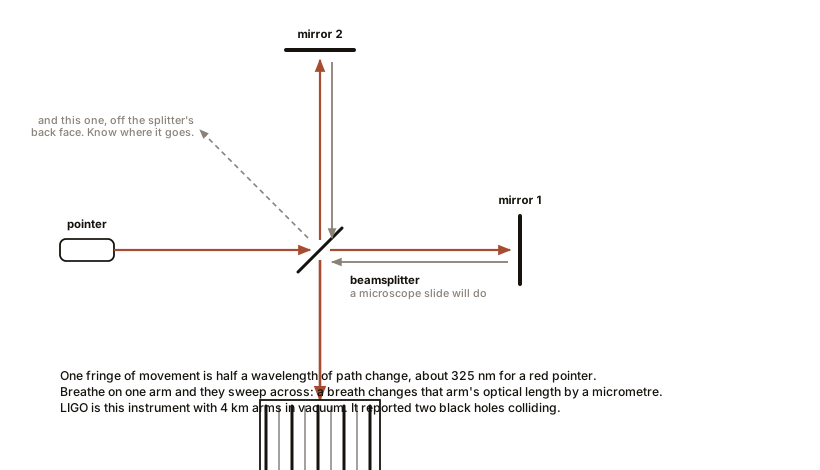
The beam hits the splitter and divides. Half goes down arm one, hits the mirror, comes back. Half goes down arm two, hits the mirror, comes back. At the splitter they recombine and travel together to the card.
And on the card you see fringes: a set of light and dark bands or concentric rings. That pattern is the two paths disagreeing about distance, made visible.
ON THE BENCH: Build a Michelson interferometer
This is the experiment of the volume, and it is the one to do if you do only one.
Parts: a red pointer under 1 mW; a microscope slide or thin glass sheet as the beamsplitter; two small flat mirrors, ideally glass rather than plastic, and a shaving mirror is too curved; a rigid base, and a scrap of 18 mm (0.7 in) plywood or an offcut of worktop is far better than a table top; modelling clay or hot glue to mount everything; a white card. Cost: about $40, less if you have mirrors. Time: an afternoon, and expect an hour of nothing working. Hazards: Chapter 2’s rules. Four beams exist here, not one: two arms, the recombined output, and a reflection off the back face of the beamsplitter that goes somewhere you did not plan. Work out where all four go before you switch on, keep them horizontal at bench height, and never at eye height. Method: mount the splitter at 45 degrees to the incoming beam. Put a mirror at the end of each arm, roughly equal lengths, 100 to 200 mm (4 to 8 in). Aim each mirror to send its beam back onto the splitter. Look at the card. Adjust one mirror in very small increments until the two returning spots overlap. What you should see: when the spots merge, fringes appear: straight bands, or rings, depending on alignment. They are unmistakable when they arrive. Then breathe on one arm. The fringes will sweep across the field, because warming the air changed its refractive index and therefore the optical path length by a fraction of a micrometre. Then touch the baseboard, gently. They will move. Then walk across the room and they will move, because the floor flexed. If you get no fringes: the overwhelmingly likely cause is that the two spots are not truly overlapping, and the second is that your path lengths differ by more than the coherence length. Chapter 5 Section 4 explains why a multi-mode pointer will only show fringes when the arms are close to equal, often within a few centimetres. Make the arms as equal as you can and the problem usually disappears.
Section 2: What You Just Built
One fringe of movement is half a wavelength of path change. Half, because the light traverses each arm twice, out and back, so moving a mirror by a quarter of a wavelength changes the path by half of one.
Which makes the arithmetic trivial and the result absurd. Count fringes as you slowly move one mirror, multiply by 325 nm for a red pointer, and you have measured a displacement to a precision no micrometer can reach.
And it is why fringes moved when you breathed. Warm air is slightly less dense and has a slightly lower refractive index, so light crosses it marginally faster. A breath changed one arm’s optical length by a micrometre or two, and the instrument reported it as several fringes.
This is also why every interferometer is inside something. Michelson floated his on mercury in a basement. Modern ones live in vacuum, on isolated tables, in temperature-controlled rooms, because the instrument does not distinguish between the thing you want to measure and the fact that someone shut a door.
IN PLAIN ENGLISH: An interferometer does not measure length. It counts how many wavelengths of difference there are between two paths, and a wavelength is a known ruler. That is why it can beat any mechanical instrument: it is comparing your object against a property of light rather than against another piece of metal.
Section 3: What This Is Actually Used For
Machine tool calibration. Every precision machine tool’s positioning is checked against a laser interferometer, because it is the only practical way to certify motion over a metre to a fraction of a micrometre. If you have ever used a part made to a tenth of a thousandth of an inch, this instrument certified the machine that made it.
Flatness and surface figure. Lay a reference flat against a surface and the fringe pattern maps its deviations directly: each fringe is half a wavelength of height. Telescope mirrors are figured this way, and an optician reads those fringes as a contour map.
Refractive index and gas sensing. Put a cell in one arm and the fringe shift measures what is in it. Your breath experiment is this technique.
Displacement and vibration sensing, wherever nanometres matter.
Section 4: The Same Instrument, Made Ridiculous
LIGO is a Michelson interferometer. Not an analogy: the same four parts, in the same arrangement, that you built on plywood.
The differences are entirely of degree, and the degree is worth stating because it is the best illustration in this book of what engineering does to an idea.
The arms are 4 km (2.5 miles) (2.5 miles) (2.5 miles) long instead of 150 mm, and the light is folded back and forth so that it effectively travels hundreds of times that.
The arms are in a vacuum more rarefied than low earth orbit, because Section 2’s air-density problem does not go away, it just gets more expensive.
The mirrors weigh 40 kg (88 lb), are polished to within a fraction of an atomic layer, and hang on multi-stage pendulums to isolate them from the ground.
And it does not count fringes. It holds the instrument at a dark fringe and measures how much light leaks out, which is a far more sensitive way to detect a tiny change than watching bands move.
What it detected in September 2015 was a length change of about one part in 10²¹, which over a 4 km (2.5 miles) arm is a distance smaller than a thousandth of the width of a proton. The cause was two black holes merging over a billion light years away, and the passing gravitational wave stretched one arm and squeezed the other.
Your version reports someone walking across the room. Theirs reports two black holes colliding. It is the same instrument, and the entire difference is how hard they worked to remove everything that was not the signal.
Section 5: Ranging, Which Is the Blunt Cousin
Interferometry measures fractions of a wavelength over short distances. For long distances there is a cruder and more useful family: time the round trip.
distance = speed of light × time / 2Light travels about 300 mm (12 in) per nanosecond, so a 1 ns timing resolution gives you 150 mm of ranging precision. That is the basis of:
LIDAR, which fires pulses and times returns, scanning to build a three-dimensional picture. Surveying, forestry, archaeology, and the sensor on the roof of an autonomous vehicle. The reason it beats radar for this is Chapter 6: a much shorter wavelength gives a much tighter beam, so the angular resolution is far better.
Rangefinders, in golf and in construction, generally using a phase comparison on a modulated beam rather than a bare pulse, because comparing phase is easier than timing a nanosecond.
Lunar laser ranging, which deserves its paragraph. Apollo 11, 14 and 15 and two Soviet Lunokhod rovers left arrays of retroreflectors on the moon: corner-cube prisms that return light along the path it arrived on. Fire a pulse from an observatory, wait about 2.5 seconds, and catch what comes back.
The return is desperately faint. The beam is a few kilometres wide by the time it reaches the moon and a dozen kilometres wide coming back, so a typical observation recovers a handful of photons out of a pulse containing about 10²⁰ of them. Detected over many pulses, that gives the earth-moon distance to a few millimetres, and it has been doing so continuously since 1969.
Which is how we know the moon is receding at about 38 mm (1.5 in) per year. Measured, over decades, by counting photons off a mirror that astronauts put there.
SLOW DOWN. Check Your Understanding: Your interferometer measures to a fraction of a micrometre but only works over path differences of centimetres. Lunar ranging works over 380,000 km (236,000 miles) but only to a few millimetres. Why can neither do the other’s job? Think about what each one actually counts.
The interferometer counts wavelengths of difference, and it can only do that while the two halves are still coherent with each other, which Chapter 5 says is set by how many longitudinal modes are running. Beyond the coherence length the halves no longer interfere and there are no fringes to count. It also cannot tell you which fringe you are on, so it measures change rather than absolute distance. Ranging counts time, which has no coherence limit and works to any distance the return signal survives, but its precision is limited by how sharply you can time an arrival. One compares light against itself and is exquisite but short-sighted. The other compares against a clock and is coarse but unbounded. Getting both at once is what a frequency comb does, and it won a Nobel Prize for exactly this reason.
Next: the same beams, sent down a piece of glass, carrying essentially all of the world’s intercontinental data traffic.

Bench Degree
Get the degree without the diploma.
Learn the material, not how to pass the exam.