Bench Degree·LASERSchapter

Chapter 12: Carrying Everything
Nearly every message that crosses an ocean is a laser blinking down a thread of glass thinner than a hair. There are about 1.4 million kilometres of it on the seabed, and it is the reason this book has an internet to be published on.
Find a length of clear acrylic rod, or fill a clear plastic bottle with water and let it drain from a hole in the side. Shine a laser pointer down the rod, or into the arc of falling water.
The light follows it. Round the bend in the rod. Down the curve of the water. It does not go straight and it does not leak out of the sides; it stays inside and comes out the far end.
That is not a lens, and nothing is aiming it. It is one reflection happening over and over, and it is the whole basis of the machinery that carries the world’s data.
ON THE BENCH: Light round a corner
Parts: a laser pointer under 1 mW; a clear acrylic rod, a length of clear plastic tubing full of water, or a plastic bottle; a dark room. Cost: a few dollars. Time: 20 minutes. Hazards: Chapter 2’s rules, and note that light emerging from the far end of a rod goes wherever the rod points, which may not be where you expected. Method: aim the beam in at one end of the rod, along its axis, and look at the other end. Then bend the rod, or use a curved one. Then try the water stream: make a 4 mm (0.16 in) hole low in a bottle, fill it, and shine the beam in through the opposite wall so it enters the stream where the water leaves. What you should see: the far end of the rod glows brightly while the sides stay dark. The falling stream lights up along its whole length and the spot lands in the bowl below, following the curve of the water. Now find the limit. Bend the rod tighter and tighter. At some radius the light starts leaking out of the outside of the bend and the far end dims. That angle is the whole engineering constraint of the next section, and you have just measured it with your hands.
Section 1: Why It Stays In
Light crossing from one material into another bends, by an amount set by how much each material slows light down. That property is a material’s refractive index: about 1.0 for air, 1.33 for water, 1.5 for ordinary glass.
Going from a slower material into a faster one, glass into air, the light bends away from the surface normal. Increase the angle at which it strikes the surface and there comes a point where it would have to bend past ninety degrees, which it cannot do.
At that point it stops crossing at all. All of it reflects back inside. Not most of it, the way a mirror reflects ninety-odd percent, but essentially all of it, because there is nowhere else for it to go.
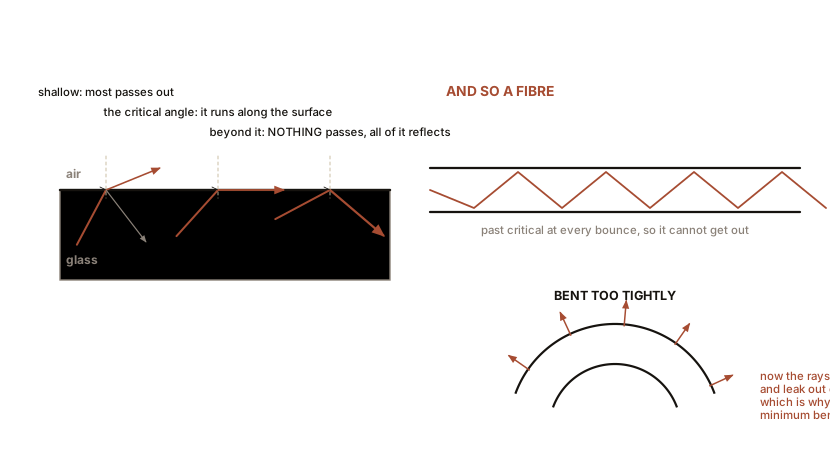
Total internal reflection, and it happens beyond a particular critical angle set only by the two indices. For glass and air that angle is about 42 degrees from the normal.
So a ray travelling nearly along a glass rod strikes the wall at a shallow angle, well past critical, and reflects. Then it strikes the other wall and reflects again. It zigzags down the rod, losing nothing at each bounce, and it cannot escape until the rod ends or bends too sharply.
Which is exactly what the tight bend showed you. Bend the rod and rays that were striking the wall past the critical angle start striking it below, and those cross the boundary and leave. Every fibre has a minimum bend radius printed on its spec sheet for this reason, and violating it does not break the glass, it just quietly loses your signal.
IN PLAIN ENGLISH: Below a certain angle light passes through a glass surface. Above it, the surface becomes a perfect mirror. A fibre is a glass thread arranged so the light always hits its wall above that angle, so it bounces along inside and cannot get out.
Section 2: What a Real Fibre Is
A telecoms fibre is not a bare rod. It is a core of glass surrounded by cladding of slightly different glass, and the light travels in the core.
The cladding is not protection. It is the second material the total internal reflection needs. Its index is very slightly lower than the core’s, by about a percent, and that tiny difference does all the work. Using cladding rather than air means the reflecting surface is buried inside solid glass where nothing can scratch, wet or dirty it, which is why a fibre survives being pulled across an ocean floor.
Around that goes a polymer coating for mechanical protection, then strength members, then jacketing.
Two families, and the distinction matters practically.
Multimode, core about 50 or 62.5 µm (0.002 or 0.0025 in) across. Wide enough that light can take many different zigzag paths, called modes. Cheap to make, easy to align, easy to couple an LED into. And it has a fatal limit: different paths have different lengths, so a pulse that entered sharp arrives smeared, because the part that went straight down the middle got there before the part that bounced. That smearing is modal dispersion, it gets worse with distance, and it confines multimode to a few hundred metres. Inside a building, fine. Across a city, useless.
Single mode, core about 9 µm (0.00035 in) across. Narrow enough that essentially only one path exists, so modal dispersion vanishes. This is what goes between cities and under oceans. The price is that you must inject light into a 9 µm (0.00035 in) target, which needs a laser rather than an LED and alignment measured in fractions of a micrometre.
Which is where this volume’s subject becomes load-bearing. You cannot get useful power into a 9 µm (0.00035 in) core from a lamp, for exactly Chapter 6’s reason: a source’s brightness cannot be improved by optics, and only a laser is bright enough. Long-distance fibre is not merely convenient with lasers. It is impossible without them.
Section 3: The Window, and Why 1550 nm
Glass is not equally transparent at all wavelengths, and the shape of its absorption curve chose the wavelengths the industry uses.
Silica glass has three low-loss windows, and the third is the good one:
| Window | Loss | Used for |
|---|---|---|
| 850 nm | ~2 dB/km | short multimode links |
| 1310 nm | ~0.35 dB/km | metropolitan distances |
| 1550 nm | ~0.2 dB/km | everything long-haul |
0.2 decibels per kilometre is a remarkable number and it is worth converting. It means that after 15 km (9 miles) the signal still has half its power. After 100 km (62 miles) it has about one percent, which is still detectable.
Compare copper. A coaxial cable at the frequencies needed to carry comparable data loses half its power in a few hundred metres. The difference is not a factor of two; it is a factor of tens of thousands, and it is the entire reason the transatlantic cables are glass.
And 1550 nm is why the retinal hazard band of Chapter 2 matters here in reverse. 1550 nm sits outside the 700 to 1400 nm window where the eye is transparent and the retina absorbs. At 1550 the cornea absorbs it instead, which is a shallower and more survivable injury, and it is why the telecoms band is described as eye-safer. Safer, not safe, and Chapter 2 said to mistrust the term. A fibre technician looking into a live 1550 nm fibre with an inspection scope can still be hurt, and the beam is invisible, so the only protection is the discipline of never looking into a fibre you have not proved is dark.
Section 4: The Amplifier That Made Oceans Possible
At 0.2 dB/km a signal is exhausted after a few hundred kilometres, and the Atlantic is 6,000 km (3,700 miles) wide. So something has to boost it on the way, and how that is done changed everything.
The old way was a repeater: detect the light, convert it to electricity, clean up the signal, and drive a new laser. That works and it has two crippling problems on a seabed. It is a complicated active device thousands of metres down where nobody can service it. And it only handles one wavelength, because the detector and the laser are built for one.
The fix was the erbium-doped fibre amplifier, and it is one of the great pieces of engineering of the late twentieth century.
Take a length of fibre and dope its core with erbium. Pump it with a diode at 980 or 1480 nm. Chapter 4’s population inversion now exists in the fibre itself, so the incoming signal is amplified directly by stimulated emission as it passes through. It is never converted to electricity. It never leaves the glass.
Two consequences, and the second is the one that mattered.
It is simple and passive apart from a pump diode, so it can sit on a seabed for twenty-five years.
And erbium amplifies a whole band at once, roughly 1530 to 1565 nm, not a single wavelength. Which means you can send many wavelengths down one fibre simultaneously and amplify all of them together.
That is wavelength division multiplexing, and it is why fibre capacity grew faster than anyone forecast. The glass did not change. The number of colours running through it did: eighty or more channels in a single fibre, each carrying tens or hundreds of gigabits, all boosted by the same erbium.
SLOW DOWN. Check Your Understanding: The erbium amplifier is described as the development that made modern submarine cable possible, yet electrical repeaters already worked and had been used since the 1950s. What did erbium actually change, given that both amplify? Think before reading on.
It changed how many wavelengths one device could carry. An electrical repeater detects, decides and retransmits, and that whole chain is built around a single wavelength; to add a second colour you need a second repeater, and on a seabed you cannot. Erbium amplifies whatever arrives within its band, without understanding it, so adding a ninetieth wavelength to an existing cable requires nothing on the seabed at all. The capacity of the installed cables multiplied without touching them, which is why the cost of intercontinental data collapsed in the 1990s rather than growing steadily. The amplifier was not faster. It was indifferent, and indifference scaled.
Section 5: What Is Actually Down There
About 1.4 million kilometres of submarine cable, in something over five hundred separate systems, carrying over ninety-five percent of all intercontinental data traffic. Satellites, contrary to most people’s mental picture, carry a rounding error of it.
A modern transatlantic cable is roughly the diameter of a garden hose, most of which is armour and strength member. The glass inside is a few strands, each thinner than a human hair, and a single fibre pair can carry tens of terabits per second.
The failure mode is worth knowing because it explains the redundancy. Cables break, routinely, and the usual causes are not exotic: fishing trawlers and ship anchors in shallow water, and undersea landslides in deep water. There are a few hundred faults a year worldwide, and a fleet of repair ships that grapple the cable up, splice it, and drop it back. The internet does not notice because the traffic reroutes, and it does not notice because everyone has assumed from the start that the cables will break.
Next: what happens when a pulse is focused hard enough that the air itself gives up and becomes a plasma, which is how a rover on Mars does chemistry from a distance.

Bench Degree
Get the degree without the diploma.
Learn the material, not how to pass the exam.