Bench Degree·LASERSchapter
Chapter 13: Light That Makes Plasma
Focus a pulse hard enough and the air breaks down. A spark made of nothing but light, in mid-air, touching no electrode, and a rover on Mars uses it to read the chemistry of a rock from seven metres away.
There is no bench experiment in this chapter, and it is worth saying why plainly rather than burying it.
Making a plasma out of air with light needs an intensity of about 10¹⁶ W/m². Chapter 9’s arithmetic says how to get there: a millijoule in a few nanoseconds, focused to a few tens of micrometres. That is a Q-switched laser, it is Class 4 by a wide margin, and this book’s Chapter 2 caps the bench at Class 2.
So this chapter explains and does not attempt. What it can give you is the ability to watch someone else do it and know exactly what you are looking at.
Section 1: Air Giving Up
Air is an insulator. The Plasma volume’s Chapter 5 puts a number on it: breaking down a millimetre of air takes a few thousand volts, and the mechanism is an electron avalanche between two electrodes.
Light can do it with no electrodes at all.
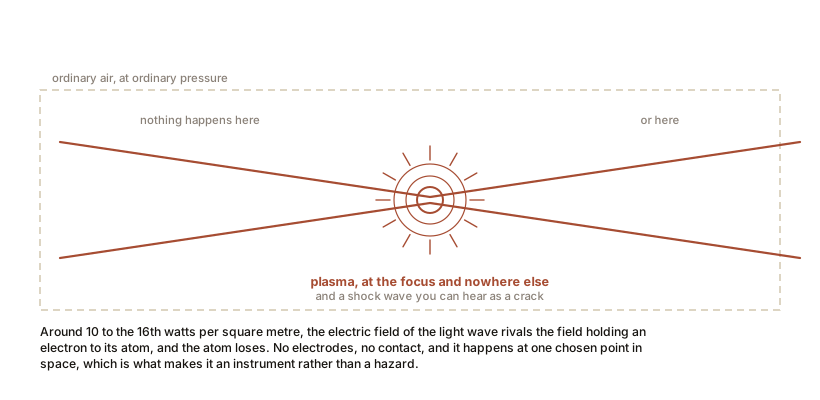
At ordinary intensities light passes through air and nothing happens: the electric field of the wave pushes electrons back and forth a little and lets them go. But the field strength of a light wave rises with the square root of its intensity, and at about 10¹⁶ W/m² that field becomes comparable to the field binding an electron to its atom.
At that point the light simply strips the electron off. Then that free electron, accelerated violently by the same wave, hits another atom and ionises it, and the same avalanche the Plasma volume describes runs its course, except that the energy is arriving as light rather than from a pair of electrodes.
Within picoseconds there is a small ball of plasma hanging in mid-air, hot, bright and loud. It expands, drives a shock wave outward, and you hear a sharp crack.
This is laser-induced breakdown, and the two things worth carrying about it are that it needs no electrodes and no contact, and that it happens exactly where the beam is focused and nowhere else along the path.
That second point is the useful one. The beam passes harmlessly through metres of air and then produces a plasma at one chosen point in space. You can put a spark inside something without reaching into it, which is a capability nothing else offers.
Section 2: Ablation, and Machining Without Touching
Do the same thing to a solid instead of to air and you get ablation: the surface material is turned to plasma and leaves.
Chapter 9 established the distinction that governs it. A long pulse melts. A short pulse removes material and leaves before heat can spread, which is cold ablation.
Which is why ultrashort-pulse ablation can do things no cutting tool can:
Machine glass and sapphire without cracking them, because there is no thermal shock.
Drill holes with an aspect ratio no drill could reach, tens of micrometres across and hundreds deep.
Cut medical stents out of thin-walled tubing, where a burr or a heat-affected edge would be a clinical problem.
Strip one layer without touching the layer beneath, which is how paint is removed from aircraft and how conductive films are patterned on touchscreens.
Clean stonework and remove corrosion, because the contaminant absorbs differently from the substrate, so the beam removes one and stops at the other. This is standard practice in conservation now, on cathedral facades and on archaeological metal.
And it is how the semiconductor industry marks and dices wafers, which along with plasma etching means the chips in the machine you are reading this on were shaped by light twice over.
Section 3: Reading What Something Is Made Of, From a Distance
Here is the technique that turns Section 1 from a curiosity into an instrument, and it is on another planet.
When the plasma from a laser pulse cools, it emits light. And what it emits is the set of spectral lines belonging to whatever elements were in the material, exactly as the Plasma volume’s Chapter 9 and this volume’s Chapter 3 describe: each element has its own list of allowed energies, so each has its own colours and no other element’s.
So: fire a pulse at a sample, catch the flash with a spectrometer, and read off which elements are present.
Laser-induced breakdown spectroscopy, or LIBS, and its properties are unusual enough to be worth listing.
No sample preparation. No grinding, dissolving, mounting or coating. Point and fire.
No contact. The laser can be metres from the sample, or looking through a window into a furnace.
Essentially non-destructive, because a pulse removes nanograms.
And it detects everything at once, including the light elements that many other techniques struggle with.
Which is why it went to Mars. The ChemCam instrument on Curiosity, landed 2012, fires a Nd:YAG pulse at rocks up to about 7 m (23 ft) away, and reads the flash through a telescope. The rover does chemistry on a rock it has not driven to and has not touched. Perseverance carries SuperCam, which does the same and adds Raman spectroscopy to it.
On earth the same technique sorts scrap metal alloys on a conveyor, checks steel composition in a running mill, screens for lead in paint, and looks for contamination on production lines.
SLOW DOWN. Check Your Understanding: LIBS reads the emission from a plasma the laser itself created. Why does the composition of that plasma reliably reflect the composition of the rock, given that the laser has just violently destroyed a piece of it and the lightest atoms should escape fastest? Think before reading on.
It does not, quite, and this is the technique’s central difficulty rather than a quibble. The plasma’s composition is only a faithful copy of the sample’s if the material is removed stoichiometrically, meaning all elements removed in the proportions they were present in. Below a certain intensity that fails: the more volatile constituents preferentially leave and the reading is skewed. Above it, the removal is violent enough to be indiscriminate and the plasma composition tracks the solid. So LIBS is run deliberately hard, well above the threshold where the effect appears, and instruments are calibrated against reference materials of known composition rather than trusted absolutely. It is superb at saying what elements are here and much harder work to make say in exactly what proportions, and any LIBS result quoting precise percentages has calibration standing behind it.
Section 4: A Conducting Path Made of Light
One more application, because it is strange and it is real.
A laser-induced breakdown does not have to be a single point. Focus a suitable pulse along a line and you can leave behind a filament of ionised air metres long, lasting microseconds.
Ionised air conducts, per the Plasma volume’s Chapter 1. So for a brief moment there is a conducting wire made of nothing, hanging in the air along the beam path.
Which means an electrical discharge can be told where to go. Fire the laser, then apply the voltage, and the discharge follows the filament rather than choosing its own path.
Laser-guided lightning has been demonstrated in the field, including from a mountaintop in Switzerland where a filament measurably diverted natural strikes toward a tower. It is the physics behind the guided-discharge devices that turn up in styropyro’s channel and elsewhere, and it is being studied seriously for lightning protection of launch pads and airfields.
Whether it becomes practical is genuinely open, and this book will not pretend otherwise. The filaments are short-lived, the energy required is large, and a laser that must be aimed at a thundercloud has its own problems. But the mechanism is not speculative and neither is the demonstration.
Section 5: What This Chapter Established
Light can ionise matter directly, with no electrodes, if the field of the wave becomes comparable to the field binding electrons to atoms, which happens around 10¹⁶ W/m².
It happens at the focus and nowhere else, which is what makes it an instrument rather than a hazard.
A pulse short enough removes material without heating what is left, which machines things no tool can touch.
And the plasma reports what it was made from, which is chemistry at a distance, and is currently being done on Mars.
Next: the largest lasers ever built, what they are for, and an honest account of the 2022 result that got more energy out than the beams put in.

Bench Degree
Get the degree without the diploma.
Learn the material, not how to pass the exam.